
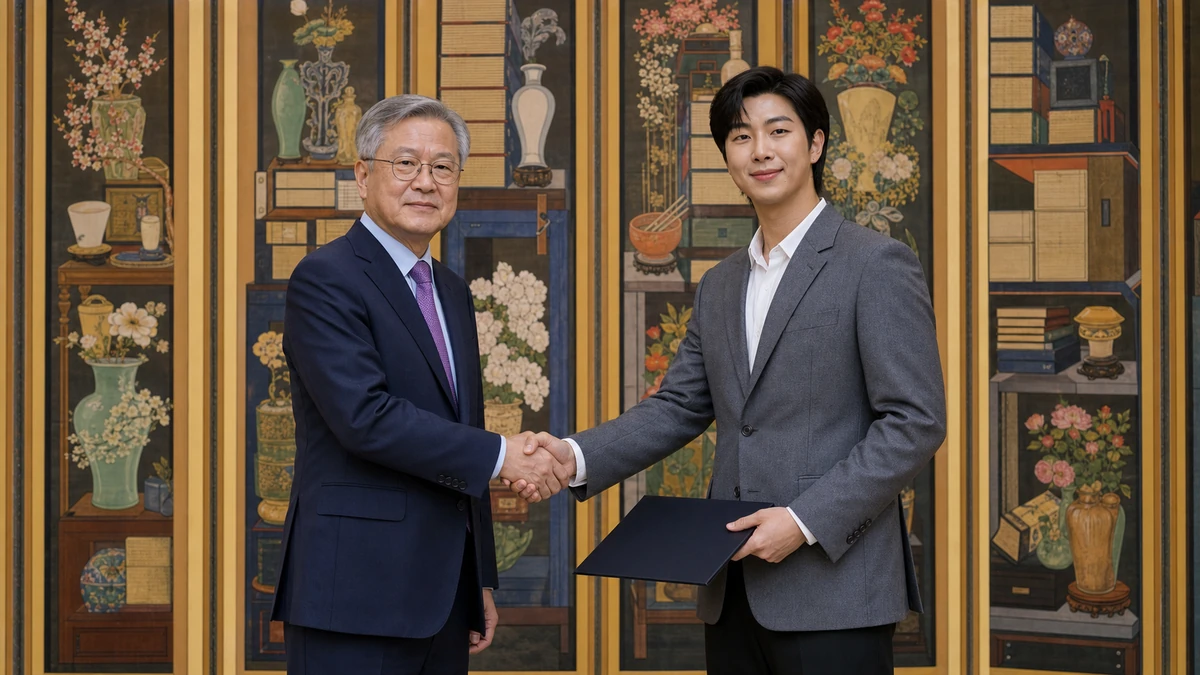
A K-pop star becomes the face of a national museum
RM, the leader of BTS, has been appointed global ambassador for the National Museum of Korea, a move that says as much about South Korea’s cultural strategy as it does about the power of modern pop stardom. The museum announced the appointment on June 20, framing RM not simply as a celebrity endorser, but as a public figure who can help introduce Korean history, art and cultural heritage to audiences far beyond Seoul.
For American readers, the closest comparison might be if a musician with the global pull of Taylor Swift or Beyoncé were tapped by the Smithsonian to help connect younger international audiences to a country’s historical collections. But even that does not fully capture the symbolism here. In South Korea, BTS is not just a chart-topping act. The group has become one of the country’s most recognizable cultural exports, credited with helping expand global interest in the Korean language, Korean fashion, Korean television and Korean identity itself.
That is what makes RM’s new role notable. The National Museum of Korea is not an entertainment institution. It is the country’s flagship museum, home to artifacts and works of art spanning ancient kingdoms, Buddhist traditions, royal court culture and Korea’s modern history. By choosing RM, whose legal name is Kim Nam-joon, the museum is effectively linking two powerful versions of Korea: the contemporary, globally marketable Korea of K-pop, and the older, deeper Korea preserved in ceramics, calligraphy, sculpture, ritual objects and historical relics.
The appointment reflects a broader shift in how countries present themselves to the world. Museums once relied mainly on scholars, tourists and official cultural diplomacy. Today, they also compete for attention in a digital environment shaped by fandoms, social media and celebrity influence. RM, whose reach extends to millions of fans across North America, Europe, Latin America and Asia, offers the museum something traditional institutions often struggle to build on their own: emotional access.
That emotional access matters. Cultural heritage can seem distant, especially to people unfamiliar with Korean history. A museum collection of celadon pottery or Goryeo Buddhist art may sound academic to an overseas audience. But when someone already known to fans for his curiosity, taste and reflective public image becomes a guide of sorts, the subject can feel more personal. The museum appears to understand that. Its choice suggests that in the era of global pop culture, institutions charged with preserving the past are looking for new ways to make that past feel alive.
Why RM makes sense for this role
The museum’s decision appears to rest on more than RM’s fame. In South Korea, RM has long been associated with a sincere interest in art, literature and traditional culture, a reputation that distinguishes him even in a celebrity landscape crowded with endorsement deals. That image has made him an unusually natural fit for a public cultural role.
Within BTS, RM has often been seen as the intellectually curious member: a songwriter and public speaker comfortable moving between youth culture, literary references and thoughtful commentary about identity, pressure and selfhood. Fans know him as a polished performer, but also as someone who visits museums, discusses art and has shown sustained interest in how culture shapes a society’s sense of itself.
That matters because public institutions, especially national museums, face a credibility test when they align with celebrities. If the partnership appears purely promotional, it can feel forced. If it appears rooted in genuine interest, it carries more weight. In this case, the museum emphasized RM’s longstanding attention to Korean traditional culture and fine art, suggesting the appointment is not a one-off publicity event but an extension of an existing relationship between the artist’s public identity and the country’s cultural sector.
For U.S. audiences, celebrity activism can sometimes be met with skepticism, especially when it overlaps with branding. But the South Korean context is slightly different. Public figures there often play visible roles in campaigns tied to education, tourism, public health and culture. The key question is usually whether the celebrity’s involvement feels authentic. RM’s reputation helps answer that question in the museum’s favor.
It also helps that he represents a version of K-pop that has already crossed over from niche fandom into mainstream cultural recognition. BTS has appeared at the United Nations, topped the Billboard charts, sold out stadiums in the United States and become familiar even to many Americans who do not regularly follow Korean music. In that sense, RM offers the museum a bridge figure: recognizable enough for casual overseas readers, but closely associated with Korean cultural identity rather than detached from it.
The symbolism of that bridge is powerful. South Korea is no longer introducing itself to many global audiences through heavy industry or export manufacturing alone. Increasingly, it is doing so through culture. First came movies and television, boosted by titles like “Parasite” and “Squid Game.” Then came food, fashion and beauty. K-pop has often been the front door. RM’s appointment suggests heritage institutions now want to usher visitors beyond that front door and into the deeper rooms of Korean civilization.
More than fandom: a museum is betting on trust
It would be easy to read the appointment as a straightforward attempt to mobilize BTS’ enormous fan base, known as ARMY. Certainly, any institution would notice the influence of a fandom that can drive global streaming numbers, charity campaigns, travel and online conversation at extraordinary scale. But the significance of this move goes beyond sheer fan power.
The museum seems to be betting on trust as much as attention. Fans do not simply consume what their favorite artists produce; they often follow what those artists value. When a musician consistently shows interest in books, galleries, civic causes or national history, followers can begin to view those subjects through a new lens. In RM’s case, that means Korean heritage may reach audiences who otherwise would never search for information about ancient Korean kingdoms, conservation projects or museum collections.
That is especially important in a field like cultural heritage, which rarely competes on the same terms as entertainment. A new album has release-day buzz. A museum conservation effort may take years and unfold largely out of public view. Restoration, cataloging and research are slow work. They are foundational, but they do not naturally command the emotional immediacy of a pop single or a stadium concert.
By appointing RM, the National Museum of Korea is effectively translating the language of heritage into the language of contemporary culture. It is not changing what the museum preserves; it is changing how the institution introduces itself. To put it another way, the museum is not becoming a pop venue. It is recognizing that in the 21st century, attention is often the first step toward education.
American museums have wrestled with versions of this same challenge. Many have expanded digital outreach, partnered with influencers, created immersive exhibitions and invested in programming designed to attract younger and more diverse audiences. The underlying concern is familiar: How do you keep cultural institutions relevant without diluting their mission? South Korea’s answer here appears to be that relevance can come from a carefully chosen cultural ambassador whose personal brand aligns with the institution’s values.
That alignment is what separates this appointment from a generic marketing campaign. RM is not just a famous face standing in front of a logo. He is someone whose public image already includes curiosity about art and tradition. That gives the museum a stronger platform from which to speak not only to loyal fans, but to a wider international audience that may be newly open to learning about Korea through him.
The donations that gave this appointment added meaning
Another reason the appointment resonates is RM’s prior record of support for Korean cultural heritage. Before taking on this new title, he had already contributed financially to preservation efforts tied to Korean artifacts located outside the country. In 2021 and 2022, he donated 100 million won each year — roughly tens of thousands of U.S. dollars per donation, depending on exchange rates — to the Overseas Korean Cultural Heritage Foundation, an organization under South Korea’s cultural heritage administration that works on the preservation, restoration and use of Korean artifacts abroad.
That history matters because it turns this announcement into something more than a headline-grabbing partnership. It establishes continuity. RM had already shown that his interest in heritage was not limited to posting about museum visits or lending prestige to an institution. He had directed resources toward the often invisible labor of protecting cultural objects, particularly those outside Korea.
For many Americans, the issue of artifacts outside their country of origin will sound familiar. Museums around the world, including major institutions in the United States and Europe, have faced growing scrutiny over collections acquired through colonialism, war, unequal power relations or opaque historical transactions. Questions about ownership, repatriation and stewardship now shape some of the most important debates in the museum world.
Korea has its own version of that story. Over centuries of conflict, colonial rule and international trade, many Korean cultural objects ended up overseas. Some are in private collections. Others are in museums and archives. The work of locating, preserving, studying and, in some cases, restoring or returning those objects is painstaking and politically delicate. It can involve diplomacy, scholarship, conservation science and public awareness.
RM’s donations to an organization focused on overseas Korean heritage suggest he understood that issue in practical terms. The public may be most drawn to glamorous museum exhibitions, but heritage preservation often depends on quieter forms of commitment: conservation treatments, research, international coordination and institutional funding. By supporting that ecosystem, RM helped build the case that his appointment is grounded in substance rather than optics.
That is likely one reason the museum’s announcement has drawn attention. It tells a more persuasive story: not that a superstar has suddenly discovered national heritage, but that someone already engaged with the subject is now taking on a larger public role. In a media environment where celebrity partnerships can feel transactional, that distinction is significant.
K-pop’s reach is expanding beyond music
The appointment also underscores a broader reality about K-pop’s global influence. For years, analysts have described K-pop as a gateway to other aspects of Korean culture. Fans who first arrive for the music often go on to explore Korean food, skin care, language classes, drama series, travel destinations and history. RM’s new role formalizes that process in a striking way: the world of Korean pop is now being used to draw attention to Korea’s cultural heritage infrastructure.
That is a sign of how mature the Korean Wave, or “Hallyu,” has become. The term refers to the global spread of South Korean popular culture, and for American readers it is worth emphasizing that Hallyu is no longer just a trend defined by catchy songs or bingeable streaming series. It is now part of South Korea’s soft power — the ability to shape global perceptions not through military force or economic pressure, but through attraction, familiarity and cultural prestige.
BTS has been central to that transformation. The group’s rise helped normalize Korean-language music in spaces once thought difficult to crack, especially in the U.S. market. Fans memorized Korean lyrics, learned bits of the language, followed Korean social customs online and became more curious about the country from which the music emerged. That cultural curiosity has always had the potential to extend further. RM’s appointment is one of the clearest examples yet of an official institution trying to channel it.
There is also a deeper symbolic appeal here. K-pop is often associated with relentless newness: new singles, new choreography, new visuals, new online content. Cultural heritage, by contrast, is about continuity, preservation and memory. Bringing the two together creates a compelling national narrative. It suggests that modern Korea does not see its past and present as competing brands, but as connected parts of the same story.
For English-speaking readers who mainly know Korea through Netflix hits or pop playlists, that is an important reminder. The country’s global cultural success did not arise from nowhere. It exists alongside a long historical tradition that includes dynastic kingdoms, Confucian scholarship, Buddhist artistry, folk practices, royal rituals and a modern history shaped by colonization, war, division and rapid industrialization. A museum can tell that longer story. A pop star can help invite people in.
That invitation may prove especially effective because fans often approach artists like RM not just as entertainers, but as curators of taste. In the age of social media, audiences often look to celebrities for reading recommendations, travel inspiration and aesthetic cues. If RM points toward the National Museum of Korea, many followers are likely to see that not as homework, but as an extension of the cultural world they already admire.
What this means for museums, fandom and public culture
The relationship between fandom and public institutions can be uneasy. Critics sometimes worry that museums, libraries and heritage organizations risk trivializing their mission when they align themselves too closely with celebrity culture. But the more interesting question is whether fandom can be a meaningful civic force rather than just a commercial one.
In the case of BTS, there is precedent for that possibility. ARMY has often been noted not only for its intensity as a consumer base, but also for its organizational ability. Fans have coordinated charity drives, social campaigns and community projects in the name of the group or its members. That does not mean every fan initiative is automatically beneficial, but it does suggest that fandom can mobilize around values as well as products.
When that energy intersects with a museum, the potential benefits are obvious. Increased visits, higher visibility, stronger international engagement and wider interest in educational programming all become more plausible. But the challenge is to convert momentary excitement into sustained curiosity. A successful ambassador partnership should not just drive traffic to a museum website for a week. It should help build a lasting relationship between audiences and the institution’s mission.
That is where authenticity becomes crucial again. If fans believe RM genuinely cares about Korean heritage, they may be more willing to follow that path with him. If they come for him, some may stay for the objects, stories and historical questions the museum presents. The institution then gains something more valuable than a spike in attention: it gains new participants in cultural memory.
There is also a public-policy dimension. National museums are not just storage spaces for old objects. They are places where a country decides how to narrate itself — what it preserves, what it highlights and what it offers to future generations and foreign visitors. By appointing RM, the National Museum of Korea appears to be saying that cultural heritage should not be sealed off from contemporary life. It should circulate within it.
That message may resonate internationally. Around the world, heritage institutions are trying to remain relevant in societies saturated with entertainment options and algorithm-driven media. South Korea’s model here may draw interest from other countries asking how to engage younger, globalized audiences without abandoning scholarly seriousness. In RM, the museum has found a figure capable of carrying both popular appeal and cultural credibility.
Why international audiences should pay attention
For readers outside Korea, the headline may first register as another example of a superstar adding a prestigious title. But that would miss the larger point. RM’s appointment illustrates how South Korea now understands its place in the global imagination. The country is not simply exporting entertainment. It is using the visibility created by entertainment to expand global access to its history, aesthetics and national memory.
That strategy has real implications. When international audiences move from K-pop songs to museums, they begin encountering a more layered Korea — one that cannot be reduced to catchy hooks, high-production music videos or viral dance clips. They may learn about the Korean kingdoms of Goguryeo, Baekje and Silla, the artistry of Joseon-era ceramics, the role of Buddhism in visual culture or the complexities of Korea’s 20th-century history. In other words, they begin to see the country as a civilization, not just a trend.
The timing also fits a larger moment. BTS as a group remains enormously influential even as its members pursue individual roles and projects. Separate BTS-related events have continued to draw large crowds in South Korea, including fan-centered programs in Busan that turned city landmarks into shared spaces of cultural experience. Those events and RM’s museum appointment are not the same kind of undertaking, but they point in the same direction: BTS and its members continue to shape how people engage with Korean places, symbols and institutions.
For American audiences, this is a useful lens on how culture works in the 21st century. Pop stars are no longer only entertainers. At their most influential, they become interpreters of place. They can direct attention, define taste and make distant subjects feel immediate. When that power is used thoughtfully, it can strengthen public institutions rather than overshadow them.
RM’s new role is best understood in that light. A globally known musician is stepping into a position that asks him to represent not just himself or his group, but a broader cultural inheritance. South Korea’s premier museum, in turn, is opening its doors to the possibilities of fan culture, digital reach and contemporary relevance.
That makes the appointment meaningful well beyond celebrity news. It is a story about how a nation with one of the world’s most successful pop-cultural exports is trying to bring global audiences deeper into its historical story. If K-pop was the invitation, the museum hopes cultural heritage will be the conversation that follows.




0 Comments