Early Leukemia Trial Puts Spotlight on a Korea-Linked Drug Candidate — and on the Promise and Limits of Cancer Research Headlines
A new leukemia data point draws attention far beyond South Korea
A small but closely watched clinical update presented this month in Europe is putting a spotlight on a drug candidate tied to one of South Korea’s best-known pharmaceutical companies — and offering a reminder of how modern cancer drug development increasingly unfolds across borders.
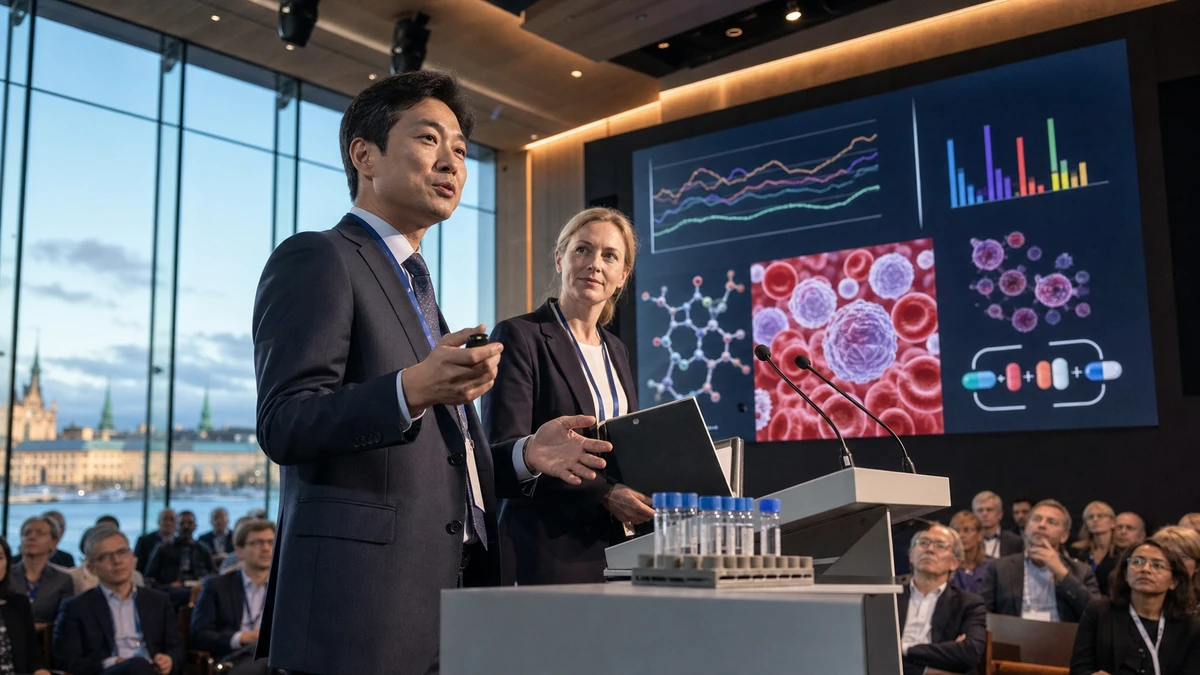
Aptose Biosciences, a partner of Seoul-based Hanmi Pharmaceutical, said new Phase 1/2 results suggest its experimental acute myeloid leukemia treatment tuspetinib showed signs of effectiveness and an encouraging safety profile when used in combination therapy. The company presented the findings in an oral session at the European Hematology Association congress in Stockholm, one of the major international meetings where blood cancer researchers share emerging data.
For American readers, the headline may sound familiar: a biotech company reports positive early-stage results in a difficult cancer, investors and industry watchers take notice, and patients wonder whether a new treatment may finally be on the horizon. But the details matter. This is not an approved drug, not a late-stage trial and not proof that standard care for leukemia is about to change. It is, instead, an early clinical signal — the kind that can generate justified interest while still leaving many critical questions unanswered.
What makes this story notable is not only the science, but the global context. Hanmi Pharmaceutical is one of South Korea’s most prominent drugmakers, part of a broader Korean life sciences sector that has spent years trying to move from being seen mainly as a manufacturing base or licensing partner to being recognized as a source of original drug innovation. When research connected to a Korean company is presented on a major international stage, it carries significance beyond a single molecule. It becomes part of a larger story about how South Korea is trying to position itself in the global biotech race.
It also lands at a moment when leukemia treatment remains an area of intense need. Acute myeloid leukemia, or AML, is a fast-moving blood cancer that begins in the bone marrow and often progresses quickly if not treated. In the United States, AML is one of the better-known adult leukemias among oncologists, but for many general readers it can help to think of it this way: this is not a slow-growing cancer that can be watched over years. It is often an aggressive disease requiring urgent treatment decisions, and outcomes can vary dramatically depending on age, genetics, prior treatments and overall health.
That is why even preliminary results can matter. In AML, where relapse is common and many patients do not respond durably to existing treatments, researchers are constantly searching for combinations that might work across different patient groups without causing side effects so severe that treatment becomes impossible to continue. Aptose said its new data suggest tuspetinib may have shown activity in patients with varied genetic backgrounds, including high-risk groups that are typically harder to treat. If confirmed in future studies, that would be meaningful. But for now, it remains a possibility, not a conclusion.
Why acute myeloid leukemia is such a hard disease to treat
To understand why this announcement is drawing attention, it helps to understand the medical landscape. AML is not one disease in the simple sense. It is a category of blood cancer with many subtypes and genetic variations. Two patients can both be told they have AML and still face very different treatment options, risks and likely outcomes.
In plain terms, AML starts when immature cells in the bone marrow grow out of control and interfere with the body’s ability to make normal blood cells. That can lead to fatigue, infections, bleeding and a range of other serious complications. Standard treatment often includes chemotherapy, targeted therapies for certain mutations and, for some patients, bone marrow or stem cell transplantation. But the disease can return, and many patients — especially older adults or people with poor-risk disease — have limited options.
That is where the language in Aptose’s presentation becomes important. The company said responses were seen in patients with a range of genetic backgrounds rather than being limited to one specific mutation. In AML, that matters because many newer cancer drugs are developed for narrowly defined molecular targets. That can be a major advance when it works, but it can also mean a drug is useful only for a subset of patients.
When a company says an experimental therapy may show activity across genetically diverse AML cases, it is signaling the possibility of broader relevance. For doctors and researchers, that can make a candidate more interesting. For patients and families, it suggests the drug may not be confined to a tiny sliver of the disease. Still, there is a crucial caveat: “showing responses” in an early trial is not the same as proving broad benefit in the real world. Early studies can include small numbers of patients, different dosing approaches and populations selected for reasons that do not always mirror everyday clinical practice.
The company also highlighted signs of activity in high-risk patients, a term that may sound vague to non-specialists. In cancer care, “high risk” usually refers to patients whose disease characteristics, medical history or prior treatment course suggest a poorer prognosis or a lower likelihood of responding well to standard approaches. In AML, that can include patients with difficult genetic features, relapsed disease or other factors that make treatment especially challenging.
That is one reason why promising data in this area attract immediate interest. Cancer medicine is full of examples in which researchers are not simply searching for a new drug, but for a drug that can help the patients who need new options most urgently. In that sense, the excitement around early AML research resembles the attention that breakthrough immunotherapy studies once received in melanoma or lung cancer in the United States: the focus is often on whether a therapy can move the needle where established treatment has fallen short.
What the trial result appears to show — and what it does not
According to the company’s account of the presentation, the combination therapy involving tuspetinib demonstrated both efficacy and safety in the Phase 1/2 setting. The company also said there were no treatment-related deaths or adverse events, emphasizing both safety and tolerability.
Those are powerful phrases in oncology, but they need careful interpretation. In everyday conversation, “effective” can sound like a drug has been proven to work. In drug development, particularly in earlier-stage studies, it usually means researchers observed encouraging anti-cancer activity, such as tumor or disease response, in a group of patients. That activity may or may not hold up in larger, more rigorous testing.
Likewise, “safe” does not mean free of risk. All cancer treatments carry some risk, and blood cancer therapies can be especially hard on patients because treatment often affects already fragile bone marrow function. In this context, safety means that researchers did not observe unacceptable or unexpected harm at the doses and in the patients studied so far. “Tolerability” refers to whether patients can physically endure treatment well enough to continue it. A drug can show anti-cancer activity, but if its side effects are too severe, that can become a major obstacle to approval and real-world use.
For readers used to seeing splashy biotech headlines, the most important detail may be the trial stage itself. Phase 1 and Phase 2 studies are not designed to provide the final answer on whether a drug should become standard treatment. Phase 1 generally focuses on dose, side effects and how the drug behaves in people. Phase 2 begins to provide a clearer picture of anti-cancer activity and ongoing safety. Only later, often in larger Phase 3 trials, do researchers attempt to compare a new treatment against current standards strongly enough to support regulatory approval and widespread adoption.
That does not make the new data unimportant. Quite the opposite: early-stage signals are the reason later-stage trials exist. But it does mean patients, families and even financial markets should resist the temptation to treat a conference presentation as a final verdict. The difference is similar to the distinction between a strong opening weekend and an Oscar win. One can generate real excitement; the other requires much more evidence.
Another point worth noting is the forum itself. The results were presented orally at the European Hematology Association meeting, which adds weight because major academic congresses are key venues for peer discussion. In medicine, conference presentations often function as an important checkpoint: they expose company data to a room full of specialists who can compare the findings to other studies, scrutinize the details and debate the significance. That is more meaningful than a stand-alone marketing claim, though still not the same as full validation through publication, regulatory review or definitive late-stage outcomes.
In short, the reasonable reading of the data is this: the company has reported a potentially encouraging early result in a difficult cancer, particularly in the combination setting and among patients with varied genetic backgrounds, while also asserting that the regimen was manageable from a safety standpoint. That is enough to warrant attention, but not enough to settle the bigger question of whether tuspetinib will eventually change clinical practice.
The South Korean angle: why Hanmi’s role matters
For readers in the United States, it may be tempting to treat this as simply another biotech item with a Korean company in the background. In South Korea, however, the industrial significance is part of the story.
Hanmi Pharmaceutical is a major player in the Korean drug industry, known at home as one of the country’s flagship pharmaceutical companies. In the same way that American readers might recognize names like Eli Lilly, Merck or Bristol Myers Squibb as institutions in the U.S. drug business, Hanmi occupies an outsized place in South Korea’s pharmaceutical conversation. It is not identical in scale or market position to those American giants, but within the Korean context it is a highly visible name associated with the country’s ambitions in innovative medicine.
That ambition has been building for years. South Korea has become globally famous for cultural exports such as K-pop, K-dramas and Korean beauty brands, all parts of what is widely known as the Korean Wave, or “Hallyu.” Less visible to international audiences — but increasingly important in policy and business circles — is another Korean export push: advanced biopharmaceutical research. Seoul and other Korean hubs have invested heavily in turning the country into a more influential player in biotech, precision medicine and high-value drug development.
In that context, a partnership-linked leukemia candidate being discussed at a major European scientific meeting carries symbolic value. It suggests that Korean-connected drug research is not staying inside domestic industry conferences or local press releases. It is moving through the same international channels that define credibility in global oncology: multicenter clinical work, partnerships, data presentations and, eventually, if a program succeeds, regulatory filings in major markets.
It also highlights how drug development works in 2025: rarely within the walls of one company, one country or one academic center. Licensing deals, co-development arrangements and cross-border scientific collaborations are common. A molecule may be discovered in one place, clinically developed in another, presented at a conference in a third and ultimately marketed worldwide. The Hanmi-Aptose relationship fits that model. For Korean industry observers, the underlying message is that domestic innovation increasingly depends not just on local research strength but on participation in global development networks.
That said, industrial pride should not obscure scientific caution. The fact that a Korean-linked candidate drew attention at an international meeting does not automatically translate into future commercial success, regulatory approval or clinical adoption. South Korea’s biotech sector, like the American biotech sector, has seen its share of high hopes, volatile valuations and programs that looked promising early before faltering later. If anything, that is another reason this story resonates internationally: the arc is familiar to anyone who follows drug development, whether in Boston, Basel or Seoul.
How to read biotech news without getting ahead of the evidence
This story also offers a useful lesson in media literacy, especially at a time when health and biotech headlines can ricochet through social media long before readers see the fine print.
There are a few questions worth asking whenever a company announces encouraging cancer trial data. First: What phase is the study in? In this case, the answer is early stage — Phase 1/2. That means the findings are important but preliminary. Second: What exactly is being claimed? Here, the claims are that efficacy and safety were observed, that responses were seen across varied genetic backgrounds and that there were no treatment-related deaths or adverse events in the reported setting. Third: Who is making the claim? The information comes from the company’s presentation and statement about its own program. That does not invalidate it, but it does mean readers should recognize that the data are being framed by a stakeholder with a direct interest in the outcome.
Fourth: What is not yet known? Quite a lot. The summary available does not provide full details about patient numbers, durability of response, comparison against other regimens, regulatory timelines or whether subsequent trial stages will reproduce the same results. It also does not establish whether the treatment will improve overall survival, which remains one of the most meaningful measures in cancer research.
For American audiences, there is an analogy in the way people follow federal drug approvals. A promising result at a conference is not the same as an FDA approval, and an FDA approval is not the same as years of real-world evidence showing how a drug performs across different hospitals and patient populations. Each stage answers different questions. The danger comes when readers collapse those stages into one and assume that “promising” means “proven.”
This is especially true in cancers like AML, where therapeutic need is urgent and hope can move faster than evidence. Patients and families often read early research with intense personal stakes, and understandably so. But even for those directly affected, responsible reporting requires balance. It is possible to say the findings are encouraging while also saying they are not decisive. In fact, doing both at once is the most accurate way to cover medical research.
The same caution applies to market interpretation. Biotech stocks can swing sharply on early clinical data, and partnerships involving companies in different countries often add another layer of excitement. But conference headlines do not guarantee downstream success. Many oncology drugs produce intriguing early signals only to disappoint later because benefits shrink in larger populations, side effects become harder to manage or competing treatments raise the bar.
For readers, then, the smartest takeaway is neither cynicism nor hype. It is disciplined curiosity: this looks worth watching, but it is not yet time to declare a breakthrough.
Why global readers should care about a Korea-linked leukemia candidate
Even stripped of national industrial pride and biotech market noise, this story matters for a broader reason. It reflects the increasingly international nature of medical progress.
Blood cancers do not recognize borders. The same is true of the search for better treatments. A drug candidate associated with a South Korean company, developed through an overseas partner and presented at a European conference may one day, if successful, become relevant to doctors treating patients in Houston, London, Singapore or Toronto. That is the modern map of cancer research: multinational, highly networked and dependent on scientific exchange across regions.
There is also a deeper implication in the company’s emphasis on responses across varied genetic backgrounds. In a world where populations differ by ancestry, environment and access to care, treatments that may have relevance across a broader range of patients are inherently important. That does not mean tuspetinib has yet proven such breadth. But it explains why the idea itself gets attention. Precision medicine has transformed cancer care by helping match some patients to highly specific drugs. At the same time, there remains strong interest in therapies that can be meaningfully effective without being confined to a single narrow molecular niche.
For South Korea, stories like this are part of a long-term national effort to be known not only for smartphones, semiconductors, streaming hits and skincare, but also for high-impact science. For American audiences, that shift is worth understanding. The Korean Wave familiar to many U.S. readers began with entertainment and consumer culture, but its next chapters increasingly include technology, defense manufacturing and biomedical innovation. That does not mean every Korean-linked clinical program will succeed. It means more of them are likely to surface in the global pipeline.
For patients with AML and their families, the message is more intimate and more restrained. New approaches are still being tested. Some may fail. Some may help define future standards. Most early results will land somewhere in between for a time, offering cautious hope rather than certainty. That is where tuspetinib appears to stand now.
The fairest conclusion, based on what has been disclosed, is that Aptose has presented a notable early signal in a hard-to-treat leukemia setting and that Hanmi’s connection gives the development additional significance in the context of South Korea’s growing global biotech profile. The finding deserves attention from researchers, industry analysts and patient advocates. But it deserves the kind of attention that serious medical news requires: informed, measured and alert to the difference between possibility and proof.
That balance can be hard to maintain in an era of instant headlines. Yet in medicine, it is exactly the balance that matters most. Early-stage data can open doors. Only time, larger trials and deeper scrutiny determine whether those doors lead to a genuine new treatment option.
Comments
Post a Comment