A presidency enters its proving ground
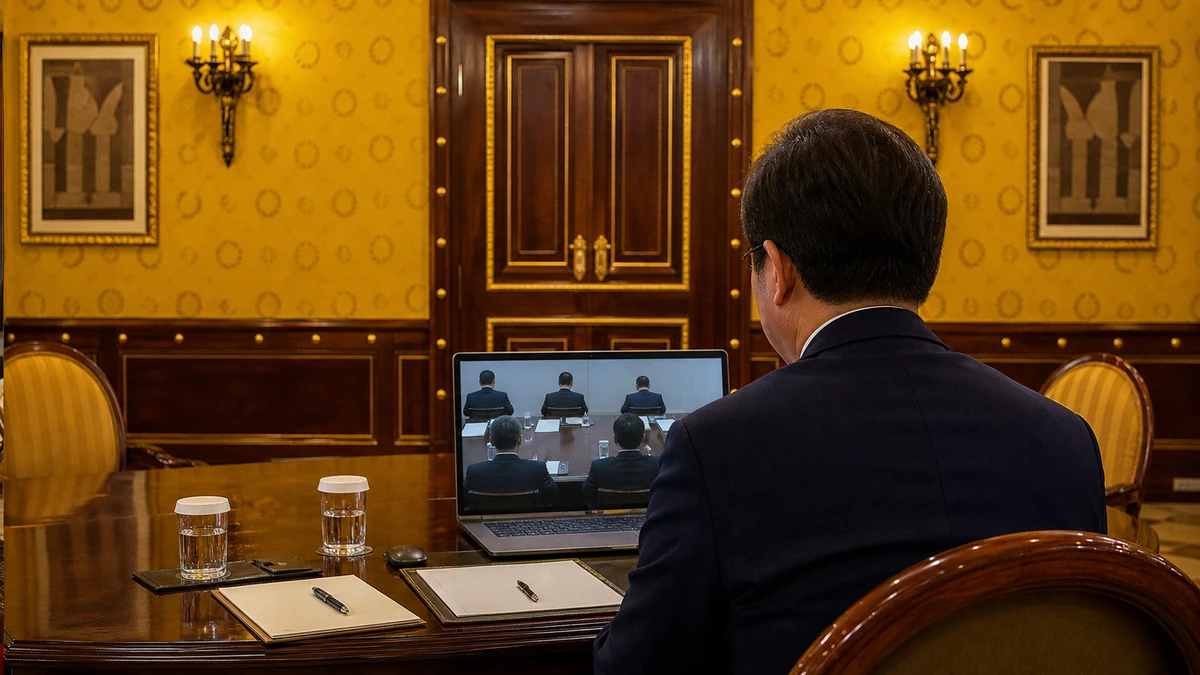
South Korean President Lee Jae-myung used an unusual setting this week to deliver what amounts to one of the clearest political messages of his presidency so far: The next phase of his administration will be judged less by vision than by execution. Speaking by video from a hotel in Rome during a state visit to Italy, Lee convened a meeting of his senior aides back home and said it would not be an exaggeration to say that the success or failure of his remaining four years depends on what happens in the second year of his term.
For American readers, the closest comparison may be the point in a White House term when campaign slogans and inaugural rhetoric give way to a harder question from voters: What, exactly, has changed in people’s lives? Lee’s remarks, delivered overseas but aimed squarely at his domestic team, suggest his government believes it has reached that moment. In the first year, he said, the task was to stabilize turmoil and draw up a broad blueprint for governing. Year two, by contrast, must focus on building the institutional foundation for key priorities.
That distinction matters in South Korea, where presidents serve a single five-year term and often face intense pressure to produce visible results quickly. Unlike U.S. presidents, who can run for reelection, South Korean leaders do not get a second term to reset their political fortunes. The calendar is unforgiving. Early years are for momentum; middle years are for proving that momentum was real. Lee’s framing of the second year as a make-or-break period reflects that reality, and it also signals to his aides, the bureaucracy and the public that broad promises are no longer enough.
Even the optics of the moment reinforced the message. Lee was in Rome on state business, engaging in diplomacy and representing South Korea abroad. Yet he chose to hold a high-level domestic policy meeting from overseas, underscoring that his administration sees foreign relations and internal reform not as separate tracks but as simultaneous obligations. The image of a president managing domestic priorities from a hotel room in Europe may sound modern and routine in the age of video conferencing, but politically it carries a message of urgency: Government work is supposed to move, even when the president is in another time zone.
There was no sweeping new policy unveiled in the meeting, and no major legislative package attached to the president’s comments. But that is precisely why the remarks deserve attention. They were not a policy rollout; they were a declaration of governing philosophy for the next stage of the administration. Lee’s words amounted to a warning to his own team that the public’s patience for planning is limited, and that the presidency is entering the period where systems, implementation and measurable outcomes will matter most.
From blueprint to institutions
The language Lee used is revealing. He described the first year of his government as a time for cleaning up disorder and sketching the “blueprint” for national administration. Now, he said, the emphasis should shift to establishing the “institutional foundation” for core tasks. In plain English, that means turning ideas into durable rules, programs and administrative systems that can actually function beyond speeches and headlines.
In Washington, politicians often talk about “building the plane while flying it” or “putting points on the board.” Lee’s version is more structural. He is essentially saying that if the first year was about setting direction, the second year must be about locking that direction into the machinery of government. For Americans accustomed to debates over whether presidents are judged by lofty vision or by roads repaired, costs lowered and jobs created, the theme will sound familiar. What changes in South Korea is the compressed timeline and the intensity of public scrutiny.
Institutionalization is especially important in a country where political swings can be sharp and administrative continuity is often a challenge. South Korea is one of the world’s most technologically advanced democracies and a major cultural exporter, but it is also a nation with a fiercely competitive political culture, highly engaged voters and a bureaucracy that can move quickly when leadership is aligned. To say that policy must be converted into institutional foundations is to say that the government wants priorities embedded deeply enough to survive friction, criticism and the normal churn of politics.
Lee also urged aides to ensure that policy execution is both fast and “tight,” a phrase that suggests thoroughness, close coordination and attention to gaps. That combination is easier to say than to achieve. Speed can create momentum and reassure the public that government is active. Precision reduces the risk that programs are rolled out sloppily, unevenly or in ways that leave vulnerable groups behind. The tension between those goals is not unique to South Korea. Americans saw the same dilemma in everything from pandemic aid to infrastructure spending: move too slowly, and voters lose confidence; move too quickly, and implementation problems can overshadow the achievement itself.
Lee’s comments indicate he wants both. He is not asking the bureaucracy simply to move faster. He is demanding that it move faster without becoming careless. That is a high bar for any administration, and especially for one that has presented itself as reform-minded. The president’s aides now face a test familiar to governments everywhere: whether internal discipline, cross-ministerial coordination and field-level responsiveness can match political ambition.
Why the economy is about more than good numbers
One of the most politically resonant parts of Lee’s remarks involved the economy. He pointed to signs of improvement in key economic indicators but stressed that better numbers on paper must translate into qualitative and real-world changes in people’s lives. In other words, growth statistics, employment figures or market signals are not enough if ordinary households do not feel relief.
That line would sound recognizable in any American campaign season. U.S. voters often hear that inflation is easing, unemployment is low or consumer confidence is recovering, only to answer with a simpler test: groceries still cost too much, rent is painful and financial anxiety remains constant. South Korea faces its own version of that disconnect. The country is home to globally competitive giants in technology, automotive manufacturing and entertainment, yet many young people and middle-class families continue to worry about housing, job stability, child-rearing costs and the widening gap between macroeconomic strength and everyday security.
Lee’s acknowledgment of that gap is politically significant because it suggests his administration understands the difference between statistical recovery and lived recovery. Governments like to cite data because data can show progress. Citizens judge governments by experience. If a person’s wages are stagnant, their rent is rising and the future feels more precarious than hopeful, a favorable chart from a finance ministry offers little comfort. By emphasizing “qualitative” and “practical” change, Lee is implicitly setting a tougher standard for his own government.
He also told aides to do their best from each of their posts, language that sounds routine on the surface but in context points to a broader governing challenge: economic outcomes do not flow from one ministry alone. They depend on policy design, budget execution, administrative procedures and whether local implementation works in practice. In a country with a strong central state, that kind of top-down instruction can carry real weight. It is a reminder that the presidency expects the entire government to function as an integrated system rather than a set of disconnected departments.
For international observers, the emphasis matters because South Korea’s domestic economic confidence affects more than its own voters. South Korea is a major exporter, an important player in global supply chains and a country whose stability matters to allies and investors alike. A government that can turn broad economic improvement into household-level gains strengthens not only its domestic standing but also its credibility abroad. The reverse is also true: if national indicators improve while public frustration deepens, political instability can grow beneath an outwardly successful economy.
Youth policy moves to the center
Lee’s separate call for broad, government-wide attention to youth policy may prove to be one of the most consequential parts of the meeting, even if it came without new spending figures or detailed policy proposals. In South Korea, “youth policy” is not a niche issue. It is shorthand for a cluster of pressures that define the country’s social future: education, employment, housing, welfare, demographic decline and the stress of competing in one of the world’s most demanding urban economies.
For American readers, imagine if concerns about student debt, entry-level wages, homeownership, delayed marriage and falling birthrates were treated not as scattered debates but as one interconnected national challenge. That is closer to the way these issues are increasingly discussed in South Korea. The term “youth” in Korean political discourse often refers not just to teenagers or college students but to younger adults navigating a brutally competitive transition into stable work, housing and family life.
South Korea’s younger generations have become central to almost every major social debate. The country’s education system is admired internationally for performance but criticized domestically for pressure and inequality. The labor market can be rewarding for those who land secure positions but punishing for those who do not. Housing prices, particularly in and around Seoul, have made the path to independence and family formation feel out of reach for many. Those stresses are tied directly to one of the country’s most urgent long-term challenges: one of the world’s lowest birthrates.
That is why Lee’s framing matters. By telling the government to approach youth policy across ministries, he signaled that this is not something to be delegated to a single office or reduced to a temporary initiative. Education policy affects job prospects. Job prospects affect housing choices. Housing affects marriage and family planning. Industrial transition, social welfare and regional development all shape whether younger South Koreans believe the system is working for them. A piecemeal response is unlikely to satisfy them.
Still, it is important not to overstate what happened. Lee did not announce a new youth package, a revised budget or a legislative calendar in the meeting described by South Korean media. The confirmed fact is narrower: He told his administration to pay attention to youth policy on a government-wide basis. The interpretation is broader: That priority could rise within the second-year agenda as his administration seeks results that voters can feel directly. Whether that leads to meaningful reforms will depend on what follows in law, spending and implementation.
A domestic message delivered from foreign soil
The setting of the meeting added another layer of symbolism. Lee was in Rome on a state visit to Italy, but his words were directed not to foreign leaders but to his own senior staff. For global audiences, that image says something about South Korea’s current position in the world. It is a country expected to do many things at once: deepen international partnerships, navigate a volatile security environment, maintain economic competitiveness and keep domestic reform moving at home.
South Korea’s rise over the past several decades has made it more visible to Americans, often first through pop culture. Many U.S. audiences encountered modern Korea through K-pop, Oscar-winning films, streaming dramas, beauty brands or Samsung smartphones before they followed its politics closely. But cultural influence is only part of the story. South Korea is also a treaty ally of the United States, a pivotal democracy in East Asia and a state whose internal political choices can shape regional diplomacy, trade and public confidence.
Seen in that light, a president running a senior domestic meeting from Rome is more than a scheduling detail. It projects continuity of governance. It tells domestic audiences that foreign travel does not pause internal priorities, and it tells international audiences that Seoul views domestic reform and diplomatic engagement as mutually reinforcing. Governments often want to show they can walk and chew gum at the same time. Lee’s Rome meeting was a version of that performance.
There is also a subtler message in the choice to emphasize domestic execution while abroad. State visits are often rich in ceremony, symbolism and alliance management. By holding this video meeting and focusing on implementation, Lee linked foreign visibility to domestic accountability. In effect, he signaled that international stature alone will not define his presidency. The more decisive test lies in whether the government can translate intent into systems, and systems into outcomes that voters feel.
That matters for how outside observers should read South Korean politics. It is tempting to focus on the dramatic elements — summitry, security tensions, major corporate announcements, cultural exports — because those are the most visible internationally. But in democratic politics, the mundane can be decisive. Budget schedules, interagency coordination, local execution and administrative follow-through often shape public opinion more than speeches do. Lee’s message from Rome was, in essence, an argument that the next chapter of his presidency will be written in that less glamorous arena.
The politics of speed and precision
If one theme tied the entire meeting together, it was Lee’s insistence on speed. He called for momentum in governance and for policy implementation that is both rapid and closely woven. In political terms, that is an attempt to energize the bureaucracy while also defining the standard by which it will be judged.
Speed matters because governments are always racing against public impatience. In the early stage of an administration, citizens may tolerate delays if they believe a clear direction exists. By year two, that tolerance narrows. Voters want evidence. They want to know whether promises are becoming programs, whether programs are reaching people and whether those people see any improvement. In South Korea’s fast-paced media environment and highly networked society, that pressure can intensify quickly.
But Lee’s use of a term meaning something like “dense,” “tight” or “closely knit” is equally important. It suggests concern about blind spots — the neighborhoods, sectors or groups that can fall through the cracks when policy is launched quickly from the top. Americans have watched similar debates unfold around everything from health care enrollment to disaster relief to student loan servicing. The challenge is not merely announcing a policy but ensuring that it works in the field, with enough detail and coordination that it does not unravel on contact with reality.
This is where second-year governance becomes difficult. It requires not just presidential urgency but administrative craft. Ministries must cooperate rather than protect turf. Feedback from local conditions must travel upward quickly. Programs must be adjusted without looking like failures. Political leaders must keep claiming momentum while technocrats deal with complexity. Lee’s remarks suggest he understands that the second year will be judged by exactly this combination of pace and competence.
That makes the meeting something more than an internal pep talk. It was an attempt to set a governing metric. The question is no longer simply what this administration wants to do. The question is how fast, how thoroughly and how visibly it can do it. In that sense, Lee was preparing not only his aides but also the public for the standards he expects them to use in evaluating his government from here on out.
What Lee’s language says about South Korean democracy
Lee’s description of his administration in terms associated with popular sovereignty, or the idea that government derives its legitimacy from the people, also deserves attention. In South Korean politics, language about democracy, public authority and the people’s mandate carries real historical weight. This is a country whose modern democratic system was shaped not only by constitutional design but by mass civic mobilization, protest movements and hard-fought struggles over accountability.
For American readers, it helps to remember that South Korea’s democracy is robust but relatively young compared with the United States. Its institutions have matured rapidly, often under intense public scrutiny. Political language there can therefore carry echoes of both democratic aspiration and factional contest. When a president speaks of government in people-centered terms, he is making both a philosophical claim and a political one: that his administration’s legitimacy comes from responding concretely to citizens, not merely from winning office.
At the same time, the article summary makes clear that the meeting did not establish a new institution or confirm a fresh policy package. That distinction matters. Political rhetoric in any democracy can invite overinterpretation, especially when it comes from the head of state. What is confirmed is Lee’s framing: year one was about restoring order and drawing the map; year two is about building institutional footing; success will be judged by execution, practical change and closer attention to youth and household realities. The larger meaning lies in how those priorities are carried out.
For Americans following South Korea mostly through the lens of security policy or pop culture, this is a useful reminder that the country’s democratic life is also driven by bread-and-butter governance. The same nation that exports globally dominant music, films and technology is also grappling with the ordinary but difficult tasks of making government feel effective, fair and responsive. That tension between global prestige and domestic demand is not uniquely Korean. It is a hallmark of many advanced democracies.
The next test is not the speech but the follow-through
In the end, Lee Jae-myung’s Rome meeting matters less for where it happened than for what it revealed about the next stage of his presidency. He appears to believe that the honeymoon period, if there ever was one, is over. The era of blueprint language is yielding to an era of institutional proof. Economic indicators must become household relief. Youth policy must move from slogan to system. Administrative energy must be measured not only by speed but by precision.
That is a demanding agenda, and one that leaves little room for symbolic victories alone. South Korean presidents operate on short clocks and high stakes, and the public is accustomed to judging them rigorously. Lee’s own benchmark was stark: the remaining four years could hinge on the results of this second year. Whether that proves politically accurate remains to be seen, but it is revealing that he chose to define the moment in such terms.
For outside observers, including in the United States, the message is straightforward. South Korea is not simply balancing diplomacy abroad with politics at home. It is entering a phase in which its domestic execution may shape how credible and stable it appears internationally. A government that can institutionalize policy, narrow the gap between data and daily life and address younger generations’ anxiety will be better positioned not only at home but on the global stage.
The president has now set the test publicly. The harder part begins next: proving that urgency can be translated into governance, and that governance can be translated into results ordinary South Koreans can feel in their paychecks, rents, job prospects and sense of the future. That is the standard Lee laid down from Rome. The rest of his presidency may be judged by whether he meets it.
Comments
Post a Comment