
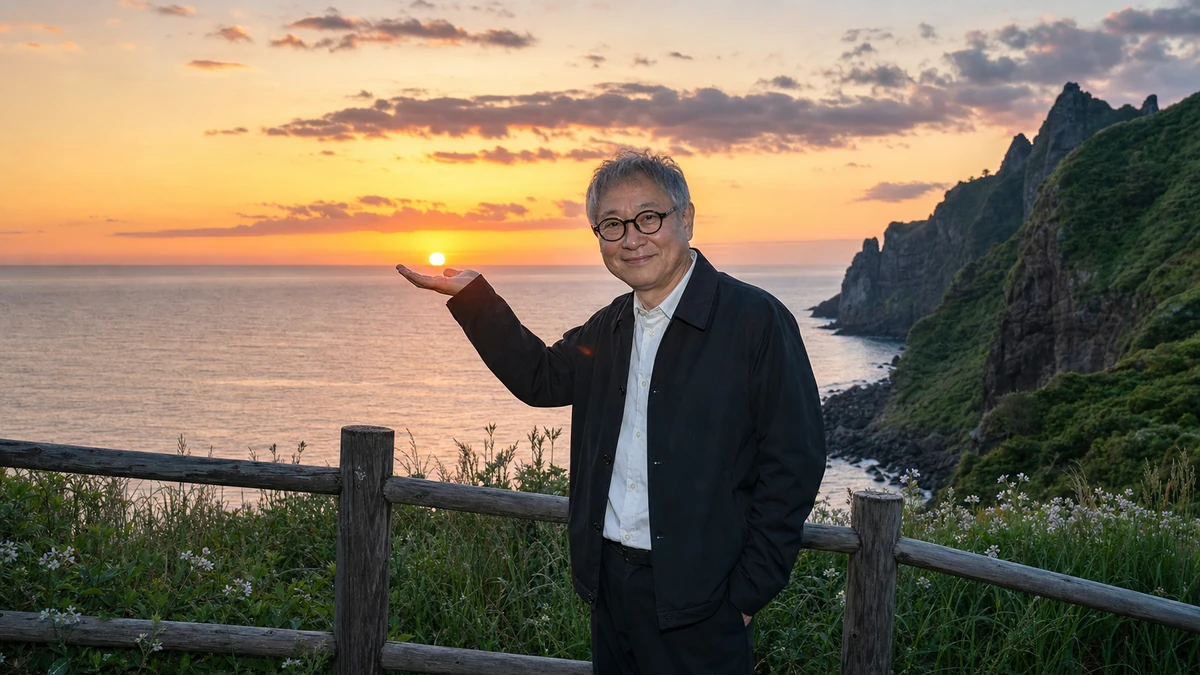
A familiar TV face is introducing Jeju to a key regional audience
South Korea has spent years exporting pop culture, from K-pop arena tours to Emmy-winning television and beauty products stacked in American big-box stores. But the latest chapter in the Korean Wave, or Hallyu, is less about a chart-topping song or a breakout streaming hit than about a place: Jeju, the volcanic island off South Korea’s southern coast that many Koreans describe as both a honeymoon destination and a place to exhale.
Officials in Jeju said this week that the island, working with the Korea Tourism Organization’s Fukuoka office, the Jeju Tourism Organization and Japanese broadcaster RKB Mainichi Broadcasting, has produced a one-hour tourism special aimed at viewers in Japan’s Kyushu region. The program is scheduled to air Saturday evening and later will be released through the broadcaster’s official news YouTube channel, widening its reach beyond a traditional local television audience.
The biggest draw is Yutaka Matsushige, the veteran Japanese actor best known as the face of the long-running drama “Solitary Gourmet,” a cult favorite series built around something deceptively simple: one man quietly eating his way through everyday places. For many viewers in Japan, Matsushige is not just another celebrity host. He is closely associated with a style of storytelling that treats food as a doorway into place, mood and daily life. That makes him an unusually effective guide for a destination campaign centered on scenery, local ingredients and slow travel.
According to the project’s organizers, Matsushige visits landmark sites including Seongsan Ilchulbong, the dramatic tuff cone often called Sunrise Peak, and the Seogwipo Healing Forest, a wooded area promoted as a restorative retreat. He also introduces Jeju’s local food culture, emphasizing ingredients shaped by the island’s distinct environment. Actor and presenter Hiroe Igeta appears alongside him, adding a lighter, more lifestyle-driven dimension focused on ocean views, sunshine, experiential travel and cafe stops.
For American readers, the easiest comparison may be to what happens when a trusted food personality on PBS, Netflix or cable turns attention to a lesser-known region and suddenly makes it feel accessible. The destination does not just look pretty; it acquires a narrative. A place that might once have registered as a pin on a map becomes a mood, a craving, a future trip. That is the strategic value of this Jeju special. It does not simply tell audiences where to go. It tries to make viewers feel they already know how they would want to be there.
That matters because tourism marketing in Asia is increasingly intertwined with entertainment. Fan communities no longer stop at watching a drama, following an idol or buying merchandise. They travel. They seek out filming locations, signature foods, scenic overlooks and the kind of cafes that populate social media feeds. Jeju’s latest push into Japanese broadcasting shows how local governments and tourism boards are adapting to that reality.
Why Jeju holds a special place in the Korean imagination
To understand why this broadcast matters, it helps to understand Jeju’s role in South Korea. The island, which lies in the Korea Strait, occupies a place in the national imagination somewhat analogous to Hawaii for mainland Americans, though the comparison is imperfect. Like Hawaii, Jeju is associated with volcanic landscapes, coastline, regional food and a sense of escape from urban life. But it is also deeply woven into Korean domestic tourism, family travel, school trips and honeymoon culture.
Jeju has long marketed itself as a destination where visitors can move at a different pace. In Korean promotional language, it is often described as a place of “healing,” a term that can puzzle English speakers if taken literally. In contemporary Korean usage, “healing” frequently refers not to medical treatment but to emotional restoration, relaxation and relief from stress or burnout. A “healing trip” is what many Americans might call a wellness getaway, a reset or simply a vacation designed to leave you feeling mentally lighter.
That framing has become especially powerful in a country known for its fast-paced work culture, dense cities and highly wired social environment. Jeju offers forests, coastal roads, mountains, fishing villages and an enormous cafe scene, all wrapped in an island atmosphere that suggests distance from routine without requiring international travel for Korean residents. It is both familiar and aspirational, a place where nature and lifestyle branding overlap.
Jeju also carries international recognition. The island’s volcanic landscape and lava tube system were designated a UNESCO World Natural Heritage site in 2007, a point frequently highlighted in tourism promotion. That status helps position Jeju not just as a beach destination but as a place of geological and ecological significance. For overseas viewers who may know Seoul for shopping, K-pop or palace tourism, Jeju can serve as a useful corrective to a narrow picture of South Korea as entirely urban and hypermodern.
For Japanese audiences in particular, Jeju holds additional appeal because of geography. Kyushu, the southwestern Japanese region targeted by the broadcast, is relatively close to South Korea. That proximity matters in practical and psychological terms. Travel content works best when viewers can imagine themselves making the trip without extraordinary effort. A destination that feels faraway in the abstract can become much more real when presented through a local broadcaster in a region where Korea is not some distant concept but a nearby neighbor across the water.
Why Yutaka Matsushige is such a smart choice
Matsushige’s involvement is the central reason this program stands out from standard tourism promotion. In the age of algorithmic travel videos and polished destination ads, familiarity is currency. Audiences are more likely to trust a place when it is filtered through someone whose persona already means something to them.
That is what Matsushige brings. “Solitary Gourmet” became popular not because it is flashy, but because it turns eating into a kind of intimate urban anthropology. The meals are often modest. The settings are unpretentious. The pleasure comes from watching attention itself: a person noticing a neighborhood, a menu, a texture, a small ritual. Food is never just food. It is atmosphere, memory, rhythm and belonging.
Transplant that sensibility to Jeju and the island’s appeal sharpens. Instead of functioning as a generic celebrity ambassador, Matsushige arrives with built-in associations of curiosity, restraint and appetite. His presence tells viewers that Jeju is not merely a place to photograph from a bus window. It is a place to taste slowly, to wander through, to experience with all the senses.
That distinction matters because modern tourism campaigns increasingly try to sell immersion rather than checklists. In the old model, a destination advertisement might emphasize landmarks, transportation or package deals. In the newer model, especially across East Asia, the emotional logic is different. Viewers are invited to imagine not just what they would see, but how they would feel while moving through a place. Matsushige’s screen persona is unusually well suited to that kind of invitation.
There is also a fandom component. Fans who know him from Japanese television may feel a low-pressure but real pull to follow his itinerary, whether that means trying local seafood, visiting scenic walking trails or seeking out the specific places shown on the program. This is not unlike what American travelers do when they visit filming locations from prestige TV series, celebrity-chef restaurants or wineries featured in lifestyle shows. The emotional bridge is powerful: If someone whose taste you trust enjoyed it, maybe you will too.
And unlike some travel programming that leans on spectacle, Matsushige’s appeal rests partly on ordinary pleasures. That makes Jeju’s message more persuasive. The island is not being sold as an unattainable luxury fantasy. It is being framed as a lived-in, flavorful, restorative destination that rewards time and attention.
Food, nature and the translation of “healing” into global tourism language
The Jeju special appears to rest on two major themes: nature and food. That may sound obvious for a tourism campaign, but in Jeju’s case the pairing is more than cosmetic. The island’s identity is closely tied to the idea that its environment produces a distinct way of living and eating. Local ingredients, ocean climate and volcanic soil all become part of the story.
That is why the program’s structure matters. Organizers say Matsushige explores sites such as Sunrise Peak and the Seogwipo Healing Forest while also introducing dishes made with Jeju’s clean, local ingredients. The point is not simply to list menu items. It is to suggest that Jeju’s flavor is inseparable from its landscape. A meal becomes evidence of place.
For American readers, think of how certain destinations are understood through taste as much as scenery: Napa through wine, Maine through lobster, New Orleans through gumbo and beignets, New Mexico through chile, Hawaii through poke and shaved ice. Jeju wants to be legible in that same way. The food is not a side attraction. It is one of the clearest ways outsiders can understand what makes the island itself distinctive.
The language of “healing” is also especially exportable. Even when the word sounds slightly awkward in English, the idea behind it travels well. Across cultures, audiences respond to a package of meaning that includes rest, nature, good food and a slower pace. In an era of overwork, doomscrolling and burnout, that message hardly needs translation. What changes is the local texture attached to it.
Jeju’s version of that package includes emerald water, forest trails, volcanic ridges, black lava rock, tangerine groves, seafood, architecture-conscious cafes and scenic drives. In Korean travel culture, cafes themselves have become a destination category, not just a stop for caffeine. A “cafe tour” can mean seeking out spaces prized for design, ocean views, photogenic interiors and a mood calibrated for lingering. The Jeju special reportedly includes that aspect as well, especially through Igeta’s segments.
This is one reason Jeju translates effectively across borders. You do not need deep background knowledge of Korean history or entertainment to understand the proposition. Beautiful nature, distinct local food, atmospheric cafes and a slower tempo are legible nearly everywhere. That simplicity is part of the campaign’s strength.
What Hiroe Igeta adds to the picture
If Matsushige represents depth, appetite and contemplative travel, Igeta appears to represent brightness, ease and contemporary lifestyle appeal. According to the organizers, she explores Jeju through experiential travel that emphasizes sunshine, sea views and cafe culture. That may sound like a softer contribution, but it is strategically important.
Travel marketing increasingly relies on multiple emotional entry points. One traveler is drawn to food. Another wants landscapes. Another is looking for what social media has taught people to call “vibes,” a word that can be imprecise but captures something real about how destinations are consumed today. Jeju’s cafe scene, coastal light and highly visual atmosphere speak directly to that audience.
In South Korea, cafes often function as hybrid spaces where architecture, branding, photography, relaxation and local identity all intersect. On Jeju, this culture has flourished in ways that can surprise first-time visitors. Converted farm buildings, oceanfront terraces and minimalist spaces looking out toward dramatic coastlines have become part of the island’s contemporary image. For younger travelers especially, those settings are not trivial. They are part of how a destination is remembered, posted about and recommended.
Igeta’s role seems to help translate that side of Jeju to Japanese viewers who may be less interested in a documentary-style pitch and more responsive to experience-driven storytelling. Paired with Matsushige, she broadens the program’s emotional range. Together, they offer Jeju not as a single idea but as a layered one: restorative but stylish, natural but curated, scenic yet edible.
That dual approach reflects a larger trend in tourism content across Asia, where destinations are no longer promoted solely through official talking points about landmarks and history. They are packaged as livable aesthetics. The ideal trip is not just informative. It is cinematic. It is sensorial. It promises both serenity and a camera roll worth sharing.
Why this matters beyond one tourism broadcast
At first glance, a regional Japanese television special about a Korean island may seem minor compared with the blockbuster headlines usually associated with Hallyu. There is no global streaming premiere here, no stadium concert, no celebrity scandal, no awards-season campaign. Yet in some ways this kind of story may say more about the Korean Wave’s maturity than another viral entertainment moment would.
For years, South Korean cultural exports were discussed primarily through music and drama. More recently, food, beauty, fashion and tourism have joined that ecosystem in increasingly sophisticated ways. What begins as media consumption often becomes consumer behavior, then travel behavior. People do not just watch Korean content; they build itineraries around it.
That helps explain why local governments and tourism boards are now working more closely with broadcasters and entertainment-adjacent personalities. The logic is straightforward. A standard ad can tell viewers Jeju is beautiful. A trusted actor associated with food and everyday discovery can make that beauty feel personal. He can transform a destination from information into desire.
The Jeju project also highlights how region-to-region media relationships can matter as much as flashy national campaigns. Because the special is being distributed through a Kyushu broadcaster, it targets an audience for whom South Korea is geographically and culturally closer than it might seem from Tokyo or from farther afield. Regional media can lower the barrier to curiosity. They speak in a more intimate register. They can make international travel feel immediate.
There is also a digital afterlife to consider. Once the program is posted to YouTube, clips, screenshots and fan commentary can circulate well beyond the original broadcast area. Contemporary destination branding is cumulative. A single show does not transform perception overnight, but repeated images do. A scenic overlook, a memorable dish, a celebrity reaction, a cafe with a view: these fragments accumulate until a place starts occupying more mental real estate.
That is especially relevant for Jeju, which has in recent years appeared in everything from Korean dramas to travel vlogs to social media travel guides. The island does not need to be introduced from scratch. Instead, it is being reintroduced through new lenses for different audiences. This Japanese special is one more lens, and a smart one.
Jeju’s invitation to the wider world
For American readers, the most interesting part of this story may be what it reveals about the next phase of global Korean influence. The Korean Wave is no longer just about stars and songs crossing borders. It is also about how places get narrated, packaged and desired through familiar cultural intermediaries.
Jeju has all the raw ingredients of a successful international tourism brand: dramatic landscapes, UNESCO credentials, a strong domestic reputation, rich food culture and highly visual travel experiences. But destinations do not market themselves. They need interpreters. In this case, Matsushige serves as a particularly effective one for Japanese viewers, while Igeta helps complete the picture with a more contemporary, mood-driven travel lens.
The result is a portrait of Jeju as more than a scenic island. It becomes a stage where several broader currents meet: cross-border broadcasting, fan culture, culinary storytelling, regional diplomacy and the globalization of lifestyle travel. It is also a reminder that culture often travels most effectively through specific, tangible pleasures. A forest walk. A bowl of something local. Sunlight on the water. A cafe designed for lingering.
That may sound modest compared with the scale of major entertainment headlines, but modesty is part of the point. Places often enter the global imagination not through grand declarations but through repeated, intimate scenes that viewers can picture themselves stepping into. Tourism boards know this. Broadcasters know it. Fans know it, too.
Whether the Jeju special produces an immediate surge in bookings is almost beside the point. Its deeper value lies in shaping how the island is imagined by viewers who may already like Korean culture, Japanese food television or both. By connecting a familiar actor with an unfamiliar but highly legible destination, the program creates a bridge between affection and aspiration.
For Jeju, that is a meaningful win. In an increasingly crowded regional tourism market, the island is not just competing on beauty. It is competing on narrative. And with a beloved food-drama star walking its trails, tasting its ingredients and looking out over its coastline, Jeju is making a persuasive case that the next memorable chapter of the Korean Wave may not be watched only on a screen. It may also be traveled.



0 Comments