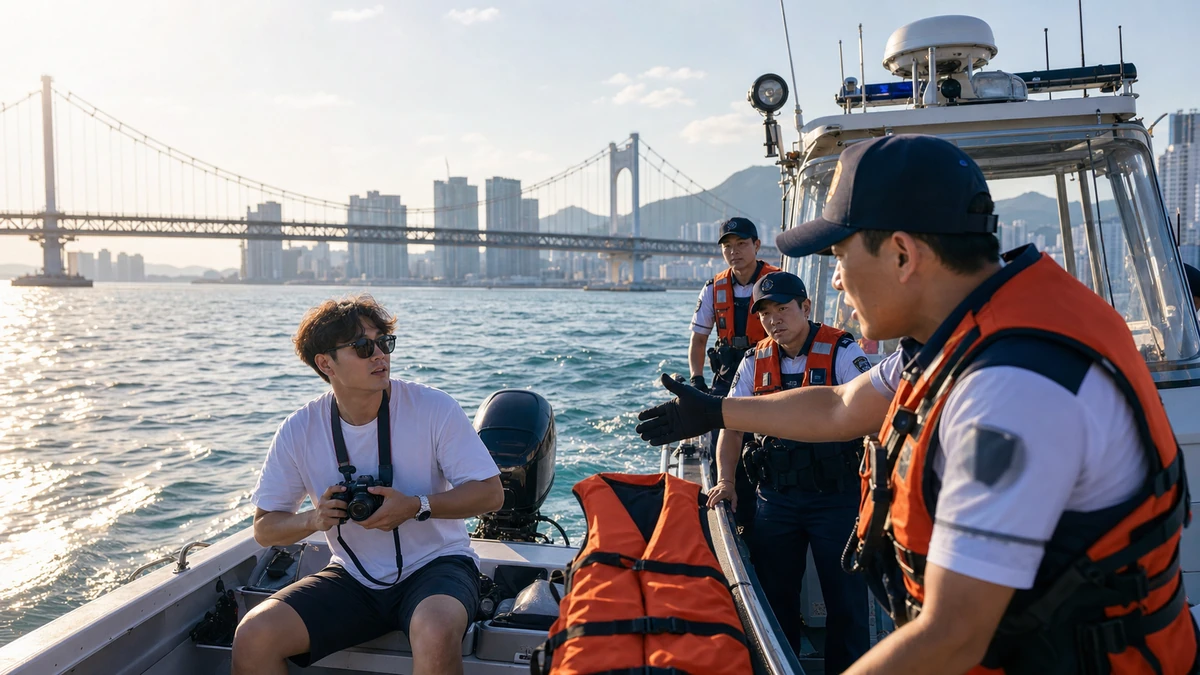
A scenic ride near one of South Korea’s most famous bridges ended with a fine — and a warning for summer travelers
For many visitors to Busan, South Korea’s second-largest city, the appeal of the coast is obvious. The city’s beaches are framed by high-rise apartment towers, seafood restaurants and broad ocean views, and in summer the shoreline becomes one of the country’s most popular escapes. One of the most recognizable backdrops is Gwangan Bridge, a sweeping suspension bridge that lights up at night and stretches across the water like a postcard image of modern Korea.
But the South Korean authorities want tourists and recreational boaters to remember something before they reach for a camera: On the water, safety rules come first.
The Korea Coast Guard’s South Sea Regional Headquarters said this week that it continues to fine people who take part in water leisure activities without wearing required safety gear, including life jackets, as summer crowds grow along the coast. Officials pointed to a recent case near Gwangan Bridge in Busan, where a man riding a motorboat while photographing the scenery was caught without a life jacket and fined 100,000 won, or roughly $70 to $75, depending on the exchange rate.
On one level, it was a routine enforcement case. On another, it captured a broader message that South Korea appears eager to send during peak travel season: The country’s marine tourism industry may be built around leisure, speed and striking views, but it is also governed by rules that authorities expect people to follow, including foreign visitors who may not know the local system.
That message may sound familiar to Americans who have rented jet skis at a Florida beach, boarded a whale-watching boat in California or taken a guided rafting trip in Colorado. There, too, the premise is simple: The excursion may be designed as fun, but the safety briefing is not optional. South Korea is making clear that its own summer coastline should be understood the same way.
Busan’s coastline has become a major summer draw, and that means more scrutiny on the water
Busan occupies a special place in South Korea’s travel culture. If Seoul is the country’s political, financial and cultural center, Busan is often imagined as its summer capital — a port city where urban life spills directly onto the beach. Americans might think of it, loosely, as a mix of Miami’s waterfront energy, San Diego’s ocean identity and Seattle’s port infrastructure, though Busan remains distinctly Korean in its density, transit culture and social rhythms.
During the hottest months of the year, domestic tourists flood Busan for beach trips, seafood markets, festivals and sea-based recreation. Motorboats, yachts and other water leisure activities have become a growing part of that summer economy. Visitors are drawn not only to the ocean itself but to the combination of city skyline and water that Busan offers so dramatically. Near Gwangan Bridge, that visual effect is especially strong: the bridge, the glass towers and the open water create the kind of image travelers increasingly seek for social media and travel photography.
That helps explain the scene described by the coast guard. A man on a motorboat was reportedly trying to capture the view on camera, an impulse that would make sense to nearly anyone visiting the area. But officials said his intentions and the beauty of the setting were beside the point. Under South Korea’s Water Leisure Safety Act, people engaging in water leisure activities are required to wear life jackets and other prescribed safety equipment. Failing to do so can trigger administrative fines.
The distinction matters. In many travel settings, visitors assume rules are flexible if no one appears to be in immediate danger. On the water, South Korean authorities are signaling that compliance is meant to be proactive, not reactive. In other words, a life jacket is not something you put on only if the weather turns, the boat speeds up or an officer appears nearby. It is part of the basic conditions for participating.
That may be especially important in Busan, where casual visitors can mistake a visually polished tourist experience for an informal one. The city’s waterfront can look relaxed and cinematic, particularly around famous landmarks. But beneath that polished surface is a highly regulated public environment, a feature common across much of South Korea, where rules governing transportation, public conduct and safety are often clearly structured and actively enforced.
The most common violation is also the most basic one
According to the South Sea Regional Coast Guard Headquarters, the most frequent type of violation under the Water Leisure Safety Act over the past three years was failure to wear safety equipment, including life jackets. From 2023 through last year, officials recorded 126 such cases that resulted in fines.
That figure is notable not because it suggests unusual danger, but because it shows where authorities believe ordinary complacency sets in. The repeated problem is not a complicated licensing issue or a technical navigation rule. It is the simplest step of all: putting on the protective gear before heading out.
That pattern is hardly unique to South Korea. Safety regulators in the United States have long faced the same challenge. Whether the setting is a lake in Minnesota, a marina on Long Island or a party boat in the Gulf Coast, the most preventable problems are often rooted in habits people dismiss as minor. A seat belt feels unnecessary on a short drive until there is a crash. A life jacket can feel bulky or unflattering until someone falls overboard.
In that sense, the Busan enforcement case speaks to a universal tension in tourism and recreation. The experience being sold is freedom: the rush of speed, the sense of escape, the promise of a memorable photo. The experience being managed by authorities is risk: wind, waves, accidents, alcohol, inattention and overconfidence. Those two realities coexist uneasily, and the burden often falls on regulators to remind travelers that the postcard version of a destination is never the whole story.
South Korea’s numbers suggest that reminder remains necessary. If the most common breach is failure to wear basic safety gear, then officials are likely dealing less with deliberate rebellion than with a mindset that treats safety preparation as secondary to the outing itself. The coast guard’s public emphasis on life jackets appears designed to reverse that order. First the equipment, then the excursion.
For international visitors, that point can be easy to miss. Travelers often prepare carefully for flights, hotel reservations and restaurant bookings, yet give less thought to local safety expectations during leisure activities. But in South Korea, as in many countries with dense tourism infrastructure, what looks like a casual add-on to a trip may still carry formal obligations, and authorities may not be inclined to overlook them simply because someone is a tourist.
What the 100,000-won fine says about how South Korea wants its tourism industry to work
The fine in the Busan case — 100,000 won — is not ruinous. For many travelers, it would amount to an expensive inconvenience, not a financial disaster. But the significance lies less in the amount than in the clarity of the penalty. South Korean authorities are demonstrating that failure to wear a life jacket is not merely discouraged; it is enforceable, and enforcement is real.
That matters in a country where tourism has become both a major industry and a matter of national image. South Korea has spent years presenting itself to the world not just through K-pop, Korean dramas and beauty products, but through a broader travel brand built around modern cities, coastal scenery, food culture and efficient infrastructure. Busan is central to that effort. It is a regular stop for international tourists, a host of major events and a symbol of Korean urban life beyond Seoul.
As that tourism footprint expands, so does the pressure to create experiences that feel both exciting and orderly. One way governments do that is by emphasizing visible rules. The logic is straightforward: A destination that takes safety seriously is easier to market as dependable, especially to families, international travelers and first-time visitors. Strict enforcement can therefore serve not only a public-safety function but also a reputational one.
Americans have seen similar logic at work in their own tourist destinations. Cities and states often walk a fine line between advertising adventure and preventing disaster. Operators encourage people to rent boats, book zip-line trips or sign up for snorkeling excursions, while regulators insist on waivers, harnesses, flotation devices and inspections. When an accident happens, questions quickly follow about whether the operator, the tourist or the government failed to uphold basic standards.
South Korea appears intent on minimizing that ambiguity. The message embedded in this case is uncomplicated: Marine leisure is welcome, but only within a rules-based framework. Authorities are not saying travelers should avoid the sea. They are saying the enjoyment of the sea depends on respecting the precautions that come with it.
That framing also reflects something broader about Korean public culture. South Korea is a highly organized society where many public systems operate on the assumption that individual convenience does not outweigh collective order. For Americans, especially those used to a looser culture around small risks, that can sometimes feel rigid. But it also helps explain why officials may view enforcement not as overreach, but as a routine duty tied to public trust.
For foreign visitors, the bigger issue may be communication, not just compliance
If there is a challenge hidden inside the coast guard’s warning, it is this: Rules are only effective when people understand them clearly enough to follow them. And in a country that is attracting more foreign tourists each year, that means safety information cannot remain overly dependent on Korean-language assumptions.
The coast guard said summer brings an increase in people enjoying marine leisure activities, which makes guidance and on-site checks more important. That observation is as much about communication as it is about enforcement. A traveler who spends the morning in a traditional market and the afternoon on a boat may not automatically understand that the second half of the day involves a different legal environment, one with more formal safety expectations.
For Americans and other English-speaking visitors, South Korea can be both easy and hard to navigate at the same time. The country’s public transit is excellent, cities are digitally connected and many tourist districts are increasingly multilingual. But outside those systems, especially in activity-based settings such as boating, hiking or rural travel, instructions may still be inconsistent or delivered too quickly for non-Korean speakers to absorb.
That is where the Busan case becomes more than a local enforcement story. It raises a practical question for operators, local governments and tourism agencies: Are they making safety rules legible enough to the people they most want to attract? A life jacket requirement is not complicated, but it still has to be communicated in a way that leaves little room for confusion. Clear signage, visual demonstrations, translated instructions and mandatory pre-departure checks can do far more than a fine alone.
There is also a cultural element. In South Korea, many routine processes rely on social cues and expectations that local residents intuitively understand. Visitors may not. A Korean customer might assume that if a staff member hands over safety gear, it is to be worn immediately and without debate. A tourist from elsewhere may interpret the same interaction more casually, particularly if they have experienced uneven enforcement back home.
That gap in assumptions can produce avoidable friction. From the perspective of the traveler, a fine feels abrupt. From the perspective of the authorities, the rule may have been obvious all along. Bridging that divide is important if South Korea wants its marine tourism industry to feel welcoming as well as disciplined.
The photo-first travel culture of summer can collide with the realities of the sea
One reason the Busan incident resonates is that it reflects a wider shift in global travel behavior. Increasingly, tourists plan activities not just around relaxation or sightseeing, but around what those activities will look like on camera. Scenic boat rides, rooftop viewpoints and dramatic waterfront settings are now part of a visual economy driven by Instagram, TikTok and travel vlogs. Gwangan Bridge, with its sweeping lines and urban backdrop, fits naturally into that world.
But the pursuit of a polished image often works against safety culture. Travelers may remove or avoid gear they think looks awkward in photos. They may pay more attention to framing a shot than to the conditions around them. They may treat the excursion as a temporary stage set rather than an environment with real physical risk.
That tension is not uniquely Korean. National parks in the United States regularly confront visitors who step over barriers for selfies. Beach towns warn against swimming in dangerous currents despite the calm look of the water. Cruise operators remind passengers not to lean beyond railings for pictures. The modern travel paradox is that the more people document their experiences, the easier it can be to forget the physical vulnerability behind them.
In Busan, the symbolism is particularly sharp because the man cited by authorities was reportedly taking pictures of the view from a motorboat. That detail turns the case into a small lesson about travel priorities. The image can wait; the life jacket cannot. For officials, that is the sequence they want visitors to internalize.
There is also a subtler point here about what makes a destination feel truly tourist-friendly. Some travelers equate convenience with freedom from constraints. In reality, many of the world’s most successful tourist destinations function smoothly because the constraints are clear, predictable and enforced. Ski resorts require helmets for some activities. Theme parks set height restrictions. Charter boats issue safety instructions before departure. The rules are part of what makes the experience manageable at scale.
South Korea’s summer coast increasingly fits that model. The country is inviting people to enjoy the water, not improvise on it. And if the result is that a few travelers end up with fines they did not expect, authorities appear willing to accept that tradeoff in exchange for a firmer safety culture.
What travelers should take from this before booking a day on the water
The practical takeaway from the Busan case is simple, and it extends beyond South Korea. If you are booking a motorboat ride, jet ski outing or other marine leisure activity anywhere, do not treat the life jacket as optional, decorative or situational. Put it on before departure, wear it properly and assume local authorities mean it when they say it is required.
In South Korea specifically, that means travelers should ask questions up front. Before boarding, confirm what safety gear is required and whether it is included. If instructions are not clear in English, request clarification rather than guessing. If an operator appears relaxed about enforcement, do not assume that local authorities will be equally relaxed. The operator’s casual attitude will not necessarily protect a customer from a fine.
It also means recognizing that a summer trip to Busan is not only about beach culture and scenic moments. It is about participating, however briefly, in a public environment that runs on established rules. For many Americans, that can be a useful reset. The best version of travel is not just consuming a place aesthetically, but adapting to how that place actually works.
There is a temptation in stories like this to frame the coast guard as the spoiler of a pleasant day out. But that is not quite right. The authorities are not objecting to leisure itself; they are defining the terms under which leisure is supposed to happen. In a coastal city that markets beauty, excitement and access to the sea, those terms matter.
And so the larger message from Busan is less punitive than preventive. South Korea wants people to enjoy its summer waters, including the urban seascape around landmarks like Gwangan Bridge. It also wants them to understand that the freedom promised by that experience has a floor beneath it: basic safety equipment, properly worn, every time.
For visitors chasing the perfect ocean shot, that may sound like a small interruption. In practice, it is better understood as the opening scene of the trip. Before the skyline, before the speed, before the camera clicks, there is the life jacket. In Busan this summer, officials are making clear that everything else comes after that.
Comments
Post a Comment