
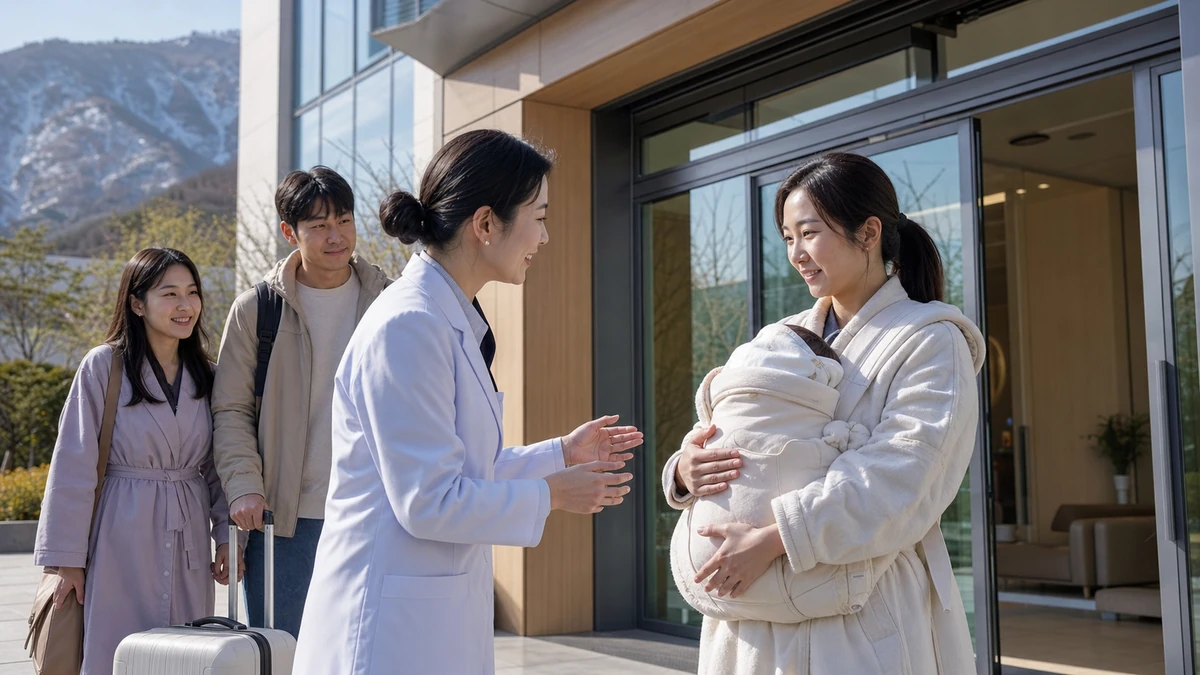
A small city’s new maternity service is drawing attention
In the mountain city of Taebaek, South Korea, a public postpartum care center has been open only a little more than two months, but its early numbers are already telling a story that reaches beyond one local facility. According to city officials, 15 mothers have used the center since it opened April 13, and reservations for July are effectively full. Another seven expectant mothers have already applied for August stays, suggesting that interest is not a one-time spike but part of a continuing local demand for organized postpartum care.
For American readers, the idea may sound unfamiliar. In South Korea, a postpartum care center — called a sanhujoriwon in Korean — is a dedicated facility where mothers can recover after childbirth while receiving support with newborn care, feeding, rest and basic health monitoring. Some are private and can be expensive. Others, like the one in Taebaek, are publicly operated by local government. The point is not luxury, though some private centers market themselves that way. At its core, the model treats the weeks after childbirth as a distinct health period deserving structure, supervision and support.
That framework matters in Taebaek, a relatively small city in Gangwon Province better known historically for coal mining than for being on the front edge of family policy. If a public postpartum center in a place like Taebaek is filling beds soon after opening, it suggests a practical need: Mothers and families outside South Korea’s biggest cities also want reliable help during one of the most physically and emotionally demanding transitions in family life.
The city’s early figures should not be overstated. A few months of use do not prove long-term success, and one facility cannot stand in for the whole country. Still, stable early occupancy and forward bookings are meaningful indicators for any new public health-adjacent service. In plain terms, this is what demand looks like when people see a service, trust it enough to reserve it and begin building it into their birth plans.
That makes Taebaek’s case worth watching — not because it is flashy, but because it offers a concrete example of how South Korea’s maternal care culture operates at the local level, and how governments can try to reduce the gap between childbirth and the support families actually receive once a baby arrives home.
What postpartum care means in South Korea
To understand why Taebaek’s center matters, it helps to understand the broader Korean concept behind it. In South Korea, postpartum recovery is not generally treated as a brief pause before a mother resumes normal life. It is often seen as a protected period in which a woman’s body needs rest, warmth, nutrition and close attention after delivery. That belief is rooted partly in long-standing cultural ideas around recovery after childbirth and partly in a modern health system that has built services around those expectations.
For many Americans, the comparison point might be a patchwork of family help, visiting nurses, lactation consultants, doulas or, for those who can afford it, postpartum nannies. In the United States, postpartum support is often highly individualized and uneven, depending on income, insurance, geography and family structure. South Korea’s sanhujoriwon system, by contrast, creates a physical place where recovery and early infant care are bundled together. Mothers typically stay for a set period after leaving the hospital, receiving meals, guidance and help with newborn routines.
That does not mean the Korean system is simple or universally accessible. Private postpartum centers can be costly, and debates over affordability and equity are common. But the existence of a public option in Taebaek highlights a key distinction: postpartum care in South Korea is not seen only as a private family matter. It can also be framed as part of local health infrastructure — something a city or county might help provide, much as an American municipality might invest in a public clinic, a senior center or a county health department program.
There is also a deeper cultural point here. Childbirth care is often discussed globally in terms of labor and delivery outcomes, infant mortality, maternal mortality and prenatal access — all critically important issues. What receives less attention in many countries is the stretch immediately afterward, when a mother is healing, sleep deprived and suddenly responsible for a newborn. South Korea’s postpartum centers reflect a social belief that those days and weeks deserve their own institutional support.
Taebaek’s early bookings suggest that this belief is not limited to wealthy neighborhoods in Seoul or Busan. It appears to resonate in smaller regional communities as well, where access to specialized services can be more limited and where a nearby, publicly run facility may carry added value simply because it is local, familiar and easier to trust.
Why the numbers matter — even if they are still early
The raw figures in Taebaek are modest: 15 mothers have used the center so far, 15 have applied for July and seven have already signed up for August. In a large metropolitan area, those numbers might not turn heads. But context matters. This is a newly opened public facility in a smaller city, and the significance lies less in scale than in momentum.
When any public service opens, the first test is not only whether people know it exists but whether they are willing to use it. That depends on several things at once: accessibility, trust, price, location, perceived quality and word of mouth. Early users are, in effect, helping the community decide whether the service is credible. Reservations for the following months suggest that the center has moved beyond curiosity and into practical family planning.
That is especially important for postpartum care because usage is tied closely to due dates. Families do not typically make this kind of decision casually or at the last minute. A booking reflects timing, confidence and expectation. In other words, these are not just abstract inquiries from residents expressing support for the idea. They are applications tied to upcoming births.
The July reservation level is particularly notable because it indicates that demand is arriving fast enough to fill capacity within the center’s first season of operation. The August applications matter for a different reason: they hint that the center is not merely benefiting from opening-week publicity but may be establishing a regular pipeline of users. In health and care services, continuity often tells more than a grand opening ever can.
None of that guarantees long-term viability. The city will still need to show that it can maintain staffing, quality, scheduling and public confidence over time. A public service can start strong and later struggle if staffing is thin, communication is poor or expectations are mismatched. But the available data support one narrow, important conclusion: the center appears to have found real demand quickly, and local families are already treating it as a realistic option rather than an experimental one.
For policymakers, that is a valuable signal. It suggests that postpartum recovery support is not an abstract “nice to have” but something residents will actively use when it is made available in a structured, credible form.
Taebaek’s local context gives the story extra weight
Taebaek is not the first place many outsiders think of when they think about South Korea. The city sits in a mountainous part of Gangwon Province and has long been associated with the coal industry that once powered much of the country’s industrial growth. Like many smaller regional communities in advanced economies, it has faced the challenge of adapting after older industries declined. Against that backdrop, investments in health and family infrastructure can take on an outsized importance.
In the United States, a useful comparison might be a former mining or manufacturing town trying to retain young families by improving essential services close to home. A new maternal health center in a rural county would say something not just about medicine, but about whether local government believes family life is still worth building around. Taebaek’s postpartum center fits into that kind of conversation.
For expectant mothers in smaller cities, distance matters. If postpartum recovery support is concentrated only in major urban centers, families in outlying regions may face difficult choices: travel farther, pay more, rely on relatives or simply go without structured help. A nearby public center reduces those barriers. It can also lessen the stress of having to navigate recovery in isolation, especially for first-time mothers or households without a strong built-in caregiving network.
There is a broader demographic shadow hanging over all of this. South Korea has spent years grappling with one of the world’s lowest birth rates, prompting national and local governments to experiment with policies meant to reduce the financial and social pressures surrounding marriage, childbirth and child-rearing. Not every family policy changes behavior, and analysts have long argued that cash incentives alone cannot solve deeper structural issues such as housing costs, work culture and gender inequality. But practical supports still matter. If having a child is to feel less overwhelming, families need systems that help them through the realities of birth and the weeks after.
Taebaek’s center should not be viewed as a cure for South Korea’s demographic woes. That would be too much weight to place on one program. But it does reflect a more grounded approach: build services people can actually use, close to where they live, at the moment they need them. In policy terms, that may be less dramatic than national slogans about boosting births. In daily life, it may matter more.
Postpartum care as public health, not a private luxury
One of the most striking lessons from the Taebaek story is how it frames postpartum care. In many countries, the period after birth is treated as a private adjustment handled mostly by the family, with formal medical attention tapering off quickly once mother and baby leave the hospital. South Korea’s postpartum center model pushes back on that assumption by recognizing recovery as a stage that may require organized support.
That support can include a safe environment for rest, help with newborn routines, assistance as mothers adapt to feeding schedules and monitoring that can catch problems before they become more serious. The postpartum period can involve pain, exhaustion, mental stress and steep learning curves around infant care. Seen this way, a postpartum center is not merely a hospitality service with baby cribs. It is a bridge between hospital discharge and fully independent home care.
For an American audience, the issue may call to mind ongoing debates over maternal health in the United States, where outcomes vary sharply by race, income and geography, and where postpartum care has increasingly become part of broader conversations about maternal mortality and mental health. The systems are not directly comparable, and South Korea has its own shortcomings and inequalities. Still, the Taebaek example raises a question worth asking internationally: What if recovery after childbirth were designed into local health policy rather than left largely to chance?
Public operation also changes the symbolism of the service. A government-run postpartum center suggests that maternal recovery has civic value. It says, in effect, that helping mothers heal and supporting families in the first days of a child’s life are legitimate public concerns. That does not mean every family will want the same model, or that institutional care should replace home- and community-based support. But it does expand the menu of what public health infrastructure can include.
Taebaek’s early demand shows that families appear ready to use that option. That is a meaningful point in itself. Public programs often fail not because the need is absent, but because design and delivery do not match how people actually live. In this case, the booking pattern suggests alignment between policy and everyday needs — at least in the center’s early phase.
What comes next will matter more than the opening buzz
The hardest part for a new public service is rarely opening the doors. It is sustaining quality after the ribbon-cutting photos are gone. For Taebaek’s postpartum center, the real test will be whether today’s steady demand turns into durable trust over the months and years ahead.
That means maintaining ordinary but essential systems: admission counseling, scheduling, staffing, communication with families and consistent standards of care. It also means understanding that demand can shift. Birth timing is seasonal. Household preferences vary. A center may be full one month and under pressure to adapt the next. Local officials will need to manage the service not simply as a one-time policy win but as an ongoing piece of public health infrastructure.
They will also need to be careful about how success is measured. User counts matter, but so do access and reliability. Are local families who need the service actually able to get in? Do mothers see the center as supportive and safe? Is information easy to obtain? Does the center serve a broad range of residents rather than only those already well positioned to navigate public systems? Those are the questions that determine whether early promise becomes long-term public value.
Even with those caveats, the early signs are encouraging. The center opened April 13. By June 19, 15 mothers had already used it. July applications had reached 15, effectively filling that month, and August had seven applicants lined up. Those facts, while limited, support a simple conclusion: there is real local appetite for postpartum support in Taebaek, and the city’s public center appears to be meeting at least some of it.
For global readers, the story is compelling because it turns an often abstract conversation into something measurable. It shows, with a few concrete numbers, how South Korea’s postpartum care culture can extend beyond private markets and into local government services. And for American readers, it offers a useful lens on a question that resonates far beyond Korea: After a baby is born, what do families actually need — and who should help provide it?
In Taebaek, at least for now, one answer is taking shape in a modest public facility where recovery, newborn care and community support are being treated not as extras, but as part of the work of public health. In an era when many governments talk broadly about helping families, that practical distinction may be the most important part of the story.



0 Comments