A city known for summer heat leans into its signature pairing
DAEGU, South Korea — In many American cities, summer festival season means barbecue competitions, county fairs, music lineups and street food that doubles as civic identity. In South Korea’s southeastern city of Daegu, the equivalent calling card is a simpler, highly recognizable combination: fried chicken and beer.
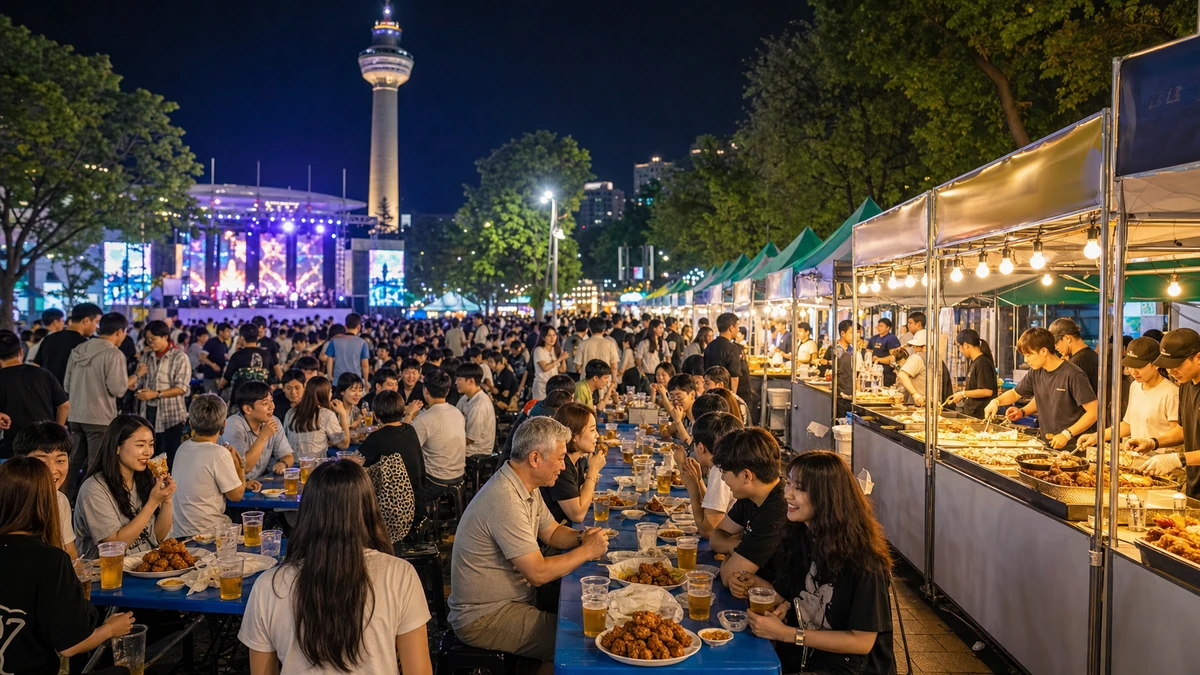
City officials said this week that the Daegu Chimac Festival, one of the country’s best-known seasonal food events, will return Aug. 1 through Aug. 5 at Duryu Park in the city’s Dalseo district. The five-day event marks its 14th edition and arrives with a bigger ambition than in past years. Organizers say 2024 will be the festival’s “first year of a global leap,” framing it not just as a food party but as a broader showcase tying together industry, tourism and culture.
For Americans unfamiliar with the term, “chimac” is a Korean portmanteau: “chi” from chicken and “maekju,” the Korean word for beer. The phrase refers specifically to the pairing of Korean fried chicken and cold beer, a combination so common in South Korea that it functions almost like a cultural shorthand for summer nights, social gatherings and casual celebration. Think of it as somewhere between America’s wings-and-beer sports bar ritual and a big-city outdoor food festival — but with its own distinctly Korean rhythms.
That combination is part of what makes the Daegu festival so legible to international visitors. Some aspects of Korean local culture require explanation, but fried chicken and beer need almost none. A traveler does not need to speak Korean fluently or understand deep historical references to know what kind of evening this promises: hot weather, crowded tables, cold drinks, shareable food and a public atmosphere meant to be enjoyed rather than merely observed.
Daegu, South Korea’s fourth-largest city, is often associated domestically with intense summer heat. That climate has helped shape the festival’s identity. Rather than hiding from the season, the city has spent years turning it into part of the pitch. The message is straightforward: if summer in Daegu is going to be hot, it might as well be memorable.
By returning to Duryu Park — a large urban park that allows for big crowds and open-air programming — the festival again places itself in a setting that feels less like a formal exhibition hall and more like a civic commons. That matters because the appeal here is not only what people eat and drink, but the collective act of sharing the city in real time.
What makes chimac more than just a meal
To outsiders, the idea of building a major tourism brand around fried chicken and beer might sound surprisingly modest. But in South Korea, chimac carries meaning well beyond the menu. It is embedded in everyday life and popular culture, from late-night delivery orders to after-work gatherings to scenes in Korean television dramas, where characters decompress over plates of crispy chicken and draft beer after a long day.
Korean fried chicken itself differs from the American versions many readers may know. It is often lighter in batter, fried for pronounced crispness, and served in styles ranging from plain to soy-garlic to sweet-and-spicy. It is also designed for sharing. A table of chicken in South Korea is rarely only about the food; it is about company, timing and atmosphere. Beer, meanwhile, makes the meal feel especially linked to summer — accessible, refreshing and inherently social.
That is part of why chimac has become unusually exportable as a tourism concept. Plenty of local traditions are meaningful because they are specific and rooted. Chimac is specific, but it is also instantly understandable. The words may be Korean, yet the experience is broadly familiar: comfort food, alcohol, friends and warm weather. It crosses language barriers without losing its local character.
For international tourists, especially those coming to South Korea for the first time, regional festivals can provide a faster understanding of a place than museums or monuments alone. Historic sites show a city’s past. Seasonal festivals show how residents inhabit the present. In that sense, the Daegu Chimac Festival offers a snapshot of contemporary Korean urban life: commercial but communal, highly organized but relaxed, and closely tied to food as a social experience.
It also reflects a broader pattern in Korean domestic travel, where festivals help define cities as much as landmarks do. Just as Americans might associate Albuquerque with its balloon fiesta or New Orleans with Mardi Gras, many Koreans increasingly associate Daegu’s midsummer identity with chimac. That repetition matters. A festival becomes part of a city’s vocabulary only when people expect it to return and build plans around it.
The city says the event has drawn more than 1 million visitors annually since its launch in 2013, underscoring that this is no one-off novelty. In a country with a crowded festival calendar and fierce competition for domestic tourists, longevity itself is part of the achievement.
From local hit to international pitch
The most notable element of this year’s announcement is not simply the date or the venue, but the language city officials used to describe the event’s direction. Daegu has cast this edition as the beginning of a “global leap,” signaling a desire to position the festival as more than a beloved domestic gathering.
That aspiration fits a larger trend in South Korea’s cultural economy. For years, the global rise of Korean pop music, television dramas, films and beauty brands has expanded the idea of what draws foreign visitors to the country. The Korean Wave — often called “Hallyu” — was initially understood abroad through celebrity culture and entertainment exports. But as that interest has matured, it has spread into food, regional travel and everyday lifestyle experiences.
The Daegu Chimac Festival sits neatly within that expansion. Not every visitor to South Korea wants only the Seoul itinerary of shopping districts, palace tours and K-pop landmarks. Increasingly, travelers are looking for ways to encounter the country beyond the capital, and local festivals offer an accessible route. A food-centered event in a regional city can feel more immersive than scripted. It allows visitors to participate in the same rhythms locals enjoy rather than simply viewing a curated attraction from the outside.
Daegu’s challenge is that, for many foreign travelers, it does not yet have the instant brand recognition of Seoul or Busan. That is precisely where an event like this can matter. Cities without top-tier global name recognition often depend on one or two signature experiences to break through. Daegu is betting that chimac — easy to understand, easy to market and photogenic in the age of social media — can be one of them.
Officials have said this year’s festival will aim to combine industry, tourism and culture. On paper, that can sound like boilerplate civic language. In practical terms, though, it suggests the city wants the event to work on several levels at once: a place where visitors eat and socialize, a platform where Korean chicken and beer companies connect directly with consumers, and a setting that leaves a durable image of Daegu as a summer destination.
That matters because the next phase for any mature festival is not simply drawing crowds. It is shaping memory. Once a city is already attracting people, the harder question becomes what, exactly, those visitors will remember — and whether the event leaves behind a coherent impression strong enough to influence repeat travel, online word of mouth or broader brand awareness overseas.
Why repeat attendance matters in tourism
The 14th edition carries significance beyond symbolism. In tourism, repetition is infrastructure. A festival that appears every year around the same time gradually enters travel planning, tour promotion and public expectation. It becomes something visitors can count on. That predictability is crucial for both domestic travelers and international guests, who often build trips around seasonal anchor events.
By saying the festival has drawn more than 1 million visitors annually, the city is making an argument not only about scale but about endurance. In the language of tourism strategy, crowd size is a signal that the event has already proven itself as a “pull factor” — something strong enough to bring people into the city, support local spending and generate attention beyond regional borders.
Of course, attendance figures alone do not guarantee quality. Many large events are crowded without being meaningful, and local governments around the world frequently exaggerate the long-term economic value of festivals. But in Daegu’s case, sustained turnout over more than a decade suggests that chimac has moved beyond gimmick status. It has become part of the city’s summer identity.
That is especially important in South Korea, where local governments often use festivals to distinguish themselves in a dense and highly connected national tourism market. Regional branding can be difficult when travelers can move quickly between cities by train and when Seoul dominates international itineraries. A festival that returns every summer creates a durable point of difference. It says this city is not just a place to pass through; it is a place with a season of its own.
For American readers, it may help to think of this in terms of how event calendars can define a place. Austin is not reducible to South by Southwest, and Milwaukee is not reducible to Summerfest, but those events undeniably sharpen public understanding of each city. Daegu appears to want the Chimac Festival to function similarly: less as a one-time party than as shorthand for what the city feels like at its liveliest.
The fact that the event began in 2013 also places it within a period when South Korean cities became increasingly sophisticated about turning lifestyle culture into tourism assets. Food was no longer just an amenity for visitors; it became a reason to visit in the first place.
Duryu Park and the appeal of the urban festival
The choice of venue is part of the story. Duryu Park is not merely a practical site for crowd management. It shapes the tone of the festival. Outdoor parks create a different kind of public intimacy than convention centers or enclosed arenas. People move through open space, gather at tables, listen to performances and absorb the city’s mood along with the food.
Urban parks are especially effective for events meant to project accessibility. They suggest a celebration that belongs to the city rather than to a ticketed elite. In South Korea, where many of the most memorable communal scenes happen outdoors — from riverside picnics to seasonal night markets — the park setting reinforces the idea that chimac is a lived social custom, not a staged spectacle divorced from everyday life.
The location also matters in how visitors build mental maps of a city. Festivals can elevate not just brands but places within cities. When a site’s name is repeated year after year in connection with a major event, it becomes more recognizable to travelers and even to people who have never visited. Duryu Park gains tourism value simply by serving as the recurring stage for one of Daegu’s most visible annual gatherings.
And then there is the weather. Daegu’s summers are famously hot by Korean standards, often accompanied by humidity that can make daytime travel exhausting. Yet summer festivals can be most powerful when they embrace the season rather than apologizing for it. The idea is not to deny the heat but to turn it into atmosphere. Ice-cold beer, outdoor seating, evening crowds and a sense of relief after sunset all become part of the emotional architecture of the event.
In that way, the Daegu Chimac Festival is selling more than taste. It is selling a familiar human desire: to turn discomfort into celebration. Plenty of cities do that with waterfronts, fireworks or baseball. Daegu does it with fried chicken, beer and a communal answer to the question of how to survive August.
How local festivals fit into the Korean Wave
One reason this event may resonate with foreign audiences is that it broadens what international interest in South Korea can look like. Much of the Korean Wave has been exported through polished cultural products — music videos, streaming dramas, award-winning films and highly branded consumer goods. Those are still powerful gateways. But they can also create a version of Korea that feels glamorous, centralized and celebrity-driven.
Regional festivals offer something different. They are less about chasing stars than about stepping into ordinary pleasures that Koreans actually organize their lives around. If Hallyu first invited the world to watch Korea, events like the Chimac Festival invite outsiders to join Korea in a more grounded way.
That distinction matters for travel. A visitor who goes to a K-pop concert or a famous filming location is often following a mediated image. A visitor who goes to a local summer festival is participating in a social pattern. That does not make one more authentic than the other, but it does produce a different kind of memory. One is about consuming cultural output; the other is about experiencing public life.
The festival’s appeal is also unusually translatable across languages. Even readers encountering the news through machine translation in English, Spanish, French, Arabic, Indonesian or Thai can grasp the essentials almost immediately: fried chicken, beer, summer park, major crowds, annual event. That clarity gives Daegu a useful advantage in the global tourism marketplace, where not every local tradition can be explained in a headline.
For the city, then, “global leap” is not an abstract slogan so much as a recognition of timing. International curiosity about South Korea is already high. The question is whether regional destinations can convert that interest into visits that go beyond Seoul. Daegu appears to believe it has a strong candidate for doing exactly that.
The next test for Daegu’s tourism brand
At this stage, officials have outlined the broad framework: dates, venue, scale and a strategy of combining industry, tourism and culture. They have not yet, at least in the information made public so far, released a detailed program that would allow for a fuller assessment of how this year’s “global” push will differ on the ground from previous editions.
That limitation is worth noting. Big tourism claims are common, and the success of any international expansion effort will depend on execution: multilingual services, visitor navigation, transportation planning, hospitality coordination and programming that makes overseas guests feel welcomed rather than incidental. A festival can attract global attention online and still fall short if the on-site experience remains narrowly domestic in practice.
Still, the underlying logic is sound. Daegu already has a festival with name recognition, mass attendance and a concept that travels well across borders. It has a venue suited to large-scale public gathering and a product — Korean fried chicken — that has already gained popularity in the United States and elsewhere. In that sense, the city is not inventing a tourism symbol from scratch. It is scaling one that has already proved its staying power at home.
For American readers considering what this says about travel in South Korea, the headline may be less about food than about how the country’s regional cities are trying to define themselves for a broader world. The Daegu Chimac Festival is an example of place branding that is highly local in origin but globally legible in form.
If the event succeeds in translating that formula for overseas audiences, it could become more than a summer favorite. It could help establish Daegu as one of the country’s more approachable second-city destinations — the kind of place travelers add not because they have to, but because it offers a version of Korea that feels immediate, social and easy to enjoy.
And that may be the strongest argument for the festival’s appeal. For all the sophistication of South Korea’s cultural exports, some of the country’s most effective invitations remain strikingly simple. A park. A crowd. Fried chicken. Cold beer. A hot summer night. For a city looking to make itself more visible to the world, that is not a bad place to start.
Comments
Post a Comment