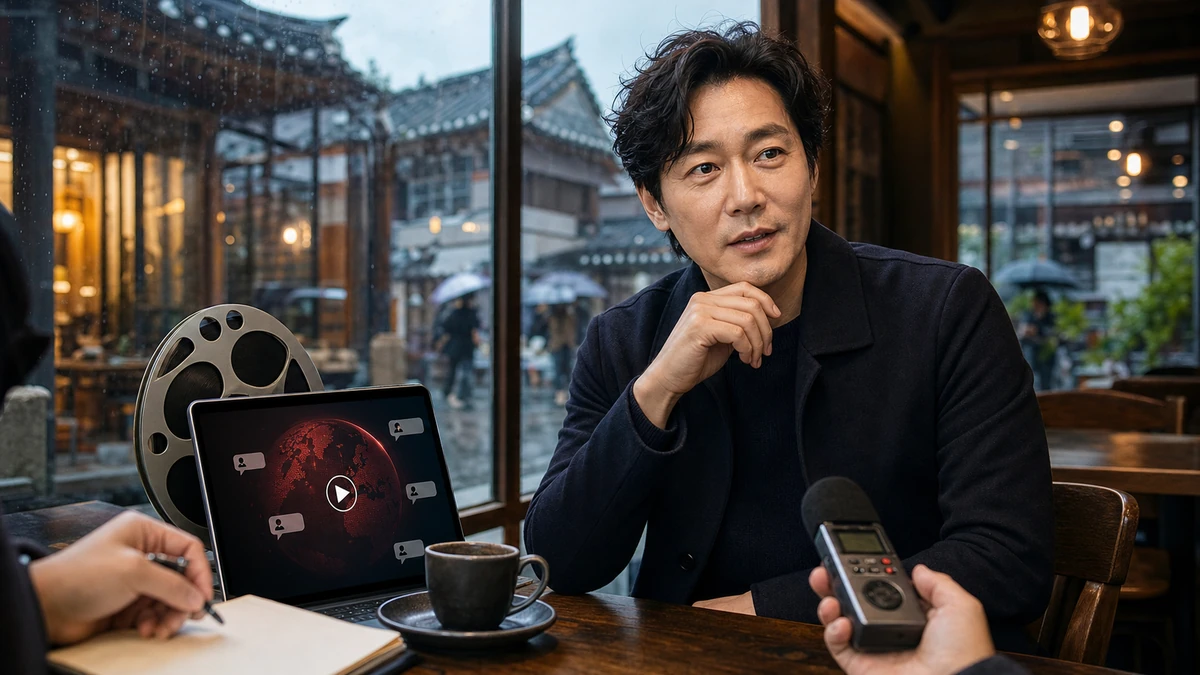
A Korean actor’s long-awaited return arrives in a very different industry
For Korean actor Kim Ji-seok, returning to the big screen after 14 years would have been a notable career moment under any circumstances. But his latest role comes with a twist that says as much about the changing shape of global entertainment as it does about one performer’s comeback: His new film did not simply open in South Korea. It landed on Netflix, instantly available to viewers around the world.
Kim is back in movies through the comedy film “Husbands,” directed by Park Gyu-tae and released on Netflix on July 19, according to South Korea’s Yonhap News Agency. Speaking at a cafe in Seoul on July 23, Kim described the project as more than just another acting credit. It marks his first film appearance since “Two Moons,” and his first experience having a Korean-language movie reach global audiences at the exact same time.
That kind of simultaneous release may sound routine to American viewers raised on weekend streaming drops and worldwide franchise launches. But for many Korean actors whose careers were built in an earlier media environment, it represents a major shift. In the past, a film’s reception was often measured first through domestic box office, local reviews and word of mouth within South Korea. Now, a Korean actor can wake up to reactions not only from Seoul but from Los Angeles, Sao Paulo, Jakarta and Paris, all arriving in different languages within hours of a title going live.
Kim said one of the most striking parts of the experience was seeing comments from viewers across the world. For an actor who has spent years working in a system once defined by local broadcast schedules and theatrical runs, the new reality is not abstract industry talk. It is immediate, personal and visible, right there in the comment sections and social media threads. His response captures something larger happening across Korean entertainment: The “Korean Wave,” or Hallyu, is no longer just about exports. It is about real-time participation by a global audience.
That makes Kim’s return especially interesting. This is not simply the story of an actor coming back to film after a long absence. It is the story of a comeback unfolding in a transformed media ecosystem, one in which Korean content no longer has to travel slowly overseas through film festivals, limited theatrical releases or niche TV slots. It can debut everywhere at once.
What “Husbands” is about, and why its premise travels well
At the center of “Husbands” is a setup that is easy for international audiences to grasp, even without much familiarity with Korean storytelling conventions. The film follows an ex-husband and a current husband who join forces to rescue a family kidnapped by a criminal organization. That blend of domestic awkwardness, masculine rivalry and crime-driven urgency gives the movie a framework that can translate cleanly across borders.
In the film, actor Jin Sun-kyu plays the ex-husband, Chungsik, while Gong Myoung plays the current husband, Minseok. The comic engine comes from putting two men connected to the same woman into a forced alliance under extreme pressure. American audiences would likely recognize the appeal of that structure right away. It draws on a familiar buddy-comedy formula, but with a distinctly personal wrinkle: These are not just mismatched partners or reluctant cops. They are two husbands, former and current, tied together by family and conflict.
That matters because many Korean comedies, especially those that travel well overseas, often hinge less on wordplay than on relationships under strain. Even when cultural nuances differ, viewers can understand the tension of exes, spouses, in-laws and family obligations colliding in a high-stakes situation. In that sense, “Husbands” appears built on a concept that does not require extensive background knowledge. The humor grows out of the clash between urgency and absurdity, between kidnapping plot mechanics and emotionally messy human dynamics.
At the same time, the film remains recognizably Korean. It was made by Korean filmmakers, performed in Korean and shaped by local comic timing and genre rhythms. That balance has become one of the hallmarks of South Korea’s entertainment success abroad. The most effective Korean exports do not usually erase their national identity to become “generic global content.” Instead, they preserve the texture of Korean performance and storytelling while relying on universal situations that viewers elsewhere can still follow.
That is one reason Netflix has become such an important platform for Korean film and television. Its global distribution model allows a movie like “Husbands” to function on two levels at once: as a local production rooted in Korean sensibilities and as a broadly accessible comedy-thriller with a premise that makes immediate sense to audiences far beyond South Korea.
Kim Ji-seok’s villain is not the usual crime boss
Kim plays Ma Do-jun, one half of a husband-and-wife criminal duo leading a rising crime organization. In the film’s setup, the group uses artificial intelligence equipment to sell drugs, giving the villains a contemporary edge that separates them from older, more familiar gangster archetypes. If traditional crime stories often lean on images of hardened street bosses and smoky back rooms, Ma Do-jun appears designed to feel newer, cleaner and more in step with an age of sleek devices and tech-enabled schemes.
Kim described the character as someone from “the dark side,” but said he did not want him to look like a stereotypical criminal. Instead, he envisioned Ma as sophisticated, stylish and representative of a younger generation. That interpretive choice is revealing. In a crime comedy, the villain cannot be so grim that he drains the fun out of the film, but he also cannot be so light that the stakes disappear. By making Ma fashionable rather than brutish, Kim seems to be aiming for a tone that supports both danger and playfulness.
American audiences have seen similar recalibrations before. Contemporary villains in streaming-era genre films are often presented less as blunt-force threats than as curated personalities: polished, image-conscious and self-aware. They are as likely to be associated with branding, design and tech as with old-school menace. In that respect, Ma Do-jun sounds like a character shaped for the present moment, one whose surface sophistication is part of the joke and part of the threat.
The artificial-intelligence angle also matters, even if the film uses it primarily as a plot element rather than a full social commentary. Across global pop culture, technology has become shorthand for modern ambition, disruption and moral slipperiness. Attaching AI tools to a criminal enterprise instantly makes the organization feel contemporary. It also offers a contrast to the movie’s more human, messy central dynamic involving the two husbands. On one side, there is family chaos and emotional baggage. On the other, there is a sleek criminal operation run by stylish antagonists. That contrast can help generate the tonal rhythm that crime comedies need.
Kim’s characterization suggests that Ma Do-jun is not meant to be terrifying in a purely realistic sense. He is meant to be memorable. In genre filmmaking, especially comedy, that distinction matters. A villain who leaves a strong impression without overwhelming the story can often do more for a movie’s afterlife than a conventionally severe antagonist. For viewers meeting Kim for the first time, Ma may become an entry point into his screen persona. For longtime Korean fans, it is a chance to see him returning to film with an image crafted for a new distribution era and a broader audience.
A Joker-Harley Quinn comparison, and what it signals about tone
Kim’s description of his chemistry with co-star Lee Da-hee may be the easiest shorthand for overseas audiences to understand. Lee plays Hye-ran, Ma Do-jun’s wife and fellow leader of the criminal group. Kim compared their dynamic to “Joker and Harley Quinn,” invoking one of the most recognizable villain couples in American popular culture.
The comparison is useful not because it suggests the Korean film is imitating a comic-book property, but because it gives viewers an immediate sense of mood. Joker and Harley Quinn, at least in their most familiar modern incarnations, represent a volatile, theatrical and darkly playful partnership. They are dangerous, but they are also stylized. Their bond is part of the spectacle. By reaching for that analogy, Kim appears to be telling audiences that Ma and Hye-ran are not just plot obstacles. They are a performance pair, a duo whose energy helps define the movie’s comic-crime atmosphere.
That distinction is important in a film like “Husbands.” The central premise already contains competing tones: a family has been kidnapped, which brings real urgency, while two husbands are forced into cooperation, which invites humor. The villain couple seems to operate as another balancing device. If the heroes’ side of the story is built around awkward emotional realism and reluctant teamwork, the villains’ side appears to bring style, exaggeration and genre flair.
Lee’s presence in that equation also matters. A husband-and-wife criminal duo provides a mirror image of the movie’s title premise. On one side, the story has an ex-husband and a current husband pulled together by family duty. On the other, it has a married pair united in criminal ambition. That structural contrast gives the film a cleaner shape. The good guys are bound by tension and necessity; the bad guys are bound by shared appetite and performance. Even before viewers see the film, it is easy to understand why that setup could generate comedy.
For American readers less familiar with Korean genre films, this is one of the keys to understanding their appeal. South Korean cinema often moves fluidly between tones that Hollywood sometimes keeps separate. A movie can be tense, sentimental, absurd and stylish without treating those modes as contradictions. The villain couple in “Husbands,” at least from Kim’s description, sounds designed to keep that tonal mix alive.
Why Netflix changes the meaning of a Korean actor’s comeback
Kim’s comments about global feedback may be the most revealing part of the story, because they point to how deeply streaming has changed not only distribution but also the lived experience of performers. He said it felt new, as an established actor, to have a project released worldwide through Netflix and to receive responses from different countries in different languages. That observation may sound simple, but it captures a profound shift in how fame works.
For much of modern entertainment history, actors often rose within national or regional systems before slowly crossing over. Success abroad depended on festival buzz, syndication, remakes or the occasional breakout role. Today, a Korean actor can appear in a locally made film and still encounter a truly global audience on opening day. The borders around performance have not disappeared, but the timing has changed dramatically. Instead of crossing over later, actors can meet foreign viewers immediately.
That has been one of the biggest effects of the Korean Wave’s latest phase. Earlier generations of Hallyu spread through television imports, fan communities and DVD-era discovery. Now, platforms like Netflix accelerate the process and compress the timeline. An actor’s work can become part of a worldwide conversation before domestic reception has even fully settled. Viewers in the United States no longer need specialized knowledge of Korean media to sample a new release; it can appear on the same home screen as a Hollywood thriller or a British mystery series.
For American audiences, it is worth remembering how unusual this would have seemed not very long ago. Korean entertainment has always had devoted international followers, but it did not always occupy such a central place in mainstream global streaming culture. The rise of “Squid Game,” the Oscar success of “Parasite” and the sustained popularity of Korean dramas on major platforms have broadened the field. That broader ecosystem creates space for films like “Husbands,” which may not arrive with the same prestige or hype as a sensation-driven title but still benefit from the larger appetite for Korean storytelling.
Kim’s response to multilingual comments speaks to another change: Actors are no longer receiving only filtered international reactions through agents, critics or trade coverage. They are seeing the audience directly. That can be validating, disorienting and strategically important. It tells performers where their work is landing, how characters are being read and how far Korean-language content now travels. In Kim’s case, it reframes his comeback. A return that might once have been measured mainly by domestic familiarity is now being watched, evaluated and discovered on a global scale.
What this moment says about Korean comedy abroad
Korean dramas and thrillers have often drawn the most attention overseas, especially among American viewers who entered the market through prestige films or survival-story phenomena. Comedy can be harder to export because jokes are frequently tied to language, timing and local references. That is why “Husbands” is notable. Its premise suggests a kind of Korean comedy that may be particularly suited for global streaming: relationship-driven, genre-supported and easy to grasp at the level of situation.
The film’s structure does much of the translation work. A rescue mission, two competing husbands, a stylish criminal couple and a collision between danger and absurdity do not need much explanation. The setup is visual and relational. Even if some wordplay or cultural nuance shifts in subtitles, the basic comic engine remains intact.
That may be one path forward for Korean comedies seeking broader audiences. Rather than relying exclusively on hyperlocal satire, they can pair specifically Korean performance energy with universal genre scaffolding. American viewers may not catch every tonal inflection the way a Korean audience would, but they do not have to in order to enjoy the film. The same logic has helped many non-English-language series and movies find footholds in the streaming era. Clear stakes and strong character contrasts can travel even when certain cultural layers remain distinct.
There is also an argument to be made that American audiences are more prepared for this kind of film than they were a decade ago. The growth of subtitles on mainstream platforms, the normalization of international viewing habits and the increased visibility of South Korean entertainment have all lowered the barrier to entry. What once might have seemed “foreign” in a limiting sense now often reads simply as another good option in an increasingly global menu of entertainment choices.
That does not mean every Korean comedy will break through broadly in the U.S., or that cultural translation is effortless. But Kim’s return in “Husbands” highlights how the conditions have changed. A Korean actor can take on a flamboyant villain role in a domestic comedy film and still reach viewers far beyond the home market. For American audiences interested in where the Korean Wave goes next, that may be one of the most important developments: not just the arrival of blockbuster sensations, but the quiet globalization of mid-range genre films and the actors who anchor them.
For Kim Ji-seok, a personal milestone meets a global industry shift
In one sense, this is a straightforward comeback story. Kim Ji-seok is returning to film after 14 years, taking on the role of a polished criminal in a comedy about rival husbands forced into a rescue mission. That alone would make for a respectable entertainment headline.
But the timing gives the story broader resonance. Kim is not re-entering the movie business he left. He is stepping into a version of Korean cinema and streaming culture transformed by international demand, platform power and real-time audience reaction. His comments suggest that he feels that transformation directly, not as a business abstraction but as a shift in how an actor experiences release day.
That is why “Husbands” matters beyond its plot. It offers a snapshot of where Korean screen culture is now. A local star returns. A Korean-language film debuts. A global platform amplifies it instantly. Audiences across multiple countries respond at once. And a performer who once would have measured reception mostly at home now finds himself reading the world in comment form.
For American readers, this is the bigger story to watch. The Korean Wave is no longer only about breakout phenomena that suddenly demand attention from Hollywood and the Academy. It is also about the quieter normalization of Korean actors, genres and films within everyday global viewing. Kim Ji-seok’s comeback, stylish villain and all, sits squarely in that new reality.
If earlier phases of Hallyu were about arrival, this phase may be about integration. Korean entertainment is not just crossing borders; it is increasingly built with the knowledge that borders will be crossed immediately. “Husbands” appears to be one more example of that change, and Kim’s 14-year return gives it a human face. For him, the comeback is personal. For the industry around him, it is another sign that Korean storytelling now plays on a much larger stage.
Comments
Post a Comment