Kim Junsu’s First Solo Concert in Macau Shows How Korean Pop’s Reach Extends Beyond the Usual Tour Stops
A long-awaited stop on an expanding Asian tour
For many American music fans, the global story of Korean pop is often told through stadium dates in Los Angeles, Billboard rankings, late-night TV appearances and social media numbers that seem to break records by the week. But the day-to-day reality of the Korean Wave, or Hallyu, is often built somewhere else: in cities that do not always make U.S. entertainment headlines, where artists deepen fan communities one concert at a time. That is part of what made singer and musical theater performer Kim Junsu’s first solo concert in Macau notable this week.
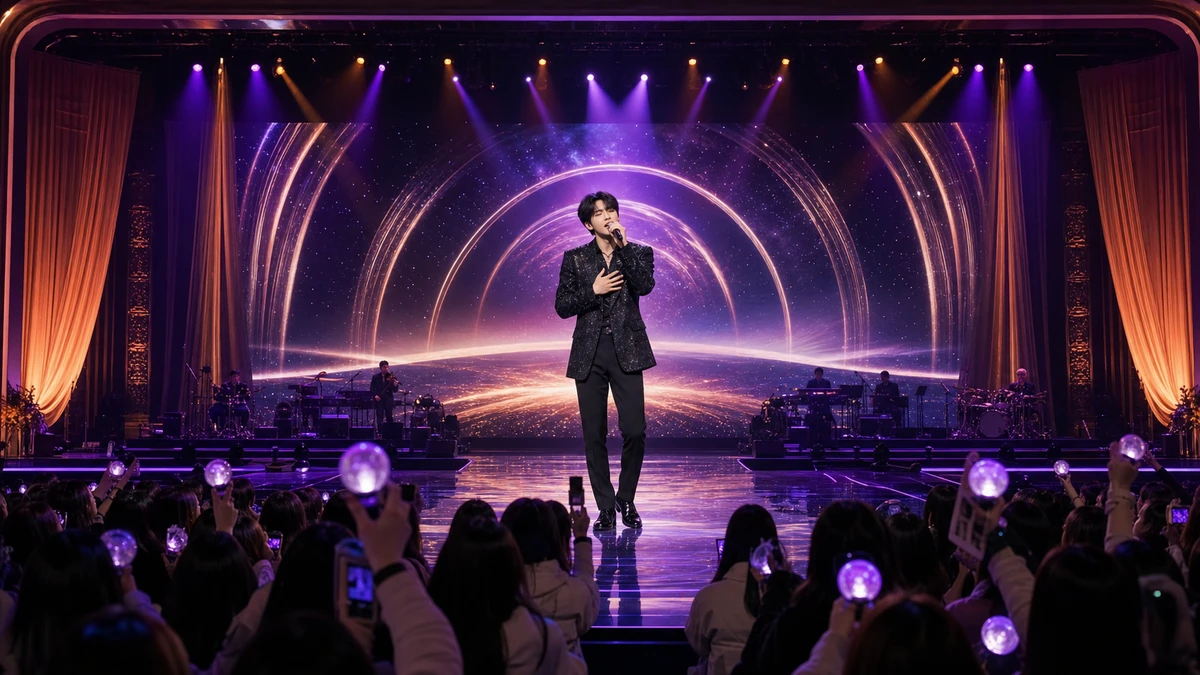
Kim performed his “Gravity” Asia tour on June 20 at the Grand Lisboa Palace Resort Macau, marking his first standalone concert in the Chinese special administrative region, according to South Korean reporting. On the surface, it is a straightforward tour update: another date, another city, another successful night for an established Korean artist. But in the context of how K-pop and Korean live entertainment have grown across Asia, the Macau show carried extra weight.
First concerts in new cities matter in ways that are easy to underestimate from afar. They are less like routine stops and more like threshold moments. For local fans, a first solo show can feel like recognition after years of following an artist online, buying albums, streaming songs and watching clips from performances in other countries. For the performer, it is a chance to test whether a fandom that may have long existed digitally can become something tangible in the room — loud, emotional and unmistakably present.
That appears to be what happened in Macau for Kim, who has spent years building a career that does not fit neatly into one lane. He is known in South Korea both as a pop singer and as a major musical actor, a dual identity that has helped him stand out in a crowded entertainment landscape. In an industry where many idols are expected to move constantly from release to release, Kim’s longevity has come from a broader set of strengths: vocal ability, theatrical expression and a relationship with fans that has endured through changes in the Korean music business.
The Macau concert also arrived at a strategically meaningful point in his schedule. Rather than revisiting only the best-known touring capitals, the stop broadened the map of his Asia tour and underscored a larger truth about Korean entertainment in 2026: growth is no longer only about reaching the West. It is also about deepening connections across Asia, where fan culture remains intensely organized, emotionally invested and highly mobile.
Why Macau matters in the geography of K-pop
To many Americans, Macau is best known as a casino destination, sometimes described as the “Las Vegas of Asia.” That comparison is useful but incomplete. Macau is also a crossroads city, shaped by Chinese and Portuguese history and positioned within a regional entertainment economy that links mainland China, Hong Kong, Taiwan, Japan and South Korea. It is a place where tourism, luxury hospitality and live performance intersect — exactly the kind of environment where contemporary Asian pop culture can travel effectively.
That context helps explain why a solo concert there can mean more than a single-night event. In the Korean entertainment industry, touring is not simply a matter of logistics. It is a visible sign of where demand exists and where agencies believe an artist can sustain interest beyond streaming platforms. A stop in Macau suggests confidence that the audience is there, that fans will travel, and that a local market is ready to support a full-fledged live experience rather than just consume content online.
In recent years, K-pop’s global conversation has often centered on North America and Europe, especially when discussing crossover success. But the genre’s commercial and cultural backbone remains in Asia, where fans often maintain a level of organization and loyalty that shapes everything from album sales to ticket demand. Cities such as Taipei, Tokyo, Hong Kong and now, increasingly, Macau function as nodes in a highly networked fan ecosystem. A concert in one city does not stay confined there; it reverberates through fan communities on social platforms, in group chats, in fan-shot videos and in the anticipatory culture surrounding the next stop.
That ripple effect is especially important for artists like Kim Junsu, whose appeal is rooted not only in trend-driven momentum but also in sustained performance credibility. For a veteran performer, entering a city for a first solo concert is not about debuting a brand-new persona. It is about confirming that years of reputation have translated into an audience eager to meet him in person. The success of such a show sends a message to the rest of the region: this is not a legacy act coasting on nostalgia, but an artist whose live presence continues to matter in the present tense.
There is also symbolic value in the fact that Macau was framed as a first solo concert rather than simply another appearance. In K-pop, the difference matters. Festival sets, joint events and televised performances can expose artists to broad audiences, but solo concerts are where fandom becomes most visible. Fans are there specifically for one artist, one catalog and one emotional universe. That singular focus turns the evening into a statement of belonging: the city is now officially part of the tour story.
“Gravity” and the return of the full-length album
The center of Kim’s current tour is his fifth full-length album, released June 2, and especially its title track, “Gravity.” That alone gives this concert cycle unusual significance. In the age of short-form clips, staggered singles and algorithm-driven promotion, a full-length album can feel almost old-school — a format associated more with artistic statement than with quick-turn market testing. For Kim, the release is particularly meaningful because it is his first new studio album in a decade.
That 10-year gap changes how the new music is received. A comeback after such a long interval is not merely another product launch. It functions more like a career marker, a way of telling fans and the wider industry where the artist stands now. Full-length albums carry narrative weight because they allow musicians to shape mood, pacing and themes across multiple songs. They offer a more complete portrait of artistic identity than a digital single ever can.
By performing “Gravity” and the album track “Forest of Memory” in Macau, Kim turned the concert into something more than a review of familiar hits. He used the stage to extend the emotional world of the album, giving songs that fans may have first encountered through headphones a different kind of force in live performance. That relationship between recorded music and the concert stage has become one of the defining engines of K-pop’s business model. The release creates anticipation; the tour converts that anticipation into communal memory.
For American readers, there is a useful parallel in the way major pop stars or legacy artists in the United States sometimes use tours to reframe an album rather than simply promote it. A song that feels intimate on streaming can become massive and cathartic in an arena. A lyric that went unnoticed can suddenly land when delivered with a certain expression or vocal emphasis in front of thousands of fans. In K-pop and Korean popular music more broadly, that transformation is especially important because performance has always been central to how artists are evaluated.
Live stages in Korea are not treated as secondary to the recording. Fans scrutinize vocals, facial expression, choreography, stamina and emotional delivery with an intensity that might remind Americans of a cross between Broadway fandom, sports analysis and pop obsession. In that environment, the success of a new album is often measured not only by charts but by whether its songs live convincingly onstage. The Macau concert appears to have offered exactly that kind of test — and, by all indications, a successful one.
An artist shaped by both pop and musical theater
Part of what distinguishes Kim Junsu in the Korean entertainment scene is that he is not just a singer. He is also one of the country’s best-known musical actors, a fact that matters greatly in understanding how his concerts work. For audiences less familiar with Korean entertainment, this dual career may sound unusual, but in South Korea it signals versatility and a particular kind of performance prestige.
Korean musical theater has become a powerful parallel industry to K-pop, with a dedicated fan base, major productions and performers who often move between commercial music and the stage. Success in musicals can carry a different kind of credibility than pop success alone because it emphasizes vocal control, acting ability and the capacity to sustain emotion in a live setting. Kim’s long involvement in both fields means he brings a theatrical sensibility to his concerts that many purely pop acts do not.
That does not mean his shows become Broadway-style productions in the American sense. Rather, it means the performance language is broader. A song can be delivered not just as a tune but as a dramatic scene. A pause, a glance or a shift in tone can matter as much as choreography or production design. Even in reports that do not detail the staging shot by shot, phrases such as “diverse performances” and strong interaction with local fans suggest a concert designed around emotional range rather than mechanical repetition.
This matters because K-pop fans, especially longtime fans, are often highly attentive to nuance. They do not just ask whether a singer hit the note. They ask how the feeling changed from the studio version, whether the performer seemed fully connected to the lyric, whether the audience’s response shifted across the set and whether the concert revealed something new about the artist’s current state of mind. Kim’s background makes him particularly well suited to that kind of scrutiny.
For American readers, a rough analogy might be an artist who can move comfortably between the pop charts and the theater district — someone whose concerts reward not just spectacle but interpretation. That kind of hybrid identity is one reason Kim has maintained relevance over time, even as the Korean music market has become younger, faster and more crowded. The Macau performance, centered on new material yet powered by established stagecraft, seems to have reminded fans why that combination still resonates.
The emotional significance of a first meeting
Near the end of the concert, Kim said he had felt both nervous and excited because it was his first time performing a solo show in Macau, according to his agency, Palm Tree Island. After meeting the audience directly, he said he felt happy enough to wonder, “Why did I come only now?” It is the kind of line that can sound simple in translation, but within K-pop fan culture, these remarks carry unusual emotional force.
Fans often place deep importance on what artists say about specific cities. In a touring culture built around repeated travel and intensely localized fan identity, a comment addressed to one audience can become symbolic. It tells fans that their city was not just another pin on a schedule, but a place that registered personally. For Macau fans who may have waited years to see Kim live on their own turf, that statement likely landed as a form of validation: the meeting mattered on both sides of the stage.
This dynamic is worth explaining for readers who may know K-pop mostly through viral clips or award show appearances. The emotional architecture of fandom in Asia is often highly place-based. Fans do not only identify with an artist; they identify as the fans who showed up in Taipei, or Tokyo, or Bangkok, or Manila. Their city becomes part of the artist’s touring history, and moments from that show can take on a near-mythic afterlife within the community.
That helps explain why a first solo concert can feel more consequential than a repeat date in a major market. There is tension in the room because no one fully knows how the exchange will unfold. Will the crowd be as loud as hoped? Will the artist seem comfortable? Will the songs connect beyond the abstract loyalty of online fandom? When the answer is yes, the release can be palpable. The performance becomes a collective memory of a barrier finally breaking.
Kim’s reported remarks suggest exactly that emotional arc: anticipation turning into relief, then relief turning into joy. For journalists, such moments are more than fan-service quotes. They reveal how touring functions as relationship-building. Especially for artists with long careers, the concert stage remains one of the few places where reputation, affection and artistic identity are tested in real time. In Macau, the verdict appears to have been emphatically positive.
A tour that reflects how fandom now moves across Asia
Following Macau, Kim is set to continue the “Gravity” tour in Taipei, Tokyo and Hong Kong, among other cities. On one level, that schedule reflects familiar regional logic. These are established destinations in the broader East Asian entertainment circuit, each with its own dense fan culture and infrastructure for hosting major live events. On another level, the itinerary underscores how Korean artists now build continuity across cities rather than treating each stop as an isolated engagement.
That continuity is one of the most important features of contemporary K-pop. Fans experience tours not only in person but also collectively online, comparing set lists, sharing videos, trading interpretations and building expectations for what may change at the next venue. In that sense, each concert functions like an episode in an unfolding narrative. Macau was important not simply because it happened, but because it now becomes part of the emotional momentum driving the rest of the tour.
American readers may recognize a version of this in the way Taylor Swift fans tracked every twist of the Eras Tour or how devotees of major touring acts dissect each night’s surprises. But in K-pop, the phenomenon is intensified by transnational fandom habits that have been honed over years. Fans often coordinate across borders, translate updates in real time and treat tour developments as shared property of a regional — and increasingly global — community.
For artists, that means a successful concert in a city like Macau can generate value far beyond ticket revenue. It can strengthen confidence among fans in upcoming cities, create new visual and emotional touchpoints for the album era, and reinforce the sense that the artist is actively growing rather than merely revisiting familiar markets. In an industry where attention is fragmented and competition relentless, those signals matter.
There is also a broader industry implication here. Korean popular music is no longer defined solely by breakout acts chasing Western expansion. It is also sustained by artists who cultivate durable regional ecosystems, where albums, tours, fan engagement and local symbolism all reinforce each other. Kim’s Macau stop fits squarely within that model. It shows how a seasoned artist can use a new album and a carefully mapped tour to widen the fan base not by chasing novelty alone, but by making long-awaited in-person connections feel meaningful.
What this moment says about the current stage of the Korean Wave
Kim Junsu’s first solo concert in Macau may not dominate U.S. entertainment coverage the way a Coachella appearance or a Hot 100 milestone would. But judged on its own terms, it is a revealing snapshot of where Korean popular music stands now. The Korean Wave is mature enough that its most interesting developments are not always about dramatic first entries into the American mainstream. Sometimes they are about how artists with established careers continue to activate audiences across Asia in increasingly precise and emotionally resonant ways.
That matters because the future of Hallyu will be shaped not only by global visibility, but by the durability of these regional circuits. Live performance remains the clearest proof that fandom is real, organized and willing to show up. A city hosting its first solo concert from a Korean artist with Kim’s profile is not a footnote; it is evidence of continued expansion in the places where Korean culture already has deep roots.
The “Gravity” tour also highlights another important point: longevity in Korean entertainment is hard won. The market moves quickly, and comebacks can be unforgiving. For Kim to return with a full-length album after 10 years and build a major Asia tour around it is a reminder that there is more than one path to relevance. Viral moments and rookie-group acceleration may dominate headlines, but there remains an audience for artists who deliver sustained vocal performance, emotional depth and mature stagecraft.
In that sense, Macau was more than a new city on the itinerary. It was a demonstration of how an artist’s story keeps expanding when music, timing and fan devotion align. The performance gave local fans a long-awaited first encounter. It gave Kim another venue in which to translate the themes of his new album into live emotion. And it offered a useful window into the mechanics of Korean pop in 2026: a business and a culture still powered, at its core, by the moment when online loyalty becomes a room full of people singing back.
For American audiences trying to understand why the Korean Wave continues to evolve rather than fade, that is the takeaway. Not every significant milestone looks like a splashy crossover headline. Sometimes it looks like an artist stepping onto a stage in Macau for the first solo show of his career there, realizing in real time that a city’s fans have been waiting much longer than the itinerary ever suggested — and leaving with the unmistakable feeling that the bond is now real.
Comments
Post a Comment