Ledgers of War: Newly Released Korean War Records Show How Onions, Radishes and Live Music Helped Keep a Conflict Running
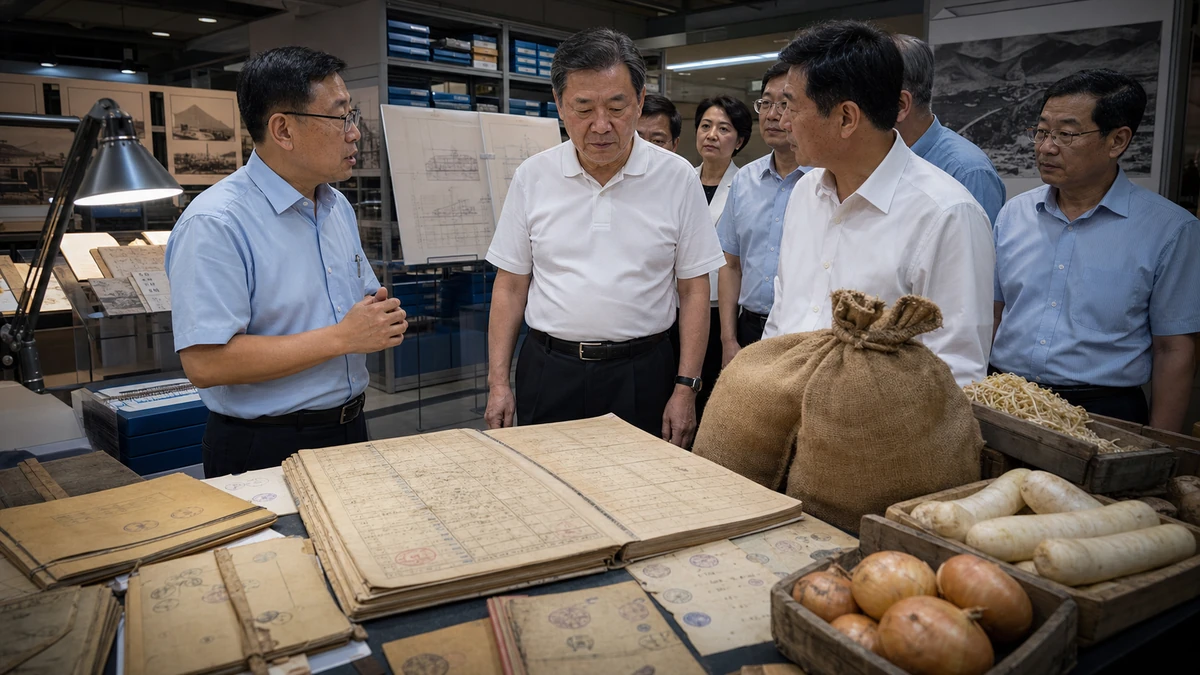
A different kind of Korean War document
For many Americans, the Korean War is remembered in familiar images: Marines fighting through bitter cold at Chosin Reservoir, civilians fleeing south, a divided peninsula, and an armistice that ended open combat without a peace treaty. It is often called the “Forgotten War,” a phrase that says as much about American memory as it does about the conflict itself. Military histories tend to focus on front lines, commanders, diplomatic cables and troop movements. But newly highlighted records from 1952 offer a striking reminder that wars are not sustained by bullets and battlefield orders alone. They are also sustained by produce shipments, invoices, contracts and entertainment schedules.
According to records made public June 24, 2026, materials related to the Korean War show that a Busan-based company called Jungang Trading supplied 35,058 pounds of onions, 79,988 pounds of radishes and 1,496 pounds of bean sprouts during the war. The same cache also includes a contract record indicating that a 26-member group from Daegu, called the Eunsung Band, performed 10 shows over one week for a U.S. military unit.
At first glance, those details may seem almost incidental next to the grand scale of war. But that is precisely what makes them so revealing. They point to a layer of wartime history that is often left in the margins: the ordinary commercial and cultural systems that made the extraordinary machinery of war function day after day. A ledger listing vegetables does not simply tell us what was eaten. It tells us that even in the middle of a devastating conflict, local merchants sourced food, transportation networks moved goods, clerks recorded quantities, military buyers tracked deliveries and institutions preserved the paper trail.
In other words, the Korean War was not only fought at the front. It was also managed in ports, warehouses, kitchens, office desks and performance spaces. The newly surfaced records do not replace conventional war history. They deepen it, showing how a global Cold War conflict reached into the marketplaces and daily routines of wartime Korea.
Why vegetables matter in military history
The numbers themselves are arresting. More than 35,000 pounds of onions. Nearly 80,000 pounds of radishes. Almost 1,500 pounds of bean sprouts. Those are not symbolic quantities. They suggest a substantial and organized supply operation serving a large military logistics system.
To American readers, there is a useful historical analogy here. In U.S. war memory, we often recognize the importance of famous industrial mobilization during World War II: Detroit automakers turning out tanks and bombers, shipyards running around the clock, ration books shaping family life at home. These Korean War documents point to a similar truth on a more local and immediate scale. Warfare depends on supply chains, and supply chains depend on civilians. Soldiers may occupy the center of public memory, but local businesses and workers often keep the system alive.
The specific vegetables listed in the records also carry cultural meaning. Radish and bean sprouts are staples in Korean cooking, including soups, side dishes and simple meals that can be prepared in large quantities. Bean sprouts, in particular, are common in Korean home cooking and institutional cooking alike. Onions, of course, are a kitchen basic in almost any cuisine. Taken together, the records suggest not luxury but practicality: ingredients that could support mass feeding under difficult conditions.
That matters because logistics is not an abstract military term. It is the study of how human beings are sustained. Armies do not merely move ammunition; they must feed soldiers, support laborers, maintain morale and organize the thousands of invisible routines that keep a command structure operational. In the Korean War, as in conflicts before and since, local civilian economies became entwined with military needs.
The Busan record is especially significant because of the city’s wartime role. During the Korean War, Busan — then often spelled Pusan in English-language historical records — became one of the most important safe zones in the South. It served as a major port, refugee hub and administrative center after North Korean forces pushed deep into the peninsula in the war’s opening months. For Americans who know the outline of the war, Busan is most familiar from the “Pusan Perimeter,” the defensive line that held in 1950 when U.S. and South Korean forces were under severe pressure. But these new records highlight Busan not only as a battlefield-adjacent location, but as a place where commerce and wartime administration continued under extraordinary strain.
The ledger from Jungang Trading shows that private enterprise in South Korea did not disappear in wartime. It adapted, survived and became part of the broader war effort. That is an important corrective to overly simplified narratives that reduce wartime societies to battle maps. Even amid displacement, destruction and uncertainty, someone was buying vegetables, shipping them, receiving them and documenting them in writing.
The home front in a war zone
One reason these records matter is that they collapse a distinction many Americans instinctively make between “the front” and “the home front.” In American history, those categories are often geographically separate. During World War II, for example, the continental United States experienced rationing, factory mobilization and family separation, but most Americans were far from active combat. In Korea during the early 1950s, that separation was much less clear. The home front was inside the war zone.
That is what makes these materials so powerful. They show that the Korean War was not just a clash of armies and ideologies. It was a social event that reorganized urban life, commerce and everyday survival. Merchants in Busan were not distant spectators to war; they were participants in the system that made military operations possible. Musicians in Daegu were not operating in some wholly separate cultural sphere; they were performing within the orbit of the U.S. military presence.
For international readers, including Americans, this offers a more concrete way to understand how deeply the war penetrated Korean society. The conflict is often framed through the language of the Cold War: communism versus anti-communism, Washington versus Beijing, the United Nations versus North Korea and its allies. Those geopolitical dimensions are real and indispensable. But the ledger entries remind us that the Cold War also showed up in sacks of onions, crates of radishes and handwritten accounts of who delivered what to whom.
That insight resonates far beyond Korea. Historians of many wars have made similar arguments, but evidence like this brings the point home with unusual clarity. Every conflict draws civilians into its orbit — through food supply, contract labor, transportation, health care, maintenance, clerical work and cultural services. What is notable here is not merely that such mobilization happened, but that the archival record preserves it in such tangible detail.
The record also suggests something about wartime bureaucracy. Somebody deemed these transactions important enough to record carefully. That administrative impulse matters. Modern war is inseparable from documentation: inventories, receipts, personnel rosters, budget requests and contract files. These papers may not stir emotion in the way battlefield letters do, but they reveal how war actually operates. They show structure where memory often offers only drama.
Music at a U.S. base, and what it says about wartime culture
Just as revealing as the produce ledger is the contract involving the Eunsung Band, a 26-member musical group from the southeastern city of Daegu. According to the record, the band performed 10 times over the course of a week for a U.S. military unit. The document reportedly included a per-performance contract price, underscoring that entertainment, like food supply, was part of a formal system of procurement and accounting.
That detail opens another underexplored window into the Korean War: the role of performance in military life and cross-cultural contact. American readers may immediately think of the United Service Organizations, or USO, which sent entertainers to perform for troops during wartime and has long occupied a place in U.S. military culture. The Korean case was not identical, but the comparison helps explain why the document matters. Armies do not only feed troops and move matériel; they also attempt to maintain morale, structure leisure and create forms of psychological relief from the stress of war.
The Eunsung Band record suggests that Korean performers were part of that ecosystem. The significance is not that this can be neatly turned into a prehistory of today’s Korean pop-culture boom. That would be too easy, and probably too simplistic. The global success of K-pop, Korean dramas and other Korean cultural exports rests on later developments in media industries, state policy, technology and transnational fandom. Still, it is hard not to notice the longer arc of Korean performers engaging foreign audiences under very different historical circumstances.
The more careful and historically grounded point is this: even during the Korean War, music and live performance were part of international contact on the peninsula. The stage at a U.S. base was not just a venue for diversion. It was a place where occupation, alliance, commerce and culture intersected. Korean musicians entered a military-managed space, performed under contract and became part of the daily life of an American-led force stationed far from home.
That matters because wartime culture is often flattened in public memory. We tend to imagine war as all deprivation, trauma and command decisions. Those elements are central, of course, but human life does not stop being human in wartime. People still seek songs, routines, distraction and moments of connection. Cultural activity can serve military purposes such as morale and discipline, but it can also reveal the persistence of ordinary social needs inside extraordinary circumstances.
The fact that the performance agreement was recorded in the language of contract and pricing is perhaps the most telling detail of all. Entertainment was not treated as an incidental afterthought. It was budgeted, scheduled and documented. Like the vegetable deliveries, it became part of the administrative architecture of war.
Why the archive matters
The records were introduced as materials held by the U.S. National Archives and Records Administration, or NARA, with archival citation information that includes Record Group 407 and a folder identifying the Korean Base Section in July 1952. They were also described as digitized through South Korea’s National Library. That custodial trail may sound technical, but it carries real significance.
For historians and journalists alike, provenance matters. Knowing where a record is stored, how it is cataloged and how it can be retrieved helps establish reliability and invites further research. This is especially important with war history, where legend, selective memory and nationalist storytelling often compete with archival evidence. A ledger with a clear archival reference is not the final word on the past, but it is a strong starting point.
There is also a larger story here about transnational memory. The Korean War was fought on Korean soil, yet many of its records reside in American institutions because the United States was such a central military actor in the conflict. When those records are digitized and circulated again through Korean institutions, the result is a kind of archival return: fragments of Korea’s wartime past move through U.S. custody and back into Korean public discussion, while also becoming newly accessible to international audiences.
That circulation reflects the war itself. The Korean War was never merely a domestic civil conflict or a purely bilateral confrontation. It was a profoundly international event shaped by U.S. military power, Chinese intervention, U.N. involvement and the ideological logic of the Cold War. The archive mirrors that complexity. Documents created in Korea, for military purposes, under international command structures, can end up preserved in Washington and rediscovered in Seoul. The path of the paper tells its own geopolitical story.
For Americans, the existence of such records in NARA is also a reminder that the Korean War remains partly hidden in plain sight. Vast paper trails from the era survive, but only some become widely known. When they do surface, they often enrich the public understanding of a war that many Americans learned only briefly, if at all, in school.
Expanding what counts as war history
A person involved in introducing the materials reportedly argued that Korean base logistics records are valuable historical sources that deserve to be treated as part of war history itself. That claim deserves emphasis. Too often, documents like these are treated as peripheral — useful for specialists perhaps, but not central to the main story. The better view is that they are central precisely because they show how war is lived, organized and endured.
Military history has broadened significantly in recent decades. Scholars now routinely examine not only generals and campaigns, but also medical systems, refugee movement, labor, race, gender, media and food. The newly highlighted Korean War records fit squarely within that broader understanding. They help document the infrastructure that made military action possible and the social environment in which war unfolded.
Consider again what these papers contain. One record traces how local agricultural goods entered a wartime supply system linked to U.S. forces. Another shows that a Korean musical ensemble performed repeatedly at an American military installation under contract. Put side by side, the two documents reveal different but related forms of integration between Korean society and the international military apparatus on the peninsula.
They also challenge a common instinct to rank historical sources by apparent drama. A battle report may seem more important than a produce receipt, just as a peace negotiation memo may seem more important than an entertainment contract. But the larger event cannot be reconstructed fully from only its most dramatic moments. Wars are cumulative systems. They rely on routines repeated thousands of times. A ledger can illuminate those routines in a way that no heroic narrative can.
In that sense, the weight of onions and radishes becomes historically meaningful. The quantities tell us that war reached the market stall and the supply depot. The bean sprouts tell us that local foodways did not vanish even under military pressure. The band contract tells us that art and commerce persisted inside a militarized landscape. None of these records is small in implication, even if each is modest in form.
The Korean War’s other face
There is a reason this story can resonate with readers beyond Korea. The documents reveal the Korean War not only as a geopolitical flashpoint but as a lived social world. They show a conflict shaped by alliances and ideologies, yes, but also by delivery schedules, accounting practices and cultural performance. That combination makes the war feel less distant and more legible as a human system.
For American audiences, this may also be an invitation to reconsider how the Korean War fits into U.S. history. More than 36,000 Americans died in the conflict, and millions of Koreans were killed, wounded or displaced. Yet the war often occupies a strangely narrow place in the American imagination, squeezed between World War II and Vietnam. Stories like this expand that frame. They remind us that U.S. involvement in Korea was not only a matter of combat command. It also created a sprawling network of local interactions, contracts and dependencies that touched Korean cities and communities in intimate ways.
The timing of the records’ release matters as well. More than seven decades after the war, new attention to these materials underscores a basic truth about history: the past is never simply over. It is continually reinterpreted as fresh documents are digitized, recirculated and read with new questions in mind. What earlier generations may have treated as mundane bureaucracy can later generations recognize as evidence of social history, cultural contact and the texture of everyday life under wartime conditions.
If the Korean War is often introduced to global audiences as a story of division, superpower rivalry and unfinished conflict, these newly highlighted records suggest another way to tell it. They show a Busan merchant supplying vegetables into a military system. They show a Daegu band performing for U.S. troops. They show papers preserved by an American archive and resurfacing through a Korean institution. Together, they reveal the war as a deeply entangled international event — one that moved not only armies, but food, money, paperwork and music.
That may be the most important lesson of all. Wars are remembered through monuments, speeches and maps, but they are lived through systems of provision and moments of ordinary human continuity. In 1952 Korea, that meant onions and radishes headed to military consumers, and a 26-member band stepping onto a base stage for another evening performance. Those details do not shrink the tragedy of war. They make its reality clearer.
Comments
Post a Comment