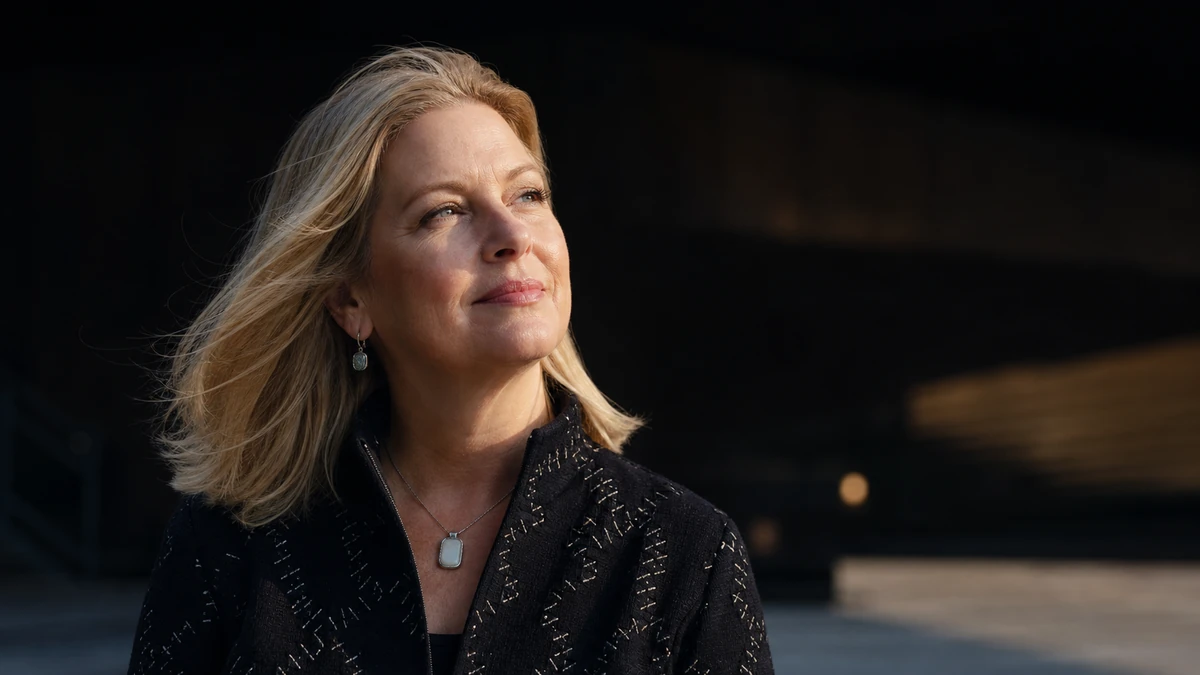
A celebrated American jazz composer is finally heading to Seoul
Maria Schneider, one of the most acclaimed jazz composers and arrangers of the past several decades, is set to make her first performance in South Korea next month, bringing her 19-piece orchestra to Seoul’s Lotte Concert Hall for a July 31 concert. For Korean audiences, the event has quickly drawn attention not simply because an internationally known musician is visiting, but because Schneider’s music is arriving in the kind of setting that underscores what makes her work distinctive: a formal concert hall built for deep listening, subtle acoustics and large-scale ensemble sound.
According to the concert organizer, Plus Hitch, the performance will begin at 7:30 p.m. in one of Seoul’s best-known classical venues. That detail matters. In the United States, Schneider is often spoken of with a kind of reverence usually reserved for artists who stretch the boundaries of genre without abandoning its roots. She is associated with jazz, but not with the casual, background-music version of jazz that some American audiences may imagine when they hear the term. Her work is expansive, layered and meticulously arranged, often unfolding more like a cinematic landscape than a club set.
For American readers who may know Seoul primarily through K-pop, Korean dramas and the country’s global technology brands, this concert offers a reminder that South Korea’s cultural life is much broader than its most visible exports. The same city that fills stadiums for idol groups and hosts red-carpet premieres for streaming-era television stars also supports a sophisticated live-performance scene where contemporary classical music, jazz, opera and experimental work all coexist. Schneider’s debut in Korea fits squarely into that larger story.
At a moment when South Korea is increasingly seen as one of the world’s major cultural capitals, the arrival of an artist like Schneider carries symbolic weight. It says something about the country’s audiences, its presenters and its concert infrastructure. It also says something about how jazz — especially large-ensemble jazz — continues to travel globally, even in an era dominated by algorithm-driven listening and short-form viral hits.
Why Maria Schneider matters in American music
Schneider, born in Minnesota in 1960, has long occupied a singular place in American music. She emerged from a lineage that includes giants such as Gil Evans and Bob Brookmeyer, both of whom helped redefine what jazz composition could do with color, texture and emotional nuance. Schneider worked as an assistant to both men after moving to New York in 1985, and that apprenticeship placed her in direct conversation with some of the most influential thinking in modern jazz orchestration.
But Schneider did not become important merely by inheriting that tradition. She built her own language. Since forming the Maria Schneider Jazz Orchestra in 1992, she has developed a body of work that challenges the old stereotype of the big band as a vehicle for blunt power, showmanship or nostalgia. In American cultural memory, “big band” can still evoke the swing era, brass-heavy dance halls and an earlier chapter of 20th-century popular music. Schneider’s music shares the scale of that tradition, but not its limitations. Her writing is often atmospheric rather than bombastic, fluid rather than rigid, and deeply attentive to the individuality of each player inside the larger ensemble.
That is one reason she has earned a reputation that extends far beyond jazz specialists. Her compositions are admired for their precision and emotional breadth, but also for the way they invite listeners into a space between structure and spontaneity. Improvisation remains central, as it does in jazz more broadly, but it unfolds within a carefully built architecture. The result can feel less like a sequence of solos and more like an ecosystem of sound.
For U.S. readers, one useful comparison might be to film without images. Schneider’s pieces often create the sensation of narrative movement — weather shifting, terrain opening, tension gathering, memory surfacing — without depending on lyrics or explicit storyline. That helps explain why even listeners who do not consider themselves jazz fans often respond to her work. The entry point is not technical knowledge. It is atmosphere, emotion and the sense of being carried through a landscape shaped by sound.
What makes this 19-piece orchestra different
The scale of the Seoul performance is central to its appeal. Schneider will not be appearing in stripped-down form, nor as a guest with a local group, but with the 19-piece orchestra that has become the primary vessel for her artistic vision. In practical terms, that means audiences will hear the music in the format for which it was conceived: a large ensemble capable of immense detail, dynamic contrast and long-form dramatic buildup.
Large jazz ensembles can sometimes be misunderstood by audiences unfamiliar with the form. In popular culture, a bigger group is often assumed to mean simply louder sound or greater spectacle. Schneider’s work turns that expectation inside out. The point of 19 musicians is not volume for its own sake. It is depth. It is the ability to place woodwinds, brass, rhythm and solo voices in conversation with one another so that the music seems to breathe, recede and bloom.
The concert organizer described Schneider’s sound as a “3D soundscape,” a phrase that may sound promotional at first glance but gets at something real about her music. A soundscape is more than melody and beat; it is the sense that sound occupies space, creates perspective and carries a listener through an environment. In Schneider’s case, that environment often feels startlingly tactile. Instruments do not merely play lines. They suggest air, distance, motion and texture. A trumpet may not function only as a lead voice, but as a flicker of light. Reeds may gather like weather. The ensemble can move as one organism while still allowing its individual parts to retain personality.
That quality is especially effective in a hall designed for acoustic listening rather than amplified spectacle. Lotte Concert Hall, located in Seoul, is widely known as a venue where audiences can hear detail with unusual clarity. In that respect, the setting is not incidental; it is part of the event. For American readers, it may help to think of the difference between hearing a chamber orchestra in a purpose-built hall and hearing similar music in a multipurpose arena. The notes may be the same, but the experience is not. Schneider’s music depends on precision of space as much as precision of composition.
More than a visiting star: Why this matters in South Korea
In Korean entertainment coverage, the phrase often translated as “first performance in Korea” carries particular significance. It is more than a scheduling note. It signals rarity, a long-awaited debut and, in many cases, an acknowledgment that Korean audiences are now important enough on the global circuit to merit a dedicated stop from artists who may have toured extensively elsewhere.
That context is especially important here. South Korea’s global image has been shaped in recent years by the extraordinary international success of K-pop, Korean film and streaming-era television. Those exports have become so dominant that they can overshadow other parts of the country’s arts ecosystem. Yet Seoul has also become a major hub for world-class live performance across genres. International orchestras, opera companies, avant-garde artists and jazz musicians increasingly treat the city not as an afterthought in Asia, but as a serious destination with engaged audiences.
Schneider’s upcoming appearance reflects that evolution. Her music is not built around celebrity in the way pop tours are. There is no choreography, no fan-light ocean, no social-media challenge attached to a hook. The attraction is the performance itself: the architecture of the compositions, the interplay among musicians and the rare chance to hear a major jazz orchestra in a room designed for concentrated listening. That may sound niche from an American commercial perspective, but in Seoul it aligns with a broader pattern of audiences embracing ambitious programming across art forms.
There is also a subtle but important cultural point here. In South Korea, major imported performances often become moments of cultural translation. Audiences do not simply consume an overseas act; they place it within Korea’s own evolving artistic conversation. A concert like this can draw jazz listeners, classical subscribers, conservatory students and younger attendees who are curious about music outside the mainstream pop pipeline. The event becomes a meeting point between local listening habits and global artistic prestige.
That is part of what makes this story noteworthy beyond the jazz world. It reveals a side of Korean cultural life that American audiences do not always see: one that is cosmopolitan, musically literate and increasingly confident in presenting forms of art that require patience rather than instant familiarity.
A composer shaped by genre-crossing collaborations
Schneider’s reputation has also been strengthened by work that reaches beyond jazz’s traditional boundaries. According to the concert materials, she has guest-conducted more than 85 ensembles in over 30 countries, an indication that her music has traveled widely and found resonance in many contexts. That matters because it places the Seoul performance within a genuinely international career, not a one-off prestige booking.
American readers may be more likely to recognize Schneider through her connections to artists outside the jazz orbit. She has performed with Sting, whose own career moved from rock stardom into jazz-inflected and classically tinged projects. She also contributed to David Bowie’s final album, “Blackstar,” a record that startled many listeners with its experimental edge and its engagement with jazz musicians and textures. Those collaborations are not trivial name-drops. They suggest that Schneider occupies a rare position in modern music: respected by improvisers, composers and mainstream pop icons alike.
That cross-genre reach helps explain why a concert in Seoul can carry meaning even for readers who do not follow jazz closely. Schneider represents a kind of American artistry that has remained vital without becoming narrowly academic. She is a composer’s composer, but also a public-facing artist whose work has touched broader currents in contemporary music. When she appears in South Korea with her own orchestra, the event speaks not only to jazz history, but to the porous edges between concert music, improvisation and popular culture.
In an age when genre categories are both rigidly marketed and constantly blurred, Schneider’s career offers a compelling model. She has not diluted her musical language to chase relevance. Instead, relevance has come to her because that language is rich enough to connect with artists and audiences across musical borders. That makes the Seoul concert a telling example of how global cultural exchange now works: not simply through the biggest names, but through artists whose influence runs deep beneath the surface of popular culture.
The themes inside the music: nature, humanity and atmosphere
One of the recurring descriptions attached to Schneider’s work is that it reflects on nature, the environment and human experience. That can sound abstract, especially in a music industry that often markets everything in emotional superlatives. But in her case, the description points to a real aspect of the art. Schneider’s pieces are often concerned less with display than with immersion. They invite the listener to inhabit a mood or a setting rather than simply admire technical complexity.
For audiences accustomed to lyric-driven songs, that may require a different mode of attention. There is no narrator explaining the theme. The meaning emerges through timbre, pacing and the way instrumental voices accumulate feeling. A piece may suggest open sky, migration, fragility or longing without stating any of that directly. The environment is not a slogan in the music. It is embedded in the sonic textures themselves.
That may be one reason her work translates so effectively across cultures. While language can divide audiences, atmosphere often travels more freely. A listener in Seoul does not need the same set of references as a listener in New York or Minneapolis to respond to the sensation of expansiveness, tension or release. In that sense, Schneider’s music is particularly well suited to international presentation. It is rooted in American jazz traditions, but not dependent on insider fluency for its emotional effect.
The Seoul concert therefore promises something more than a high-profile booking. It offers an experience likely to reward close listening in a city increasingly recognized as a crossroads for international culture. For Korean audiences, it is the arrival of a major artist who has never before presented this orchestra there. For English-speaking readers, it is also a useful lens on how South Korea’s arts scene has matured beyond the frames most commonly exported overseas.
What this concert says about Seoul’s place in global culture
There is a tendency in American coverage of South Korea to treat culture as synonymous with pop culture. That is understandable given the worldwide success of BTS, Blackpink, “Parasite” and “Squid Game.” But the risk of that framework is that it turns one of the world’s most dynamic cultural markets into a caricature of itself: all youth culture, all the time, endlessly optimized for global consumption.
A performance like Schneider’s pushes back against that flattening. It reminds us that Seoul is not only a launchpad for Korean exports, but also a destination where global artists bring serious work to serious listeners. It is a place where a 19-piece jazz orchestra can command attention in a premier concert hall and where the event can be discussed not as a novelty, but as an important addition to the city’s cultural calendar.
That distinction matters. The strongest cultural capitals are not just producers of exportable entertainment. They are places where different traditions meet, where audiences are curious across genres and where artistic ambition has institutional support. New York, London and Paris built parts of their reputations on exactly that mix. Increasingly, Seoul belongs in the same conversation.
Schneider’s first Korea performance is, on one level, a single concert on a summer evening. On another, it is evidence of a broader shift in how global music circulates and where prestige now resides. South Korea is no longer simply sending culture outward. It is also drawing a wide range of international artists inward, creating a more complex exchange than the one-way narrative often implied by discussions of the Korean Wave.
For fans in Korea, that means a rare chance to hear one of America’s premier jazz composers in her preferred format. For observers abroad, it is a sign that the country’s cultural story keeps expanding in ways that do not fit neatly into the K-pop box. And for anyone who cares about where live music still matters as a communal, attentive experience, the image of Schneider and her 19 musicians taking the stage in Seoul next month carries its own resonance: an American art form, shaped by decades of innovation, meeting a Korean audience ready to hear it on its own terms.
Comments
Post a Comment