
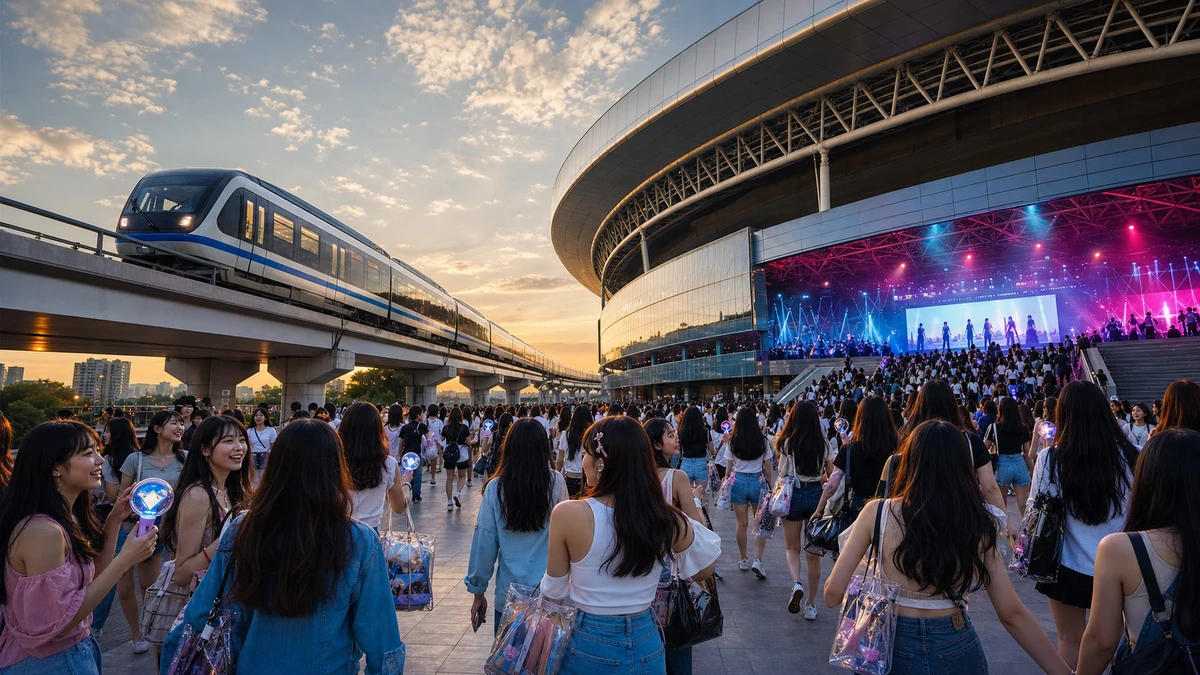
A fan meeting that looks more like a major league event
In American pop culture, the phrase “fan meeting” might suggest something modest: a backstage Q&A, a convention panel, a VIP package or a brief artist appearance in a theater ballroom. In South Korea’s K-pop industry, the term has evolved into something much bigger, and few examples make that clearer than Seventeen’s latest event in Incheon.
The 13-member K-pop group is holding its standalone fan meeting, “Seventeen in Carat Land,” on June 20 and 21 at Incheon Asiad Main Stadium, according to Yonhap News and the group’s agency, Pledis Entertainment. The venue alone tells an important story. This is not a cozy hall or a small-scale fan sign event. It is a stadium, the kind of setting American audiences would associate with an NFL game, a Taylor Swift stop or a major international soccer match. Calling it a fan meeting may be technically correct in K-pop terms, but in scale, ambition and audience expectation, it sits much closer to a full-scale live spectacle.
That matters because it reflects where K-pop is now. The genre is no longer built only on albums, music videos and social media virality. It increasingly runs on immersive, fandom-centered live events that blur the line between concert, theatrical production, community gathering and brand experience. In that sense, Seventeen’s Incheon event is not just another date on a tour calendar. It is a case study in how South Korea’s entertainment industry has expanded the very idea of what it means for an artist to “meet” fans.
Seventeen is well positioned to pull off that kind of event. Debuting in 2015, the group built a reputation on synchronized choreography, self-produced music and a highly organized team identity unusual even in K-pop, where large groups are common. For many Western audiences, the closest comparison is not a standard boy band but a hybrid of a vocal group, dance company and multimedia franchise. Their fan base, known as Carats, has become one of the most visible and loyal in the K-pop world, stretching far beyond South Korea into North America, Europe, Southeast Asia and Latin America.
What makes this weekend’s event especially notable is that it centers not just on the artists, but on the fandom itself. That has long been a defining feature of K-pop culture. But when a fandom-branded event moves into a stadium, it becomes a public statement: this is no longer a niche subculture gathering in side rooms and online chat spaces. It is a mass cultural force capable of filling real-world landmarks.
What “Carat Land” means in K-pop culture
To understand why “Seventeen in Carat Land” resonates so strongly with fans, it helps to understand how fandom operates in K-pop. Fan names are not casual labels. They are carefully constructed identities that become part of the artist’s world-building. Seventeen fans are called Carats, a name tied to the group’s branding and the idea that fans help the group shine, like a gem measured by carats. In practice, the name functions as a badge of belonging, something closer to membership in a community than just a demographic category.
That is one reason “Carat Land” carries symbolic weight. It signals that the event is not merely a performance delivered to passive spectators. It is a space explicitly framed as belonging to fans. In American entertainment, there are parallels in events like Comic-Con, Disney’s D23 or fan cruises built around a single franchise, where the attraction is not only the stars onstage but the feeling of entering a shared world. K-pop has refined that logic into its own live format, where official colors, light sticks, slogans, chants and recurring story concepts help transform attendance into participation.
Pledis said this year’s fan meeting is built around the concept of Seventeen and the audience boarding an express train bound for “Carat Land.” That kind of setup may sound whimsical to newcomers, but it fits squarely within K-pop’s broader storytelling approach. Concepts in K-pop are rarely limited to costume changes or stage design. They often provide the emotional and visual framework through which fans experience an event. The audience is not just told to watch; it is invited to imagine itself moving with the artists toward a common destination.
For English-speaking readers unfamiliar with that ecosystem, the easiest way to think about it is this: if a traditional pop concert is like attending a game, a K-pop fan event is often designed more like entering a themed environment where the audience already knows the rules, rituals and references. Fans arrive prepared. They know the lore. They recognize the inside jokes. They understand when to sing, when to wave their light sticks and when a seemingly small song choice carries emotional significance because it has been requested for years.
That collective fluency is part of the appeal. It is also one reason K-pop fandom has proven so durable in the streaming age. In a digital media environment that often makes music feel disposable, these events create a sense of appointment viewing and physical belonging. They turn fandom into something visible and communal. “Carat Land,” then, is not simply a title. It is the organizing principle of an experience designed to tell fans: this event is about your place in the Seventeen story.
Why a stadium matters
Incheon Asiad Main Stadium sits in Seo District, west of Seoul, and its size gives this event a significance beyond a normal promotional appearance. Stadiums are shorthand for cultural scale. In the United States, when an artist graduates from clubs to arenas and then to stadiums, the message is clear: this act has crossed into a different tier of visibility, demand and economic power. The same logic applies here, even if the label on the event is “fan meeting” rather than “concert.”
Traditionally, fan meetings in South Korea implied a more intimate format. Artists might perform a few songs, play games, answer questions, interact with fans and create a sense of direct connection less formal than a concert. But as K-pop grew globally, so did the expectations surrounding fan service and live production. The result is that fan meetings have increasingly absorbed the language of major shows: large stages, elaborate sets, curated set lists, event-specific themes and the emotional pacing of a full performance experience.
Seventeen’s event illustrates that shift. Organizers have indicated that the program will include both the group’s hit songs and songs fans have long been waiting to hear. That blend is revealing. Hits serve the broad public-facing function of reminding everyone why the group commands a stadium in the first place. The deeper cuts or long-awaited selections serve a different purpose: they reward fan memory, acknowledge insider devotion and signal that this event is tailored for the people who know the catalog best.
That dual strategy mirrors what many American legacy acts do when they balance radio staples with fan-favorite tracks, but in K-pop it carries an added layer of identity politics within fandom. A thoughtfully built set list can validate years of fan investment. It tells Carats that the event is not just a victory lap of chart success, but a shared archive of moments, eras and emotional attachments.
The venue also matters because it highlights a broader structural truth about modern K-pop: fandom is one of the industry’s most dependable engines. Streaming numbers, album sales and viral clips remain important, but large in-person gatherings demonstrate something more tangible. They show who is willing to travel, spend money, commit time and participate in coordinated ritual. Even without official attendance or local economic figures attached to this specific event, a stadium-scale fan meeting carries obvious implications. It requires organization, infrastructure and confidence that the audience will come.
That confidence is not built overnight. It comes from years of cultivating loyalty through music, variety content, online interaction and a carefully maintained group identity. Seventeen’s rise has followed that arc, and “Carat Land” may be one of the clearest demonstrations yet of how far the K-pop fan-event model has expanded.
The express train concept and the business of immersion
The express train concept at the center of this year’s event may seem like a simple decorative idea, but it points to one of the most sophisticated features of the K-pop system: immersion. South Korean entertainment companies have become adept at packaging music as part of a larger narrative universe. Songs, visuals, merchandise, social posts, light sticks and live events all reinforce one another. When it works, fans are not just consuming content; they are inhabiting a shared framework.
In this case, the image of Seventeen and Carats boarding a train together is especially effective because it casts fans as fellow travelers rather than spectators. That distinction is subtle but important. One of K-pop’s signature achievements has been to make fans feel essential to the event itself. The choreography may happen onstage, but the atmosphere depends on the audience’s collective response: synchronized light sticks, fan chants and emotional recognition of references that outsiders may miss.
Americans may recognize parts of this dynamic from sports culture. Think of the way college football traditions, team colors and chants turn the crowd into part of the performance, or the way a Marvel fan event can turn a trailer release into a communal ritual. K-pop borrows some of that emotional logic and adapts it into music-centered fandom. The result is a live environment where participation is not optional texture; it is a built-in expectation.
This is also where K-pop’s business model becomes visible. Immersive concepts are not only artistic choices. They are also tools for deepening attachment. A recurring event name like “Carat Land” becomes a recognizable piece of intellectual property. It can be renewed, reimagined and circulated across markets. Fans know what it means, anticipate its return and carry its symbolism online afterward. In an era when entertainment companies are increasingly seeking experiences that travel well across platforms, that kind of repeatable concept has real value.
For global fans following from abroad, the event offers another window into how K-pop translates intimacy into scale. Unlike many Western pop systems, which often draw a sharp line between a premium fan event and a large commercial concert, K-pop has found ways to combine the two. The show can feel deeply insider-oriented while still occupying one of the biggest venues available. That tension, between closeness and enormity, is one of the genre’s defining strengths.
It also helps explain why K-pop fandom remains so visible online even when fans are physically dispersed across continents. The live event acts as a kind of anchor. People who cannot attend still follow set lists, clips, costumes and surprise moments in real time. A stadium in Incheon becomes, for a weekend, a digital gathering point for viewers far beyond South Korea.
More than music: memory, curation and emotional payoff
One of the most telling details about “Seventeen in Carat Land” is the promise that it will include not only the group’s best-known songs but also tracks fans have been waiting a long time to hear. That may sound routine, but in K-pop it is a form of curation with emotional stakes. The careful selection of songs can function almost like an editorial statement about what kind of relationship the group wants to affirm with its audience.
Hit songs serve an obvious purpose. They energize the crowd, reward first-time attendees and create the collective highs that dominate social media clips after the event ends. But the long-awaited songs speak more directly to fandom memory. They remind fans that their devotion is measured not just by what was popular on streaming charts, but by the moments that lived in fan communities: songs discussed, requested and emotionally preserved over time.
Seventeen’s appeal has always depended partly on the interplay between polished performance and group chemistry. With 13 members, the group has long projected a kind of organized chaos that can feel both technically impressive and emotionally warm. That combination is not easy to sustain in a venue as large as a stadium, where intimacy can get swallowed by scale. One of the key tests of this event, then, is whether Seventeen can preserve that sense of connection even while performing in an enormous physical space.
K-pop groups often solve that challenge by structuring live events around interaction as much as music. Fan meetings may include talking segments, games, video interludes or playful concept-driven skits that would feel out of place in a conventional Western pop concert. Those elements are not filler. They are part of the social contract. Fans come not just to hear songs but to watch personality, humor and relational dynamics unfold in real time.
That is particularly important for a group like Seventeen, whose brand has long been tied to teamwork and member chemistry. In many American pop acts, the star system is built around a central individual. In Seventeen’s case, the draw is collective. Fans often attach themselves to specific members, but the larger emotional architecture depends on the ensemble. A fan meeting is therefore one of the most effective formats for reinforcing what makes the group distinct: the feeling that the members’ interactions are part of the entertainment, not just the music they produce.
Seen that way, “Carat Land” is not simply a live show. It is a reaffirmation ritual. It gathers the fandom, revisits shared memories and packages them in a format large enough to symbolize success but intimate enough, at least in design, to preserve emotional access. That balance is one reason K-pop’s fan-centered events continue to resonate so powerfully.
Incheon as a real place, not just a backdrop
It is also worth paying attention to where this is happening. K-pop is often discussed in the abstract, as a digital export propelled by YouTube, TikTok and global streaming platforms. But its biggest moments still depend on physical geography. Fans travel. They line up. They fill transit systems, restaurants, hotels and nearby commercial districts. A major K-pop event can transform a neighborhood’s atmosphere, even when official economic impact figures are not immediately available.
Incheon, a major city west of Seoul and home to South Korea’s main international airport, is often the first place foreign visitors encounter when they arrive in the country. That gives it an added symbolic role. A stadium event there is not just a local entertainment booking. It sits in one of the most internationally legible entry points into South Korea. For overseas fans who make the trip, attending a show in Incheon can feel like stepping directly into the geographic infrastructure of the Korean Wave, or Hallyu, the term used to describe the global spread of South Korean popular culture.
For American readers, it may help to think of the event not only as a concert equivalent but as part of a travel ecosystem, closer to the way a major sports weekend or festival can animate a city. The article summary does not provide verified attendance numbers or measurable local business impact, so it would be premature to claim a specific economic effect. But the broader pattern is familiar. When fandom mobilizes in person at scale, cities feel it.
That physical dimension matters because it counters a common misconception that K-pop fandom exists mostly online. Digital networks are essential, but they are only part of the story. The more revealing measure of power is what happens when those communities converge in a real place at a real time, wearing coordinated colors, carrying official light sticks and turning a venue into a collective display of identity.
Stadium events also reinforce the role of place in cultural legitimacy. Just as selling out Madison Square Garden or SoFi Stadium can function as a symbolic milestone in the United States, commanding a major Korean stadium for a fan-centered event sends a message about status. It says the group’s relationship with its audience is large enough to shape not just timelines and trends, but space itself.
What comes next for Seventeen
The fan meeting is also arriving as part of a broader flow of Seventeen activity, underscoring how large K-pop groups sustain momentum through multiple layers of content. According to the summary, a new unit called V8, made up of The8 and Vernon, is set to release its first mini album, also titled “V8,” on June 29 and launch a solo performance in July. Meanwhile, the group’s youngest member, Dino, is scheduled to release an album on Aug. 3 under the alter ego “Picheorin,” a fictional producer and agency head described as warmhearted and full of spirit.
For American audiences, these kinds of side projects can seem unusually elaborate. But within K-pop, they are part of an established strategy. Units and alter egos allow agencies to showcase different musical colors inside a larger group structure. They keep individual members visible, satisfy fans hungry for variety and create new points of entry for audiences who may not yet be committed to the full group.
The alter ego concept, in particular, reflects how comfortable K-pop has become with blurring performance and character. In U.S. pop, artists sometimes adopt personas for albums or eras, but K-pop often institutionalizes that practice more overtly, turning it into a recurring layer of storytelling. For fans, that can deepen engagement by extending the entertainment beyond songs into narrative play. For critics, it can raise questions about how heavily managed the idol system remains. Both readings can be true at once.
In Seventeen’s case, these activities demonstrate the flexibility that has helped the group endure in a highly competitive market. While the full group remains the core brand, subunits and character-based projects prevent the act from feeling static. They create movement between large communal moments like “Carat Land” and more specialized releases that spotlight individual members or pairings.
That matters because K-pop audiences are not only consuming music; they are following ongoing storylines. A stadium fan meeting reinforces the bond between the full group and its fandom. Unit and solo projects then spin that energy outward into new forms. It is an ecosystem built on continuity, and Seventeen has become one of its most effective practitioners.
A snapshot of where K-pop is headed
In the end, Seventeen’s Incheon fan meeting is significant not because it breaks from K-pop’s fan culture, but because it magnifies it. It shows how an event once associated with closeness and small-scale interaction can expand into a stadium production without shedding its core purpose. The point is still to honor the bond between artist and fan. The difference is that the bond is now strong enough to fill one of the country’s major venues.
For English-speaking readers trying to make sense of K-pop’s continuing global rise, that may be the most useful takeaway. The genre’s power does not come only from catchy songs, slick videos or high-performance choreography, though all of those matter. It also comes from a system that treats fandom as a central creative and commercial force. “Carat Land” is the visible expression of that system: a branded world where fans are named, addressed, invited and staged as co-participants in the event.
The express-train theme captures that philosophy neatly. Seventeen and Carats are framed as traveling together toward the same destination. In practical terms, that means a stadium weekend in Incheon. In symbolic terms, it speaks to a broader truth about K-pop in 2024 and beyond. The industry is increasingly built around shared experiences that merge music, identity, live spectacle and community into a single package.
That is why this is more than a routine entertainment item from South Korea. It is a glimpse of the contemporary K-pop model at work: fan-centered, highly conceptual, globally legible and physically massive. Whether you are a longtime Carat or an American reader just beginning to understand the mechanics of Korean pop fandom, Seventeen’s latest event offers a vivid picture of how the Korean Wave continues to evolve — not by moving away from its fans, but by building ever larger stages for them to gather on.



0 Comments