SK Telecom’s $540 million bet on an SK Hynix U.S. unit shows how South Korea’s AI giants are redrawing the map
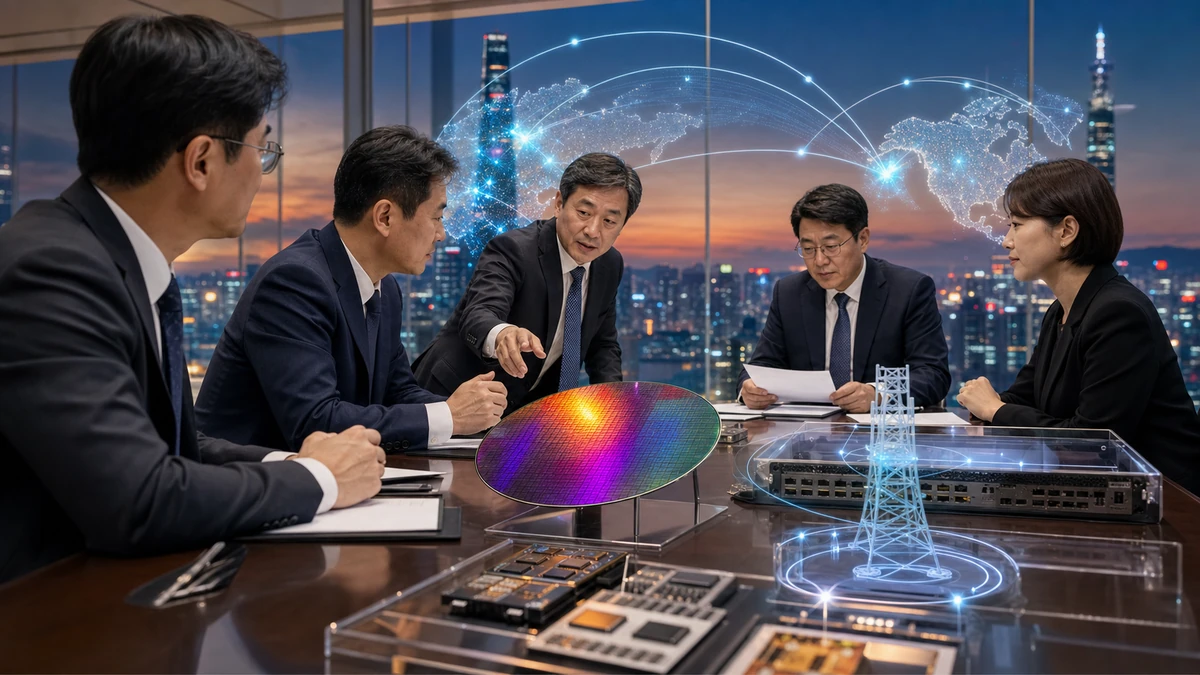
South Korean heavyweights are putting more money behind AI infrastructure
South Korea’s largest mobile carrier is making a sizable wager on the kind of back-end technology that increasingly determines who wins in artificial intelligence.
SK Telecom said it has agreed to invest 738.384 billion won — roughly $540 million at recent exchange rates — into SK Hynix NAND Product Solutions, a U.S. investment subsidiary set up by fellow SK Group affiliate SK Hynix. The stake SK Telecom is expected to receive is small, about 0.9%, according to the company’s regulatory filing, but the message is much larger than the percentage suggests: One of Korea’s best-known telecom companies is moving deeper into the capital-intensive plumbing of the AI boom.
For American readers, a useful comparison would be this: Imagine a major U.S. wireless carrier deciding that the next phase of growth will not come mainly from selling more phone plans, but from helping finance the chips, storage systems, data centers and network capacity that power ChatGPT-style services and enterprise AI. That is the strategic shift this deal appears to represent.
The transaction was disclosed through South Korea’s electronic disclosure system, the formal filing platform companies use to report material decisions to investors. In practical terms, that means this is not just a broad corporate talking point about future ambitions. It is capital being allocated in a visible, reportable way.
SK Telecom said the investment is aimed at creating synergy among SK Group affiliates, arguing the conglomerate has “full-stack” capabilities in AI data centers. In the language of the tech industry, “full-stack” means a company or a group of companies can contribute across multiple layers of the business rather than at just one point — from chips and storage to networking, operations and data processing. In a moment when AI has become as much an infrastructure race as a software race, that distinction matters.
The investment also underscores how South Korea’s industrial strategy is evolving. For decades, the country’s global business identity rested heavily on exporting finished products — smartphones, TVs, cars, ships and memory chips. Today, its biggest corporations are trying to secure a larger role in the invisible but essential systems underneath the digital economy. AI data centers, semiconductor supply chains and global investment vehicles are now just as important to the Korean growth story as consumer gadgets once were.
Why a telecom company is investing in a chip-related vehicle
At first glance, a wireless carrier investing hundreds of billions of won into a chipmaker’s U.S. subsidiary may sound unusual. But in the AI era, the line between telecommunications and semiconductors is getting thinner.
Artificial intelligence systems require enormous computing power, massive amounts of storage, fast data movement and stable operating environments. That means AI is not only about clever software models or flashy consumer apps. It is also about data centers, high-bandwidth connectivity, memory, storage architecture, cooling, electricity and system management. Telecom companies already understand networks and large-scale digital operations. Semiconductor companies supply the hardware that makes those operations possible. Increasingly, those capabilities need to work together.
That helps explain why SK Telecom would want a closer seat at the table as AI infrastructure is built out. South Korea’s telecom market is mature, and like many carriers around the world, SK Telecom faces the familiar challenge of finding growth beyond traditional subscriber services. U.S. investors have heard versions of this story before. Wireless companies can only squeeze so much additional growth out of monthly phone bills. The bigger prize is often in enterprise services, cloud connectivity, edge computing and the broader digital infrastructure economy.
In that respect, SK Telecom’s investment can be read as part hedge, part expansion and part statement of intent. It is a hedge against being boxed into a lower-growth, utility-like role in communications. It is an expansion into higher-value AI infrastructure. And it is a statement that the company believes the next tech cycle will reward those who control not just customer access, but also pieces of the underlying compute and storage ecosystem.
The target of the investment is also telling. The unit’s name — SK Hynix NAND Product Solutions — points to NAND, a type of flash memory widely used in storage devices. While the public summary of the filing did not spell out every operational detail of the U.S. entity, the broader logic is clear enough: AI systems are not powered by processors alone. They also depend on fast, reliable storage and memory systems capable of moving and retaining vast quantities of data.
For years, much of the public conversation around AI chips has focused on graphics processing units, or GPUs, because of their role in training and running advanced models. But data storage and memory have quietly become just as critical. Training large AI models requires enormous data throughput, and deploying those models at scale means serving, storing and retrieving data efficiently. In other words, the glamour may go to the headline chips, but the economic value increasingly spreads across the full data-center stack.
Understanding SK Group, the kind of Korean conglomerate that shapes the economy
To fully understand why this transaction matters, American readers need a bit of Korean corporate context.
SK Telecom and SK Hynix are both part of SK Group, one of South Korea’s largest family-controlled conglomerates, known locally as a “chaebol.” The term refers to the sprawling business groups that dominate much of the Korean economy, somewhat analogous — though not identical — to a mix of old-line industrial empires and modern corporate holding structures in the United States. Think of something with the breadth of a major American conglomerate, but with deeper cross-affiliate coordination and a more visible role in national industrial strategy.
Chaebol such as Samsung, Hyundai Motor, LG and SK have long been central to South Korea’s export-led rise. Their businesses often span industries that might seem disconnected to outsiders: semiconductors, telecom, energy, chemicals, batteries, retail, logistics and finance. What can look unwieldy on paper can become an advantage during periods of technological transition, because the group can align capital and expertise across subsidiaries.
That appears to be what SK is doing now around AI.
According to the summary of the filing, other SK affiliates had already put money into the same overall effort earlier this year. In March, SK Inc., the group’s investment holding company, invested $250 million, while SK Innovation, the energy and industrial affiliate, invested $380 million. Added to SK Telecom’s new commitment, that suggests a broader, coordinated push rather than an isolated move by one subsidiary.
This is significant because it hints at how Korean corporations are thinking about AI infrastructure. Instead of treating AI as the domain of a single software team or one standalone subsidiary, they are approaching it as a group-wide industrial buildout. One affiliate brings capital. Another brings energy or industrial know-how. Another brings networking expertise. Another brings semiconductor capabilities. Together, they try to create scale and strategic leverage.
That group-level approach fits a familiar Korean corporate pattern. In past technology cycles, chaebol often competed by bundling strengths across divisions and moving aggressively once a strategic direction became clear. The AI race appears to be producing a similar response — except this time the focal point is not a smartphone or a television, but the infrastructure behind data centers and machine intelligence.
Why the U.S. vehicle matters in a global AI race
The fact that this investment is going into a U.S. subsidiary is not a footnote. It is central to the story.
The United States remains the most important arena for advanced AI development, hyperscale cloud investment and leading-edge data-center expansion. It is where many of the world’s biggest AI model developers, cloud providers and chip customers are concentrated. It is also a market where access to capital, customers and strategic partnerships can shape the competitive future of companies far beyond American borders.
For Korean firms, using a U.S.-based vehicle can serve several purposes at once. It places investment activity closer to major technology customers and infrastructure partners. It helps position the company within the ecosystem where AI spending is moving fastest. And it reflects a reality that increasingly defines global tech competition: even when the corporate parent is Korean, Japanese or European, the battle for AI relevance often runs through U.S. markets, U.S. customers and U.S.-located infrastructure.
That is especially true in semiconductors and data centers, where supply chains are global but demand concentration can be highly regional. A Korean company may design, manufacture or package critical components in Asia, but still need a U.S. foothold to capture strategic value in deployment, financing and partnership formation.
There is also a geopolitical layer in the background. Over the past several years, Washington has pushed hard to rebuild or diversify parts of the semiconductor supply chain and encourage more advanced technology investment on U.S. soil. The CHIPS and Science Act, export control debates and growing concerns about resilience in technology supply chains have all changed how companies think about where they place investment vehicles and where they expand capacity. While this specific filing does not lay out a political rationale, it arrives in a policy climate where a stronger U.S. presence can carry both commercial and strategic benefits.
For American readers, the broader point is straightforward: This is not simply a Korean domestic corporate reshuffle. It is part of the international competition to own the foundations of AI, and the United States remains the center of gravity for much of that contest.
The small stake masks a larger strategic signal
One detail that stands out is the apparent mismatch between the size of the investment and the size of the ownership stake. SK Telecom is expected to acquire 1,198 newly issued shares and end up with about 0.9% of the entity. On its face, that is less than 1% ownership for more than half a billion dollars.
That may sound counterintuitive to readers used to equating control with percentage ownership. But strategic investments do not always work that way, especially in fast-moving infrastructure sectors. A small stake can still secure alignment, information flow, optionality and a foothold in future projects. It can also signal confidence in a broader initiative without requiring full operating control.
In the American market, investors have seen comparable logic in deals involving cloud infrastructure, data-center partnerships and AI startups. A company may accept a minority position if the real objective is not immediate financial control but access — access to technology, to capacity, to future deal flow or to a more central place in an emerging ecosystem.
That seems especially plausible here. SK Telecom has said it plans to identify opportunities in the rapidly changing AI ecosystem. That wording stops short of promising a specific product launch or naming a precise development pipeline. But it suggests the company sees value in being financially and strategically embedded in whatever projects emerge from the U.S. unit and the broader SK AI infrastructure strategy.
There is another reason the stake size should not be dismissed too quickly. In corporate groups like SK, influence often comes not only from a single ownership percentage, but from the wider network of relationships among affiliates. If multiple SK companies are backing the same strategic direction, the relevant question may be less “Who owns what fraction?” and more “How is the group pooling capital and capabilities to shape the outcome?”
From that perspective, the filing matters because it turns strategic ambition into measurable capital deployment. Companies say many things about AI. What investors look for is where the money actually goes.
What this says about South Korea’s AI strategy
This deal also offers a window into how South Korea sees its place in the next phase of the AI economy.
Much of the global AI narrative has centered on software platforms, consumer chatbots and a handful of Silicon Valley names. South Korean companies, by contrast, are often strongest in the industrial layers underneath — memory chips, manufacturing, displays, batteries, telecom networks and the engineering required to scale complex systems. That does not mean Korea lacks software ambitions, but it does mean its comparative advantage often lies in infrastructure.
SK Telecom’s investment reflects that reality. Rather than trying to tell a story built only around consumer-facing AI applications, the SK ecosystem appears to be leaning into the sectors where Korea has long been globally competitive: hardware, network operations and industrial coordination. In the AI era, that could prove a powerful position if the real bottlenecks remain in compute, storage, power and data-center deployment rather than in app design alone.
The phrase SK used — “full-stack capabilities” in AI data centers — is worth unpacking in this context. It implies a belief that value will accrue to companies able to offer an integrated approach. A high-performing AI data center needs advanced semiconductors, robust storage architecture, high-speed connectivity, reliable electricity and efficient operations. Korea has companies with expertise in nearly every one of those fields. The strategic challenge is connecting them in a way that creates durable advantage.
There is also a financial-market angle. Analysts and investors have increasingly rewarded companies tied to AI hardware and infrastructure, especially those seen as suppliers to the broader ecosystem rather than bets on a single consumer application. South Korean equities have benefited at times from that narrative, particularly around semiconductors. The new investment reinforces the idea that Korean corporations want to be seen not as peripheral spectators to the AI boom, but as builders of the systems that make it possible.
That message could resonate well beyond Seoul. International investors are constantly looking for clues about which companies and countries are positioning themselves for the next leg of AI-related spending. A telecom company in Korea putting substantial money into a U.S.-based chip-linked entity is one such clue.
What remains unclear — and what to watch next
As with many regulatory disclosures, the filing answers some questions and leaves others open.
The public summary does not provide a detailed roadmap for the U.S. unit’s projects, timelines or customer relationships. It does not specify exactly which AI data-center opportunities the vehicle will pursue, how the capital will be deployed across products or regions, or how responsibilities will be divided among SK affiliates. That means caution is warranted. Investors and observers should avoid assuming more operational detail than the disclosure provides.
Still, even without those specifics, the contours of the strategy are visible. SK Telecom is putting a large amount of capital into an affiliate-backed U.S. vehicle connected to semiconductor and storage capabilities, while publicly framing the move around AI data-center synergy and group-level full-stack strength. That is enough to draw a meaningful conclusion: SK is organizing itself for an AI economy in which infrastructure, not just applications, determines long-term power.
The next things to watch will be concrete follow-through. Will the U.S. unit announce partnerships with cloud players, enterprise customers or data-center operators? Will SK affiliates detail how they plan to combine semiconductor, network and energy capabilities? Will the group tie this investment to new facilities, procurement agreements or AI service offerings? Those are the developments that would turn a strategically intriguing capital move into a fuller industrial story.
For now, the investment stands as a marker of where one of South Korea’s biggest corporate groups thinks the future is heading. In the early internet age, telecom companies helped connect people. In the smartphone era, chipmakers helped power personal devices. In the AI era, those worlds are converging inside data centers, where memory, storage, networking and compute must all work together at enormous scale.
That convergence is what makes this filing more than a routine corporate disclosure. It is a sign that South Korea’s industrial champions are recalibrating around AI’s physical backbone — and doing so on U.S. soil, where the global contest for technological leadership is increasingly being financed, built and tested.
For American audiences, the takeaway is not simply that another foreign company is investing in AI. It is that some of the most consequential players in the next stage of AI may not be the consumer brands people use every day, but the infrastructure companies — and the conglomerates behind them — quietly assembling the pieces that make the whole system run.
Comments
Post a Comment