South Korea and China release 7.29 million young fish and crabs into the Yellow Sea, turning a routine marine project into a quiet form of diplomacy
A shared sea, and a rare example of cooperation
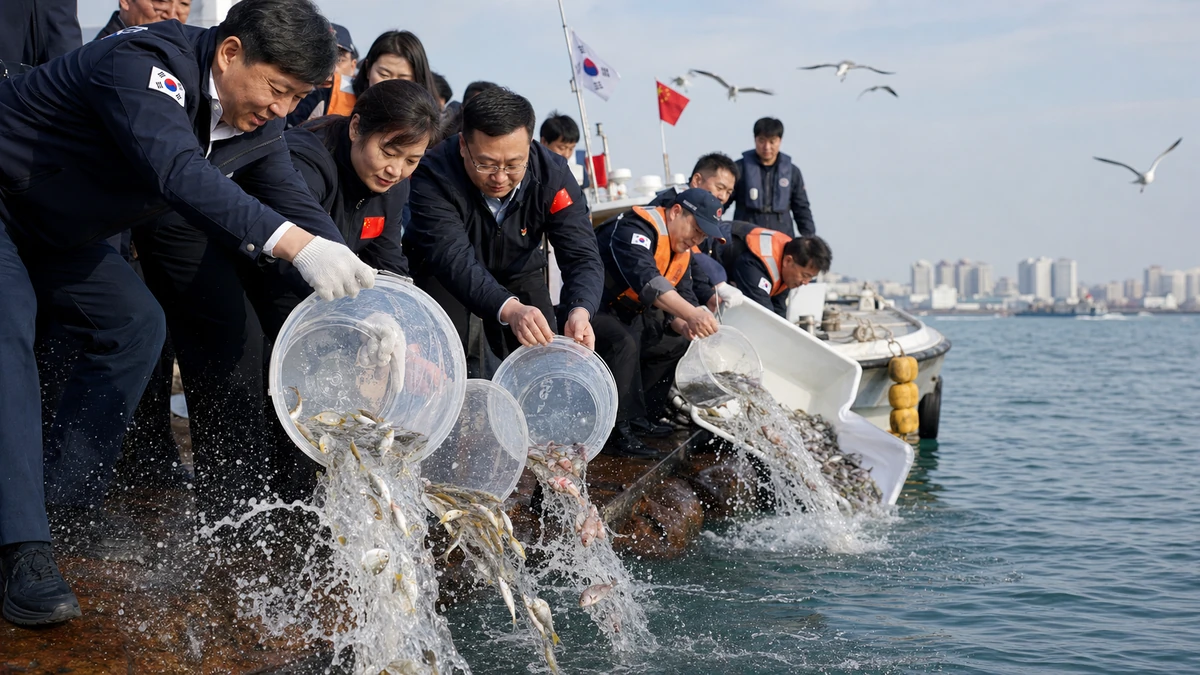
South Korea and China have jointly released 7.29 million juvenile fish and crabs into the Yellow Sea, a move officials in both countries described as part of a long-running effort to restore depleted marine resources and protect a fragile coastal ecosystem. The release took place simultaneously off Incheon, the major port city west of Seoul, and in Yantai, a coastal city in China’s Shandong province across the water.
On paper, the event might sound modest: hatchery-raised juveniles were released into the sea in hopes of boosting future stocks. South Korea released 4.29 million young croaker, red sea bream and blue crabs off Incheon, while China released 3 million filefish, blue crabs and black porgy near Yantai, according to reports citing Chinese state media and official statements. But the symbolism of the event goes beyond aquaculture logistics.
For two countries whose relationship is often described through the lens of strategic rivalry, supply chains, missile defense, or tensions involving the United States, this was something quieter and more practical. It was a reminder that South Korea and China are not only neighbors in a geopolitical sense. They also face one another across a shared body of water where fish migrate, tides move pollutants and environmental damage ignores national borders.
That makes the Yellow Sea — known in Korea as the West Sea, or Seohae — a place where cooperation is not merely idealistic. It is often necessary. Fish do not stop at an invisible maritime line. Neither do changes in water temperature, habitat loss or declining spawning grounds. If one country tries to restore stocks while the other does not, the ecological payoff can be limited. The same is true for pollution and overfishing: one side’s actions can easily affect the other.
In that sense, the joint release was less a ceremonial act than a public demonstration of a simple reality. In Northeast Asia, even at moments of political strain, some problems still demand shared management.
What exactly happened off Incheon and Yantai
The coordinated release took place in two coastal cities with deep maritime identities. Incheon, South Korea’s third-largest city, is best known to many Americans as the site of Gen. Douglas MacArthur’s dramatic landing during the Korean War. Today, it is one of the country’s busiest ports and a gateway to the capital region. It also sits directly on the Yellow Sea, where fishing, shipping and coastal industry shape everyday life.
There, South Korean authorities released 4.29 million fish and crab juveniles into nearby waters. The species included croaker, a fish familiar to Korean consumers and prized in home cooking; red sea bream, a valuable commercial species; and blue crabs, which are especially important in Korean cuisine and coastal fisheries. Blue crabs, for example, are widely used in spicy stews and soy-marinated dishes that are staples in many Korean households.
On the Chinese side, the release took place near Tianma Trestle in Yantai, a city on the Shandong Peninsula that faces the same sea from the opposite shore. Yantai is an important port and fishing center on China’s eastern coast. Chinese authorities released 3 million juveniles, including filefish, blue crabs and black porgy.
The species differed by country, but the objective was shared: rebuild fisheries resources in a semi-enclosed sea where ecological health matters not just to marine scientists and bureaucrats, but to fishing communities, seafood markets and consumers. The simultaneous timing was a message in itself. This was not one country acting first and the other following later. It was a coordinated gesture, staged in parallel, to underline that the two sides see the problem as common.
That message matters because fisheries management can easily become contentious. When fish stocks fall, governments come under pressure from local fishermen, who often face tighter catch limits, higher costs and shrinking incomes. In many parts of the world — from the Gulf of Maine to the South China Sea — coastal resource disputes can turn political fast. By coordinating these releases, Seoul and Beijing appeared to be emphasizing cooperation over blame.
A program that has continued since 2018
This was the seventh joint fishery resource enhancement and release event between South Korea and China since the program began in 2018, according to the Korean summary of the reports. The effort continued annually except during the disruption caused by the COVID-19 pandemic. Over that period, the two countries have released a combined 18.75 million juvenile marine animals into the Yellow Sea.
That cumulative number is significant less because of the headline figure alone than because it suggests institutional continuity. Environmental projects can be easy to announce and easy to forget. Budgets change. Political attention shifts. Elections intervene. Diplomatic moods sour. Yet this program has continued over multiple years, which indicates that both governments see value in maintaining at least one channel of practical maritime cooperation.
For American readers, there is an analogy here to cross-border environmental management between the United States and Canada. Whether the issue is salmon, Great Lakes water quality or migratory birds, the principle is familiar: a shared ecosystem requires repeated coordination, not a one-time event. The work is often technical and unglamorous, but it can become one of the steadiest forms of international engagement.
That appears to be what is happening here. The annual release program does not resolve every fisheries problem in the Yellow Sea. It does not erase broader disagreements between South Korea and China. But it creates a small, durable framework through which officials, scientists and local stakeholders can keep working on something concrete.
The fact that this year’s release of 7.29 million juveniles accounts for a sizable portion of the total cumulative number also suggests an expanding scale or renewed emphasis. Whether that reflects improved hatchery capacity, greater policy support or a desire to send a stronger public signal is not fully clear from the available reports. Still, the sheer size of the release makes it harder to dismiss as merely symbolic.
Why fish releases matter — and what they cannot prove
Releasing juvenile fish and crabs into coastal waters is a common fisheries management practice in parts of Asia and elsewhere, but it can be misunderstood. It is not the marine equivalent of flipping a switch and restoring a damaged ecosystem overnight. Hatchery releases are intended to supplement wild populations, support future catches and, in some cases, help stabilize species under pressure. But their effectiveness depends on many factors, including survival rates, habitat quality, water conditions, predation and fishing pressure after release.
That means the latest South Korea-China initiative should be understood with some caution. The reports establish the scale of the release, the species involved, the locations and the continuity of the program since 2018. What they do not provide are detailed outcome measures: how many of the released animals are expected to survive, how much the program has affected catch volumes, or whether biodiversity indicators in the Yellow Sea have improved as a direct result.
That distinction is important in journalism, especially in environmental coverage. Large numbers can create the impression of guaranteed success, but marine ecosystems are notoriously difficult to engineer. Scientists have long debated when stocking programs are most useful and when they risk becoming a substitute for harder reforms such as stricter catch enforcement, habitat restoration or pollution control.
Still, the absence of definitive results does not make the effort meaningless. In fisheries policy, repeated coordinated action can matter even when outcomes are gradual and imperfect. If the Yellow Sea’s fish stocks have been weakened by overfishing, warming waters, coastal development and other pressures, then no single intervention is likely to reverse the damage alone. Hatchery releases may be one tool among several.
And from the standpoint of coastal communities, even incremental gains can be meaningful. When fishery resources decline, the effects are not abstract. They show up in smaller catches, thinner profit margins and more uncertainty for families whose livelihoods depend on the sea. That is true in Korean and Chinese fishing ports, just as it is in places such as Louisiana, Alaska or New England.
Chinese state media, according to the summary, linked the release effort to higher incomes for fishermen. That is a plausible policy goal, but one that would require longer-term data to verify. For now, the stronger conclusion is narrower: the two governments are continuing to invest in a program designed to support resource recovery, even if the exact payoff remains to be measured.
The Yellow Sea’s place in Korean life
To understand why this story matters in South Korea, it helps to understand the role of the Yellow Sea in Korean geography, economy and identity. The sea borders the Korean Peninsula’s west coast and includes tidal flats, islands, shipping lanes and fishing grounds that have supported communities for generations. Incheon, where South Korea’s portion of the release took place, is not just a modern logistics hub with an international airport. It is also part of a coastline where marine life has long shaped local commerce and cuisine.
Seafood occupies a central place in Korean food culture, though international audiences often focus more on Korean barbecue, fried chicken or instant ramen because those are the Korean dishes that traveled most easily through pop culture. In reality, everyday Korean meals frequently include fish, shellfish, fermented seafood products and banchan — the small side dishes served with rice and soup. Blue crab, one of the species released in both countries, is especially recognizable in Korea because it appears in dishes that many Koreans associate with home-style cooking and seasonal eating.
The Yellow Sea also carries strategic and emotional weight. It is a zone of shipping and commerce, but also of occasional military tension, especially near the maritime boundary with North Korea. That can make stories of ecological cooperation along the western coast stand out. They present a different image of the sea: not as a line of confrontation, but as a shared habitat needing stewardship.
For South Korea, there is another layer. The country’s global image in the United States has been transformed over the past two decades by what is often called the Korean Wave, or Hallyu — the worldwide popularity of Korean music, television dramas, film, beauty products and food. For many Americans, South Korea is now associated with BTS, "Parasite," "Squid Game," Samsung and a dynamic export economy. What stories like this one reveal is a less visible side of modern Korea: a middle power managing the unglamorous but essential work of regional environmental governance.
That matters because countries are not only defined by their most marketable cultural exports. They are also shaped by the practical choices they make about shared resources, local livelihoods and long-term sustainability.
China’s state media and the language of ecological diplomacy
The report on the joint release was carried by Chinese state media, including coverage linked to official government announcements. That detail is notable in itself. In China’s media system, stories highlighted by state outlets are often intended to do more than inform. They can also signal policy priorities and frame how audiences should interpret an event.
In this case, the framing appears straightforward: China and South Korea were shown working together in the service of ecological recovery and shared prosperity. That kind of narrative fits neatly with a broader diplomatic pattern in which environmental cooperation is used to demonstrate responsibility, stability and mutual benefit — especially in relationships that may be complicated in other areas.
For journalists, the involvement of state media also raises the usual need for care. Official accounts can provide useful factual details, but they often emphasize positive messaging and leave out ambiguity. That is one reason the absence of post-release outcome data stands out. Governments can celebrate the act of cooperation more easily than they can prove ecological results in real time.
Even so, the political value of the event should not be underestimated. Much of the international coverage of South Korea-China relations centers on contentious topics: Beijing’s response to U.S.-South Korea security coordination, trade frictions, concerns over technology dependence, and differing positions on North Korea. Those issues are real and important. But if that is the only frame, it becomes harder to see the smaller systems of cooperation that keep neighboring countries functioning side by side.
Marine resource management is one such system. It lacks the drama of summit meetings and the audience pull of security crises. Yet it may be more revealing of how states behave when they are forced to deal with a common physical reality. The sea demands coordination whether politicians are eager for it or not.
What this says about South Korea’s broader global role
There is a temptation, especially in American coverage of Asia, to read every development through great-power competition. Stories become shorthand for U.S.-China rivalry, alliance politics or industrial strategy. Those frames are often justified, but they can flatten countries like South Korea into supporting roles in someone else’s geopolitical script.
This marine release project suggests a broader view. South Korea is not only a U.S. ally, a semiconductor powerhouse or a cultural super-exporter. It is also a country that must manage a difficult neighborhood through a mix of hard security, economic pragmatism and technical cooperation. Sometimes that cooperation happens in highly visible settings, such as climate summits or trade negotiations. Sometimes it happens in the water off Incheon, where millions of juvenile fish and crabs are released in coordination with a larger and often more politically difficult neighbor.
That is why the event can be understood as a form of small-scale diplomacy. Not diplomacy in the grand sense of treaty signing or summit declarations, but diplomacy rooted in shared maintenance. The concept may feel familiar to Americans who have watched local officials and federal agencies work across state lines on rivers, wildfire management or coastal restoration. The scale is regional, the language technical, but the politics are real.
South Korea has become adept at this kind of layered statecraft. It can project soft power through entertainment, compete economically in advanced industries and still engage in the less visible administrative work that keeps regional systems intact. In that respect, the fish release is not an outlier. It is part of a larger pattern in which Seoul operates as a highly networked middle power, balancing national interests with practical cooperation.
For English-speaking audiences, that may be the most useful takeaway. The story is not just about fish. It is about how two Asian neighbors, despite mistrust and asymmetry, continue to return to a shared problem because they have to. Climate stress, biodiversity loss and pressure on food systems will only make such arrangements more important in the coming years.
Whether this year’s 7.29 million released juveniles will produce measurable gains in catches or ecosystem health is a question for future data. But the immediate significance is already clear. South Korea and China chose, once again, to treat the Yellow Sea as a shared responsibility. In an era when international news is so often dominated by confrontation, even a modest example of functional cooperation is worth noticing.
And for South Korea, the message reaches beyond this single shoreline. The country’s story on the world stage is no longer told only through K-pop, Oscar-winning films or advanced consumer technology. It is also told through the quieter work of tending a common sea.
Comments
Post a Comment