South Korea and the U.S. move to lock down the AI supply chain, signaling a broader shift in tech diplomacy
Why a routine diplomatic meeting matters far beyond Seoul and Washington
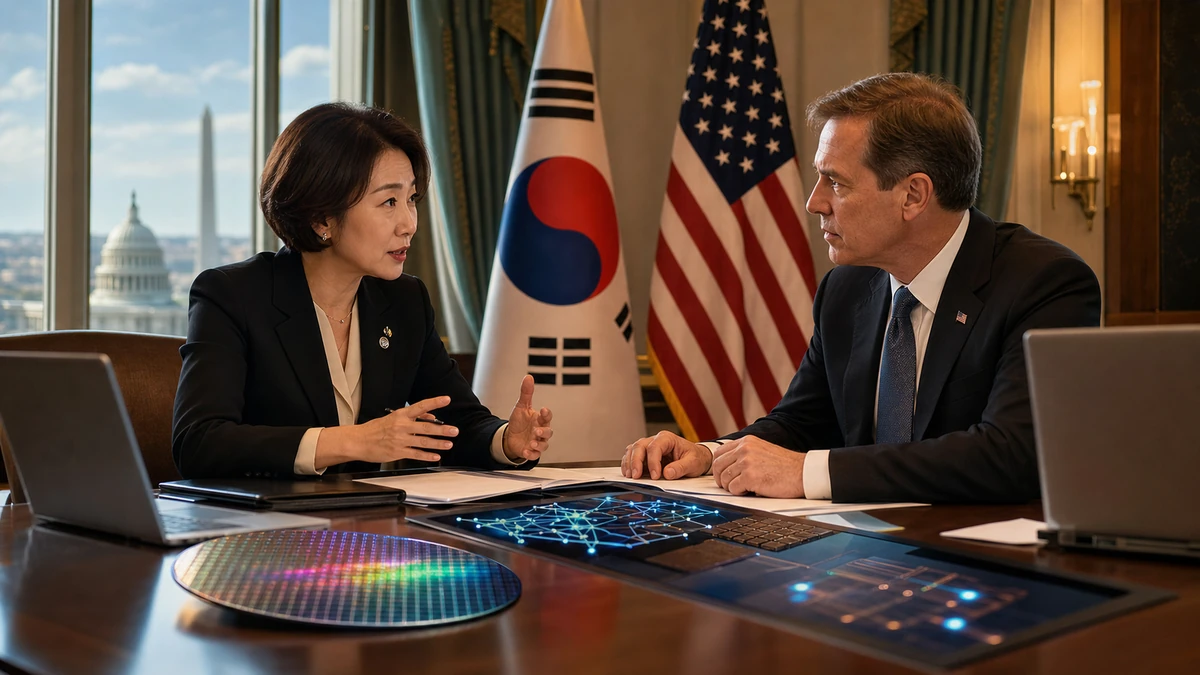
At first glance, the meeting looked like the kind of procedural government encounter that rarely breaks through to a general audience: South Korea’s second vice foreign minister, Kim Jin-a, met in Washington with Jacob Helberg, the U.S. State Department’s undersecretary for economic growth, energy and the environment, to discuss supply chains, artificial intelligence and broader economic cooperation. But beneath the formal language was something much bigger — a window into how the United States and one of its closest Asian allies are trying to shape the physical foundations of the AI economy.
According to South Korea’s Foreign Ministry, the two officials met in Washington on July 24 and discussed the main agenda for the Pax Silica Summit as well as bilateral economic cooperation. They also agreed on the importance of cooperation among what the ministry described as “trusted partners” to stabilize supply chains in advanced industries such as AI and digital technology.
That phrase — “trusted partners” — has become one of the defining ideas of the current global tech era. In Washington, it often means friendly or aligned countries that can be counted on to supply critical components, raw materials, manufacturing capacity and investment without the geopolitical risks associated with strategic rivals. In plain English, it reflects a lesson both governments absorbed during recent shocks, from the pandemic to semiconductor shortages to intensifying U.S.-China competition: It is not enough to invent breakthrough technologies. Countries also need to know who will mine the materials, generate the electricity, fabricate the chips, build the equipment and keep the system running when politics or conflict disrupt the market.
That is why this meeting deserves attention from English-speaking readers, even if it did not produce a splashy new agreement or a headline-grabbing dollar figure. The significance lies less in a single announcement than in what the conversation reveals. South Korea is not positioning itself merely as a participant in AI-era economic talks. It is increasingly presenting itself as a country that can help build, secure and execute the industrial architecture that AI depends on.
For Americans used to thinking of AI in terms of ChatGPT, Silicon Valley, Nvidia chips or a race among tech giants, the Korean angle may not be obvious. But South Korea’s role sits much closer to the hardware and manufacturing side of the story. It is home to world-leading semiconductor companies, advanced manufacturers and an export-driven industrial base that has long made it a critical node in global supply chains. What Washington and Seoul are now signaling is that those capabilities are no longer just commercial assets. They are becoming instruments of diplomacy.
AI is not just software — it is chips, power, minerals and factories
One of the most important takeaways from the Washington meeting is the reminder that AI is often misunderstood in public debate. In the United States, AI discussions frequently center on the software layer: chatbots, image generators, automation, copyright disputes and the fear that machines may replace white-collar jobs. Those are real issues, but they describe only one part of the AI story.
Large-scale AI systems run on an enormous physical backbone. They require semiconductors sophisticated enough to train and run advanced models. They require data centers that consume huge amounts of electricity. They require networks of suppliers that produce everything from advanced packaging materials to precision tools. And they require critical minerals — the raw materials essential for electronics, batteries, manufacturing equipment and energy systems. If any of those links break, the AI boom slows down.
That is why the agenda discussed by Kim and Helberg matters. The South Korean government said the Pax Silica framework focuses on building stable supply chains across AI-related sectors including critical minerals, energy, advanced manufacturing and semiconductors. In other words, the conversation was not about one app, one chip or one company. It was about the ecosystem that makes the whole AI economy possible.
For American readers, there is a useful comparison here to the Biden-era push to bring semiconductor manufacturing back to U.S. soil through the CHIPS and Science Act, and the broader bipartisan concern about overreliance on vulnerable overseas supply chains. U.S. policymakers have increasingly concluded that technological leadership depends not just on research labs, but on resilient industrial capacity. South Korea’s value in that conversation comes from the fact that it already occupies a strategic position in several of those layers — especially semiconductors and advanced manufacturing.
In that sense, this is not simply a Korean foreign ministry meeting that happened to mention AI. It is part of a wider effort to redesign the rules of economic security around emerging technology. The logic is straightforward: The country or coalition that can secure dependable access to the components of AI will hold a major advantage in the next phase of global competition.
What Pax Silica is trying to build
The framework at the center of this discussion, Pax Silica, is not yet a household name in the way NATO, the G-7 or even APEC is. But the concept points to an increasingly important trend in international politics: countries building coalitions not only around security commitments or trade liberalization, but around the industrial foundations of key technologies.
According to the South Korean Foreign Ministry, Pax Silica was launched in December of last year and includes 18 countries. Its purpose is to establish stable supply chains across sectors tied to AI, including semiconductors, advanced manufacturing, energy and critical minerals. Even the name carries a message. “Silica” evokes the material basis of semiconductors, while “Pax” suggests a rules-based order or zone of coordination among like-minded states.
That is important because the group’s purpose appears broader than simply co-developing a product or negotiating a tariff reduction. It is trying to create a trusted ecosystem — one in which countries that share strategic concerns can coordinate on the hard infrastructure of advanced technology. If successful, such a framework could help reduce vulnerability to supply disruptions, lower the risk of coercion by rival powers and speed up investment decisions among member countries.
For Americans, the easiest way to understand this is to think of AI not as an app-store competition, but as something closer to the global energy market or the defense industrial base. It requires strategic planning, dependable partners and long-term commitments. In that context, a forum like Pax Silica becomes less about diplomacy for diplomacy’s sake and more about industrial alignment.
South Korea’s participation gives the group real weight. Seoul is not a peripheral technology player seeking relevance through multilateral branding. It brings serious industrial capabilities to the table. It also brings a track record of working closely with the United States while maintaining a globally integrated manufacturing economy. That combination makes it useful in a world where Washington wants both resilience and scale.
At the same time, the meeting in Washington suggests South Korea sees value in operating on two tracks at once: strengthening bilateral cooperation with the United States while also working through a larger 18-country framework. That dual approach reflects a larger truth about today’s technology politics. No single alliance, company or country can fully control the AI supply chain on its own. The challenge is too broad, stretching from mining and processing to fabrication, power generation, logistics and regulation.
Why South Korea is leaning into an execution-based message
Another notable point from the South Korean account was Kim’s emphasis on implementation. The Foreign Ministry said she explained South Korea’s efforts to carry out strategic investment projects in the United States, including the enforcement of a special law on South Korea-U.S. strategic investment and the launch of a strategic investment corporation tied to that effort.
That may sound bureaucratic, but in Washington such details matter. American officials and investors have grown accustomed to hearing governments promise partnership, resilience and shared values. What often matters more is whether those promises are backed by legal mechanisms, financing tools and institutions capable of turning announcements into factories, contracts and supply flows.
In other words, South Korea appears to be telling the United States that it is not coming to the table with rhetoric alone. It is trying to show that it has built domestic machinery for follow-through. That is a meaningful shift in the language of diplomacy. Traditional foreign policy often emphasized broad alignment — support for the alliance, support for trade, support for regional stability. Tech diplomacy increasingly demands something more concrete: Can you invest? Can you manufacture? Can you deliver on schedule? Can your domestic system support long-term coordination?
There is also a cultural dimension here worth explaining for readers outside Korea. South Korean governments often place strong emphasis on implementation and state-backed industrial coordination, particularly in sectors considered nationally strategic. That does not mean a top-down command economy. Rather, it reflects a development model in which government policy, industrial planning and major private-sector players frequently move in closer coordination than Americans might be used to seeing. In advanced sectors such as semiconductors, batteries and digital infrastructure, that coordination can become a geopolitical asset.
The South Korean statement did not provide details about investment size, specific new projects or fresh bilateral commitments, so it would be premature to claim a breakthrough. But even without that, the underlying message is clear. Seoul wants Washington to see it as a partner capable of execution at a time when credibility in advanced-industry cooperation depends on more than goodwill.
The strategic meaning of “trusted partners” in the U.S.-China era
The phrase “trusted partners” may sound bland, but it carries substantial geopolitical weight. It is shorthand for one of the central dilemmas of the 21st-century economy: how to preserve the efficiencies of globalization while reducing strategic dependence on countries viewed as risky, coercive or politically adversarial.
That concern has intensified sharply in Washington over the past several years. China remains deeply embedded in many global supply chains, from manufacturing and minerals processing to consumer electronics. At the same time, U.S. policymakers across both parties have become increasingly wary of relying too heavily on China for critical technologies and industrial inputs. The result has been a wave of concepts such as “de-risking,” “friend-shoring” and “economic security.”
South Korea occupies an especially interesting place in that landscape. It is a treaty ally of the United States and a high-capacity technology producer, but it is also geographically close to China and economically intertwined with it. That means Seoul often has to balance strategic alignment with Washington against the commercial realities of regional trade. When South Korean officials publicly embrace the language of trusted partnership in advanced-industry supply chains, they are signaling that Korea intends to be counted within the U.S.-aligned camp on key technology infrastructure.
For American readers, a useful analogy may be Europe’s reassessment of Russian energy dependence after the invasion of Ukraine. The lesson in both cases is similar: a supply relationship that looks efficient in stable times can become a major vulnerability during geopolitical stress. In AI, the relevant chokepoints are different — chips rather than gas pipelines, minerals rather than oil tankers — but the strategic logic is familiar.
This is why a vice-minister-level meeting about AI supply chains is more than a niche trade story. It reflects the merging of national security, industrial policy and diplomacy. That merger is one of the defining features of the current international order. Countries are no longer treating advanced technology as a neutral marketplace alone. They are treating it as a terrain of competition that must be secured through alliances, capital, law and manufacturing capacity.
Why semiconductors and advanced manufacturing now sit at the diplomatic table
For decades, diplomacy and industry often occupied separate lanes. Diplomats handled alliances, treaties and crises; corporations handled production and markets. That division has weakened dramatically. Today, semiconductors, battery materials, electric grid resilience and advanced manufacturing regularly appear alongside traditional foreign policy topics because the health of those sectors now influences military readiness, economic growth and technological leadership.
The Washington meeting between Kim and Helberg reflects that shift. The agenda connected AI, digital industry, supply chains, advanced manufacturing, semiconductors and strategic investment in a single conversation. That convergence tells us something important about how governments now view technology: not as an isolated business sector, but as part of the core architecture of national power.
South Korea is especially relevant to that transition because of its manufacturing depth. Americans may know Korea culturally through K-pop, Korean dramas, beauty products or food — all part of the broader Korean Wave, or “Hallyu,” the global spread of South Korean popular culture. But Korea’s economic influence rests just as much on less glamorous strengths: memory chips, display panels, shipbuilding, batteries, automotive production and precision manufacturing. Those capabilities are exactly the kind that become strategically valuable when countries start worrying about who can reliably support the digital economy at scale.
That helps explain why South Korea’s role in AI diplomacy may grow even if it is not always the loudest voice in AI software branding. A country does not have to produce the most famous chatbot to matter profoundly in the AI race. It can matter because it helps produce the chips, materials, capital coordination and industrial reliability that the entire field depends on.
From Washington’s perspective, that makes Seoul a practical partner. From Seoul’s perspective, it creates both opportunity and pressure. Opportunity, because global powers need Korea’s industrial strengths. Pressure, because with that importance comes the expectation that Korea will explain not only its strategic intentions, but its implementation record.
What this means for the future of the U.S.-South Korea alliance
The broader significance of the meeting is that it shows how the U.S.-South Korea relationship is evolving. For most Americans, the alliance is still primarily associated with defense: U.S. troops on the Korean Peninsula, deterrence against North Korea and regional stability in Northeast Asia. Those priorities remain central. But the alliance is increasingly becoming economic and technological as well.
That evolution mirrors a larger trend in U.S. foreign policy. Alliances are no longer measured only by troop deployments or diplomatic statements. They are also measured by whether partners can help build resilient supply chains, support strategic industries and reduce dependence on adversarial systems. In this sense, the future alliance is as much about fabs, minerals and energy security as it is about missiles and military drills.
The Washington talks do not mean every problem has been solved. Supply-chain coordination across countries is difficult. Domestic politics can interfere with long-term industrial plans. Business incentives do not always align neatly with geopolitical strategy. And because the South Korean statement did not announce a new project or final agreement, much remains to be seen.
Still, the direction of travel is unmistakable. South Korea is participating in a multilateral framework focused on the AI industrial base. Its senior diplomatic officials are discussing that framework directly with U.S. counterparts in Washington. And Seoul is presenting its own legal and institutional efforts as evidence that it can deliver on strategic investment cooperation.
For an American audience, the takeaway is straightforward. If the next era of global power is shaped not only by who invents the best AI models but also by who secures the most reliable industrial ecosystem behind them, then South Korea is likely to be one of the countries that matters far more than casual observers realize. This was not just another meeting in a government building. It was a glimpse of the emerging map of tech power — one in which the United States and South Korea are trying to ensure that the supply chains behind artificial intelligence are built among partners they trust, rather than left to chance.
That may sound like technical policy language. But its consequences are concrete. It will affect where factories are built, where investments flow, how secure future technologies are and which countries get to shape the rules of the digital age. In that sense, what happened in Washington was not a side story to the AI race. It was part of the race itself.
Comments
Post a Comment