South Korea’s green pivot comes into focus in an unlikely place
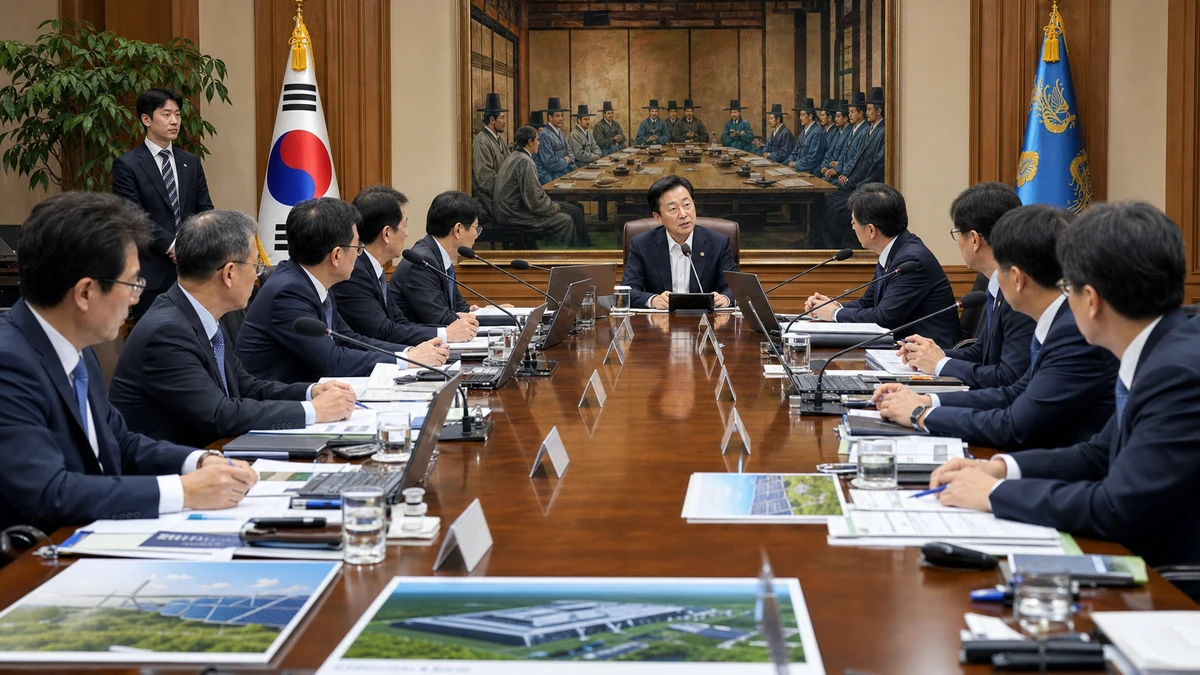
South Korea’s top economic policymaker traveled this week to a stretch of coastal land in the country’s far southwest and used the visit to deliver a message that goes far beyond one local development project: The government wants to spend much more aggressively over the next decade to push the country’s transition to a greener, more technologically advanced economy.
At Solar City, or Solaseado, in Haenam County, Deputy Prime Minister Koo Yun-cheol said South Korea would sharply expand fiscal investment for what officials call the “green transition” over the next 10 years. He also pointed to a broader package of tools — tax incentives, green and transition finance, and regulatory changes — meant to make it easier for private companies to invest alongside the government.
For American readers, the easiest comparison may be the way the United States has tried to use public money, tax credits and industrial policy to steer investment into semiconductors, electric vehicles and clean energy through legislation such as the Inflation Reduction Act and the CHIPS and Science Act. South Korea is operating on a smaller geographic scale, but the strategic logic sounds familiar: Build the infrastructure, lower the cost of investment, reduce red tape and try to secure the industries that will define the next generation of economic growth.
What makes the visit notable is that Koo did not frame green policy mainly as a climate or conservation issue. Instead, he presented it as a core industrial strategy. In the South Korean context, that matters. This is a country whose economy depends heavily on exports, advanced manufacturing and industrial competitiveness. Changes in energy costs, power supply and industrial location can directly affect the strength of major sectors ranging from batteries and autos to electronics, cloud computing and chipmaking.
The symbolism of the trip matters, too. Rather than making the announcement in Seoul, the country’s capital and dominant economic center, Koo went to Haenam, a mostly rural county in South Jeolla Province near the southwestern tip of the Korean Peninsula. That choice underscored another Korean policy priority: spreading future growth beyond the Seoul metropolitan area, where jobs, wealth and population have long been concentrated.
In that sense, the Haenam visit was not just about one solar project. It was a field-level demonstration of how South Korea increasingly sees the future — not simply as a matter of recovering from short-term economic pressures, but of rewiring its energy base, digital infrastructure and regional growth model at the same time.
What Solaseado is, and why Seoul is paying attention
Solaseado is being promoted as a next-generation growth hub that combines renewable energy, advanced industry and tourism in a single large-scale development zone. For readers unfamiliar with South Korean geography, Haenam is about as far from Seoul, politically and economically, as a major national project can get while still being inside the country. It is agricultural, coastal and better known domestically for open landscapes and seafood than for high-tech industry.
That is precisely why the site is important. South Korean officials are trying to show that the green transition is not just about retrofitting existing factories near major cities. It is also about creating new industrial geography — places where power generation, digital infrastructure and industrial sites are planned together from the ground up.
During the visit, Koo toured land designated for a data center as well as nearby solar power facilities, according to the Korean news summary. He later met with companies and experts. That itinerary tells its own story. Data centers are among the most energy-hungry pieces of modern infrastructure, and around the world they are under growing pressure to prove they can secure reliable electricity while cutting emissions. Pairing them with renewable energy sources is not a simple fix, but it has become an increasingly attractive strategy as governments and tech firms alike search for cleaner ways to power the digital economy.
South Korea’s government appears to see Solaseado as a place where that equation could be tested at scale: renewable power generation nearby, industrial land available for development, and a chance to build a cluster rather than a standalone facility. In the language often used by economic planners, the goal is not just to host a project but to create an ecosystem.
There is also a political layer. South Korean administrations often try to put a distinctive stamp on regional development, especially when they want to show they are serious about reducing the imbalance between the capital region and the rest of the country. When Koo described Haenam as a forward base for the Lee Jae-myung government’s “GX” strategy — shorthand for green transformation — he was signaling that this is meant to be a flagship location, not an afterthought.
For global investors and policy watchers, the more interesting question is whether Solaseado can become a real test case for integrating clean power, digital infrastructure and industrial development in one place. If it can, the project could serve as a model for how middle-sized advanced economies compete in a world where energy security, artificial intelligence capacity and industrial decarbonization increasingly overlap.
Why fiscal investment matters in South Korea’s industrial playbook
Koo’s promise to significantly expand fiscal investment over the next decade is important because in South Korea, government spending is not just a macroeconomic tool. It is often used as a strategic instrument to shape markets, support technology development and build industrial capacity.
In plain terms, fiscal investment means the state is prepared to use budget resources and policy support to develop industrial foundations, research and development capacity and regional infrastructure. That can include everything from transmission and site preparation to pilot programs, public financing mechanisms and support for local governments. Officials did not, based on the source summary, announce a specific budget figure during the visit. But the policy direction itself is significant.
That is because green transformation in an export-oriented economy like South Korea’s is expensive and complicated. Private companies may want to invest in next-generation solar, battery-linked systems, grid upgrades or clean-powered data facilities, but they often hesitate if land use rules are uncertain, financing is costly, interconnection is slow, or government policy looks temporary. By pledging long-horizon fiscal support, Seoul is trying to reduce some of that uncertainty.
For Americans, this may sound similar to a debate that has played out in Washington: whether industrial policy is an efficient use of public money or an essential response to strategic competition and climate change. South Korea has historically been more comfortable than the United States with a strong state role in guiding industrial development, especially in sectors viewed as nationally important. The country’s rapid rise in shipbuilding, steel, automobiles, consumer electronics and semiconductors was shaped in part by close coordination between government and large business groups known as chaebol, family-controlled conglomerates such as Samsung, Hyundai and LG.
Today’s green transition differs from those earlier industrial drives in important ways, but the state’s underlying instinct remains recognizable: If the market alone will not move fast enough, government should help build the platform on which private investment can follow. Koo’s remarks suggest Seoul now sees clean energy, advanced data infrastructure and low-carbon industrial sites as part of that platform.
Just as important, the announcement suggests South Korean policymakers are increasingly treating the green transition as a growth engine rather than merely a compliance burden. In a country where export industries must sell into markets with tightening carbon standards and increasingly climate-conscious consumers, the ability to produce clean power and attract green capital is becoming a competitiveness issue. In that sense, public spending on the green transition is being framed not as charity for environmental goals, but as a down payment on future market share.
Solar, data centers and the race to define the next industrial cluster
One of the most revealing parts of Koo’s message was his emphasis on “next-generation solar” and top-tier advanced technology and products capable of leading global markets. That language is familiar in South Korea, where policymakers often speak in terms of being first, best or globally dominant in targeted industries. It reflects a national development model built on moving quickly up the value chain.
Solar power, of course, is not new. But next-generation solar can refer broadly to improved efficiency, better materials, more advanced manufacturing processes, smarter installation environments and other innovations that make solar more competitive and more useful at industrial scale. South Korea is not the world’s biggest solar market, nor is it the only country trying to localize parts of the clean-energy supply chain. What it can offer, however, is a sophisticated manufacturing base and a proven ability to integrate advanced engineering into exportable products.
The addition of data centers makes the strategy even more interesting. Around the world, the rise of artificial intelligence, cloud services and digital platforms has intensified demand for large-scale data infrastructure. Those facilities need steady power, cooling capacity and reliable network connections. They also face growing scrutiny over their environmental footprint. A data center running on or linked to renewable energy can be more appealing to both operators and their customers, especially multinational firms under pressure to meet sustainability targets.
That does not mean the challenge is solved simply by putting solar panels near server racks. Renewable energy supply can be intermittent, and data centers typically require uninterrupted electricity. Bridging that gap may require storage, grid upgrades, backup systems and smarter energy management. Still, the Korean government’s decision to tour solar facilities and a data center site together signals that it sees the intersection of clean power and digital infrastructure as one of the key battlegrounds of future competitiveness.
For the United States, there is an obvious parallel in states such as Texas, Arizona or Nevada, where abundant land, growing renewable energy capacity and business-friendly development policies have made certain regions attractive for data centers and advanced manufacturing. South Korea, with far less land and a denser population, does not have the same spatial advantages. That makes site selection and coordination even more critical. A place like Solaseado becomes valuable not because it is huge by American standards, but because it can be planned in a tightly integrated way.
If South Korea can make such sites work, it may gain something valuable in global competition: proof that a compact, import-dependent economy can still carve out an edge in a world where industrial policy is increasingly shaped by the links between energy, technology and geography.
The tax, finance and regulatory package behind the message
Another key feature of Koo’s remarks is what he did not do: He did not suggest government spending alone would carry the transition. Instead, he paired fiscal investment with tax incentives, green and transition finance, and what the summary described as bold regulatory innovation.
That package matters because large industrial projects often fail not for lack of political speeches, but because of bottlenecks. A renewable energy installation may run into land-use disputes or grid connection delays. A data center may face questions about power allocation, local permits or water use. An industrial complex may struggle to line up enough private financing if rules are unclear or if returns depend on policy that could later change. In other words, money helps, but predictability matters just as much.
Tax incentives are one obvious lever. They can reduce the upfront cost of investment, improve project economics and help attract firms deciding among several possible locations. Green and transition finance is another. In this context, transition finance generally refers to funding mechanisms that help companies or regions move from more carbon-intensive systems toward lower-carbon ones, even if the destination is not achieved overnight. For a government trying to mobilize capital for long-lived infrastructure, such financing tools can be as important as direct subsidies.
Regulatory reform may be the hardest part. South Korea, like many advanced economies, has a reputation for having layers of permits, local approvals and bureaucratic coordination challenges. Businesses frequently say that uncertainty over licensing, grid access or project timelines can be as discouraging as high costs. By meeting with companies and experts on site, Koo appeared to be signaling that the government wants to identify those choke points early and present itself as a problem solver.
That does not mean all barriers will disappear. Rural development projects can stir local concerns anywhere in the world, including over land use, environmental effects, visual impact and whether promised jobs will actually benefit nearby residents. South Korea is no exception. The same project that excites national planners can generate skepticism on the ground if people believe benefits will flow elsewhere.
Still, the policy mix described in Haenam suggests a more mature phase of Korean green strategy. Rather than treating climate-related investment as a separate environmental silo, officials are bundling it with the core tools of economic management: taxation, finance, infrastructure planning and industrial regulation. That is often what distinguishes a symbolic policy push from a serious one.
Why this matters beyond South Korea
For international audiences, especially in the United States, the Haenam announcement is worth watching because it illustrates how a close U.S. ally is repositioning itself in a period of intense competition over energy systems and advanced industry.
South Korea already has global weight in semiconductors, batteries, electric vehicles, shipbuilding and consumer technology. What the government now appears to be attempting is to connect that industrial base more directly to clean power and digital infrastructure. If successful, that could strengthen the country’s appeal as a location for future-facing investment, from AI-related facilities to low-carbon manufacturing.
There is also a geopolitical dimension. Countries across Asia, Europe and North America are all trying to reduce strategic vulnerabilities in supply chains while meeting climate goals and supporting domestic industry. South Korea sits in a particularly delicate position: It depends heavily on exports, imports most of its energy, competes with China in manufacturing, partners closely with the United States on technology and security, and must constantly think about resilience in the face of regional uncertainty. That makes green industrial policy not just an economic matter, but a strategic one.
The Haenam visit also highlights a broader shift in how governments talk about the energy transition. A few years ago, public discussion often treated green policy mainly as a sacrifice — a cost of reducing emissions, a burden on traditional industries, or a moral obligation. Increasingly, governments are selling it as an opportunity to dominate emerging sectors, attract investment and secure long-term competitiveness. Koo’s remarks fit squarely within that trend.
There is reason for caution, of course. Ambitious announcements do not automatically turn into successful projects. South Korea will need to show how the promised spending is reflected in actual budgets, how financial programs are structured, what regulations are changed and how quickly developers can move from planning to construction. It will also need to demonstrate that projects like Solaseado can secure stable power arrangements, win public acceptance and generate real economic value rather than serving as political showcase pieces.
But even with those caveats, the message from Haenam is clear. South Korea wants the world to understand that it sees the green transition not as a niche environmental agenda, but as the organizing framework for its next stage of industrial growth. In American terms, think less “conservation program” and more “strategic economic development plan” — one that tries to link clean energy, advanced manufacturing, digital infrastructure and regional revitalization in a single national project.
That is why a visit to a remote development zone on the southwestern coast matters. What happened in Haenam was not simply a tour of solar facilities. It was a statement about where South Korea thinks the future economy is headed — and about how aggressively the state is prepared to help build it.
What to watch next
The next stage will depend on whether the government can translate broad promises into concrete policy. Investors and analysts will be looking for detailed budget plans, the scale and design of tax incentives, financing programs for green and transition projects, and specific regulatory changes that reduce approval delays or uncertainty.
They will also be watching whether Solaseado becomes an anchor for actual business commitments. So far, based on the source summary, officials have outlined direction rather than finalized specific corporate investments or construction starts. That distinction matters. In South Korea, as elsewhere, big economic announcements can sometimes race ahead of implementation.
Still, the timing is notable. South Korea is juggling immediate economic concerns such as inflation, housing supply and financial conditions while also trying to prepare for deeper structural change. Koo’s message in Haenam suggests that the government does not want to choose between short-term management and long-term transformation. It wants to pursue both at once.
For a country with limited natural resources but a long track record of climbing into high-value industries, that approach makes strategic sense. The question now is whether South Korea can turn a promising vision on paper — renewable energy, next-generation solar technology, green-powered data centers and regional growth outside Seoul — into a model that actually works in practice.
If it can, Haenam may come to represent something larger than one county’s development plan. It could become a symbol of how a U.S. ally in East Asia is trying to write the next chapter of industrial policy in the age of climate change and artificial intelligence.
Comments
Post a Comment