
Aging at home gets a bigger push in South Korea
South Korea is widening an experiment that could reshape how one of the world’s fastest-aging societies cares for older adults: bringing more medical care directly into people’s homes instead of requiring frail seniors to travel to hospitals or move into institutions.
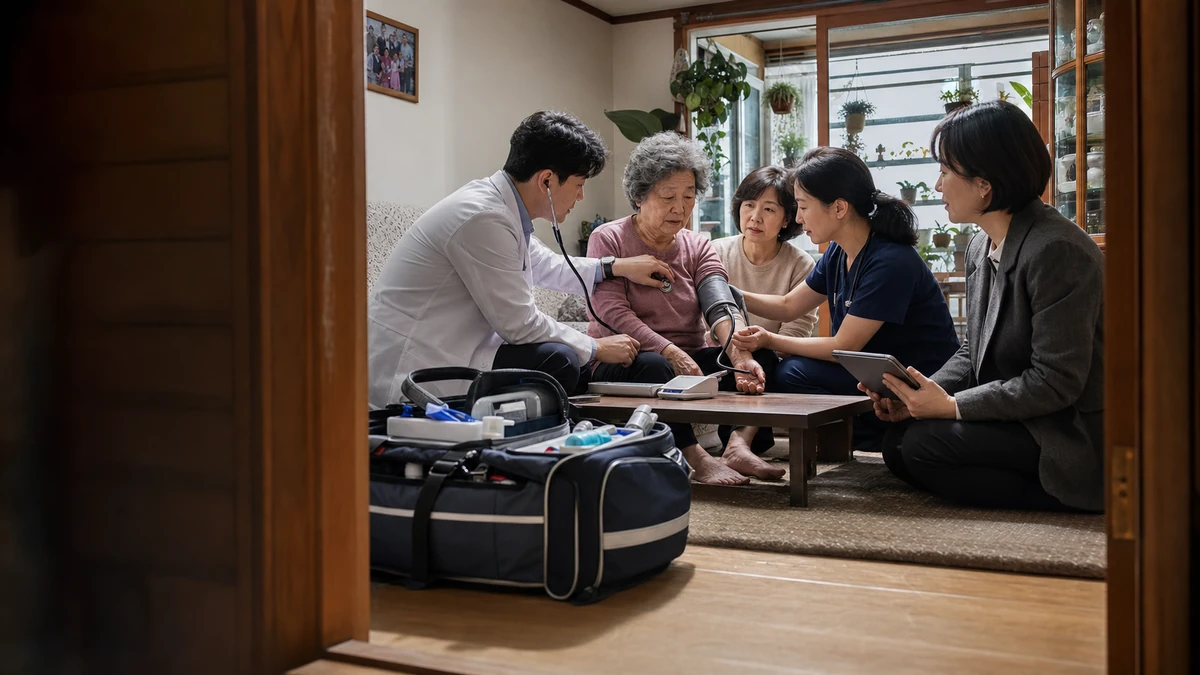
The country’s Health and Welfare Ministry said it has designated 50 additional medical institutions to participate in a pilot program for long-term care home medical centers, according to the Yonhap News Agency. The model is straightforward in theory but significant in practice. A team made up of a doctor, a nurse and a social worker visits older adults who qualify for South Korea’s long-term care insurance system, providing medical treatment while also linking patients to local support services.
For American readers, the idea may sound familiar in part. The United States has long debated “aging in place,” a policy and cultural concept that argues older adults should be able to remain in their homes and communities for as long as possible rather than entering nursing homes or other facilities. But South Korea’s latest move stands out because it tries to weave medical care and daily-life support into a single public framework at a time when the country is confronting a demographic crunch with unusual speed.
In practical terms, the expansion means more older South Koreans with limited mobility may be able to receive checkups, monitoring and ongoing care where they live. In policy terms, it suggests the center of gravity in elder care may be moving, however gradually, from hospital buildings and family caregiving toward a more organized home-based model.
That matters because South Korea, like many wealthy countries, is wrestling with a hard question: What happens when a growing elderly population needs more help than families can easily provide, but does not necessarily need to live in a hospital or residential facility full time?
The answer South Korea is now testing is that the care team should go to the patient, not the other way around.
Why this program is bigger than a simple increase in clinic numbers
On paper, the ministry’s announcement is about adding 50 institutions to a pilot project first introduced in December 2022. But the policy carries weight beyond the number itself. It reflects a broader rethinking of what elder care should look like in a super-aged society, a term used in Asia and elsewhere to describe places where a large share of the population is age 65 or older.
South Korea’s health system has traditionally been hospital-centered in many respects, while family members have often shouldered much of the hands-on caregiving burden at home. That arrangement has become harder to sustain as the country’s birth rate has fallen, households have gotten smaller and more women, who have historically carried much of the unpaid care work, remain in the labor force.
In that environment, a home medical model does more than spare an elderly patient a difficult car ride or ambulance trip. It challenges a long-running assumption that safety and proper treatment are most reliably found inside institutions. Instead, it asks whether professional care can be delivered in the familiar setting of a patient’s own home, with better continuity between medical needs and day-to-day living conditions.
That distinction is crucial. A frail older adult may not just need a doctor to review blood pressure, medication or chronic disease symptoms. The patient may also need help with meals, hygiene, mobility, housing conditions, family support or access to community programs. A hospital can address some of those issues, but not always in a coordinated way once the patient goes home. The home-care center model is designed to close that gap.
South Korean officials have framed the initiative as a way to help older adults with mobility limitations receive necessary care at home rather than entering long-term care hospitals or facilities. For families, that could mean a loved one spends less time moving between disconnected systems: one for treatment, another for welfare services and another for practical caregiving.
Seen through an American lens, the policy sits somewhere at the intersection of home health, primary care, social services coordination and long-term care planning. It is not just a doctor making a house call. It is an attempt to build a structured network around older adults whose medical needs are tightly bound up with how they live each day.
Why the team includes a doctor, a nurse and a social worker
One of the most notable features of the South Korean pilot is the way it defines care as a team effort rather than a single clinical encounter. Under the program, a physician evaluates and manages health conditions, a nurse handles ongoing observation and treatment needs, and a social worker connects the patient to local care and welfare resources.
That design reflects a basic reality of aging that families in any country quickly recognize: Health problems in old age rarely come one at a time, and they rarely stay confined to a doctor’s office.
An older adult with limited mobility may have diabetes, heart disease, arthritis or cognitive decline. But the medical chart tells only part of the story. Is the patient eating regularly? Can they safely use the bathroom? Is the apartment free of fall hazards? Does a spouse or adult child provide care, and if so, are they exhausted? Is the family paying out of pocket for private help? Can the patient get transportation? Is there a neighborhood service program that could reduce isolation or support medication adherence?
In many health systems, including the United States, those questions often sit in separate bureaucratic lanes. Medicine is one lane. Social services are another. Long-term care is another. Family caregiving, meanwhile, is often treated as an invisible reserve force expected to absorb whatever the formal system does not cover.
South Korea’s pilot appears to be built on the idea that splitting those functions too sharply no longer works for an aging population with complex needs. By sending a mixed team into the home, the program recognizes that treatment and living conditions are deeply linked. A doctor can adjust medication, but if nobody notices that a patient cannot prepare meals or has no one to help with bathing, the medical intervention may fall short.
This is also why the program is specifically aimed at recipients of long-term care insurance. South Korea’s long-term care insurance system, administered alongside the country’s broader public health insurance structure, was created to support older adults who need help with daily functioning over time. To American readers, it may be helpful to think of it not as identical to Medicare or Medicaid, but as part of a national attempt to publicly organize services for elders with ongoing care needs rather than leaving families to navigate entirely on their own.
By tying home medical visits to that long-term care population, policymakers are focusing on people most likely to fall through the cracks between hospitals, community services and family caregiving.
Home as a place of treatment, not just recovery
The ministry’s message is also cultural as much as administrative: home should be treated as a legitimate place of care, not merely the place a patient returns to after “real” treatment happens elsewhere.
That may sound abstract, but it carries emotional and political significance. For most people, home is not just a physical location. It is where routines, relationships and identity are rooted. For older adults, especially those with frailty or cognitive decline, familiar surroundings can reduce confusion and stress. Staying connected to neighbors, relatives and everyday habits can help preserve dignity and quality of life in ways institutions sometimes cannot.
Of course, home-based care is not automatically safer or better. It requires staffing, coordination and reliable follow-through. A patient living at home still needs access to medical expertise, emergency planning and practical assistance. If those supports are weak, “aging in place” can become a slogan that masks unmet needs.
That is why the South Korean expansion matters. It suggests the government is trying to put structure behind the idea. Rather than simply telling families to keep older relatives at home, it is experimenting with a model in which medical professionals move into the patient’s everyday environment and connect care with local support systems.
For American audiences, the comparison might be the continuing U.S. push to reduce unnecessary hospitalizations and help seniors remain in their homes for longer, even as families struggle with the high cost of nursing homes, assisted living and in-home aides. The difference is that South Korea’s demographic urgency is especially intense. The country has one of the world’s lowest birth rates and is aging at a pace that has alarmed economists, health planners and lawmakers for years.
That demographic pressure turns questions of elder care into national policy priorities. If too many older adults end up institutionalized because there is no viable alternative, costs rise and family stress deepens. If too many families are left to improvise care on their own, inequality widens: households with money can buy help, while others bear the strain privately.
The home medical center pilot does not solve those dilemmas by itself. But it represents a shift in mindset. Instead of organizing care around the institution first, it organizes around the person’s living space and support network.
A parallel push to improve caregiving inside hospitals
The home-care expansion did not come in isolation. The same day, the Health and Welfare Ministry said it had prepared and distributed standard guidelines for caregiving services at hospital-level medical institutions, an acknowledgment that care quality and patient safety have varied from one hospital to another.
That second move may seem separate, but it addresses the same underlying problem from the other side. If one policy focuses on making care at home more viable, the other focuses on making care inside hospitals more consistent and accountable.
In South Korea, as in many countries, families have often had to shoulder a significant burden when a loved one is hospitalized, whether by directly helping, hiring private caregivers or navigating a patchwork of arrangements that differ by hospital. Officials said the new standard guidelines are meant to clarify how caregiving providers should be secured and overseen, including recommending direct hiring by medical institutions or labor-dispatch contracts, with other arrangements used when necessary.
For readers outside Korea, the details may sound technical, but the policy signal is clear. South Korean authorities are trying to reduce gaps in caregiving quality and sharpen institutional responsibility rather than leaving families to manage an opaque and inconsistent system on their own.
Together, the two announcements paint a fuller picture of where policy is heading. When older adults are at home, the system needs a stronger bridge between medicine and daily living support. When they are in hospitals, caregiving needs clearer standards and supervision. In both cases, the central issue is not just treatment in the narrow sense. It is the quality, safety and continuity of care across settings.
That broader approach reflects the reality of a super-aged society. An elderly patient’s journey rarely fits neatly into one box. A person may move from home to hospital and back again, with family members trying to coordinate each transition. Weakness in any part of that chain can lead to avoidable crises, repeat admissions or burnout for caregivers.
The growing political problem of private caregiving costs
Behind these policy changes is a larger social anxiety that Americans will recognize immediately: the fear that the burden of caring for aging parents is becoming financially and emotionally unsustainable for ordinary families.
At a public discussion held by the ministry on the same day, improving nursing and caregiving systems was a central issue. Jang Sook-rang, a professor of nursing at Chung-Ang University, warned that the private burden of caregiving borne by the public is becoming a social crisis. That is a striking phrase, but it captures a familiar reality in aging societies. When care systems are thin or fragmented, families become the fallback provider of labor, time and money.
Jang argued that South Korea needs improvements in nursing and caregiving systems in acute-care hospitals and reforms to caregiving arrangements in long-term care hospitals, including changes related to insurance coverage for caregiving costs. Her comments point to a debate that extends far beyond one pilot program: Who should pay for care, who should provide it and how much responsibility should a modern society ask families to absorb before private strain becomes a public emergency?
That debate has deep resonance in the United States, where millions of family caregivers provide unpaid support to older relatives, often while juggling jobs and their own children. Americans understand the arithmetic quickly. Even modest levels of paid home care can become expensive. Nursing homes are notoriously costly. Medicare’s coverage is limited in key long-term care areas, and Medicaid often becomes the default payer only after families have spent down assets.
South Korea’s system is different, but the underlying pressure is similar. As populations age and family size shrinks, relying on daughters, sons or spouses to absorb growing care needs becomes harder. Public systems are then forced to decide whether they will invest more in home-based support, institutional care, caregiver subsidies or some combination of all three.
The South Korean government’s expert committee on medical systems for a super-aged society is expected to submit mid- to long-term policy recommendations later this month to the broader Medical Reform Committee. That suggests the country is entering a more serious redesign phase, not just conducting isolated experiments.
In other words, the expansion of 50 home medical centers may be only one visible piece of a wider reconsideration of how South Korea will care for older adults in the decades ahead.
Why the rest of the world is watching
South Korea’s latest move deserves attention well beyond its borders because it touches a universal question now facing rich and middle-income countries alike: Where should old age unfold, and what kind of public system makes that possible with dignity?
There is no magic solution in the ministry’s announcement. Home-based care brings challenges of its own, including staffing shortages, regional disparities, coordination between hospitals and local governments, and the need to ensure quality outside institutional walls. A program can look promising on paper and still falter if there are not enough trained workers to visit patients or if rural areas remain underserved.
But the pilot’s structure offers an important clue about what successful reform may require. It treats elder care as more than a bed count problem and more than a medical billing problem. It assumes that older adults need an integrated web of support that follows them into daily life.
That may be especially relevant to countries like the United States, where policymakers and families alike are still searching for ways to balance independence, affordability and safety for a rapidly aging population. The Korean case underscores that the real question is not only how to treat illness, but how to build systems around frailty, dependency and the ordinary realities of living longer.
For now, South Korea is still in pilot mode. Officials are gathering field experience and testing how well multidisciplinary teams work, how smoothly local services can be connected and how much benefit patients and families actually experience. That caution is important. The program has not yet solved the hard implementation questions that often determine whether reform succeeds.
Still, the direction is unmistakable. By adding 50 more home medical centers, South Korea is signaling that elder care cannot remain anchored solely in hospitals or carried quietly on the backs of families. The state is beginning, step by step, to shift care toward the home while trying to formalize the support structures that make staying there possible.
For families in South Korea, that could mean more options and less pressure to choose between exhausting home care and premature institutionalization. For foreign observers, it offers a glimpse of how one advanced society is responding to the demands of longevity. And for anyone with aging parents, or for anyone thinking about their own future, it raises a deeply human question that transcends borders: If more of us are going to live longer, where and how do we want to be cared for when independence becomes harder to maintain?
South Korea’s answer, at least for now, is increasingly clear. As the country ages, the health system may have to learn to knock on the patient’s front door.



0 Comments