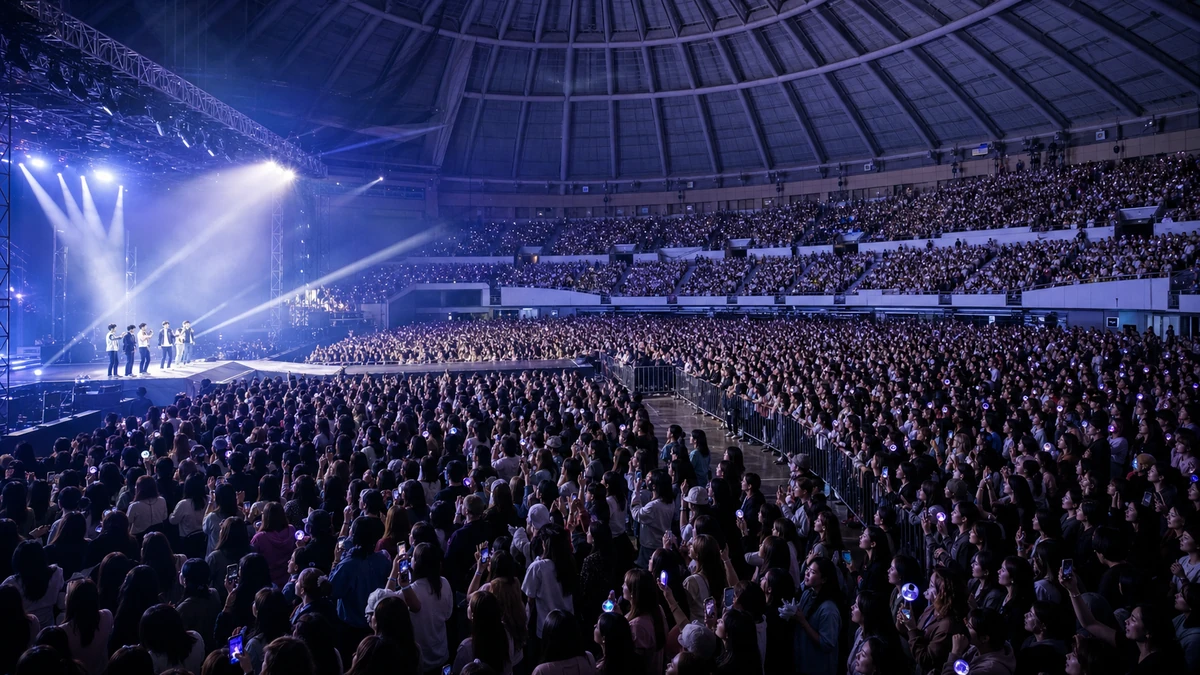
A government bet on the next stage of K-pop
South Korea is making a pointed investment in one of the less glamorous but increasingly important parts of the K-pop economy: the buildings where fans actually gather. The Ministry of Culture, Sports and Tourism said it will spend 12 billion won this year — roughly $9 million at recent exchange rates — on a new program aimed at upgrading public sports and multipurpose facilities so they can better host pop music concerts, including K-pop shows.
On paper, the idea may sound modest. Rather than announcing a gleaming new arena in Seoul or a purpose-built concert hall in Busan, the government is focusing on existing public facilities in six regions around the country. But in practical terms, the plan addresses a problem that has become increasingly visible as Korean pop culture has gone global: demand for live performances has grown faster than the supply of suitable venues.
K-pop is often discussed outside South Korea in terms Americans readily recognize — streaming numbers, Billboard placements, sold-out world tours, Coachella appearances and fan armies organized online with the sophistication of political campaigns. What gets less attention is the physical infrastructure that supports all of that attention at home. Concerts require more than stars and songs. They require acoustics, backstage rooms, lighting grids, security systems, crowd flow, loading access and seats configured for a crowd that does not behave like the audience at a basketball game.
That mismatch has been a recurring challenge in South Korea, where many live performances have been staged in facilities originally designed for sports, school events or general civic use. Those spaces can work, but often imperfectly. The ministry’s new project amounts to a national acknowledgment that K-pop and popular music are no longer side uses for local public venues. They are part of the cultural economy, and the spaces need to catch up.
The ministry will select one facility in each of six regions — the Seoul metropolitan area, Gyeongsang, Jeolla, Chungcheong, Gangwon and Jeju — through an application process running from June 23 to July 24, 2026. Each selected site can receive up to 2 billion won in central government funding. Eligible applicants include local governments, public corporations, local state-run enterprises and schools that operate sports or multipurpose facilities with at least 1,000 seats.
In other words, this is not a private-sector arena boom. It is a public-sector retrofit strategy, built around the notion that South Korea can respond more quickly and cheaply by adapting what it already has.
Why venue shortages matter in a country that exports pop culture
To many Americans, South Korea’s entertainment industry can appear almost frictionless: slick music videos, military-precise choreography, polished fan engagement and a constant stream of digital content. But live performance exposes the limits of even the most successful pop ecosystem. However powerful the online fandom may be, artists still need real rooms, real stages and real local infrastructure.
That is particularly true in K-pop, where concerts are not simply recitals of recorded hits. They are immersive productions that combine music, synchronized lighting, choreography, costume changes, high-definition video, fan chants and branded light sticks. Fan chants — organized call-and-response moments in which audiences shout members’ names or repeat designated lines — are a signature part of K-pop concert culture. They are rehearsed online, shared across fan communities and treated almost like a participatory ritual. Venue design affects how that energy travels.
Americans familiar with touring economics in the United States will recognize the broader issue. A star can have national demand, but if there are not enough mid-size or large-capacity venues in the right markets, the tour map narrows. Fans travel farther. Ticket competition intensifies. Some regions get skipped altogether. The same dynamic exists in South Korea, even though the country is geographically much smaller than the United States.
That helps explain why venue access has become a policy issue. In a country where K-pop is one of the most visible exports, the shortage of dedicated concert halls and music-ready arenas has long been a source of frustration for promoters and fans. Major performances tend to cluster in or near the capital region, where the transportation network, population density and concentration of entertainment companies make event planning easier. The result is a familiar kind of centralization: Seoul and its surrounding areas become the default destination, while fans elsewhere shoulder the time and expense of travel.
The government’s new initiative suggests officials see this as more than a private inconvenience. They appear to be treating the concert venue shortage as a structural bottleneck — one that affects regional cultural access, local economies and the long-term health of South Korea’s live music industry.
From gymnasium to concert venue
The core of the program is practical. Instead of constructing entirely new halls, the ministry will help convert or upgrade existing public facilities so they function more like real concert spaces. The supported improvements go well beyond putting up a temporary stage. According to the ministry, funding can be used for retractable or adjustable seating, soundproofing and acoustic upgrades such as sound-absorbing materials, stage lighting, dressing rooms, audience convenience facilities and safety-related improvements.
Each of those details matters. Retractable seating, for example, can change the relationship between artists and the audience. A sports facility is typically arranged around competition sightlines, not concert immersion. But K-pop staging depends heavily on visual proximity, fan interaction and carefully managed movement between stage zones. Adjusting the seating layout can help transform a cavernous public arena into a more responsive concert environment.
Acoustic treatment may be even more important. Gymnasium-style venues often produce echoes and muddy sound because they were designed for sports whistles, crowd cheers and public announcements rather than layered vocals and live band arrangements. Anyone who has attended a concert in an ill-suited arena in the United States knows the problem: bass overwhelms lyrics, vocals blur and the room feels noisy rather than musical. In K-pop, where performance precision is central to the brand, weak acoustics can damage not only the audience experience in the room but also the clips and fan-shot videos that quickly circulate online.
Dressing rooms and backstage areas may sound like small upgrades, but they are essential to whether a venue can attract performers and production crews. K-pop shows often involve costume changes, makeup preparation, extensive technical coordination and careful management of artist movement. In an industry where image, timing and camera-ready presentation are inseparable from the performance itself, the backstage environment is part of the venue’s overall quality.
The inclusion of safety improvements is also significant. Large-scale live events require clear ingress and egress routes, crowd control planning, equipment safety and coordination among venue staff, security personnel and local authorities. South Korean officials, like event planners elsewhere, are operating in an era of heightened scrutiny around crowd management and public safety. Upgrading a public facility for concerts is not just about making it look more glamorous. It is about making it more competent.
Taken together, the program treats concert readiness as an ecosystem, not a one-off purchase. That may be its most serious feature.
A regional strategy, not just a Seoul story
One of the most notable parts of the plan is how deliberately it is spread across the country. The ministry will pick one facility in each of six broad regions, rather than concentrating the full budget in one or two major cities. That approach reflects a long-running tension in South Korea between the capital area and the rest of the country.
For an American reader, the parallel might be the way major touring acts can seem to orbit New York, Los Angeles and a handful of big markets, while fans in smaller cities wait to see whether they will be included. South Korea’s scale is different, but the cultural geography is familiar. Seoul dominates media, finance, politics and entertainment. That concentration creates efficiencies, but it also leaves regional audiences feeling peripheral.
In K-pop, the issue is especially visible because fandom is so organized and so geographically dispersed. Fans outside the capital regularly travel long distances for performances, often combining train fares, hotel costs, merchandise purchases and ticket fees into a trip that can become prohibitively expensive, especially for younger audiences. More local concert-ready venues could lower those barriers and widen access to live events.
That does not mean every region will suddenly become a routine stop for the biggest idol groups. The ministry’s program is better understood as infrastructure groundwork than as a guarantee of blockbuster bookings. Promoters will still make decisions based on expected demand, scheduling, routing, production needs and an artist’s market strategy. But infrastructure changes the menu of options. A city with a more functional venue becomes easier to include.
Regional live events also carry political and economic symbolism. When a concert comes to a city, it can boost nearby restaurants, hotels, transit use and local visibility. Officials frequently frame these events not only as entertainment but as catalysts for urban activity and regional branding. The ministry did not provide specific economic projections in the summary of the project, and responsible reporting should stop short of overstating the impact. Still, the logic is familiar: if cultural traffic spreads out geographically, some of the spending and attention may spread with it.
That matters in a country that has spent years trying to balance growth beyond the capital. In that sense, the K-pop venue plan sits at the intersection of cultural policy and regional development policy.
Why restoring the field after the concert matters
One of the more revealing details in the project is that, for sports facilities, government support can also cover restoration costs after a performance, including repairs to turf or other damaged areas. That may sound like a footnote, but it points to the everyday reality of trying to use multipurpose public spaces for entertainment.
When a stadium or athletic facility hosts a concert, the event can put serious stress on the site. Heavy equipment, stage construction, crowd movement and temporary flooring systems can damage grass, flooring and auxiliary spaces. Facility operators may worry that a concert will leave them with weeks of repairs, complaints from local users and budget headaches. Those concerns can discourage venue owners from saying yes in the first place.
By explicitly including recovery costs, the ministry appears to be addressing that reluctance head-on. It is effectively saying that public facilities should not have to choose between hosting a concert and preserving their original community function. If the central government helps cover both the upgrade and the reset afterward, local administrators may feel more comfortable opening their doors to events they might otherwise avoid.
This may be one of the smartest parts of the policy. Cultural infrastructure often fails not because the headline idea is wrong, but because the maintenance burden lands on someone who was never fully compensated. A city can be enthusiastic about live entertainment in theory and hesitant in practice if it fears damaged grounds, overtime staffing costs, neighborhood complaints or safety liabilities. Including restoration within the support package suggests policymakers have listened to how public venues actually operate.
It also reflects a broader reality: these are shared civic spaces, not dedicated entertainment palaces. They still need to host sports, school events and local gatherings after the lights go down and the fans leave. A sustainable concert strategy has to account for that.
The fan experience is part of the product
To understand why these venue upgrades matter, it helps to understand how modern K-pop concerts function. The performance on stage is only part of the event. Fans often gather before and after shows, trade photo cards, coordinate outfits, wave custom banners and document the experience in minute detail for social media. Light sticks — official, artist-branded LED devices synchronized with the show — have become one of the most recognizable visual features of K-pop fandom. They turn the audience into part of the production.
That means the quality of a venue shapes more than whether people can hear the songs clearly. It affects sightlines, entry lines, restroom access, waiting areas, backstage logistics, emergency exits and the flow of thousands of people who are attending not just a concert but a highly social event. In an age when a fan-captured video from a regional arena can race across TikTok, YouTube, Instagram and X within minutes, the local venue is no longer a purely local matter. It becomes part of the global image of the artist and, by extension, of K-pop itself.
This is one reason the ministry’s focus on lighting and convenience facilities is notable. Stage lighting is not only for the people seated inside the building. It is also for the cameras, the livestream fragments, the fancams and the post-concert clips that help sustain fandom far beyond the arena. A poorly lit or badly configured room can make a performance feel second-rate online even if the artist delivers a strong set in person.
American readers may think of this in terms of how venue quality shapes the reputation of a sports franchise or touring circuit. Some places are known as premier stages because they offer a complete experience, from the moment the crowd enters to the moment the event floods social media afterward. K-pop, perhaps more than many other genres, depends on that total experience.
So while the ministry’s language is administrative, the implications are cultural. Better seating configurations, improved acoustics and safer crowd systems are not merely technical upgrades. They are part of what makes a fan feel that a city is worth traveling to, that a show felt special and that the local venue can stand alongside better-known stages in Seoul.
What this does — and does not — solve
The ministry’s announcement is significant, but it would be a mistake to oversell it. Upgrading six facilities does not instantly erase South Korea’s venue shortage, nor does it guarantee a broad geographic redistribution of the country’s biggest concerts. The project is still in the application stage, and its long-term impact will depend on several unanswered questions: which facilities are selected, how effectively they use the funding, how quickly improvements are completed and whether promoters ultimately book the spaces on a regular basis.
There is also a difference between making a venue concert-capable and making it competitive for top-tier productions. Elite K-pop tours come with demanding technical requirements, tight schedules and sophisticated production teams. Some local venues may become ideal for mid-size performances, festivals, showcase events or touring acts that do not require the full scale of a stadium spectacle. That would still matter. A healthier live music ecosystem does not depend solely on mega-events. It also depends on having enough functional spaces for a range of performers and audience sizes.
Even so, the policy reveals something important about where K-pop stands now. South Korea is no longer only managing a hit-making machine; it is managing an infrastructure challenge created by that machine’s success. The era when K-pop could be discussed mainly in terms of talent agencies, training systems and digital reach is over. The bottlenecks now include load-in docks, dressing rooms, seating geometry and post-event field repair.
That may sound unromantic. But it is also what mature cultural industries look like. Broadway depends on theaters. The American sports business depends on arenas and transportation grids. The live concert economy depends on buildings that can safely and effectively absorb intense bursts of public attention. South Korea’s latest move suggests its officials increasingly understand K-pop in those terms: not just as a content export, but as a live public culture that requires durable local support.
If the plan succeeds, its payoff may not arrive as a single headline-grabbing moment. It may appear more quietly — in a wider tour map, in a regional city landing an event it once would have missed, in a cleaner sound mix, in a better fan experience, in a facility manager finally deciding the risk is manageable. Those are not flashy outcomes. But they are the kinds of changes that make an entertainment ecosystem deeper, more resilient and more widely shared.
For global fans who tend to imagine K-pop through the lens of Seoul, the message is equally clear: the map of Korean live music may be starting to widen. And for South Korea, that widening is no longer being left to chance. It is becoming public policy.
Comments
Post a Comment