Why Seoul Is Watching a Distant Waterway So Closely
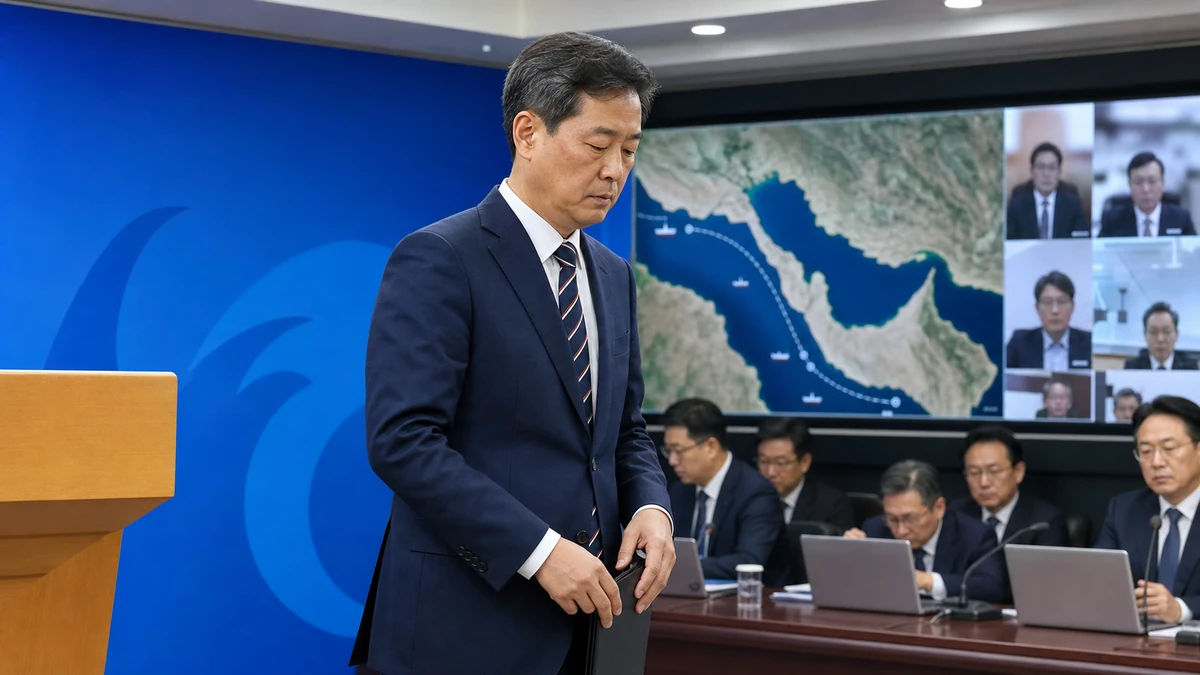
South Korea’s Foreign Ministry convened an emergency-style video conference this week to review the safety of South Korean ships traveling through the Strait of Hormuz, underscoring how a narrow stretch of water thousands of miles from the Korean Peninsula can carry enormous consequences for one of Asia’s biggest trading economies.
According to the South Korean government and reports from Yonhap News Agency, the meeting brought together not only diplomats from Seoul but also officials from the Ministry of Oceans and Fisheries and South Korean embassies in the United States, Iran, Oman, Japan, Qatar and Pakistan. The session was chaired by Jeong Gwang-yong, director-general for African and Middle Eastern affairs at the Foreign Ministry, and focused on maritime traffic conditions in and around the strait and how to help South Korean vessels pass through safely and without delay.
For American readers, the Strait of Hormuz is best understood as one of the world’s most sensitive energy chokepoints — the maritime equivalent of a major interstate bottleneck where a shutdown, even a partial one, can ripple through gas prices, supply chains and financial markets. The channel sits between Iran and Oman and serves as a gateway between the Persian Gulf and the open ocean. A large share of the world’s oil and liquefied natural gas exports moves through it, which means even modest instability there can put governments on edge from Washington to Tokyo to Seoul.
South Korea is especially vulnerable to those disruptions. The country is a manufacturing powerhouse with few domestic energy resources of its own, and it relies heavily on imported crude oil and natural gas to keep factories running, lights on and exports moving. In practical terms, that means any threat to shipping in the Gulf region is not some abstract foreign-policy issue for Seoul. It is a kitchen-table concern in a country whose economy depends on stable maritime trade routes.
The Foreign Ministry said the review came after the signing of what South Korean officials described as a memorandum of understanding related to an end to hostilities between the United States and Iran. Even if political tensions appear to be easing on paper, maritime officials know that shipping lanes do not automatically become safe overnight. Insurance costs, naval postures, local enforcement, commercial routing decisions and the threat of miscalculation can all linger long after diplomatic announcements are made.
That appears to be the logic behind Seoul’s move. Rather than assume that a shift in the political climate has fully stabilized the waterway, the government is treating ship safety as a matter requiring its own real-time assessment. In the world of shipping, a signature on a diplomatic document and a captain’s confidence at sea are not always the same thing.
A Practical Display of South Korean Diplomacy
What stands out about the South Korean response is not dramatic rhetoric or a showy military announcement, but something more understated and in many ways more revealing: bureaucratic coordination. Seoul pulled together multiple ministries and a geographically broad diplomatic network to compare information, assess risk and discuss support for commercial transit. That kind of interagency response is a hallmark of how middle powers manage international crises that they did not create but cannot afford to ignore.
In South Korea, the Foreign Ministry handles diplomacy and communication with other governments, while the Ministry of Oceans and Fisheries oversees maritime administration and works more directly on shipping-related issues. Embassies in the field then provide local reporting, contact with host governments and an on-the-ground read of how policy changes are affecting real-world conditions. When those pieces are connected in one meeting, Seoul can build a clearer operational picture than any single office could on its own.
That may sound routine, but it carries political meaning. South Korea is often viewed abroad through two lenses: its security alliance with the United States and its global pop-culture influence, from K-pop and Korean dramas to Oscar-winning films and bestselling skincare brands. Those are real parts of modern South Korea, but they can obscure another equally important reality: It is also a highly networked trading state that must constantly manage geopolitical risk far beyond Northeast Asia.
This episode is a reminder that South Korean diplomacy is not just about summit meetings with Washington, North Korea policy or high-profile international forums. It is also about quieter forms of statecraft — monitoring shipping routes, maintaining embassy networks, sharing risk assessments and making sure Korean companies and citizens are protected when international conditions suddenly change.
For U.S. readers, there is a familiar parallel here. When American officials monitor the Panama Canal, Red Sea shipping or disruptions at major ports, they are doing the same basic kind of work: linking foreign policy to commerce, transportation and everyday economic stability. South Korea, though smaller than the United States, faces a similar imperative. Its export-driven economy leaves little room for complacency when one of the world’s most important sea lanes comes under scrutiny.
The inclusion of so many embassies in the video conference also suggests that Seoul is seeking a layered view of events rather than relying on any one country’s account. That matters because the Strait of Hormuz is never just a bilateral issue. Even when tensions center on Washington and Tehran, the consequences spill into neighboring states, regional ports, insurers, shipping firms, navies and foreign governments whose vessels must pass through the area.
Why the Strait of Hormuz Matters to South Korea More Than Many Americans Might Realize
In the United States, foreign-policy attention often shifts quickly unless American troops are directly involved or energy prices spike sharply at home. South Korea does not have that luxury. Its economy is more immediately dependent on smooth maritime imports, and disruptions overseas can travel quickly into domestic politics, industrial costs and public anxiety.
Think of South Korea as a country whose economic model depends on being deeply plugged into global circulation. It imports energy and raw materials, turns them into semiconductors, automobiles, ships, petrochemicals, batteries and consumer products, and exports them around the world. When one critical shipping artery becomes unstable, it can affect both sides of that equation: the imports South Korea needs to produce and the larger logistics environment on which its exports depend.
That is why Seoul’s statement emphasizing the free navigation and safety of all ships in the Strait of Hormuz is significant. On one level, it is clearly about protecting South Korean interests. On another, it is a way of aligning those interests with the broader international principle that major sea lanes must remain open and secure. For a trade-dependent democracy like South Korea, the idea of freedom of navigation is not merely a legal abstraction. It is a condition of national economic survival.
There is also a strategic logic to framing the issue in universal terms. If Seoul were to discuss the strait only as a Korean shipping problem, it would narrow its diplomatic room to maneuver. By stressing the safety of all vessels, South Korea places itself within a larger international consensus around maritime order, lowering the temperature of its message while still defending its own needs. That is a classic middle-power move: principled in tone, practical in purpose.
Americans may be most accustomed to hearing the phrase “freedom of navigation” in the context of the South China Sea, where U.S. officials use it to push back against excessive maritime claims by Beijing. But the same principle matters in the Gulf. Sea lanes remain viable not simply because maps say they are open, but because governments, shipping companies and security actors behave in ways that keep them open in practice. That is the gap Seoul appears to be trying to monitor — the difference between formal political change and actual conditions on the water.
South Korea has seen this kind of risk before. Over the years, concerns about piracy, drone attacks, tanker seizures and regional military tensions have all affected how countries think about Middle Eastern shipping lanes. Even in periods when the headlines calm down, the underlying risks rarely vanish entirely. Seoul’s latest meeting suggests that officials are wary of exactly that kind of false reassurance.
The Diplomatic Geography of the Meeting Matters
One of the most interesting details from the South Korean government’s account is the list of embassies involved. The participation of the South Korean embassies in Washington and Tehran is especially striking, because those two capitals represent the key diplomatic poles of the current issue. If the reported memorandum related to an end to hostilities is indeed shaping expectations around the strait, then Seoul would have every reason to seek assessments from both sides rather than depend on a single narrative.
That kind of cross-checking is central to effective diplomacy. Governments often receive conflicting signals in moments of transition: one country says conditions are improving, another warns that implementation is incomplete, and shipping operators may be seeing something different altogether. By drawing in embassies from multiple regional nodes, South Korea appears to be building a mosaic of information rather than relying on headline diplomacy alone.
The presence of the embassies in Oman and Qatar is also notable. Those Gulf states sit close to the maritime and political realities surrounding the strait and can offer insight into port conditions, regional official thinking and commercial traffic patterns. Pakistan, meanwhile, occupies an important position along broader Indian Ocean routes, and Japan’s inclusion suggests that Seoul may also be considering coordination or information sharing with a fellow U.S. ally that is similarly dependent on imported energy.
This is the kind of detail that might look minor in a brief dispatch but matters a great deal in practice. In crisis management, the quality of a government’s response often depends on the quality of its information network. A military confrontation is only one kind of danger. Confusion, delay, incomplete reporting and overconfidence can be just as damaging when shipping decisions must be made quickly.
South Korea’s use of its overseas diplomatic network also reflects the way the country has matured as a global actor. Over the past several decades, Seoul has expanded far beyond its once mostly regional focus. Its diplomacy now stretches across energy security, development, defense exports, supply chains and multilateral coordination. A meeting like this may lack the headline appeal of a summit photo, but it illustrates the nuts-and-bolts machinery of a country that sees itself, increasingly, as a stakeholder in global order.
For Americans who often encounter South Korea through cultural exports or the North Korea issue, that broader frame is worth noting. The same nation that sends K-pop groups to the top of Billboard charts and negotiates with Pyongyang also spends its diplomatic capital tracking tanker routes in the Gulf. That is what it means to be a globalized economy in the 21st century: security and commerce are intertwined, and diplomacy is as much about shipping lanes as speeches.
What Seoul’s Statement Reveals About Its Broader Foreign Policy Style
The language used by South Korean officials points to a familiar pattern in Seoul’s foreign policy: cautious, coordinated and deliberately pragmatic. The government did not announce a sweeping new initiative or portray the situation in dramatic terms. Instead, it emphasized review, support, communication and the principle of safe and free passage.
That restraint is not accidental. South Korea typically prefers calibrated messaging in sensitive geopolitical situations, especially in regions where it has important interests but limited appetite for taking on an outsized political role. The country wants to protect its citizens, companies and shipping without appearing to insert itself unnecessarily into disputes among larger or more directly involved powers.
In that sense, this response fits a broader Korean diplomatic tradition. Seoul often works through institutions, technical coordination and carefully worded statements rather than maximalist public declarations. That approach can seem understated compared with the more performative style often seen in Washington, where foreign policy is frequently filtered through congressional politics, television appearances and presidential messaging. But understated does not mean passive. In many cases, it is a sign that the real work is being done through channels designed to reduce risk rather than amplify politics.
There is also a domestic political dimension. South Korean governments are judged not only on ideological direction but on administrative competence. Can they respond early to risk? Can they coordinate ministries? Can they protect supply chains and reassure the public without overreacting? Even when an issue is far from home, those questions matter politically, because South Koreans know from experience that external shocks can hit the domestic economy quickly.
The timing of the meeting reflects that awareness. Officials did not wait for an obvious shipping disaster or a direct incident involving a South Korean vessel to begin publicly coordinating. Instead, they reviewed the overall traffic and safety situation as the broader regional context shifted. That is a signal of preventive governance — the idea that good crisis management often begins before a crisis fully materializes.
Seoul’s promise to continue close communication with overseas missions, relevant government agencies and related countries also suggests that this is not a one-off check-in. The ministry appears to be framing maritime security in the area as a continuing management task rather than a problem solved by one meeting. That may prove crucial if the regional picture remains fluid or if commercial operators begin adjusting routes and schedules in response to evolving conditions.
What This Means for Global Shipping — and for Washington
The immediate issue is the safety of South Korean vessels, but the larger takeaway is about how interconnected today’s geopolitical risks have become. A diplomatic change involving the United States and Iran can trigger a rapid response in Seoul because the consequences are felt not just in security circles but in shipping, energy, trade and corporate planning. In a world of tightly linked supply chains, distance does not insulate economies the way it once did.
That reality should sound familiar in the United States, where Americans have repeatedly seen overseas disruptions show up at home in the form of higher fuel prices, delivery delays or stock market volatility. What may be different is that South Korea often experiences these external vulnerabilities more intensely. Its trade dependence is sharper, its energy import exposure is greater, and its margin for logistical disruption is smaller.
For Washington, South Korea’s response is also a reminder that U.S. allies do not experience American diplomacy as a matter of headlines alone. They experience it operationally. If U.S.-Iran tensions rise or fall, allies must recalculate insurance costs, commercial routes, embassy postures and contingency planning. They have to translate broad geopolitical shifts into practical decisions about ships, cargo, workers and national resilience.
That helps explain why Seoul would want direct input from its embassy in Washington. American policy in the Middle East is never just America’s business. It affects how allied governments read the security environment, what assumptions they make about risk and how quickly they mobilize their own bureaucracies. Whether the atmosphere is escalating or easing, the downstream effects are immediate.
The inclusion of Japan in the conversation is also worth watching from an American perspective. Washington has spent years encouraging closer cooperation among its allies, especially on supply chains and regional security. While this meeting was not presented as a trilateral initiative, it hints at the wider reality that maritime disruptions often create incentives for quiet coordination among like-minded trading states. When the sea lanes that fuel advanced industrial economies are under pressure, politics and pragmatism tend to meet.
Ultimately, the South Korean government’s move is best understood as a case study in modern middle-power diplomacy. It is careful rather than flashy, technical rather than ideological, but no less important for that reason. By bringing ministries and embassies together to review conditions in the Strait of Hormuz, Seoul is showing how seriously it takes the link between distant geopolitical events and everyday national security.
For a U.S. audience, the lesson is straightforward: South Korea’s global role is no longer confined to the Korean Peninsula, and its diplomacy increasingly reflects the responsibilities of a country deeply embedded in the world’s commercial and strategic systems. When the Strait of Hormuz becomes uncertain, Seoul does not treat it as someone else’s problem. It treats it as a direct test of how a modern state protects its interests in an unpredictable world.
That may be the most revealing part of the story. The news out of Seoul was not about a warship deployment, a dramatic warning or a diplomatic breakthrough. It was about a video conference — the sort of unglamorous administrative act that rarely draws much attention. Yet in moments like this, those meetings can be the first line of defense. They are where governments compare facts, sort out uncertainty and try to keep a distant crisis from becoming a domestic one.
Comments
Post a Comment