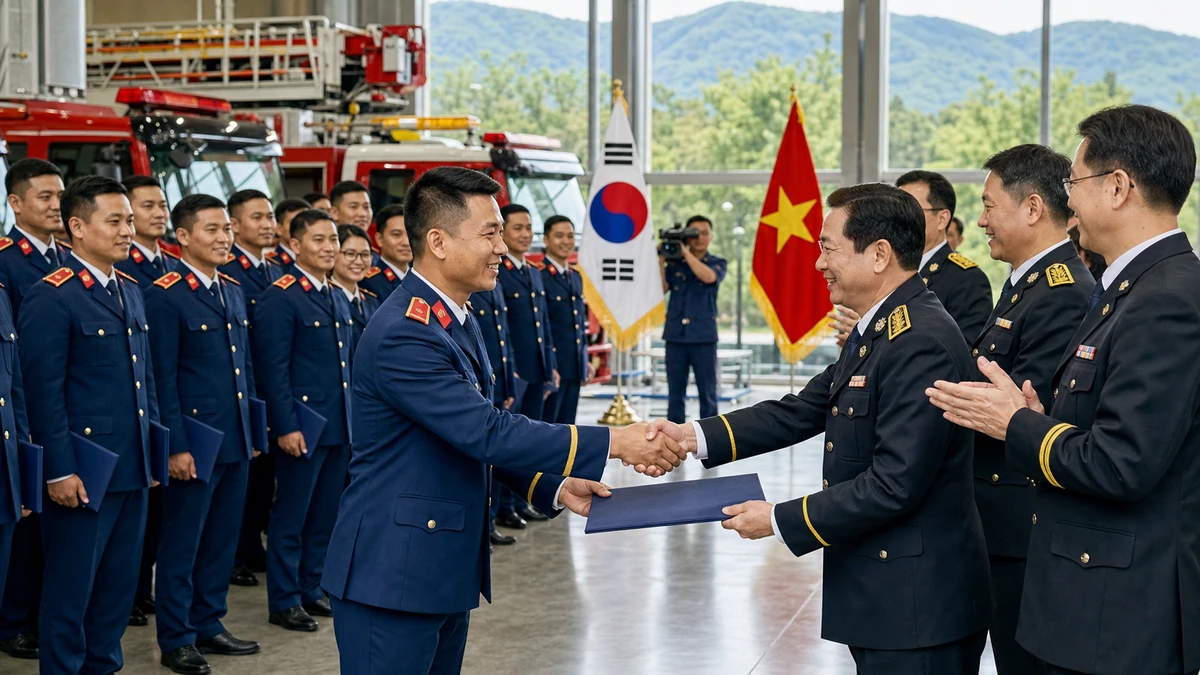
A fire academy in the mountains becomes a stage for international cooperation
In the global conversation about South Korea, the images most familiar to American audiences tend to be the flashy ones: K-pop stadium tours, Oscar-winning films, beauty brands, smartphone giants and the packed streets of Seoul. But far from those well-known symbols of the so-called Korean Wave, or hallyu, another kind of Korean influence is taking shape — quieter, more technical and arguably just as consequential.
At the Gangwon Fire Academy in Taebaek, a small mountain city in northeastern South Korea, officials recently held a graduation ceremony for 20 Vietnamese fire leaders who completed the academy’s fifth Global Fire Leader Course. According to the South Korean news agency Yonhap, the group included 10 firefighters from Vietnam’s Lam Dong province and 10 professors from the Fire University in Hanoi. Over roughly two weeks, beginning July 9, they studied Korean firefighting technology, emergency medical response, disaster scene control and leadership training.
On its face, the event was modest: a training course, a completion ceremony, a few official remarks. But it points to a broader story about how South Korea increasingly presents itself to the world — not only as a cultural powerhouse or tourist destination, but also as a country with exportable public systems, specialized training and practical expertise in safety and emergency response.
For American readers, there is an easy analogy. This is less like a cultural exchange at a museum and more like international officials coming to the United States to study FEMA coordination, wildfire management in California, or emergency medical protocols at a regional training center. The point is not spectacle. The point is systems.
That distinction matters. In disasters, whether a high-rise fire, factory accident, flood or multi-vehicle crash, the difference between chaos and survival often comes down not only to equipment, but to organization: who takes command, how first responders communicate, how scenes are secured, how victims are triaged and how teams from different specialties work at the same time without getting in one another’s way. The South Korean program appears designed around exactly that premise.
Why Vietnamese firefighters and fire professors came to South Korea
The makeup of the Vietnamese delegation is one of the most revealing parts of the story. This was not a group made up only of frontline firefighters, nor only of academics. It included both: firefighters from Lam Dong province, who bring operational experience and field needs, and professors from Hanoi’s Fire University, who help shape how future firefighters are trained.
That combination gives the program a wider reach than a standard skills workshop. If frontline officers return home with techniques they can apply at a fire scene, that has immediate value. If instructors and professors return with ideas about curriculum, command systems and training design, the effects can spread more broadly through an institution over time. In other words, the course was aimed not just at individual performance, but at multiplying knowledge through teaching and leadership.
For readers in the United States, where emergency services training often blends practical drills with classroom instruction at academies, colleges and regional centers, that may sound familiar. The significance here is that South Korea is positioning itself as a place where that kind of professional development can happen for overseas public safety officials.
Vietnam and South Korea also have steadily deepened ties in recent years through trade, education, labor migration and investment. South Korean companies have a major presence in Vietnam, and people-to-people ties have expanded well beyond diplomatic formality. In that context, cooperation in public safety is not isolated. It fits into a larger pattern of two Asian countries building practical links through institutions, not just markets.
Still, firefighting cooperation carries a particular kind of weight. Unlike a business seminar or tourism promotion event, fire and disaster response concern some of the most basic responsibilities of government: protecting life, preserving order in emergencies and building public trust. When a country invites foreign fire leaders to observe how it trains for disaster, it is effectively opening one of its core state functions for inspection and exchange.
What the trainees studied — and why systems matter more than gadgets
According to the summary provided by Yonhap, the Vietnamese participants studied Korean firefighting technology and systems, took emergency medical training and received instruction in disaster scene control and command capability. Each of those areas points to a different layer of modern emergency response.
Technology is the easiest part for the public to see. It includes equipment, suppression techniques, rescue tools and operational procedures. But in emergency services, technology by itself is not enough. A truck can be modern and a response team well equipped, yet a scene can still deteriorate if leadership is unclear or if responders lack a common method for making quick decisions under pressure.
That is why the emphasis on systems deserves close attention. In practical terms, a system includes the chain of command, communication protocols, on-scene coordination, training standards and the expectations different units have of one another. It determines who does what first, what happens when conditions change, how information moves and how leaders allocate limited time and resources.
Americans who followed major disasters such as Hurricane Katrina, the Sept. 11 attacks, Western wildfires or large industrial accidents will recognize how often post-disaster analysis turns to coordination failures, command confusion or communication breakdowns. The lesson is consistent across countries: disasters expose systems, not just personnel.
The emergency medical portion of the program is also significant. In many disasters, the first critical interventions happen before a patient ever reaches a hospital. Firefighters and rescue personnel are often the first on scene, and the choices they make in the opening minutes — airway management, bleeding control, assessment, stabilization, transport decisions — can shape whether victims survive and how well they recover. Training in emergency care is therefore not a side issue. It is central to life-saving response.
Just as important is scene control, which can sound bureaucratic until one considers what it means in reality. Scene control is the disciplined management of space, movement and priorities at a chaotic incident. It helps keep bystanders out of danger, gives rescuers room to work, prevents vehicle congestion, protects evidence when relevant and allows firefighting, rescue and medical response to happen simultaneously rather than competitively. In the American context, it is the difference between a well-managed emergency perimeter and a site where everybody arrives at once but no one can work efficiently.
The command training mentioned in the course may be the most valuable export of all. Leadership in a disaster is not merely rank; it is the practiced ability to assess risk, absorb incomplete information, give clear direction and adapt as conditions change. If the Vietnamese participants were trained not only in what Korean responders use, but in how leaders organize a scene, then the program’s value extends well beyond any single tool or drill.
Taebaek offers a different image of South Korea than many foreigners know
There is another reason this story stands out: where it happened. The training took place not in Seoul, South Korea’s sprawling capital, nor in Busan, the country’s better-known port city, but in Taebaek, a smaller city in Gangwon province. For many foreign visitors, especially first-time travelers, South Korea is often understood through its biggest urban centers, major palaces, shopping districts and entertainment hubs. Taebaek represents a very different side of the country.
Nestled in a mountainous region once associated with mining and now better known domestically for outdoor landscapes and winter scenery, Taebaek is not usually the first place a foreign audience thinks of when imagining South Korea’s international profile. Yet that may be precisely the point. This exchange suggests that South Korea’s global role is no longer confined to headline-grabbing cities or consumer-facing industries. Provincial institutions can also serve as international platforms.
That has real implications for how the country is perceived abroad. For years, much of the international fascination with South Korea has centered on visible culture — music, food, fashion, TV dramas and tourism. Those sectors remain important, and they are often grouped under the broad label of hallyu, a term used to describe the global popularity of Korean culture. But the Taebaek program hints at a parallel development: South Korea as a destination for professional learning, technical exchange and public-sector training.
For an American audience, one useful comparison might be how a visitor to the United States can experience the country in more ways than by seeing Times Square, Hollywood or Disney World. A foreign official may instead travel to a military college in Pennsylvania, a public health center in Atlanta or an emergency management facility in Texas. Those visits tell a different story about what a country exports. South Korea appears to be building more of that kind of story for itself.
Even the act of staying for nearly two weeks at a regional academy carries symbolic value. These Vietnamese participants were not passing through on a sightseeing stop. They were living, training and observing within a Korean institution. That is a deeper form of engagement, one that allows visitors to experience not only a place, but the routines, discipline and assumptions of a public system.
Public safety diplomacy is less glamorous than pop culture, but often more durable
International cooperation in firefighting and emergency response does not usually attract the same attention as a summit meeting or a blockbuster streaming series. Yet it can be one of the most durable forms of cross-border partnership because it is built on repeated training, professional trust and practical results.
When fire officials from one country train in another, the exchange is not simply ceremonial. They see how facilities are run, how instructors teach, how scenarios are structured and how leadership is evaluated. They bring home not only notes, but habits of thinking. Over time, those habits can shape doctrine, classroom instruction and decision-making in the field.
That is especially important in Asia, where rapid urbanization, industrial growth and climate-related risks have increased the complexity of disaster response. Dense apartment towers, logistics hubs, tunnels, factories and extreme weather events all demand highly coordinated emergency services. Countries facing those pressures have strong incentives to learn from one another’s systems.
South Korea has its own reasons for emphasizing preparedness. It is a highly urbanized, technologically advanced country with dense infrastructure and a long record of investing in public systems. Like many nations, it has also faced painful reminders of what happens when safety systems fail or are insufficient. That broader history has helped drive a national focus on training, coordination and institutional competence in disaster response. The result is a model that other countries may find useful to study, even if they adapt it to local conditions.
For Vietnam, the relevance is straightforward. Firefighters and instructors who sharpen command skills, emergency medical response and scene management may be better equipped to improve outcomes at home. No imported training can simply be copied and pasted across borders; geography, budgets, laws and local risks all differ. But leadership principles and response frameworks often travel well when applied thoughtfully.
At the graduation ceremony, Gangwon Fire Academy chief Kim Myung-joong said he hoped the advanced firefighting technology and command know-how learned in the program would become a strong foundation for protecting the safety of the Vietnamese people. He also said the academy would continue strengthening firefighting cooperation between the two countries. Those comments were diplomatic, but they also reflected something concrete: the goal was not for the training to end in South Korea. The expectation is that it will be carried back into Vietnamese institutions and emergency scenes.
A broader meaning behind a seemingly small ceremony
It would be easy to dismiss the event as a routine completion ceremony at a specialized academy. But doing so would miss the larger significance. The program reflects a shift in how international influence works in the 21st century. Countries are no longer known only for what they sell, perform or promote. They are also judged by what they can teach.
South Korea has become exceptionally good at exporting culture, from K-pop to cinema to cuisine. What this firefighting program suggests is that the country is also exporting confidence in its institutions — in this case, confidence that its way of organizing training, command and disaster response is worth sharing with overseas professionals.
That may not generate viral social media clips, but it is a meaningful development in how South Korea engages the world. It expands the definition of what a visit to Korea can mean. For some visitors, the destination is not a concert hall, a cosmetics district or a UNESCO heritage site. It is a classroom, a drill ground, an emergency response simulator or a public training center.
That broader definition matters because it reflects a maturing international image. A country that draws visitors for leisure has one kind of soft power. A country that draws them for professional instruction, especially in areas tied to governance and public trust, has another. The latter can be slower to build, but often deeper and more institutional.
For American readers accustomed to thinking of South Korea through entertainment headlines or geopolitical tensions with North Korea, the Taebaek program offers a more grounded and less familiar lens. It shows South Korea as a middle power using expertise, regional partnerships and local institutions to build influence through public service. It also shows Vietnam engaging not as a passive recipient, but as an active partner seeking ideas that can strengthen its own emergency systems.
None of this should be overstated. Based on the information available, the known facts are limited: 20 Vietnamese fire leaders took part in the fifth Global Fire Leader Course, they stayed at the Gangwon Fire Academy for about two weeks, they studied Korean firefighting and emergency response systems, and they graduated at a ceremony on July 18. But even within those facts, the story carries a message larger than the event itself.
In a world of increasingly complex disasters, from urban fires to climate-fueled emergencies, the exchange of public safety knowledge may become one of the most valuable forms of international cooperation. And in a mountain city in South Korea, far from the usual imagery of Korean global success, that cooperation was on display in one of its most practical forms: firefighters learning how to save lives from other firefighters.
What this says about the future of Korea’s global role
If there is a takeaway beyond the ceremony itself, it is that South Korea’s international appeal is widening. The country is no longer just a place people watch, stream, eat or visit. It is increasingly a place where professionals come to learn how institutions function — how public services are taught, how safety is organized and how specialized expertise is passed from one country to another.
That does not replace the Korean Wave. It complements it. In fact, the success of Korean culture may have helped create the familiarity and goodwill that make these deeper forms of exchange easier. Once a country has captured the world’s attention through entertainment and consumer culture, it has a stronger platform from which to showcase less visible strengths such as education, technology, administration and public-sector training.
For the United States and other English-speaking audiences, that means South Korea is worth watching not only as a pop culture exporter or strategic ally, but also as a country trying to turn practical know-how into a form of global partnership. The graduation ceremony in Taebaek was small. Its implications are not. It offered a glimpse of a future in which Korea’s influence is measured not only in fans and tourists, but in the professionals who return home carrying pieces of its systems with them.
Comments
Post a Comment