South Korea’s Jeonbuk province is betting Americans would call it a ‘farm stay’: A summer push to make rural vacations mainstream
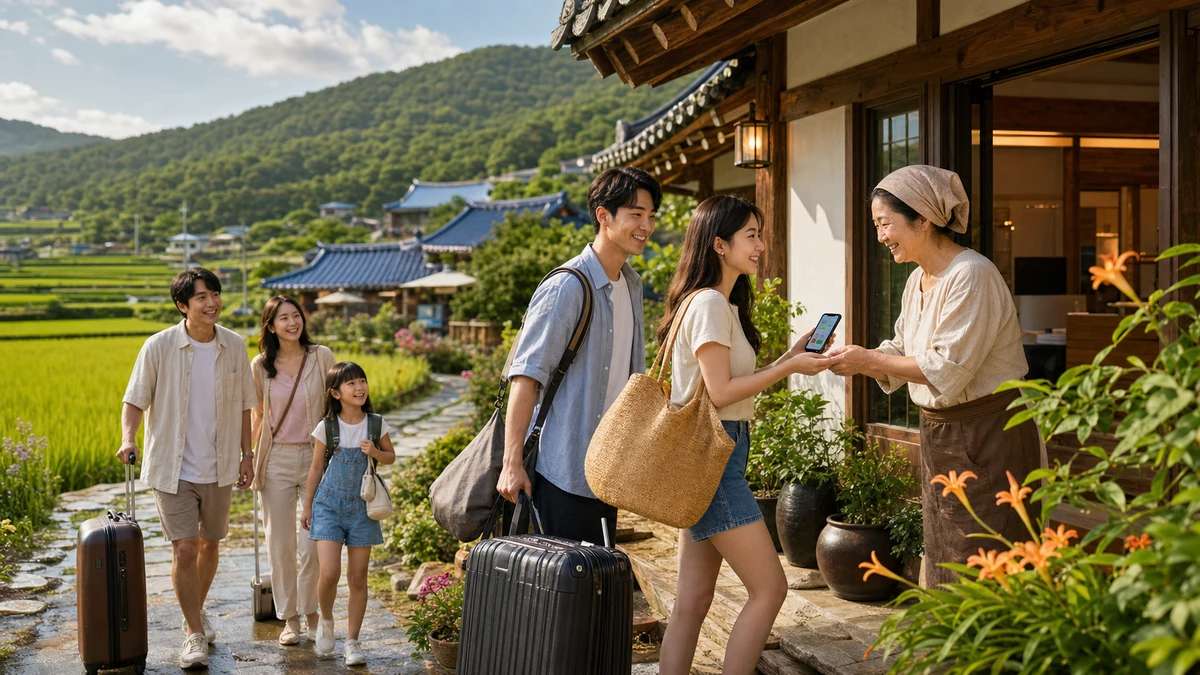
A summer getaway, Korean style — but not the one most visitors imagine
For many Americans, a summer trip to South Korea tends to conjure a familiar set of images: the neon intensity of Seoul, beach crowds in Busan, K-pop landmarks, beauty stores and late-night food alleys packed with young travelers. But officials in one southwestern province are promoting a very different vision of a Korean summer vacation — one rooted in farm villages, slower rhythms and overnight stays built around local life rather than tourist spectacle.
Jeonbuk State, a provincial government in the country’s southwest, said this week it will subsidize up to 50% of lodging costs for travelers staying at designated rural experiential villages during the summer vacation season. The discount applies to check-ins from Monday through Thursday in July and August, according to the province. The program is part of a broader initiative aimed at boosting rural tourism and drawing more visitors to communities that are often overshadowed by South Korea’s major cities and marquee attractions.
The offer may sound modest on paper: a weekday lodging discount during peak travel season. But it also captures a broader shift in how South Koreans are thinking about travel, rest and what counts as a desirable vacation. In a country where domestic tourism has long centered on beaches, mountain resorts, urban hotels and famous sightseeing districts, rural villages are increasingly being marketed not just as places to pass through, but as destinations in their own right.
That trend has a catchy Korean name: “chon-cance,” a hybrid term that combines the Korean word for village or countryside, chon, with the French-derived Korean word vacance, meaning vacation. The result is a made-in-Korea expression for a rural escape — something like a farm stay, country retreat or slow-travel getaway, but with a distinctly Korean flavor. It reflects an appetite for experiences that feel more local, more grounded and less choreographed than the standard itinerary of city shopping and big-ticket attractions.
Jeonbuk’s new subsidy is, in effect, a government-backed nudge to turn that lifestyle trend into measurable travel demand.
What rural experiential villages are — and why Korean officials care about them
The villages at the center of the program are known in Korean policy language as rural experiential recreation villages. The term can sound bureaucratic in English, but the idea is fairly straightforward. These are village-based destinations that connect overnight lodging with hands-on activities, local food, natural scenery and everyday rural culture. Travelers do not simply book a room. They are encouraged to experience the village as a living place — one where farming landscapes, neighborhood routines and community-run tourism are part of the appeal.
For an American reader, the closest comparison might be a blend of agritourism, bed-and-breakfast culture and community-based travel. Think less luxury resort and more the appeal of staying on a working farm, joining a seasonal harvest activity, eating regional specialties and waking up to a landscape shaped by agriculture rather than highways and chain hotels. The Korean version, however, sits within a much more compact geography, where even rural destinations are often just a few hours from major metropolitan areas.
That matters because South Korea’s travel economy has long been defined by concentration — not just of people, but of spending. A handful of cities and headline destinations dominate attention. Rural regions, despite their cultural and environmental assets, often struggle to attract the same level of overnight tourism. When they do attract visitors, trips may be short, heavily seasonal or concentrated on weekends, leaving local businesses with limited benefit.
By subsidizing stays in rural experiential villages, Jeonbuk is making a policy argument as much as a tourism pitch: that the countryside should not be treated merely as a backdrop for agriculture or a stop between larger destinations. It can also function as a place of rest, education, consumption and cultural exchange.
The program is being carried out jointly by Jeonbuk State and a support center focused on invigorating rural economic and social services. That institutional partnership is notable because it suggests the initiative is not being framed solely as tourism marketing. It is also tied to a broader set of concerns common in South Korea’s regional development debate: how to sustain local economies, how to make rural communities viable and how to spread the benefits of travel more evenly beyond the usual urban winners.
Why the 50% discount matters beyond the price tag
On one level, a discount is simply a discount. Families looking at peak-season travel costs may be more willing to try a rural lodging option if the nightly bill is cut nearly in half. But the significance of the Jeonbuk program goes beyond affordability.
First, the subsidy lowers what tourism planners sometimes call the “first-visit barrier.” For travelers used to booking recognizable hotels through large platforms, village-based stays can feel uncertain. There may be less standardized information, fewer polished photos, less brand recognition and less confidence about what the experience will actually be. Even if the destination is attractive, unfamiliarity can discourage bookings. A 50% discount is a practical way to persuade someone to take a chance on a place they might otherwise scroll past.
Second, the program targets one of the thorniest challenges in leisure travel: not just attracting visitors, but shaping when they arrive. The Jeonbuk subsidy applies to Monday-through-Thursday check-ins in July and August, the heart of South Korea’s summer vacation period. That weekday condition is not incidental. It is an attempt to spread demand during a season that can otherwise become crowded, expensive and unevenly distributed.
American travelers will recognize the logic. U.S. tourism boards and hotel operators often push shoulder-season trips, midweek deals or off-peak packages to flatten demand and avoid the feast-or-famine economics of tourism. Jeonbuk’s approach uses a similar playbook. Rather than simply promoting the countryside in general terms, it attaches a concrete incentive to a specific behavioral goal: get people to stay in rural villages on weekdays during peak summer.
Third, the discount implicitly repositions rural travel from niche activity to mainstream option. In many places, countryside tourism is treated as worthy but secondary — a wholesome alternative for families, school groups or travelers seeking something educational. The scale of the discount in Jeonbuk sends a different message. Rural lodging is not being sold as a consolation prize for people avoiding the city; it is being presented as a competitive summer choice.
That symbolic shift may be one of the program’s most important effects. Travel decisions are shaped by status and habit as much as by price. When a provincial government makes rural tourism a headline summer policy, it helps validate the idea that time in the countryside is not old-fashioned or inconvenient, but timely and aspirational.
The rise of ‘chon-cance’ and the changing meaning of vacation in South Korea
The popularity of “chon-cance” speaks to something larger than clever branding. It reflects a generational and cultural rethinking of what people want from time off. In South Korea, as in the United States, vacations have often carried a pressure to maximize enjoyment through movement, consumption and visible experiences — the kind that photograph well, fit neatly into recommendation lists and can be checked off as accomplishments.
But there has been a noticeable countercurrent, especially in the wake of pandemic-era travel disruptions and the broader popularity of slower, more local forms of leisure. In Korea, this has shown up in the rise of village stays, “healing” travel, temple visits, quiet cafes in small towns and trips centered not on seeing everything, but on doing less. The Korean word healing, widely used in everyday speech, often means emotional restoration or decompression rather than medical care. In that sense, rural tourism fits neatly into a national lifestyle conversation about burnout, overstimulation and the need for rest that feels genuine rather than performative.
To American ears, “healing travel” or “village vacation” may sound like wellness-industry language. In Korea, however, the appeal is often less commercial than practical. Rural travel offers distance from crowded urban life in a country where a large share of the population lives in and around the Seoul metropolitan area. It also offers contact with a version of Korean life that is culturally familiar yet increasingly less central to daily experience for younger city residents.
That is part of what makes “chon-cance” resonant. It is not only about scenery. It is about tempo. The countryside in South Korea represents a different pace of life, different food traditions, different sounds and different social interactions. A village stay may include local produce, small-scale lodgings, outdoor activities and a schedule defined more by weather and community routines than by nightlife or retail hours.
For foreign audiences who know South Korea primarily through its most exportable images — K-pop, K-dramas, skin care, tech giants and fast-moving city life — this trend is a reminder that the Korean Wave has always traveled with blind spots. The country’s soft power abroad is heavily urban, polished and youth-oriented. Rural tourism highlights another Korea: one tied to regional identity, agricultural landscapes and domestic debates about how to preserve local communities in the face of aging populations and economic centralization.
Why Jeonbuk is making this push now
Jeonbuk has strong reasons to put rural tourism front and center. The province, located in the country’s southwest, is known for fertile agricultural land, regional cuisine and a mix of coastal, mountain and village landscapes. Yet like many non-capital regions in South Korea, it must compete for attention in a national tourism market dominated by more globally recognizable names.
Promoting rural experiential villages allows Jeonbuk to lean into assets it already has instead of trying to imitate Seoul or other major tourism hubs. That is a strategic choice increasingly familiar to state and local governments around the world: differentiate by emphasizing place-based experiences that cannot be easily replicated elsewhere.
There is also an economic rationale. Spending in village-based lodging can have a different footprint from spending concentrated in large hotel zones or major entertainment districts. When travelers stay within a village setting, more of their trip is likely to intersect with local food providers, activity operators and community-run services. The question, in other words, is not just where tourists go, but where the money stays.
That point is especially important in rural policy. Tourism campaigns often promise local revitalization, but the gains do not always remain in the communities being advertised. Large outside operators, booking platforms or centralized attractions can capture the lion’s share of revenue. Village lodging, by contrast, is frequently presented as a form of tourism where the value chain is shorter and more localized, even if the exact economic impact varies from place to place.
Jeonbuk’s announcement did not provide details such as the number of participating villages, the total budget for subsidies or the booking system travelers will use. Those omissions make it difficult to judge the eventual scale of the program. Still, the policy design that has been disclosed is revealing. The province is not merely urging people to consider rural travel in the abstract. It is using peak-season demand to redirect attention toward communities that want visitors but may struggle to compete without official support.
That makes the initiative part tourism policy, part regional development strategy and part cultural messaging campaign — all wrapped into a single discount.
A different image of Korea for foreign travelers and cultural observers
Even though the Jeonbuk program is aimed at tourists visiting the province’s rural villages, the broader significance extends beyond domestic travel logistics. It offers a useful window into how South Korea is trying to broaden the story it tells about itself.
For years, the global image of Korea has been driven by sectors that thrive on scale, speed and concentration: entertainment, cosmetics, consumer technology and urban dining culture. Those industries have been extraordinarily successful. But they can also flatten the country into a narrow identity centered on Seoul and a handful of globally legible cultural products.
Rural tourism policy pushes back against that flattening. It suggests that Korean identity, and Korean leisure, cannot be fully understood through downtown neighborhoods and export brands alone. Village-based travel brings into view the textures that mass culture often leaves out: agricultural traditions, local festivals, regional cooking, slower hospitality and the social meaning of the countryside in a highly urbanized nation.
That may be especially interesting to Americans, whose own travel culture includes a long history of romanticizing the road trip, the national park, the small town and the farm stand, even as many rural communities struggle with depopulation and economic change. South Korea’s version of that conversation unfolds differently because of its size, density and development history, but the underlying questions feel familiar. How do you keep smaller communities economically alive? How do you make heritage meaningful without turning it into a museum piece? And how do you persuade travelers that rest can be found somewhere other than the most crowded and advertised destinations?
Jeonbuk’s subsidy program does not answer all of those questions. It is, at base, a targeted lodging incentive for weekday summer stays. But its timing and framing show how much cultural weight a tourism policy can carry. This is not only about filling empty rooms. It is about reimagining the countryside as a place people actively choose.
What this says about Korea’s summer travel future
There is a temptation to treat measures like this as small-bore local promotion, useful mainly for budget-conscious vacationers. That would miss the larger signal. Jeonbuk’s move reflects a broader evolution in South Korean travel culture, one in which the most compelling summer trip may no longer be the one with the most famous skyline, busiest beach or most algorithm-friendly itinerary.
Instead, policymakers and travelers alike appear increasingly open to a different kind of value: staying longer in one place, spending money closer to local communities and treating rural life not as nostalgic scenery but as a contemporary travel asset. In that sense, the province’s support for village lodging is less about novelty than normalization. It is trying to make rural travel feel ordinary, bookable and practical.
That effort may resonate well beyond one summer season. If travelers who would not normally consider a village stay decide to try one because of the discount — and if the experience feels accessible rather than intimidating — the effect could outlast the subsidy itself. First visits matter. In tourism, habit often begins with one low-risk experiment.
For now, the confirmed facts remain limited to what Jeonbuk has announced: tourists using lodging products in participating rural experiential villages can receive up to 50% off for check-ins from Monday through Thursday in July and August, under a program designed to activate rural tourism. The finer points of implementation remain unspecified.
Even so, the message is clear. At a time when South Korea is globally associated with urban trendsetting and fast-moving popular culture, one provincial government is making a pointed case for a quieter version of Korean summer: sleep in a village, slow down, and let the countryside compete for your vacation plans.
For foreign observers of Korea, that may be the most revealing part of the story. The country that sells the world on speed, style and spectacle is also trying to market stillness. And this summer, in Jeonbuk, it is willing to subsidize the invitation.
Comments
Post a Comment