
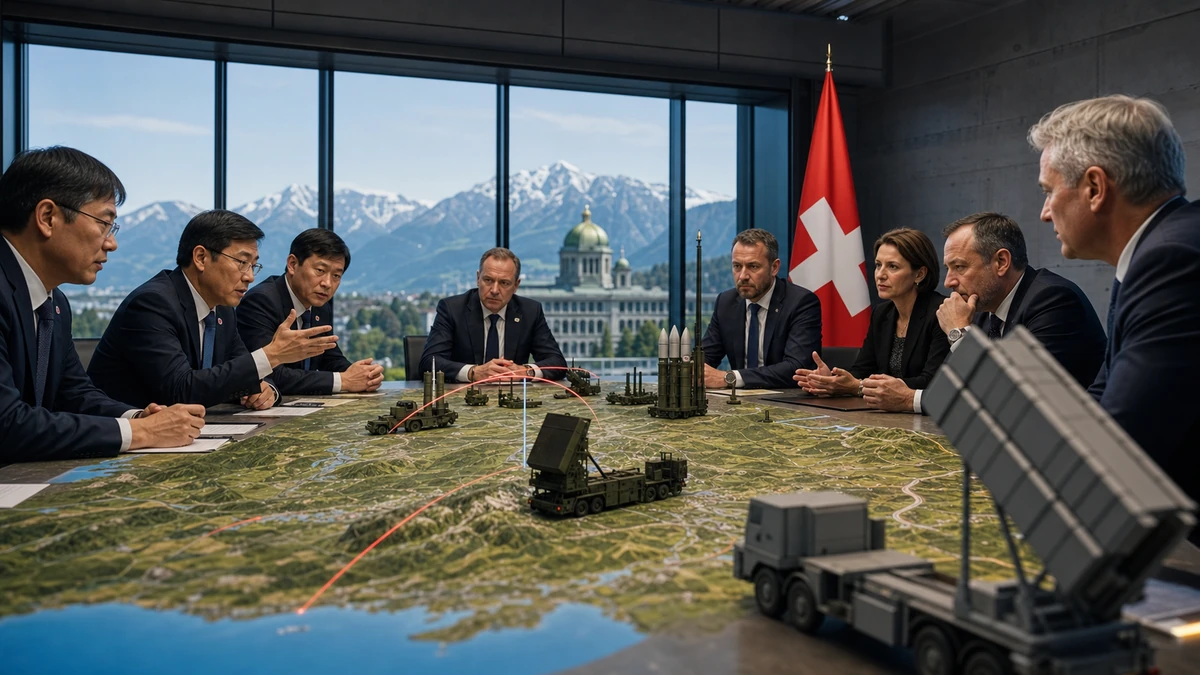
A Swiss procurement problem with global implications
Switzerland, a country better known to many Americans for banking, diplomacy and armed neutrality than for missile defense, is now confronting a problem familiar to governments across Europe: how to strengthen national air defenses quickly in a world where delivery timelines are slipping and threats feel closer than they did just a few years ago.
The Swiss government said it has opened contract negotiations with manufacturers from France, Israel and South Korea for a new long-range ground-based air defense system, according to reporting from South Korea’s Yonhap News Agency and statements from Swiss authorities. The move comes after delays in the delivery of Patriot air defense systems that Switzerland had already ordered from U.S. defense contractors Raytheon and Lockheed Martin.
On its face, this is a defense procurement story, the kind that can seem technical or remote. But it is also a revealing snapshot of how the war in Ukraine, instability in the Middle East and bottlenecks in global weapons production are reshaping choices for U.S. allies and partners. It also helps explain why South Korea, long known internationally for K-pop, K-dramas and consumer electronics, is now increasingly part of serious conversations about European security.
For American readers, the easiest comparison may be the way supply chain disruptions during the pandemic exposed how a delay in one part of the world can ripple quickly across industries and borders. In defense, the stakes are far higher. Countries are not waiting on cars or appliances. They are waiting on systems meant to protect cities, critical infrastructure and national airspace from missiles and aircraft.
Swiss officials have made clear that the issue is urgency. They are not scrapping their Patriot order. Instead, they are looking for a way to fill what amounts to a dangerous time gap between when they expected to have a stronger shield in place and when that shield may actually arrive.
Why the Patriot delay matters so much
Switzerland ordered five Patriot air defense units in 2022, expecting delivery between 2026 and 2028. That timeline has now been pushed back by roughly five to seven years, according to the Korean summary of the Swiss announcement. The reason is not a Swiss budgeting dispute or a technical issue specific to the country. It is the broader international security environment.
The war in Ukraine has dramatically increased demand for air defense systems across Europe and beyond. Russia’s extensive use of missiles and drones has turned air defense from a specialist military topic into a central lesson of modern warfare. At the same time, conflict and tension in the Middle East have placed additional pressure on production lines and strategic priorities. In practical terms, systems like Patriot are finite, production capacity is limited and governments with more immediate battlefield or alliance demands can alter who gets equipment first.
For a country like Switzerland, a delay of several years is not just an inconvenience. Air defense is part of the basic architecture of national security. If a government’s plans assumed new long-range intercept capability would begin arriving within a few years, and then those plans are pushed nearly a decade farther out, defense planners must decide whether to accept the risk or find an interim answer.
That is why the language from Swiss authorities matters. Officials are not simply reviewing options in the abstract. They are seeking an additional system that can more rapidly strengthen defenses against long-range attacks. The key ideas are speed and supplementation. Switzerland appears to be trying to add another layer rather than replace the U.S.-made Patriots it already purchased.
That layered approach is common in modern air and missile defense. Americans may think of it like home security with multiple lines of protection: cameras, alarms, reinforced locks and neighborhood response all working together. Military air defense operates on a much more complex and expensive level, but the concept is similar. No single battery or interceptor solves every problem. Countries typically seek overlapping capabilities that can detect, track and engage threats at different distances and altitudes.
In that sense, the Swiss move reflects a broader strategic reality. Delivery dates are now almost as important as performance specifications. A highly capable system that arrives too late may leave a country with years of vulnerability.
How South Korea became part of this discussion
The South Korean angle is what gives this story added international significance. The Swiss government’s negotiating list includes manufacturers from France, Israel and South Korea. The Korean summary does not identify the specific South Korean company or system under discussion, and there is no indication that a final selection has been made. Still, inclusion at this stage is notable.
For years, South Korea’s global image in the United States has been shaped largely by culture and technology. American audiences know Seoul as the home of BTS and Blackpink, of Oscar-winning and Emmy-winning Korean storytelling, of Samsung phones and Hyundai vehicles. Those exports helped make South Korea one of the most visible Asian soft-power successes of the 21st century.
Less familiar to many Americans is South Korea’s rise as a major defense exporter. That growth is rooted in the Korean Peninsula’s own security reality. Because South Korea has lived for decades under the threat of North Korean missiles, artillery and military provocation, it has invested heavily in domestic defense manufacturing. What emerged over time was not only a military built for national defense, but also an industrial base capable of producing advanced systems at scale.
In recent years, South Korea has increasingly marketed that industrial base abroad. Its defense exports have drawn attention in Poland, the Middle East and Southeast Asia, among other regions. Buyers are often attracted by a combination of factors: competitive pricing, relatively fast production schedules and systems designed in a country that treats readiness as an everyday necessity, not a distant theory.
That context helps explain why Switzerland’s outreach matters. Being mentioned alongside France and Israel in negotiations over long-range air defense suggests that South Korean manufacturers are being treated not as fringe alternatives but as credible contenders in a demanding market. European governments weighing national air defense do not casually add names to the shortlist. Inclusion typically reflects some combination of technical competence, manufacturing credibility and confidence that a supplier can deliver under pressure.
For South Korea, that is politically and economically important. It reinforces the country’s status as more than a cultural powerhouse. It also signals that in a world of strained supply chains, South Korea’s defense industry is benefiting from a reputation for responsiveness and industrial depth.
What this says about Europe’s changing security mindset
Switzerland occupies a distinctive place in Europe. It is not a NATO member, and its long-standing posture of neutrality has often set it apart from alliance politics on the continent. To Americans, Swiss neutrality can sometimes sound like a historical curiosity, a relic of old Europe. But neutrality does not mean indifference to security, and it certainly does not mean immunity from changes in the regional threat environment.
The Swiss Defense Ministry said the worsening security situation means Switzerland must be able to defend itself quickly. That statement is striking not because Switzerland has abandoned neutrality, but because it shows how even states outside military alliances are adapting to a more dangerous neighborhood.
In the post-Cold War years, many European countries reduced defense spending or deprioritized air and missile defense, believing large-scale war on the continent was increasingly unlikely. Russia’s full-scale invasion of Ukraine shattered that assumption. Missiles, drones and long-range strike capabilities are now central to military planning again. Even countries not directly bordering Russia are recalculating.
Switzerland’s search for supplementary systems fits that new logic. It suggests that governments are no longer comfortable relying on procurement schedules created under calmer assumptions. They want redundancy. They want speed. And they want options in case a single supplier or a single product line cannot meet demand.
This matters for the United States as well. Patriot remains one of the most recognized and battle-tested air defense systems in the world, and American firms remain central players in this market. But when delivery delays stretch for years, even close partners and like-minded states will look elsewhere for stopgap or complementary solutions. That does not necessarily signal a rejection of U.S. technology. More often, it reflects the hard arithmetic of immediate need.
Seen from Washington, the Swiss case underscores a broader challenge for the U.S. and its defense industrial base: allies and partners are not just buying capability, they are buying timelines. If the West wants to maintain cohesion in defense procurement, the ability to produce and deliver on schedule will matter as much as brand recognition and battlefield reputation.
The new rules of the defense market: performance and delivery
One of the clearest lessons from the Swiss decision is that the defense market is changing. Traditionally, public discussion of missile defense focused heavily on technical performance: range, radar sophistication, interception success and compatibility with allied networks. Those factors still matter enormously. But the current environment has added another decisive criterion: who can deliver, and how fast.
That shift is not unique to Switzerland. Across Europe, governments are trying to rebuild inventories, modernize forces and plug capability gaps exposed by the war in Ukraine. In many cases, they are competing for the same limited pool of systems, ammunition and manufacturing capacity. A nation that can produce more quickly, or ramp up production more easily, gains an advantage even before detailed price negotiations begin.
For American readers, it may help to think of the defense industry less like a store where products sit on shelves and more like a highly specialized shipyard where every order is expensive, customized and scheduled years in advance. When crises erupt, the queue changes. Governments that assumed they had secured a place in line may discover that strategic priorities elsewhere have moved them back.
That appears to be the situation facing Switzerland. The country’s existing Patriot order remains in place, but the original schedule no longer matches the moment. The resulting gap is forcing Swiss planners to rethink how to structure national defense in the interim. That is why this story is not simply about whether South Korea might win a contract. It is about how states are redesigning defense plans around uncertainty in supply.
The Korean summary is careful not to overstate the case, and that caution is important. Switzerland has only begun negotiations. There is no confirmed contract with a South Korean supplier, no public detail in the provided material on price or capabilities, and no indication of the precise terms under discussion. Any conclusion beyond that would go too far.
Still, negotiations themselves are meaningful. In international defense procurement, reaching the table is a signal. It suggests the supplier has already passed a threshold test of seriousness. Countries do not begin talks over strategic air defense with companies they view as symbolic placeholders.
Why this matters beyond Switzerland and South Korea
The deeper significance of the story is the way it connects regional crises into one global system. A war in Eastern Europe and instability in the Middle East affect production priorities for U.S.-made missile defenses. Those delays shape the choices of a neutral European state. And that, in turn, creates an opening for South Korean industry to enter a conversation that might once have centered almost entirely on U.S. or European suppliers.
That chain reaction tells us something important about today’s security order. It is no longer enough to think of defense in strictly regional terms. Production lines, alliance obligations, export controls and industrial capacity now form a tightly linked international network. A delay in one node can create strategic consequences far away.
It also highlights South Korea’s evolving place in global affairs. Much of the Korean Wave, or Hallyu, is cultural. The term generally refers to the international spread of South Korean popular culture, from music and television to film, beauty products and food. But there is another side to South Korea’s global rise: the expansion of its industrial and strategic relevance. The country is increasingly exporting not just entertainment and consumer brands, but heavy industry, energy technology and defense systems.
For an American audience, that evolution matters because it broadens the way South Korea is understood. It is not only a treaty ally facing North Korea. It is also becoming a larger force in the global supply chains that underpin Western and partner-country security. As Europe rearms and diversifies suppliers, South Korea is positioned to benefit.
Switzerland’s eventual decision will be worth watching for that reason. If it chooses a South Korean manufacturer, the symbolism will be powerful: a neutral European state turning to East Asia to help close a defense gap created by global conflict and U.S. supply delays. If it chooses France or Israel instead, the story still remains significant because South Korea’s presence in the negotiations shows how the field of credible suppliers is changing.
For now, the facts are narrower but still consequential. Switzerland has not canceled its Patriot order. It has, however, begun talks with manufacturers from France, Israel and South Korea to quickly strengthen its long-range air defense posture as previously planned U.S. deliveries slip years beyond the original timeline.
In an era when governments are relearning the value of air defense the hard way, that may be the most important takeaway. The competition is no longer only about whose system is best on paper. It is increasingly about whose system can arrive in time to matter.



0 Comments