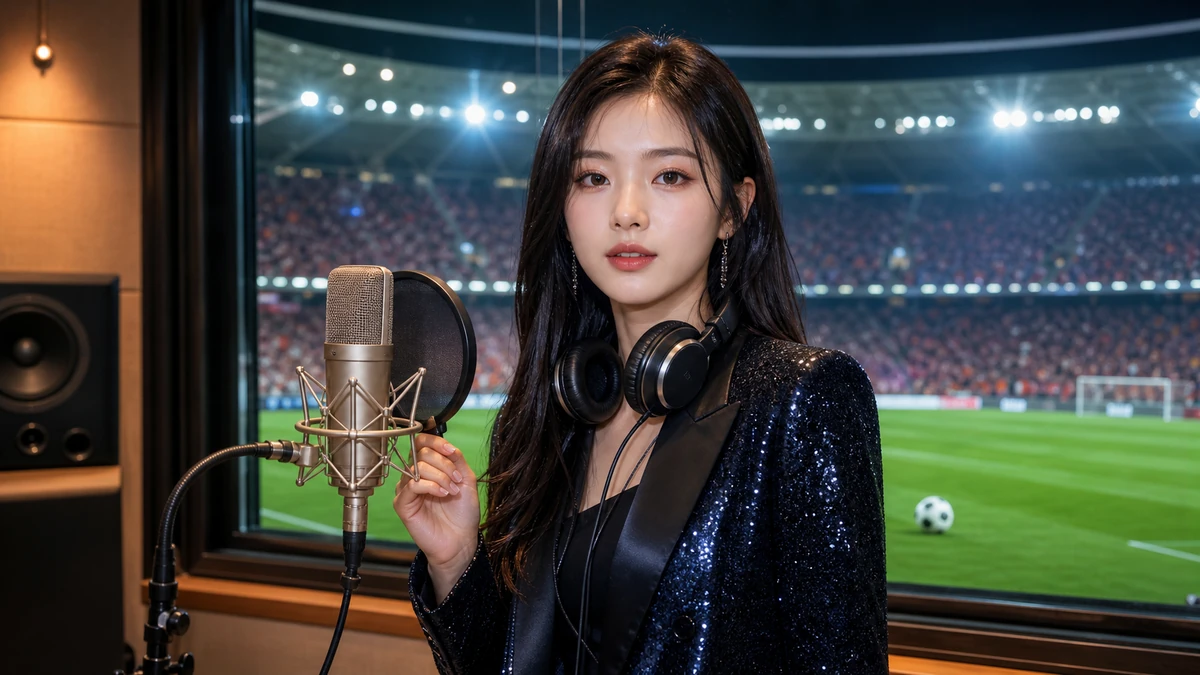
A K-pop star steps into soccer’s biggest orbit
Jihyo, the powerhouse vocalist of the South Korean girl group TWICE, has joined the lineup for “Follow Me,” a global collaboration song tied to the 2026 FIFA World Cup in North America, according to her agency, JYP Entertainment. The track was officially released June 12, and its music video, unveiled June 22, adds another layer of spectacle by featuring internationally known soccer figures alongside the singers.
On paper, this may sound like a straightforward celebrity collaboration: a major K-pop singer lends her voice to a song connected to the world’s biggest sporting event. In practice, it signals something larger about where global pop culture is heading. As the World Cup prepares to land in the United States, Canada and Mexico in 2026, organizers and music partners are clearly aiming for a soundtrack that feels as multinational as the tournament itself. Jihyo’s presence in that mix is a reminder that K-pop is no longer operating at the edges of global entertainment. It is increasingly part of the main event.
For American readers who may know the World Cup but not necessarily the inner workings of South Korea’s music industry, Jihyo is not a random celebrity pick. She is one of the most recognizable voices in TWICE, a group that has become one of K-pop’s defining acts of the past decade. TWICE has sold out arenas, placed records on U.S. charts and built a fan base that stretches from Seoul to Los Angeles, from Tokyo to São Paulo. In K-pop terms, Jihyo is not simply a member of a famous group; she is one of the performers most closely associated with that group’s vocal identity.
That matters because songs tied to global sports events are rarely just songs. They are branding exercises, emotional cues and cultural bridge-builders all at once. Whether Americans remember Shakira’s “Waka Waka,” Ricky Martin’s “The Cup of Life,” or the Super Bowl halftime show as a cultural event bigger than football for some viewers, the formula is familiar: music helps give sports its emotional afterlife. A match lasts 90 minutes. An anthem lingers for years.
In that sense, “Follow Me” appears designed to do more than promote a tournament. It is built to connect fan communities that might not otherwise meet in the same place: soccer fans, K-pop fans and mainstream pop listeners. Jihyo’s inclusion makes that strategy especially clear.
Why Jihyo’s involvement matters beyond a guest vocal
There is a tendency in Western coverage to treat K-pop collaborations as novelty pairings, as if the significance begins and ends with a recognizable name on a track list. But Jihyo’s participation reflects a deeper shift in how Korean pop artists are positioned in international projects.
Within the K-pop world, vocals carry symbolic weight. K-pop is known globally for synchronized choreography, polished visuals and intense fan engagement, but vocal distinctiveness still matters. Jihyo has long been viewed by fans and industry observers as one of TWICE’s core singers, the kind of artist whose tone can ground a song even amid heavy production and multiple collaborators. So when a global project wants a Korean artist who can represent more than just market reach, choosing Jihyo makes strategic sense.
For U.S. audiences, it may help to think of this in the way major American sports or entertainment brands choose ambassadors. A World Cup-linked song is not just about streaming numbers. It is about recognizable voices, cross-market appeal and emotional credibility. A vocalist like Jihyo brings an existing global fandom, but she also brings a style of performance that translates well across language barriers. You do not need to speak Korean to understand what K-pop fans mean when they describe her as commanding a stage or carrying a chorus.
Her appearance on “Follow Me” also fits a broader pattern. K-pop artists are increasingly moving beyond traditional album cycles and into international soundtracks, brand campaigns, festival circuits and event-linked collaborations. That is a notable development because K-pop was once treated, especially in American media, as a self-contained industry with its own rules and audience. Now it is becoming more integrated into the larger entertainment ecosystem, including sports, fashion and streaming-era multimedia events.
There is also a timing element. The 2026 World Cup will be the first men’s tournament hosted jointly by the United States, Canada and Mexico, and it is expected to be one of the most commercially ambitious in the event’s history. The host nations bring huge media markets, diverse immigrant communities and a ready-made bilingual and trilingual audience. A song associated with that tournament was always likely to aim for a wide cultural sweep. Including a Korean pop vocalist with deep fan loyalty is part of that calculation.
A song built for crossover in the streaming era
According to the details released around the project, “Follow Me” was conceived as a collaboration intended to connect soccer fans and music fans worldwide. That description may sound like standard promotional language, but it captures a real feature of how entertainment works now. Modern global hits are often engineered not around one country or one genre, but around convergence.
In earlier eras, a sports anthem might have been more straightforward: a stadium-ready chorus, a few universal slogans, maybe a superstar soloist with broad name recognition. Today, the formula is more layered. A successful global release has to travel across TikTok, YouTube, short-form clips, streaming playlists, fan edits and sports highlight packages. It has to work in a stadium, but also on a phone screen. It has to mean something slightly different to different audiences while still sounding cohesive.
That is where a project like “Follow Me” becomes especially interesting. The reported participating artists include Jihyo alongside other international performers such as French Montana, Ludmilla and Adriana C, creating a lineup that does not sit neatly in one national or musical category. Instead, it reflects the logic of global pop in 2026: assemble artists whose audiences overlap just enough to amplify one another, then anchor the result to an event powerful enough to command worldwide attention.
For Americans used to seeing genre walls fall in mainstream music, this is not entirely new. Hip-hop artists jump onto Latin pop tracks. Country stars appear with EDM producers. Afrobeats and reggaeton routinely cross into the U.S. Top 40. But K-pop’s role in that ecosystem has changed noticeably. It is no longer simply borrowing from Western pop or trying to break into the American market on American terms. Instead, K-pop artists are increasingly being selected as equal participants in multinational cultural products.
The title “Follow Me” itself suggests collective motion, something especially useful in a sports context. World Cup songs tend to lean on emotionally direct themes: unity, momentum, anticipation, pride. These tracks are not usually subtle. They are designed to be shouted, danced to, clipped into montages and replayed during moments of triumph or heartbreak. A title like “Follow Me” fits that tradition, offering a simple invitation that works across languages and fan cultures.
What is notable here is not any one lyric or claim about chart performance, but the structure of the collaboration itself. Even before the tournament begins, the project is already demonstrating how global entertainment companies imagine audience behavior: not as separate national publics, but as interconnected fandoms.
Where music and soccer fandom meet
The music video released June 22 appears to lean fully into that crossover strategy. Alongside Jihyo and the other artists, the video includes recognizable soccer names such as Brazil’s Ronaldo, Morocco’s Brahim Diaz and Uruguay’s Federico Valverde. That kind of casting is not accidental. It creates multiple entry points into the same cultural product.
A TWICE fan may click because Jihyo is in it. A La Liga or international soccer fan may click for Diaz or Valverde. A casual viewer may stay because the combination itself feels novel. That is how contemporary fandom works: not as isolated silos, but as overlapping communities connected by algorithms, clips and shared online attention.
In the United States, where soccer has grown rapidly but still occupies a different cultural place than the NFL, NBA or college football, the 2026 World Cup is expected to be a major visibility moment. The tournament will likely pull in longtime fans, immigrant communities with deep ties to national teams abroad, younger audiences raised on European club soccer, and casual viewers drawn by the scale of the event. Music will play an important role in shaping that atmosphere, particularly before the first whistle is ever blown.
There is a clear American parallel here. Think about how the Super Bowl operates not just as a championship game but as a convergence point for advertising, music, celebrity culture and social media conversation. The World Cup, globally speaking, functions on an even larger scale. A collaboration song helps create a mood around the event long before any bracket is finalized or any upset unfolds.
K-pop and soccer also share one important cultural trait: highly participatory fandom. K-pop fans do not just listen to songs. They organize streaming campaigns, dissect performances, create subtitled content, mobilize on social platforms and treat releases as communal events. Soccer supporters, meanwhile, build rituals around chants, match-day routines, club identity and national pride. Put those two ecosystems in conversation and you get a particularly potent form of audience energy.
That does not mean every soccer fan will suddenly become a K-pop listener, or that every K-pop fan will be watching qualifying tables. But it does mean the cultural distance between those worlds is shrinking. Projects like “Follow Me” are designed precisely to shorten that distance.
Explaining TWICE and Jihyo for readers new to K-pop
For audiences less familiar with Korean pop culture, TWICE is one of the most successful girl groups to emerge from South Korea’s idol system, the tightly organized training-and-debut model that produces many of K-pop’s biggest acts. The group debuted under JYP Entertainment, one of the major companies in the Korean music business, and became known for bright pop hooks, precise choreography and a strong bond with fans.
K-pop “idols,” a term that can sound unusual in American entertainment coverage, refers to performers who are trained not only as singers but often as dancers, media personalities and multilingual ambassadors for their groups. The system can be rigorous, but it also produces artists who are adept at operating across formats and markets. That versatility helps explain why K-pop artists often adapt well to large-scale international campaigns.
Jihyo stands out within that system. She is widely recognized as a lead vocal force in TWICE and, more recently, as an artist whose individual identity has become more visible even outside the group’s activities. To K-pop fans, hearing her on an international sports collaboration is meaningful because her voice is associated with both technical strength and emotional clarity. To a project built around mass appeal, those qualities are valuable.
There is another cultural layer that American readers may miss without explanation: in K-pop, group members often carry distinct symbolic roles within fandom even when they all perform together. Some members are known for dance, some for visuals, some for variety-show charisma, some for songwriting and some for vocal power. Jihyo’s image has long been tied to vocal leadership. So her participation in a project like this reads not only as star power, but as a specific kind of artistic endorsement.
That helps explain why this news resonated quickly among K-pop fans. It is not merely that a famous Korean singer joined a big global song. It is that one of TWICE’s signature voices has been placed inside a World Cup-related project meant to travel across borders, platforms and fan identities.
What this says about K-pop’s place in mainstream global culture
Perhaps the biggest takeaway from Jihyo’s participation is not about one song at all. It is about how K-pop is now being used in the cultural architecture of international events.
For years, Western outlets often framed K-pop as an export phenomenon: impressive, lucrative and enthusiastic, but still somehow separate from the core institutions of mainstream entertainment. That framing is getting harder to sustain. K-pop acts headline festivals, appear on U.S. television, collaborate with major brands and occupy chart spaces that once seemed largely closed to non-English-language artists. Now, just as significantly, they are part of the emotional packaging of events meant for mass global consumption.
That matters because sports events like the World Cup are among the few cultural experiences that still command truly worldwide attention at the same moment. To be included in a soundtrack orbiting such an event is to be treated not as a niche act, but as part of a shared international vocabulary.
There is a business rationale behind this, of course. K-pop fandom is organized, global and digitally active. It can help propel visibility around a release. But reducing Jihyo’s role to pure marketing would miss the broader point. K-pop’s rise has also changed the sound and look of global pop, from performance standards to fan engagement norms to multilingual collaboration strategies. When an artist like Jihyo appears on a World Cup song, she is not just bringing consumers with her. She is bringing a set of performance expectations and cultural associations that now matter on the world stage.
The 2026 tournament, hosted across North America, will almost certainly be packaged as a celebration of internationalism. It will unfold in countries shaped by migration, linguistic diversity and hybrid pop culture tastes. In that environment, a track that pairs K-pop, hip-hop, Latin-leaning global sounds and soccer iconography feels less like an experiment than like a preview of the future.
For English-speaking audiences, the lesson is simple. If K-pop once felt like a separate lane, it no longer is. It is increasingly woven into the same cultural fabric as the events and entertainment products Americans already understand instinctively. Jihyo’s turn on “Follow Me” is one more sign that when the 2026 World Cup arrives, the soundtrack around it may be as globally mixed as the crowds in the stands.
The road to 2026 is already becoming a cultural event
One reason this announcement stands out now is that it arrives well before the tournament itself. That early timing shows how the World Cup is no longer just a sports event that peaks in one summer. It is a rolling media ecosystem, built months and years in advance through branding, storytelling, host-city promotion and entertainment tie-ins.
By the time the opening match begins in 2026, many fans will already have developed an emotional relationship with the tournament through promotional content, music, social media campaigns and celebrity appearances. That is especially true for younger audiences, who often encounter major events first through clips and cultural moments rather than official broadcasts or newspaper coverage.
Jihyo’s involvement helps place K-pop inside that early-stage emotional buildup. For fans of TWICE, this becomes one more reason to pay attention to the World Cup. For soccer fans, it is one more sign that Korean pop’s influence extends well beyond dedicated music spaces. And for the broader entertainment industry, it reinforces a now-familiar reality: global culture works best when it invites multiple fandoms into the same room.
Nothing about that guarantees commercial success or lasting anthem status. The available facts are more modest and more concrete: Jihyo participated vocally in “Follow Me,” the song was released June 12, and the music video released June 22 includes globally known soccer figures. But even with those limited confirmed details, the project’s cultural significance is visible. It brings together one of K-pop’s most recognizable voices, international artists from multiple music spheres and the imagery of the world’s most watched sport.
In a media environment saturated with collaborations, that combination still says something important. It shows that K-pop artists are not just crossing over into Western markets; they are helping define what a global event sounds like. As North America prepares to host the world in 2026, Jihyo’s voice on “Follow Me” offers an early hint of the kind of border-crossing pop culture spectacle that audiences can expect.
Comments
Post a Comment