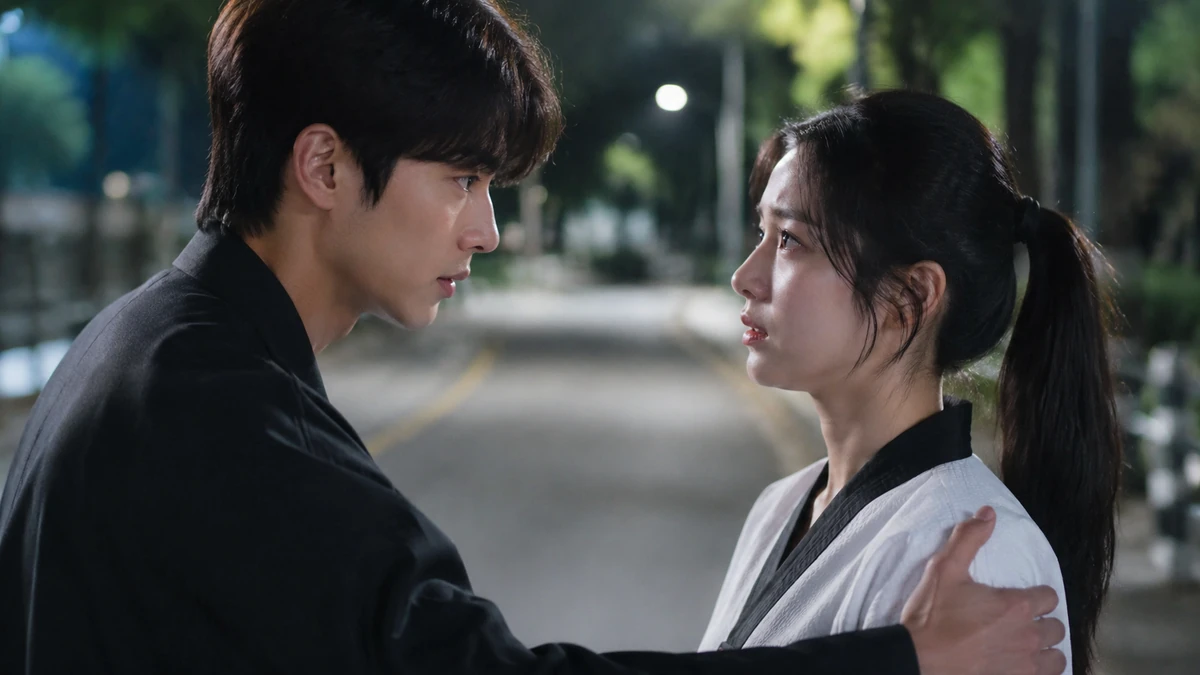
A reunion drama with more than star power
South Korean cable network tvN is betting on a familiar pleasure with a fresh twist: the return of two young actors in a romance that blends first love, mortal danger and the kind of high-concept storytelling that has helped make Korean television a global habit. Lee Chae-min and Roh Yoon-seo have been cast as the leads in the upcoming drama “The Reason I Decided to Die,” a series scheduled to air next year and adapted from a webtoon, the digital comic format that has become one of the most reliable engines of Korean screen storytelling.
For viewers in the United States who may not follow the churn of Korean entertainment news, the headline item is simple enough: two sought-after young actors are reuniting three years after an earlier collaboration, this time in what Korean broadcasters often call a “youth romance,” a genre centered on people in late adolescence or early adulthood navigating love, identity and ambition. But the project’s premise suggests something broader than a straightforward campus-style love story. According to details released by tvN, the drama follows a man who repeatedly dies and returns to the same point in time in order to save the woman he loves, while that woman, rather than waiting to be rescued, fights against the fate laid out for her and tries to protect him in return.
That setup matters. In the crowded universe of K-dramas, reunions between attractive young leads can generate quick buzz on their own. Yet this one is drawing attention because it promises more than chemistry or nostalgia. The series combines a recognizable romantic framework with a time-loop structure — a storytelling device American audiences know from films like “Groundhog Day,” “Edge of Tomorrow” and, in a more recent television mode, “Russian Doll.” The difference here is tonal. Korean dramas often use genre blending with unusual confidence, moving from melodrama to suspense to humor and back again within the same episode. In this case, the emotional engine is not simply whether the couple gets together, but how much pain, sacrifice and moral choice can accumulate when love must survive repetition, memory and death itself.
That is one reason the project stands out in a television market saturated with high school romances, fantasy thrillers and webtoon adaptations. It arrives with the recognizable packaging of a youth romance but appears designed to test the boundaries of that label. The story is not only about longing; it is about endurance. It is not only about fate; it is about whether fate can be negotiated, delayed or rewritten by two people acting together.
For global viewers who came to Korean television through international breakout hits and stayed for its emotional precision, that combination is likely to feel instantly legible. Love across impossible conditions is universal. A looped timeline adds urgency. And a heroine defined not by fragility but by discipline and fight gives the drama a contemporary edge that may resonate well beyond Korea.
The story: romance under pressure, with death on repeat
At the center of the drama are Cha Gyeol, played by Lee, and Nam Ji-o, played by Roh. Cha Gyeol repeatedly experiences death and regression — in other words, he dies and returns to an earlier point in time — as he tries to prevent Ji-o’s death. If that sounds like a fantasy concept built for plot mechanics, Korean drama history suggests the opposite may be true. In many K-dramas, speculative elements such as reincarnation, body swapping, parallel timelines or supernatural contracts are not there mainly to showcase visual effects or mythology. They are there to intensify emotion. The extraordinary premise becomes a pressure cooker for ordinary human questions: How much can someone endure for love? What does sacrifice mean if it must be repeated? When does hope turn into obsession?
The title itself, rendered in English from the Korean, carries a dramatic charge that hints at just how serious the emotional stakes may become. Korean series are often more direct than American TV in their titles, using phrases that foreground inner crisis, longing or destiny. That can sound heightened to English-speaking audiences at first, but it is part of the emotional contract many K-dramas make with viewers: feelings will not be tucked away or treated as subtext alone. They will be confronted head-on.
In this story, the time loop is not just a puzzle box. It is punishment, opportunity and test. Each return offers Cha Gyeol another chance to save the person he loves, but it also requires him to go through death again. That means the drama’s emotional tension rests not merely on whether he can change events, but on what repeated suffering does to a person’s mind, resolve and sense of self. Repetition in storytelling can flatten stakes if it becomes mechanical. Used well, it can do the opposite. It can reveal how the same moment changes depending on what a character knows, fears or is willing to lose.
Ji-o, meanwhile, is not written as a passive object of rescue. She is described as a promising taekwondo athlete with dreams of winning Olympic gold, someone defined by grit, discipline and a fundamentally upright character. For American viewers, it may be helpful to understand how loaded that detail can be in a Korean context. Taekwondo is not just a sport from Korea that became globally popular; it is also a source of national pride, a martial art closely associated with self-control, perseverance and resilience. Making Ji-o a taekwondo prospect signals more than physical ability. It suggests an ethic — the trained refusal to submit easily, the habit of getting up after impact, the belief that discipline is inseparable from identity.
That contrast is one of the concept’s strongest hooks. Ji-o’s life is oriented toward the future: training, competing, pursuing a dream measured in forward progress. Cha Gyeol, by contrast, is trapped in backward motion, forced to relive time in order to preserve that future for her. One character advances; the other must return. The contradiction sharpens the romance. Their love is not simply delayed by circumstance. It is stretched between two opposing movements through time.
Why this pairing is getting attention in Korea
Lee Chae-min and Roh Yoon-seo belong to a generation of actors who have benefited from the global rise of Korean content but still operate within the intensely competitive domestic star system that shapes careers in Seoul. In Korea, casting news often carries a weight more akin to sports free agency or franchise casting in Hollywood. Networks, production companies and fans all track which actors are moving into lead roles, which pairings show promise and which projects are positioned as the next breakout.
That makes the “reunion” angle significant, even if it is not the whole story. Korean entertainment media routinely highlight when actors work together again after a previous project, especially if audiences responded to their earlier dynamic. It is a shorthand way of telling viewers there is already a reservoir of familiarity and expectation attached to the pair. Three years may not sound like a long gap in Hollywood terms, but in the fast-moving ecosystem of Korean television — where actors can appear in multiple major projects in that span — it is enough time for both performers to mature, gather new audiences and return with altered screen personas.
For broadcasters like tvN, that is valuable. The network has built its reputation on glossy, actor-driven dramas that often sit at the intersection of commercial appeal and emotional sophistication. While Korea’s public broadcasters helped define the modern K-drama template, cable channels like tvN have played an outsized role in the past decade in shaping what international viewers now recognize as prestige-adjacent Korean television: romantic dramas with sharp aesthetics, compelling ensemble casts and genre elements calibrated for binge-friendly viewing.
In practical terms, a reunion between two rising actors helps draw early attention, but it also raises the bar. Audiences will not only expect chemistry. They will expect evidence of growth. Lee’s role appears particularly demanding because it requires variation within repetition. Playing a man who returns to the same circumstances again and again means the actor must show what changes internally even when the outer situation looks similar. Roh’s challenge is different but equally substantial. Ji-o must carry the physical credibility of an athlete while also registering emotional intelligence and agency. If the drama leans too far toward making her a symbol of what must be protected, the premise narrows. If it allows her to be an active force — someone who makes decisions, takes risks and pushes back against destiny — the story opens up.
That is why many early assessments in Korean media have focused on the structure of “mutual salvation.” In a lot of conventional romance narratives, one character exists mainly to rescue the other. Here, the appeal lies in the idea that each becomes responsible for the other’s survival, emotionally and literally. That reciprocity feels in step with a broader shift in contemporary Korean dramas, particularly those aimed at younger audiences, where female leads are increasingly written as strategic, competent and narratively central rather than merely inspirational.
What a webtoon adaptation tells us about the show
The fact that the drama is based on a webtoon is more than an industry footnote. For anyone trying to understand Korean pop culture in the 2020s, webtoons occupy a role somewhat comparable to what comic books, YA novels and prestige streaming IP do in the United States — except their integration into daily life is often even more seamless. Read vertically on smartphones, webtoons are built for the rhythms of mobile consumption. They reach vast audiences, cultivate devoted fan communities and provide producers with stories that already have a visual identity and a proof-of-concept readership.
That pipeline has become central to Korean entertainment. Some adaptations arrive with sprawling fantasy worlds. Others rely on more intimate emotional premises. Either way, the move from webtoon to television usually raises the same question: Can the adaptation preserve what made the original compelling while deepening characters enough for live-action performance? With a time-loop romance, that challenge becomes even more pronounced. What viewers need to understand clearly is not only what repeats, but what changes — in dialogue, in glances, in tactics, in fatigue, in resolve.
That may sound technical, but it is really a question of emotional architecture. Repetition is easy to write as plot. It is much harder to make it feel like accumulating experience. The strongest versions of this type of story do not just reset events; they allow memory to become a burden. Every new attempt carries the invisible weight of prior failures. That is where live-action performance can add something a comic page cannot fully reproduce. A pause before a line, a flicker of dread, a body that looks more exhausted than the scene itself would otherwise explain — these are the kinds of details that can make a loop story feel devastating rather than gimmicky.
There is also the matter of audience expectation. Webtoon readers often arrive protective of tone and character dynamics. New viewers, meanwhile, simply want the show to work on its own terms. For the adaptation to succeed broadly, it will need to satisfy both. The premise already offers a strong foundation: love, death, repeated chances, a looming fate. But the drama’s staying power will depend on whether it earns the emotional logic of those elements rather than merely arranging them as hooks.
In that sense, the adaptation process mirrors a larger pattern in Korean television’s international success. The most exportable stories are often not the biggest or loudest. They are the ones that combine a clean, high-concept premise with intensely specific feeling. Viewers anywhere can understand trying again. They can understand watching someone you love head toward danger. The Korean context gives the story texture; the emotional stakes make it travel.
Taekwondo, youth ambition and the Korean idea of resilience
Ji-o’s identity as an Olympic-minded taekwondo prospect is likely to be one of the drama’s most culturally resonant details, and one of the easiest for foreign viewers to grasp with a little context. In the United States, audiences are familiar with sports dramas built around singular discipline — the gymnast chasing the Olympics, the boxer training through injury, the swimmer measuring life in fractions of a second. Korea has its own long tradition of sports-centered storytelling, but taekwondo carries special symbolism because of its national roots and international reach.
As an Olympic sport and one of Korea’s most recognizable cultural exports, taekwondo embodies a blend of physical rigor and moral language. It is associated not just with combat, but with respect, restraint and perseverance. A character shaped by that training is therefore not simply athletic. She is coded as someone accustomed to routine, impact and self-command. When a Korean drama labels a young woman a taekwondo hopeful with dreams of Olympic gold, it signals that she is pursuing one of the most demanding and visible forms of success available to a young athlete.
That ambition also places her squarely within a recognizable Korean social reality. South Korea is a highly competitive society in which academic and professional pressure often dominates narratives about youth. Dramas centered on young people frequently explore not only romance, but the burden of achievement: the pressure to qualify, to excel, to justify sacrifice. Ji-o’s Olympic goal gives her a concrete future, something larger than the romance itself. That is important because it prevents the story from treating love as the only meaningful destiny available to a young woman. She has a life trajectory, a vocation and a disciplined identity outside the relationship.
For American audiences, it may be useful to think of her as occupying a narrative space somewhere between a top college recruit and an Olympic hopeful — someone whose daily life is organized around training, expectations and the possibility of national recognition. Her struggle against fate, then, is not abstract. It threatens not only survival, but a future she has worked to build through effort and self-denial.
Thematically, that gives the drama a sturdy counterweight to its fantasy elements. One of the reasons time-loop stories can feel weightless is that they remove normal consequence. But anchoring the female lead in an athlete’s regimen introduces a powerful sense of stakes. Training depends on time. Growth depends on continuity. A life repeatedly disrupted by catastrophe is also a life pulled away from the steady work required to become elite. In that respect, the romance may derive some of its force from a painful asymmetry: Cha Gyeol sacrifices himself to preserve Ji-o’s tomorrow, while Ji-o must keep moving toward that tomorrow even as time itself refuses to behave normally around them.
Why the “saving each other” angle matters
One of the most intriguing elements in the announced premise is its refusal, at least on paper, to settle for a one-way rescue story. There is a long history across global popular culture of narratives in which a man saves a woman from danger, and romance grows from that protection. That model remains commercially durable, but it can also feel dated if the woman becomes little more than a symbol of innocence, trauma or reward. By contrast, “The Reason I Decided to Die” appears to frame both leads as active agents in each other’s survival.
That distinction matters especially in a media environment where audiences are increasingly attuned to questions of agency. The most compelling contemporary romances are often the ones in which devotion does not erase personhood. Mutual rescue can mean many things. It can mean literal protection from physical danger, but it can also mean refusing to let the other person collapse under guilt, despair or fatalism. In a time-loop narrative, those emotional forms of rescue may be just as important as plot interventions. A man who dies repeatedly for love may look heroic from a distance. Up close, he may also be exhausted, traumatized or tempted to see himself as expendable. If Ji-o’s role includes pushing back against that logic, then the drama could achieve something richer than tragic chivalry.
There is another reason the “saving each other” framing travels well across borders. It aligns with the way many international fans now talk about the appeal of Korean dramas: not simply that they are romantic, but that they take emotional interdependence seriously. K-dramas often grant their relationships a level of earnestness that American television has sometimes treated skeptically or ironically. Characters say what they feel. They endure. They choose. Under the right creative hands, that sincerity can feel refreshing rather than sentimental.
The phrase “fighting fate” is itself a staple of Korean drama language, but it works here because fate is not an abstract philosophical idea. It is dramatized as recurring death, irreversible loss and a countdown that love alone may not be able to stop. That tension — between emotional conviction and structural inevitability — is where many of the genre’s most successful stories live. The audience is asked not merely to root for the couple, but to confront the possibility that wanting something desperately may still not be enough.
If the show succeeds, it may do so because it understands that rescue is rarely clean. To save someone can also wound you. To be saved can create guilt as much as gratitude. And to love someone inside a repeating disaster means facing the possibility that sacrifice itself can become a trap. Those are mature ideas for a youth romance, and they suggest why this drama is attracting interest beyond the novelty of a casting reunion.
K-dramas keep finding global audiences by mixing the familiar and the specific
At a broader industry level, this project lands at a moment when Korean scripted television continues to enjoy a level of international attention that would have seemed improbable two decades ago. Streaming made subtitles less intimidating for many viewers, but the Korean Wave — often referred to by the Korean term “Hallyu” — was already building through music, film, beauty products and earlier generations of television exports. What has changed is not simply access. It is confidence. Korean producers now make dramas with the expectation that they may be watched in Los Angeles, London or Lima soon after domestic broadcast.
That does not mean every series is designed for the world first. In fact, many of the most successful international titles remain deeply Korean in setting, language and social cues. What travels is the emotional clarity and the efficiency of the premise. A grieving immortal. A woman trapped in a marriage contract. A prosecutor chasing corruption. A man reliving time to save the woman he loves. These are ideas that can be summed up quickly across languages, then enriched by local texture once viewers step inside the world.
“The Reason I Decided to Die” seems to fit that pattern. Its core concept is instantly accessible. Anyone can understand the wish to go back and prevent catastrophe. Anyone can understand the ache of loving someone whose future feels threatened. But the specific coloring — the taekwondo background, the youth-drama framing, the heightened emotional register typical of Korean melodrama — gives it an identity distinct from a generic sci-fi romance.
For American audiences who may still associate Korean television primarily with a handful of high-profile thrillers or historical epics, projects like this offer a reminder of the breadth of the medium. A K-drama need not be grim or sensational to be compelling. Often, its power lies in how confidently it lets romance carry narrative weight while borrowing tension from adjacent genres. Time travel becomes a delivery system for heartbreak. A sports dream becomes a moral compass. Fate becomes a clock the audience feels ticking in every scene.
That may ultimately be the reason this casting news has generated interest. Not because two actors are meeting again, though that helps, and not simply because a webtoon is being adapted, though that is now a proven formula. It is because the series appears to understand a truth that Korean television has used to great effect for years: the more fantastical the premise, the more grounded the emotional choices must be. If Lee and Roh can make those choices feel credible — if each repeated death and each act of resistance carries a fresh emotional cost — the drama may find viewers far beyond its home market.
For now, the show remains a promise more than a finished work. But it is a revealing one. In its premise, you can see many of the features that have defined modern Korean drama at its most exportable: a clear hook, a strong emotional thesis, a female lead with purpose, a male lead pushed to the edge of sacrifice and a willingness to treat love not as decoration but as a force capable of colliding with death, destiny and time itself. That is a language global audiences increasingly understand — no cultural translation required, only context.
Comments
Post a Comment