A New Rail Link Near Busan Will Mirror Subway Fares, Making Cross-City Commuting Easier in South Korea
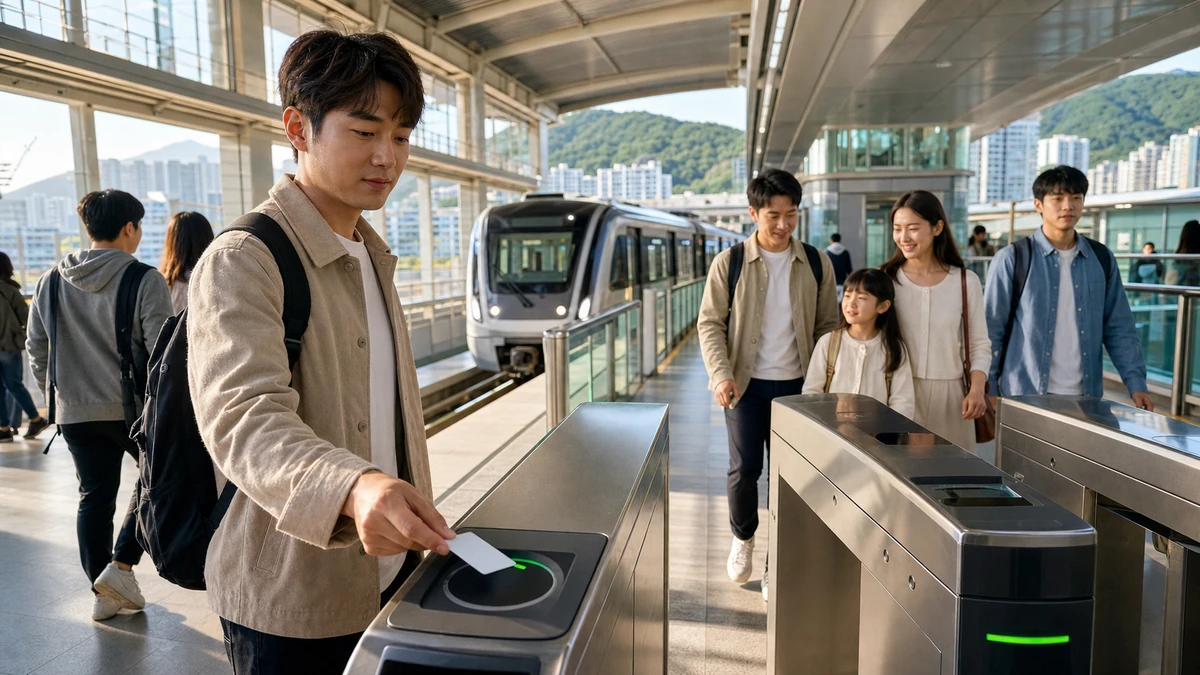
A fare decision aimed at keeping a new rail line simple
South Korean officials have set the maximum fare range for the Yangsan Urban Railway, a new metro-style line scheduled to open in December and designed to connect the city of Yangsan with neighboring Busan, the country’s second-largest city. The headline figure is straightforward: the top-end fare cap will match Busan’s existing subway pricing, with adults using transit cards paying no more than 1,600 won for a one-zone trip and 1,800 won for a two-zone trip. Teen riders using transit cards would pay no more than 1,050 won for one zone and 1,200 won for two zones.
That may sound like a narrow bureaucratic adjustment, but in practical terms it is the kind of detail that can shape whether a new transit line feels intuitive or frustrating from day one. In metro systems anywhere, from New York to Washington to Seoul, riders care not only about whether a train arrives on time but also whether they can easily understand what the trip will cost. South Korean officials are trying to avoid a common regional-transit problem: a line may physically connect two places, but if the fare structure feels separate, confusing or unexpectedly expensive, the promise of easy commuting is weakened.
The new line matters because Yangsan and Busan function as part of the same broader daily living area even though they are governed separately. People commute across the boundary for work, school, shopping, hospital visits and family obligations. The Yangsan Urban Railway is not simply a neighborhood shuttle within one municipality. It is being built as a regional connector, linking different local jurisdictions while feeding directly into Busan’s established subway network.
In that context, the fare cap decision is less about setting a final ticket price than about sending a message on how the line will operate: this railway is meant to feel like part of the larger metropolitan transit experience, not an isolated add-on with its own unfamiliar rules.
Why this rail line matters beyond one midsize Korean city
For readers in the United States, it may help to think of Yangsan as a city in the orbit of a much larger regional hub. Busan, a port city on South Korea’s southeastern coast, is often described as the country’s second city after Seoul. It is dense, heavily urbanized and anchored by an extensive subway network. Yangsan, in neighboring South Gyeongsang province, sits just outside Busan and has grown as part of the wider metropolitan footprint, much the way suburban and exurban communities in the U.S. become economically tied to a central city even while keeping separate local governments.
South Korea’s administrative boundaries can look crisp on paper, but daily life often ignores them. That is especially true in metro regions where people routinely move between cities in one continuous pattern of commuting and consumption. The Yangsan Urban Railway reflects that reality. According to the government’s outline, it will connect to Busan Metro Line 1 at Nopo Station and to Busan Metro Line 2 at Yangsan Jungang Station. Those transfer points are important because they make the new line part of a broader network rather than a standalone route.
That network effect is what transit planners often hope for and what riders immediately notice. A new line has more value when it extends the usefulness of older lines already familiar to the public. In the U.S., regional transit debates frequently center on whether agencies can make transfers seamless across jurisdictions. In the New York area, for example, riders navigate different systems and fare expectations depending on whether they are on the subway, commuter rail or a suburban bus network. In the Washington region, passengers often cross between the District, Maryland and Virginia within a single workday, but the user experience still depends heavily on whether the transfer feels coordinated. South Korean officials appear to understand that same logic here: a cross-boundary rail service works best when its fare structure feels familiar.
That is why the choice to mirror Busan’s pricing ceiling matters symbolically as well as economically. It tells riders that the new Yangsan line is being built into an existing commuting culture, not imposed as a separate system that requires people to relearn how local transit works.
What officials actually decided — and what they did not
The most important caveat is that South Gyeongsang province did not announce the final fare passengers will definitely pay. It announced the upper limit, or ceiling, within which Yangsan city will later set the actual fare. That distinction is crucial.
Under the plan released by the province, the highest allowable fare for an adult using a transportation card would be 1,600 won for Zone 1 and 1,800 won for Zone 2. For teenagers using transportation cards, the cap would be 1,050 won for Zone 1 and 1,200 won for Zone 2. Those amounts align with Busan Metro fare levels rather than establishing a premium price for the new line.
But riders should not read that as a final published rate sheet. The province has essentially drawn a boundary around what Yangsan can charge. The city still has to decide the actual amount within that range through its own fare-setting process. In other words, the line could open at the ceiling, or it could open at a lower price. What it cannot do, under the current framework, is exceed the maximum set by the province.
This kind of layered decision-making is common in public transportation, though it often confuses riders because the administrative process moves in stages while the public mostly wants one simple answer: How much will I pay? In this case, South Gyeongsang province convened a fare adjustment committee earlier in July to establish the broad parameters, then publicly disclosed the result several days later. The province said the goal was to minimize confusion among passengers and support stable regional transit service.
That wording is notable. Officials are treating fare policy not as a narrow revenue tool but as part of service design. The idea is that price clarity itself is an element of usability. Anyone who has stood at a ticket machine in an unfamiliar city — unsure how zones work, whether a transfer is included, or whether a special local surcharge applies — understands why that matters.
The cultural context: transit cards, zones and Korea’s commuter culture
To many Americans, the numbers themselves may mean little without context. South Korea’s urban transit systems generally rely heavily on rechargeable transportation cards, the equivalent of using a contactless fare card rather than buying a disposable paper ticket each trip. Riders tap in and out, and the system calculates fares according to established rules. These cards are deeply embedded in everyday Korean life and are used across buses and rail lines in major metro areas. That makes fare simplicity even more important because the expectation is that transit should feel frictionless, fast and routine.
The distinction between general riders and youth riders is also standard in Korea. Teen fares are often separately structured to reflect student mobility and household costs. In practical terms, that means a family evaluating a new rail line may be looking at several pricing categories at once, especially in a place like Yangsan where students commute to schools and after-school academies across municipal lines.
The zone structure is another important piece. Rather than one flat price for all travel, the Yangsan Urban Railway will distinguish between a first zone and a second zone. For adults using transit cards, the difference between the two maximum fares is 200 won. That is a modest gap, but the structure still signals that travel distance or section length matters. The same principle applies to teenage fares, which also have separate caps for the two zones.
In many Korean metropolitan areas, transit is not a supplemental option reserved for downtown office workers. It is a core part of ordinary life, woven into routines from commuting to shopping to leisure travel. Subway stations often double as neighborhood anchors, linked to bus networks, apartment developments and commercial districts. So when officials talk about minimizing rider confusion, they are addressing something larger than a policy memo. They are trying to shape the daily experience of a public that expects transit to be legible, predictable and well integrated.
That expectation helps explain why matching Busan’s fare level is politically and operationally attractive. Busan’s metro system already provides a known reference point for many potential Yangsan riders. If the new line had launched with a visibly higher cap or a quirky separate standard, commuters might have perceived it as a penalty for crossing municipal lines. By using Busan’s fare level as the benchmark, officials are telling riders that a cross-city trip should still feel like part of one connected metropolitan journey.
Why seamless fares matter as much as tracks and stations
Public officials often celebrate rail openings by focusing on infrastructure: tunnels completed, tracks laid, stations finished, vehicles tested. Those are essential milestones, but transit experts know that a successful line is also a product of what riders experience after the ribbon-cutting. Fare policy, transfer design and clear information can determine whether a line feels welcoming or cumbersome.
The Yangsan project underscores that point. The railway will connect with Busan Metro Line 1 at Nopo and with Line 2 at Yangsan Jungang. On a map, that kind of dual linkage is a significant strength. It gives riders multiple ways to move through the larger urban area. But if the financial logic of the trip became too opaque — if riders had to guess which rules applied or worry that crossing into another jurisdiction triggered a hidden extra cost — then some of the convenience would be lost.
Americans know this problem well. Regional transit fragmentation is a familiar challenge in the U.S., where agency boundaries often shape rider experience more than geography does. A train line can appear continuous on a map while fare rules tell a different story. That tension is especially visible in metropolitan areas where different cities or counties operate adjacent pieces of the system. South Korea, despite its reputation for efficient public transit, faces its own version of that issue whenever a line crosses administrative boundaries.
What makes the Yangsan decision noteworthy is that officials appear to be addressing the user experience before service begins, not after complaints pile up. The province’s argument is simple: if the line is supposed to function as a regional connector, then the fare framework should support that identity from the outset. In effect, the price ceiling becomes part of a broader effort to make the new line feel native to the existing Busan transit ecosystem.
That does not mean fares are trivial. Commuting costs add up quickly, especially for workers and students who ride every day. In that sense, even a small difference in fare policy can influence household budgets and transit habits. The final number Yangsan sets will therefore attract close public attention. But by capping the allowable fare at Busan levels, provincial officials have at least narrowed the range of uncertainty.
What riders should watch before the December opening
The next key step is Yangsan city’s final decision on the actual fare. The city will make that determination within the range approved by the province’s transit fare adjustment process. Until then, the current announcement should be understood as a pricing framework, not the final amount that will appear on passengers’ cards when service starts.
Still, the framework already answers some of the biggest early questions. It clarifies that officials are not planning to treat the Yangsan line as a premium service priced above Busan Metro. It confirms that the system will use a two-zone structure. It sets separate maximum fares for adults and teenagers using transit cards. And it suggests that regional integration, not administrative separation, is driving the policy approach.
That matters because fare announcements are often one of the first real-world signals of how a transit project sees its riders. A complicated or inflated price structure can make a new line feel like a burden. A familiar, easily explained one can build confidence before the first train departs. South Korean officials seem to be betting on the latter.
For Busan- and Yangsan-area residents, the larger significance is practical rather than dramatic. This is not the kind of infrastructure story that hinges on a grand national vision or a flashy technology debut. It is about how people move through an interconnected metro region and what kind of transit experience they will have when crossing from one local government’s territory into another. Those decisions rarely generate the excitement of station openings, but they can have a more lasting effect on whether the service becomes part of everyday life.
For international observers, the case offers a useful window into how South Korea manages urban growth at the regional level. The country’s cities are not only extending rail lines; they are also negotiating how those lines fit into daily patterns of movement, cost and convenience. In a world where metropolitan areas increasingly spill across municipal borders, that may be the more important lesson. Transportation integration is not just about connecting tracks. It is about making an entire journey — including the price — feel coherent to the people who take it.
As December approaches, the remaining question is straightforward: where within the approved ceiling will Yangsan set the final fare? Riders do not know that answer yet. But they now know the line will be built around a familiar benchmark, and that alone may help the new railway start with something every transit system wants: public trust that the trip will make sense.
Comments
Post a Comment