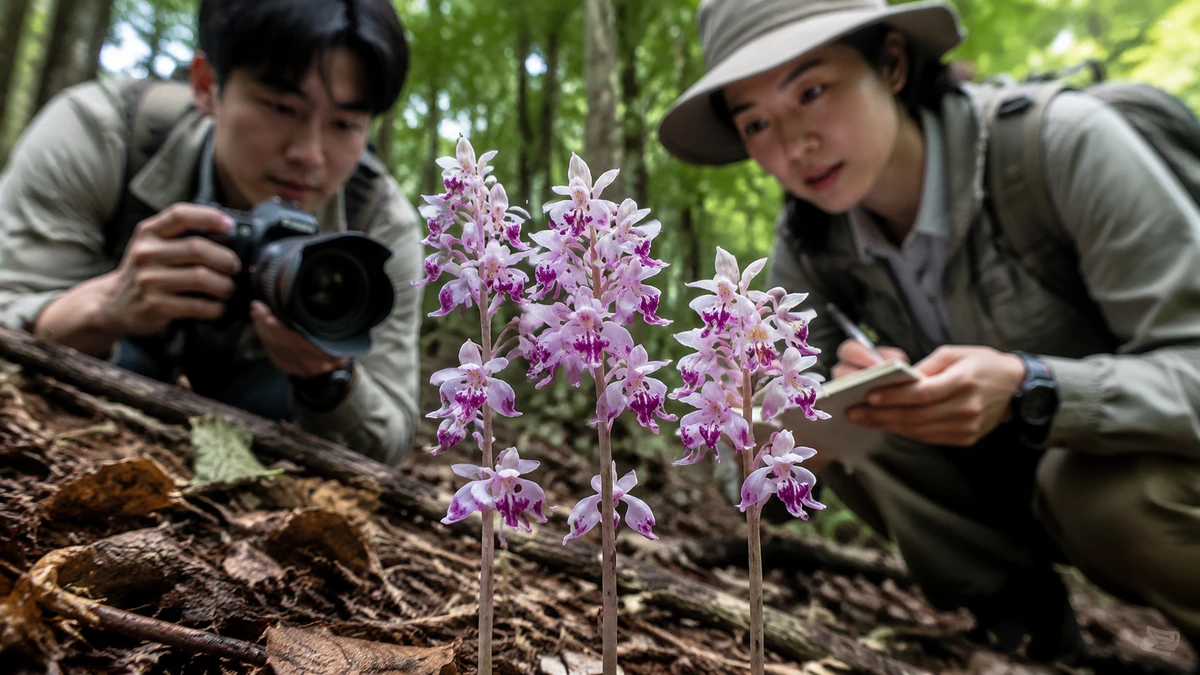
A fleeting bloom in South Korea’s summer forest
In the mountains of southeastern South Korea, park officials say they have confirmed the flowering of a rare and endangered wild orchid in a discovery that is as much about patience and protection as it is about botanical beauty. According to South Korea’s national park authorities, the endangered plant known in Korean as daeheungnan was found in bloom on July 24, 2026, in the Eunhaesa area of Palgongsan National Park, a heavily visited mountain park with deep religious and ecological significance.
At first glance, the news may sound like a simple nature item: a rare flower has appeared in the woods. But in Korea, where mountain landscapes, Buddhist temples and tightly managed parklands often exist side by side, the confirmation carries broader meaning. The flower was not spotted by chance during a single scenic hike. It was documented after nearly two years of repeated monitoring that began when citizen scientists and park staff located a colony in October 2024. At that time, they mostly found dried flower stalks — evidence that the orchid had been there, but not proof of what it looked like in full bloom during its short summer flowering season.
Officials at the western district office of Palgongsan National Park said continued close observation of the site eventually led to photographs of the plant in flower. In an era when nature stories often revolve around viral images and rapid social media attention, this one underscores something slower and more disciplined: conservation depends on staying with a place long enough to understand it.
For American readers, the closest comparison may be the excitement that follows the rediscovery of a rare wildflower in a protected area like Great Smoky Mountains National Park or Shenandoah, especially if the plant is sensitive enough that land managers will not publicize its exact location. What matters is not just that something rare was seen, but that the ecosystem supporting it is still functioning well enough for that species to survive and reproduce.
That is the larger message emerging from Palgongsan. The bloom is not being treated simply as a tourist attraction or a striking photograph. It is being framed as a field record showing that one of Korea’s most delicate native species still has the conditions it needs to live on a forest floor shaped by leaf litter, moisture, shade and time.
What makes this orchid so unusual
Daeheungnan is not the kind of orchid many Americans might picture from a florist’s shop, a grocery store display or a windowsill plant with broad green leaves and bright tropical blossoms. This is a rare wild orchid that lives without leaves, one of the details that makes it especially intriguing to botanists and conservationists.
Instead of relying on the familiar leaf-driven process of photosynthesis in the same way most plants do, the orchid survives by drawing nutrients from organic matter produced as fallen leaves decompose on the forest floor. That means its life is tied not just to a patch of soil, but to a whole web of ecological conditions: the accumulation of leaf litter, the fungal and microbial processes that break it down, the surrounding canopy that regulates light and moisture, and the relative stability of the habitat from year to year.
In practical terms, it is a plant that does not advertise itself. It does not stand out with lush greenery or a conspicuous stem visible from far away. It depends on the kind of forest floor many hikers might overlook entirely — a layer of decaying leaves, organic material and subtle seasonal change. Its flowers, which bloom in July and August, are described as white or pale pink with magenta patterns. The visual effect can be delicate and striking, but only if someone is looking at the right place during the right moment in a narrow summer window.
That helps explain why the 2026 images matter. Seeing the orchid in full bloom is not just aesthetically satisfying. It confirms that the species made it through its annual cycle in that specific habitat. In other words, the flower is evidence of ecological continuity.
For readers less familiar with Korean conservation terminology, the species is classified as a level II endangered wild plant under South Korean law, meaning it receives formal protection as a species at risk. The classification is a reminder that the stakes go beyond scientific curiosity. A flower like this can vanish not only from public awareness but from the landscape itself if the conditions around it are disturbed.
That sensitivity is part of why the story has resonated. The orchid’s survival is linked to a kind of natural infrastructure that is easy to damage and slow to rebuild. A boot stepping off trail may seem harmless to a casual visitor. But when a plant depends on an intact layer of decomposing matter and on microhabitat conditions that can be altered by trampling, compaction or collection, even small disturbances can matter.
Why Palgongsan matters beyond the flower
Palgongsan is one of the best-known mountain areas in the Daegu and North Gyeongsang region of South Korea. In the Korean imagination, mountains are not just recreation spaces; they are cultural landmarks, spiritual settings and biodiversity reservoirs. Hiking is a national pastime in South Korea, and mountain trails can draw crowds in a way that may remind Americans of popular routes in national parks out West or heavily used trails in the Appalachians during peak foliage season.
The Eunhaesa district, where the orchid colony was identified, takes its name from Eunhaesa, a historic Buddhist temple located on the mountain. That setting is important context for international readers. In Korea, temples are often embedded within mountainous landscapes rather than isolated from them. The result is a centuries-old overlap of pilgrimage, tourism, forest management and ecological preservation. A trail may lead not only to a viewpoint or summit, but also to a temple complex, a hermitage or a culturally significant forest area.
That blend of human and natural history makes conservation both more complex and more visible. A site like Palgongsan is not wilderness in the American frontier sense. It is a lived-in, visited and symbolically important landscape. Protecting a rare orchid there means managing a place where hikers, worshippers, local residents and nature enthusiasts all intersect.
In that respect, the Korean park service response mirrors challenges familiar to U.S. land managers: how do you tell the public that something rare and exciting exists without encouraging the exact kind of attention that could harm it? American park officials face similar questions when dealing with sensitive nesting sites, fragile desert blooms or endangered amphibian habitats. The usual answer is controlled information, clear trail guidance and repeated emphasis that seeing nature does not require touching, entering or claiming it.
That is essentially the message from Palgongsan. The announcement highlights the bloom, but it stops well short of turning the orchid into a must-see destination. Officials are asking visitors to stay on designated trails and not collect plants. That may sound routine, but in a case like this it is central to the story. The orchid’s value lies partly in the fact that it remains in place, in a functioning habitat, not in whether individuals can approach it for a closer look.
From dried stalks to a confirmed bloom
What makes the discovery especially notable is the timeline. The colony in the Eunhaesa area was first identified during a joint survey in October 2024 that included citizen scientists. But because the survey took place after the flowering season, researchers mainly observed dried stalks believed to be from previous blooms. Those remains served as clues, not conclusions.
That distinction matters. In ecological fieldwork, especially with rare plants that flower briefly and can be difficult to identify outside that period, a site visit often captures only fragments of a life cycle. A dried stalk may tell researchers that a species was present. It cannot fully reveal the flower’s condition, coloration or the precise timing of that year’s bloom. To gather that information, observers must return repeatedly and time their visits to the plant’s seasonal rhythm.
That is what the Palgongsan western district office did. After the 2024 survey, officials continued close monitoring of the site. By the summer of 2026, they were able to photograph the orchid in full bloom. The progression from trace evidence to visual confirmation turns the story into something larger than a one-day find. It becomes a case study in why rare-plant conservation often depends on long-term attention rather than one-off discovery.
For American audiences, there is an easy analogy in birding or wildlife biology. Spotting an old nest or feathers tells you a bird was there. Documenting nesting behavior, hatchlings or migration patterns requires follow-up over time. The same logic applies here. A rare orchid does not yield its full story to a single visit, especially when its blooming period is short and its habitat conditions are subtle.
The timing also adds scientific value. Because daeheungnan flowers in July and August, the contrast between the October 2024 finding of dried stalks and the July 2026 documentation of open flowers helps establish a more continuous seasonal record for the colony. Researchers can better understand not just where the plant grows, but how it moves through its annual cycle in that specific place.
That may sound technical, but it has immediate conservation implications. The better officials understand when and how the plant emerges and flowers, the better they can shape monitoring schedules, visitor guidance and habitat protection measures. In short, the photographs are not just pretty; they are useful.
The role of citizen scientists
One of the most compelling aspects of the story is who helped set it in motion. The original 2024 survey was conducted with citizen scientists, meaning members of the public who take part in organized data collection and observation efforts alongside professionals. In the United States, citizen science has become familiar through bird counts, butterfly monitoring, community water sampling and apps like iNaturalist that allow volunteers to contribute biodiversity records. South Korea has developed similar models, and the Palgongsan orchid find shows how meaningful those contributions can be.
In this case, citizen participants were involved in the survey that first confirmed the colony’s presence. Park authorities then carried the work forward through sustained monitoring. The sequence is important because it illustrates complementary roles rather than a feel-good one-day event. Volunteers helped detect the trace. Professionals stayed with the site long enough to document the bloom and manage its protection.
That is a useful reminder at a time when “citizen science” can sometimes be marketed as little more than a public engagement slogan. At its best, citizen science expands the number of eyes on the landscape while linking local attention to institutional follow-through. The public may notice patterns or sites that deserve more study; trained staff can then verify, monitor and protect them.
The Palgongsan case appears to show exactly that. Without the joint survey, the colony might have remained undocumented. Without the park office’s extended observation, the story would likely have ended with a few dried stalks and a tentative conclusion. Instead, the collaboration produced a concrete field record of flowering nearly one year and nine months later.
There is also a democratic dimension to this kind of work. In both Korea and the United States, conservation often succeeds when people who use public lands are treated not just as visitors but as stewards. That does not mean everyone should wander off trail searching for rare plants. Quite the opposite. It means people can contribute by reporting responsibly, respecting boundaries and understanding that the most important outcome is not personal access, but long-term survival of the species.
In that sense, the orchid story is not only about what was found. It is about how ecological knowledge gets built: through careful observation, shared effort and a willingness to let patient monitoring matter as much as dramatic discovery.
A fragile habitat in the age of viral travel
There is an obvious tension embedded in a story like this. The moment a rare bloom becomes news, public curiosity spikes. In the age of Instagram, travel blogs and location-sharing, a beautiful and unusual flower can quickly become the object of a scavenger hunt. That is exactly what conservation officials are trying to avoid.
The head of the Palgongsan western district office emphasized that the orchid’s ecological environment is extremely sensitive and urged visitors not to leave designated trails or engage in unauthorized collecting. That warning is more than boilerplate. It reflects a hard truth seen in parks around the world: publicity can protect a species by raising awareness, but it can also endanger a species by drawing too many people too close.
Americans have seen versions of this before. California’s “super blooms” have brought massive crowds into fragile desert areas. Social media has sent hikers off established paths in search of photo-worthy views or wildflowers. Even in national parks with strong visitor infrastructure, managers struggle to balance access with preservation when a landscape becomes newly famous online.
Palgongsan’s orchid poses an even more delicate challenge because the plant depends on an intact forest floor. If its nutrition comes from organic material generated as leaves decompose, then the habitat is not just the stem and flower; it is the layer beneath and around it. Trampling, soil disturbance and collection do not merely threaten the visible blossom. They can disrupt the ecological conditions that make future blooms possible.
That is why officials are emphasizing behavior rather than directions. The point is not to guide more people to the site, but to shape how people think about the site. A rare plant discovery is not being presented as a new attraction to consume. It is being framed as a test of whether visitors can accept distance as part of appreciation.
That may be one of the most culturally transferable lessons in the story. Whether in South Korea, the United States or anywhere else, conservation increasingly asks people to redefine what counts as a meaningful experience in nature. Sometimes the most responsible encounter is indirect: seeing official photographs, learning the ecology and leaving the habitat undisturbed.
What one flower says about modern conservation
In many ways, the bloom of daeheungnan in Palgongsan tells a bigger story than the appearance of a single orchid. It reveals a chain of conservation that depends on many links holding at once. Citizen scientists joined an initial survey. Dried stalks were recognized as evidence worth following. Park managers kept watching. Seasonal timing was understood. The habitat remained intact enough for the plant to flower. And officials chose to share the news in a way that stressed restraint rather than spectacle.
That chain is easy to overlook because the final image — a rare flower in bloom — feels self-contained. But the image only exists because of the network behind it. This is true in wildlife recovery, habitat restoration and endangered species management far beyond South Korea. The public often sees the end result: a nest, a calf, a blossom, a return. The real work is slower, less visible and cumulative.
There is also a philosophical point here. Modern travel culture often encourages speed: see it now, get close, post proof, move on. The Palgongsan orchid story pushes in the opposite direction. It suggests that understanding nature may require waiting through seasons, returning to the same place, noticing traces before spectacles and accepting that protection can matter more than proximity.
For Korea, the announcement is also a subtle showcase of how its national parks function as more than scenic backdrops. They are managed landscapes where biodiversity, tourism, religion and citizen participation intersect. For global readers, especially Americans accustomed to their own debates about trail crowding, habitat stress and endangered species management, the message is familiar even if the setting is not.
The confirmation of the bloom does not mean the conservation challenge is over. If anything, it sharpens the next question: can the species continue to survive if attention to it grows? Officials appear to understand that the answer will depend partly on visitor behavior. The request to stay on regular trails and avoid collecting plants is not a side note. It is a direct conservation strategy.
In the end, the most significant fact may be the simplest one. Behind the legal category “endangered wild plant” is a living organism that made it through another cycle in a Korean mountain forest and opened its flower in midsummer. That bloom is beautiful. It is also evidence — evidence that a fragile habitat still works, that patient observation still matters and that conservation is often measured not in dramatic rescues, but in whether a species can quietly keep doing what it has long done.
For readers half a world away, that is what makes this more than a local nature brief. It is a reminder that biodiversity stories are rarely just about rarity. They are about relationships: between species and habitat, volunteers and institutions, curiosity and restraint. In Palgongsan, one small orchid has brought all of those relationships into focus.
Comments
Post a Comment