At the 2026 World Cup final, South Korean star Jung Ho-yeon helped unveil the trophy — and showed how far Korean culture has traveled
A Korean actor steps onto soccer’s biggest stage
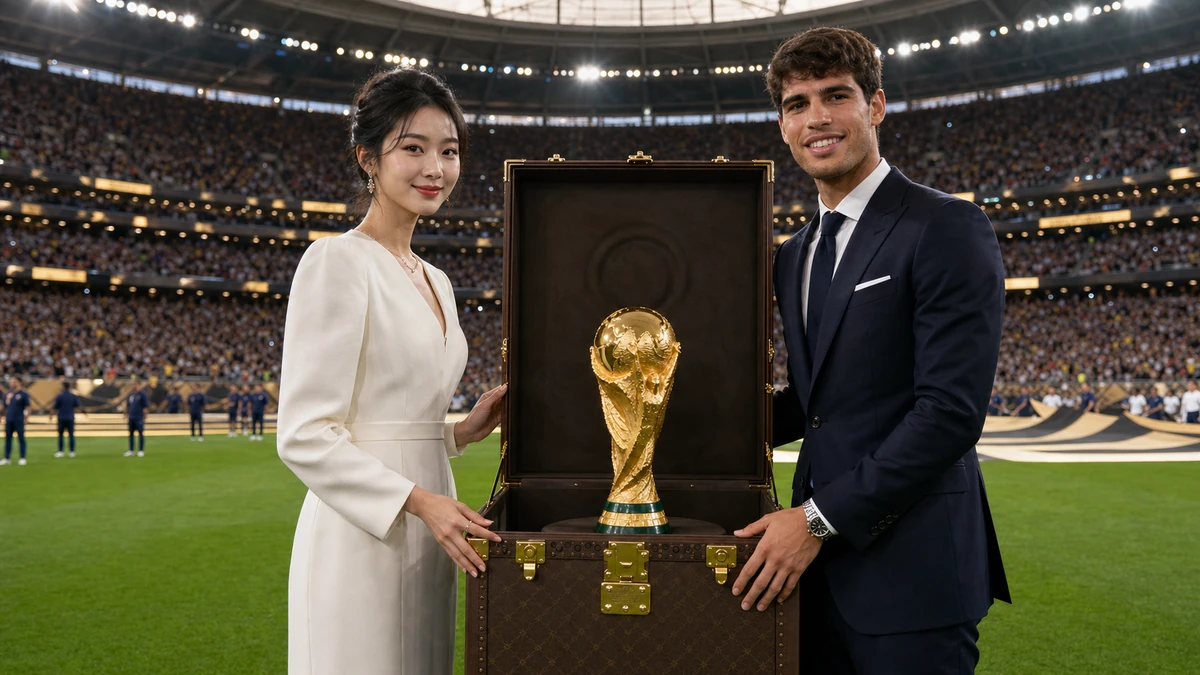
Before a ball was kicked in the 2026 FIFA World Cup final, one of the night’s most striking images had little to do with tactics, lineups or even soccer itself. On the field at the New York-New Jersey stadium hosting the final, South Korean actor Jung Ho-yeon walked out alongside Spanish tennis star Carlos Alcaraz carrying the Louis Vuitton trunk that held the World Cup trophy. Together, they opened it and revealed the prize every player in the tournament had spent a month chasing.
In one sense, it was a brief piece of pregame pageantry, the kind of made-for-TV ceremonial moment that accompanies global sporting events. But in another, it was a vivid snapshot of how the World Cup has evolved into something bigger than a championship match and how South Korea’s cultural presence, once treated as a niche export in the United States, now moves easily through the most mainstream spaces in global entertainment.
Jung’s role did not require a speech, a performance or even much screen time. That was part of what made it notable. She was not there as a novelty guest or as a representative of a separate “K-culture segment.” She was woven directly into the official symbolism of the final itself. The trophy reveal is not filler. It is the opening image of the championship’s central drama, the moment the stakes are made literal and visible. By placing Jung in that role, organizers effectively positioned a Korean actor at the ceremonial center of the biggest event in the world’s most popular sport.
That matters because global recognition often reveals itself not just in awards, box-office numbers or streaming charts, but in who is allowed to help define a shared international moment. In American terms, this was not unlike seeing a film star walk onto the field before the Super Bowl carrying the Lombardi Trophy — except on a larger scale, with an audience spanning continents and a tournament that still commands a level of worldwide attention unmatched by any single annual U.S. sporting event.
The final itself ended with Spain defeating Argentina 1-0 after extra time. But even before that result was settled, the ceremony had already delivered a message about the current shape of global celebrity: soccer, tennis, fashion and film now meet on the same stage, and a South Korean actor can be as legible to that moment as a European sports icon.
Why the trophy reveal carries real symbolic weight
To American readers who may be less familiar with World Cup rituals, the trophy’s entrance is more than an ornamental pregame flourish. In the World Cup final, the trophy is not just another prop. It is the visual embodiment of the tournament’s stakes, its history and its mythology. Every close-up of the gold trophy is meant to remind players and viewers alike what the next 90 or 120 minutes are about.
That is why the identity of the people who escort and unveil it can carry meaning beyond celebrity optics. In this case, Jung and Alcaraz were not randomly selected famous faces. Their appearance framed the final as a cultural event as much as an athletic contest. Alcaraz, one of Spain’s most recognizable contemporary athletes outside soccer, brought a modern sports dimension linked to one of the finalist nations. Jung, a globally recognizable actor and a Louis Vuitton ambassador, added a different form of international visibility, one tied to film, fashion and the cross-border power of Korean pop culture.
After Jung and Alcaraz opened the trunk, Spanish soccer great Andres Iniesta and Argentine legend Mario Kempes each lifted the trophy. That sequence was carefully constructed. First came present-day global celebrity; then came the living memory of World Cup history. Iniesta, of course, is forever linked to Spain’s 2010 title, having scored the winning goal in that final. Kempes remains one of the defining figures of Argentina’s 1978 triumph on home soil. The ceremony essentially connected three timelines at once: the present media landscape, the history of the two finalist nations, and the enduring mythology of the World Cup itself.
In that arrangement, Jung’s presence was not incidental. She served as part of the bridge between soccer’s past and the broader global culture surrounding it now. That is a subtle but important distinction. She was not on the sidelines as a fan. She was part of the official visual language through which the final introduced itself to the world.
For a U.S. audience, the significance may be easiest to grasp by comparing it to those moments when sports and entertainment merge so seamlessly that the guest becomes part of the institution’s own ritual. Think of a presidential first pitch at a World Series game or a carefully choreographed Olympic opening ceremony appearance by a major cultural figure. The person on stage is not simply famous; they are helping tell the story the event wants to tell about itself.
Jung Ho-yeon’s rise mirrors the rise of Korean cultural influence
Jung’s appearance also lands differently because of who she is and how she became internationally known. She first broke out globally through Netflix’s “Squid Game,” the South Korean survival drama that became a cultural phenomenon in the United States and far beyond. For many Americans, that series was not just a hit show; it was an entry point into the broader Korean Wave, or “Hallyu,” a term used to describe the international spread of South Korean entertainment and cultural products, including television, film, music, fashion and beauty.
Over the past decade, Americans have watched that wave move from the margins to the mainstream. Bong Joon Ho’s “Parasite” won the Oscar for best picture. BTS became a stadium act and a fixture in U.S. pop culture. “Squid Game” turned Korean-language drama into appointment viewing for households that may never previously have watched Korean television. Korean skin care, Korean food and Korean fashion have all gained wide commercial and cultural visibility. What once required explanation now often arrives pre-recognized.
Jung belongs to that story, but her appearance at the World Cup final suggests something slightly newer. This was not a Korean event being exported abroad, nor was it an awards show appearance in an industry where she is directly employed. This was a major sports event in the United States, staged for a worldwide audience, making room for a Korean actor in one of its core symbolic roles. That indicates a shift from representation to integration.
In earlier stages of the Korean Wave, Korean stars often entered Western consciousness in contexts that still marked them as specific cultural imports: the breakout foreign-language film, the K-pop crossover single, the festival sensation, the prestige streaming show. Here, Jung appeared without needing translation, context panels or explicit branding as “the Korean star.” Her nationality was part of the meaning, but it did not require special framing for her to belong in the moment. That is often what mature cultural influence looks like: not just visibility, but ease.
There is another layer here, too. In South Korea, celebrities frequently operate across multiple industries in ways that can surprise American audiences. An actor may simultaneously be a fashion ambassador, variety show guest, luxury brand partner and international campaign face. Jung’s position as a Louis Vuitton global ambassador helps explain the fashion dimension of the ceremony, but it does not fully explain its resonance. What stands out is not merely that a brand-connected celebrity appeared in a branded moment. It is that a Korean actor has become a natural fit for the kind of globally staged image-making once dominated almost exclusively by Western film stars, athletes and supermodels.
How the World Cup has become a broader cultural spectacle
None of this happened in a vacuum. The modern World Cup final is not just a soccer match. It is a platform where nations, brands, celebrities and media industries all compete to shape the event’s meaning. If the game remains the main attraction, the surrounding ceremonies increasingly resemble a blend of championship sports, luxury marketing and cultural diplomacy.
The Louis Vuitton trunk itself is part of that story. The French luxury house has created official trunks for the World Cup trophy since the 2010 tournament in South Africa. What might once have functioned simply as protective packaging now plays an active role in the ceremony. The closed trunk builds suspense. The opening of it becomes a staged visual cue that the final has truly begun. It is branding, yes, but branding folded into ritual so thoroughly that it becomes part of how the event is remembered.
The 2026 final’s trophy reveal put that convergence on full display. A Korean actor associated with a French luxury brand and a Spanish tennis champion entered before a match between Spain and Argentina, in a stadium in the United States, to present the sport’s most famous prize to a worldwide television audience. That is a remarkably condensed expression of how globalized big-stage entertainment has become.
American audiences are accustomed to this kind of cross-industry blending in events like the Super Bowl halftime show, where corporate sponsorship, music spectacle and sports broadcasting are inseparable. But the World Cup final operates on an even broader geopolitical and cultural scale. The people chosen for even a brief ceremonial role are not just decorating the event. They are part of a larger statement about what kind of world the tournament imagines itself reflecting.
That statement, in this case, was unmistakably transnational. Soccer legends from the two finalist countries stood alongside stars from other sports and other parts of entertainment. The message was that the final belongs not only to the teams on the field or the countries represented in the bracket, but to a global celebrity ecosystem in which culture and sport reinforce one another.
Why Jung’s appearance matters for how Americans see Korea
For American readers, the easiest mistake would be to dismiss this as a glamorous cameo with little lasting significance. But moments like this often reveal how perceptions have already changed. A decade ago, a Korean actor’s appearance in a ceremonial role at a major world sporting event in the United States might have been treated as a curiosity requiring explanation. Today, many viewers already know Jung by name or face, whether from “Squid Game,” fashion campaigns or the wider familiarity Americans have developed with Korean entertainment.
That does not mean everyone in the U.S. follows Korean pop culture closely. It does mean, however, that Korean public figures increasingly occupy a space familiar to American audiences: not foreign novelties, but recognizable participants in mainstream global culture. That is a different level of influence. It reflects not only the success of Korean media companies and stars, but also a shift in American viewing habits. Streaming services, social media and global fan communities have weakened the old gatekeeping structures that once confined non-English-language stars to specialty markets.
There is also something revealing about the fact that Jung did not need to wear explicitly “Korean” symbolism to represent the broader rise of Korean culture. No national costume, no heavy-handed promotional slogan, no formal state-backed messaging was required. She appeared simply as herself: a Korean actor with international standing, functioning naturally inside a global event. In some ways, that may be the clearest sign yet of how South Korea’s soft power now works.
Soft power, a term Americans may know from discussions of Hollywood or U.S. music, refers to influence built through culture, attraction and prestige rather than military or economic force alone. South Korea has become one of the clearest modern examples. Its television dramas, films, music, food and fashion have created an ecosystem of interest that extends well beyond traditional diplomacy. Jung’s presence at the World Cup final was not a government campaign, but it still communicated something meaningful about South Korea’s place in the world.
It suggested that Korean culture no longer needs a separate invitation to join major international stages. It is already in the room, helping design the ceremony.
A ceremony that linked history, celebrity and national memory
The sequence of the trophy reveal also resonated because it tied contemporary star power to the soccer histories of Spain and Argentina, the two teams playing for the title. After Jung and Alcaraz opened the trunk, Iniesta and Kempes each displayed the trophy, invoking two of the most important chapters in their nations’ soccer memory.
For Spain, Iniesta is more than a retired player. He is associated with a defining national sports moment: the extra-time goal that gave Spain its first World Cup title in 2010. For Argentina, Kempes represents the country’s 1978 triumph, a foundational chapter in Argentine soccer identity. Their presence reminded fans that the final was not simply about the current squads. It was about legacy, pressure and the weight of national memory that World Cup matches uniquely carry.
By placing Jung and Alcaraz before those legends, the ceremony made a subtle narrative choice. Today’s globally recognizable cultural figures opened the door, and yesterday’s soccer heroes completed the ritual. That sequencing underscored how contemporary mega-events package history for mass audiences: memory is preserved, but it is introduced through the language of present-day celebrity and visual culture.
That may sound overly orchestrated, but in truth it is central to how sports now function as entertainment. The emotional power of a final does not come solely from the scoreboard. It comes from the stories layered around it — past victories, national expectation, iconic figures, familiar faces, luxury signifiers, camera choreography. The trophy reveal condensed all of that into a matter of minutes.
And in a final where Spain eventually beat Argentina 1-0 after extra time, the ceremony’s symbolism gained an added retrospective neatness. Iniesta’s Spain-era legacy hovered over the occasion, while Argentina, pursuing another title, fell just short. Outside the stadium, Argentine supporters reportedly continued to sing for their team despite the loss, a reminder that World Cup finals produce civic emotion as much as sports results. The match generated both a winner and a broader set of cultural images, with Jung’s appearance among the most memorable of them.
More than a cameo, a sign of a changing global mainstream
It is tempting in media coverage to overstate every celebrity appearance as a milestone. Not every brief turn on camera signals a historic realignment. But Jung Ho-yeon’s role at the 2026 World Cup final does seem to capture something real about the current moment: the mainstreaming of Korean cultural figures into the ceremonial heart of global events that are not specifically about Korea at all.
That distinction is crucial. The significance lies less in the fact that Jung attended the final than in the nature of the role she was asked to play. She was not an invited observer in a VIP suite. She was a participant in the final’s formal storytelling. That suggests a widened understanding of who can represent international glamour, prestige and relevance on one of the largest stages available.
For American readers, this may be one more sign that the old cultural map — with the United States and Western Europe as the near-exclusive centers of global entertainment legitimacy — no longer fits the world as it is. South Korea has become one of the most visible examples of a country whose cultural industries now shape how global audiences dress, watch, stream, listen and imagine. Jung’s brief walk onto the field did not create that reality. It reflected it.
And because it happened in the setting of the World Cup final, in the United States, before an audience that cuts across language and geography, the image carried unusual force. It showed that Korean pop culture’s reach is no longer best measured only through charts, awards or trending shows. It can also be measured by ritual, by who gets entrusted with the symbols that matter most.
At the start of the night, Jung and Alcaraz opened a trunk and revealed a trophy. On paper, that is a small job. In the visual economy of modern global culture, it said quite a lot. A Korean actor stood at the crossroads of soccer, fashion, celebrity and history, and looked entirely at home there. That may be the clearest headline of all.
Comments
Post a Comment