At The Grove, a Korean Retail Giant Tests Whether K-Beauty Can Sell a Seoul Experience, Not Just Skin Care
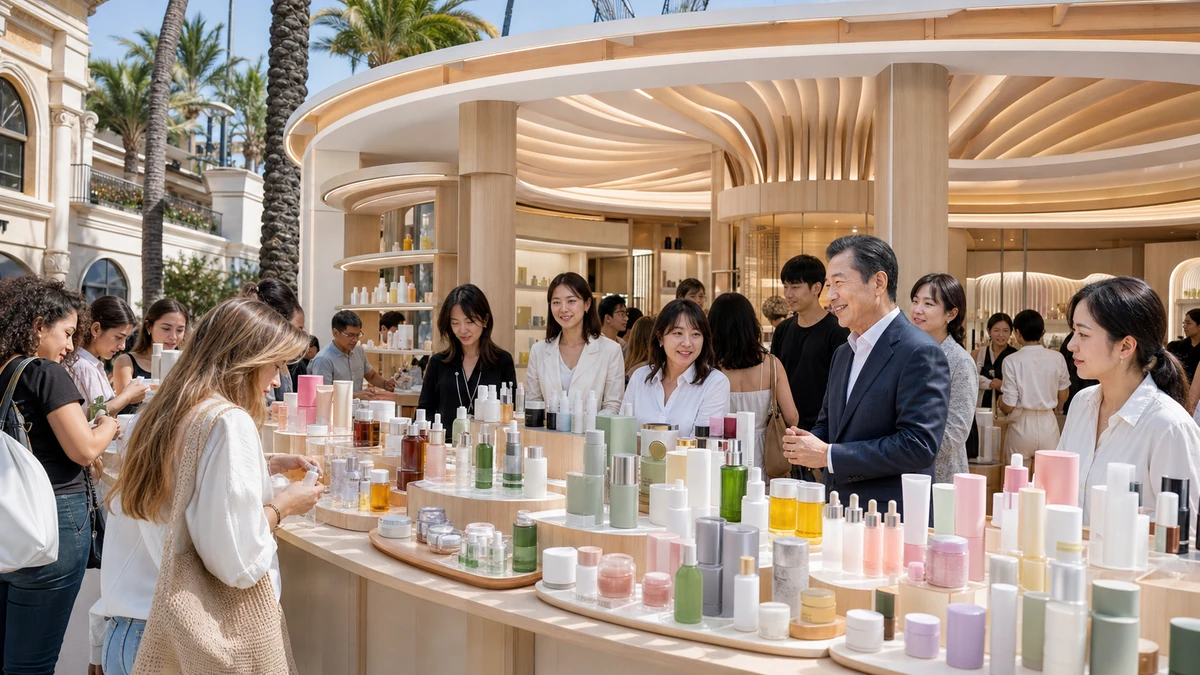
K-beauty’s next American test arrives in Los Angeles
Los Angeles has become one of the most important proving grounds in the United States for Korean consumer culture, from K-pop concerts and Korean barbecue chains to prestige skin care brands that now sit comfortably on the shelves of Sephora. This week, that trend took another step forward when Lotte Home Shopping, a major South Korean retail and TV commerce company, opened a K-beauty pop-up store at The Grove, one of LA’s best-known outdoor shopping destinations.
The store, branded as “Esel” by the company, features 40 Korean beauty brands, most of them from small and midsize businesses rather than the global names Americans may already recognize. According to company officials on site, the project is meant to be more than a temporary sales floor for serums, masks and lip tints. It is designed as an experiment in what happens when a Korean home shopping company leaves the television screen behind and meets U.S. consumers face to face in one of the country’s most visible retail markets.
That distinction matters. In South Korea, home shopping has long been a powerful sales channel, blending live presentations, celebrity hosts and limited-time offers in a format that sits somewhere between QVC, HSN and modern livestream commerce. But Lotte’s Los Angeles venture signals a broader shift in how Korean retail companies see global expansion. Instead of simply exporting products through wholesale channels or online listings, they are increasingly trying to stage an in-person cultural encounter.
Los Angeles is a logical place to try it. The city has one of the nation’s largest Korean American populations, a deeply established Korean business community, and a consumer base already comfortable with international beauty trends. But The Grove is not Koreatown. It is mainstream, high-traffic, image-conscious retail real estate, the kind of place where a brand tests whether it can move beyond a niche audience and reach shoppers who may know little about Korea except perhaps BTS, “Squid Game,” or the idea that Korean skin care means lots of steps and unusually dewy complexions.
That makes this pop-up a revealing case study in the next phase of the Korean Wave, or “Hallyu,” the term used to describe the global spread of South Korean popular culture. For years, American interest in Korea was often channeled through entertainment first, then food, then beauty. What Lotte appears to be betting on now is that K-beauty has matured enough in the U.S. market to support something broader: not just product sales, but a lifestyle story built around the image of Seoul itself.
From TV pitches to tactile retail
Lotte Home Shopping Chief Executive Kim Jae-kyum described the Los Angeles project as a move beyond television and into a new consumer space: offline retail. That may sound straightforward, but in business terms it represents a meaningful strategic pivot. Home shopping is built on mediated persuasion. A host explains texture, function and value through a screen. The consumer imagines the product. In a pop-up store, especially one centered on cosmetics, that equation changes.
Beauty products are unusually dependent on touch, color and personal trial. A foundation shade that looks flattering on camera may not suit a shopper under natural light. A cleanser can be described as gentle or hydrating in a broadcast, but in a store a customer can feel the texture immediately. Packaging, scent and shelf presentation also matter more in person than they do in a televised sales segment. For that reason, offline retail generates a different kind of information than television ratings or e-commerce click-throughs.
Lotte has said it intends to collect local consumer data from the Los Angeles experiment, and that point may be the most important part of the entire story. Pop-ups are often presented as flashy brand events, but for retailers they are also compact laboratories. Which displays make shoppers stop? Which ingredients prompt questions? Which products turn curiosity into purchase? Which brands are recognized already, and which need more explanation? In a U.S. market as large and fragmented as America’s, those details can shape whether a company moves toward a permanent store, a wholesale partnership, or a retreat.
Kim has indicated that a permanent location could eventually be considered, but only after the company gathers enough information. That cautious wording is worth noting. American retail is full of examples of international brands that mistake social media buzz for durable demand. A pop-up at The Grove gives Lotte a relatively controlled way to measure real-world behavior without immediately committing to the cost structure of a permanent flagship.
There is also a symbolic layer here. For a South Korean home shopping company, moving into a high-profile American shopping district suggests that Korean retail is no longer content to operate solely as a back-end distributor for overseas markets. It wants to shape the shopping environment itself. In other words, the experiment is not just about whether Americans will buy Korean skin care. It is about whether a Korean retailer can choreograph the experience of buying it.
Forty smaller brands share a rare American stage
The Los Angeles pop-up is built around 40 K-beauty brands from South Korean small and midsize enterprises. That structure sets it apart from the typical brand showcase Americans see when a single major label opens a temporary activation space. Instead of elevating one hero brand, Lotte is presenting a collective platform.
For U.S. consumers, that creates a wider view of what K-beauty actually is. In American conversation, the term is often used loosely, almost as if it describes one aesthetic rather than an entire industry. In reality, Korean beauty spans luxury and mass-market, clinical and playful, minimalist and highly stylized. A store with 40 brands allows shoppers to compare those differences in one place. That can help move K-beauty out of the novelty category and into something more like a recognizable ecosystem.
For the companies involved, the arrangement may be even more significant. One of the biggest obstacles facing smaller Korean brands is not product development but market access. Breaking into the U.S. usually requires either a large marketing budget, a distribution partner, or a major retail account, all of which can be difficult for emerging businesses. A shared pop-up in a premium retail location offers exposure that many of those brands would struggle to secure on their own.
It also creates an unusual type of market intelligence. When many brands are shown together, differences in consumer response become easier to read. A retailer can observe whether American shoppers are drawn more to ingredient-driven messaging, sleek packaging, bright color cosmetics, functional skin care claims, or products tied to broader Korean lifestyle cues. It becomes possible to compare how shoppers respond not only to individual products but to categories and storytelling styles.
That kind of comparison may be especially useful because the U.S. K-beauty consumer is no longer a blank slate. Early waves of American interest often centered on sheet masks, snail mucin, cushion compacts, or the famous — and sometimes exaggerated — idea of a 10-step Korean skin care routine. Today, the market is more educated and more skeptical. Shoppers want to know whether a product works, whether it fits their skin type, and whether it delivers value in an already crowded beauty environment. A collective retail format gives smaller Korean brands a chance to see where they stand in that more mature conversation.
At the same time, the multi-brand strategy lets Lotte act as a platform, not just a seller. In that role, the company becomes an intermediary linking Korean manufacturers to Western consumers while also learning which brands might have the strongest long-term potential abroad. If the Korean Wave’s first stage was exporting finished products, this looks more like the export of retail infrastructure and market-making power.
Why Los Angeles matters in the K-beauty map
Lotte is not entering untouched territory. Korean cosmetics are already visible in the American market, and Los Angeles in particular has emerged as one of the country’s hottest K-beauty hubs. Sephora, arguably the most recognizable prestige beauty chain in the U.S., already carries multiple Korean brands. Olive Young, the South Korean beauty retail giant often described as Korea’s answer to Sephora or Ulta, has also opened two stores in Los Angeles.
That context makes the Lotte pop-up more interesting, not less. If Korean products were still a novelty in the U.S., simply showing up might be enough. But that is no longer the case, especially in Southern California. Consumers in Los Angeles can already buy Korean cleansers, sunscreens and makeup through established channels. They can order them online, see them on TikTok, or pick them up in stores. So Lotte has to answer a more difficult question: What makes its version of K-beauty distinct?
The company’s answer appears to be curation and atmosphere. Rather than merely offering Korean products in an American store or reproducing a Korean chain abroad, Lotte is framing the retail space as an experience of Seoul. That language matters because it recognizes a new stage of competition. Once a category becomes familiar, origin alone is no longer enough to stand out. Brands and retailers have to sell context, identity and memory.
In practical terms, that means the pop-up is competing on more than inventory. It is competing on the emotional afterimage a shopper carries away. Did the space feel modern? Aspirational? Distinctly Korean without becoming a caricature? Did it offer discovery in a way that a standard retail aisle does not? These questions are increasingly central in beauty retail, where consumers often buy as much into a narrative as into a formula.
Los Angeles is also significant because it is both a gateway and a spotlight. Trends that succeed in LA do not automatically conquer the rest of the United States, but they often gain disproportionate visibility there because of the city’s influence in entertainment, fashion and digital culture. If Lotte can generate buzz at The Grove, it may resonate beyond the local market through influencers, tourists and media attention. If it struggles, that will be informative too. Either outcome gives the company data in a setting where Korean culture is visible enough to attract interest but mainstream enough to expose weak points.
Selling Seoul, not just serum
Perhaps the most ambitious part of Lotte’s strategy is the idea that the store is meant to let consumers “experience Seoul.” For American readers, that phrase may sound like a marketing flourish, but it reflects a broader shift in how Korean businesses are packaging national identity for export. Seoul, South Korea’s capital, is not just a city in this framing. It is shorthand for speed, trend awareness, dense retail culture, pop sophistication and a certain polished urban cool that has become globally marketable.
That image has been built over years by Korean dramas, K-pop videos, fashion, food trends and social media tourism. Many international consumers who have never visited Korea still carry a vivid mental picture of Seoul as hypermodern, style-conscious and always a step ahead of the next trend cycle. By invoking Seoul, Lotte is effectively trying to place its beauty brands inside that larger imaginative world.
There is a smart business logic to that. Many of the 40 participating brands are not household names in the United States. But if they are presented under a common Seoul-centered identity, they may benefit from the cultural recognition Korea has already built in other sectors. This is one of the defining features of the Korean Wave: entertainment often opens the door, and consumer goods walk through it.
Still, turning city identity into a retail experience is not as simple as printing Hangul on a wall or playing K-pop in the background. The challenge is translating cultural aspiration into something legible and appealing for a broad American audience. Too little context and the space feels generic. Too much stylization and it risks becoming theme retail. The balance matters, especially when trying to persuade consumers that the experience adds value beyond what they could get from purchasing a product online.
There is also a deeper question beneath the aesthetics. Can place branding — in this case, Seoul — actually drive purchases, or does it mainly create interest at the top of the funnel? The answer likely varies by consumer. For a devoted K-beauty fan, a Seoul-themed environment may reinforce existing enthusiasm. For a casual American shopper wandering through The Grove, the test is whether the concept feels accessible enough to invite entry and concrete enough to convert curiosity into a sale.
That is why Lotte’s emphasis on data collection is so important. The company does not need abstract proof that people like the idea of Seoul. It needs evidence that shoppers will stay, browse, ask questions, buy products and perhaps return. In that sense, the Los Angeles store is not only a retail activation; it is a live referendum on whether cultural storytelling can become a durable commercial model.
A Paris stop suggests a larger global strategy
Kim has said the company plans to open another pop-up in October in Paris’ Marais district, a neighborhood known for fashion, design and trend-sensitive shoppers. The Paris move suggests that Los Angeles is not a one-off experiment but part of a larger strategy to test how Korean beauty and Korean retail concepts perform across different global capitals.
That matters because American and French consumers may respond to the same products in very different ways. Beauty preferences are shaped by local norms, ingredient literacy, price expectations and the structure of existing retail markets. What attracts attention in Southern California may not resonate in Paris, and vice versa. A multi-city pop-up strategy allows Lotte to compare those reactions before deciding how — or whether — to build permanent locations abroad.
It also hints at a new ambition within Korean distribution companies. For years, discussions about Korea’s global consumer footprint focused heavily on manufacturing excellence or cultural exports such as music and film. Retail infrastructure itself received less attention. But if companies like Lotte can successfully build overseas channels that they control — not just supply products into someone else’s system — that would mark a significant evolution in Korea’s international commercial reach.
At the same time, caution is warranted. Pop-ups are good at generating attention, but attention is not the same as long-term viability. Many retail concepts work as novelty experiences and struggle when translated into permanent operations with rent, staffing and inventory pressures. Kim’s comments reflect that reality. A standing store remains only a possibility, contingent on what the data shows.
For now, the value of Los Angeles may be less about immediate sales and more about information. The company can learn which brands connect, which storytelling devices travel well, and whether the idea of “Seoul as experience” resonates outside Korea in a way that justifies a larger investment. That learning process may ultimately be the most consequential part of the venture.
What this says about the next phase of the Korean Wave
The Lotte pop-up at The Grove is, on the surface, a beauty retail story. But it also says something broader about how South Korea is evolving as a global cultural and commercial force. The first chapter of the Korean Wave introduced international audiences to Korean entertainment. The next chapter brought food, cosmetics and fashion into the mainstream. What is emerging now is a more integrated export model in which products are sold alongside atmosphere, place identity and a curated idea of modern Korea.
That approach mirrors a wider shift in global retail. Consumers increasingly seek experiences, not just transactions. Brands that can turn shopping into participation often enjoy an advantage in crowded markets. Korea, with its highly developed urban consumer culture and strong visual branding instincts, may be especially well positioned to compete in that environment. Seoul itself has become a kind of exportable concept, as recognizable in some circles as Tokyo minimalism, Paris chic or California wellness.
For American audiences, the significance of this moment lies partly in how normal it has become to encounter Korean cultural products in everyday life. A decade ago, a Korean beauty pop-up in one of Los Angeles’ marquee shopping destinations might have felt novel. Today it feels like part of a larger pattern: Korean content shapes entertainment algorithms, Korean restaurants define dining neighborhoods, and Korean consumer brands increasingly move from specialty appeal to mainstream visibility.
Still, mainstreaming is not the same as permanence. The real test for Lotte will be whether it can convert the broad appeal of K-beauty into repeat business, brand loyalty and a sustainable physical retail model. That requires more than trendiness. It requires understanding American shoppers at a local level while preserving the distinctiveness that makes Korean beauty attractive in the first place.
For the smaller Korean brands inside the pop-up, the stakes are also high. A successful showing could open doors to broader U.S. distribution, partnerships or direct-to-consumer growth. A weaker response could underscore how difficult it remains for emerging beauty labels to break through in a market already saturated with claims, ingredients and aesthetic promises.
Either way, the pop-up at The Grove captures a telling moment in the globalization of Korean commerce. It is not just about whether Americans want another skin care product. It is about whether Korean retailers can build spaces that translate the energy of Seoul into something legible, desirable and profitable abroad. In Los Angeles, one of America’s most image-conscious cities, that question now has a very public testing ground.
Comments
Post a Comment