At a Mexico City World Cup festival, ENHYPEN shows how K-pop is becoming part of the global sports soundtrack
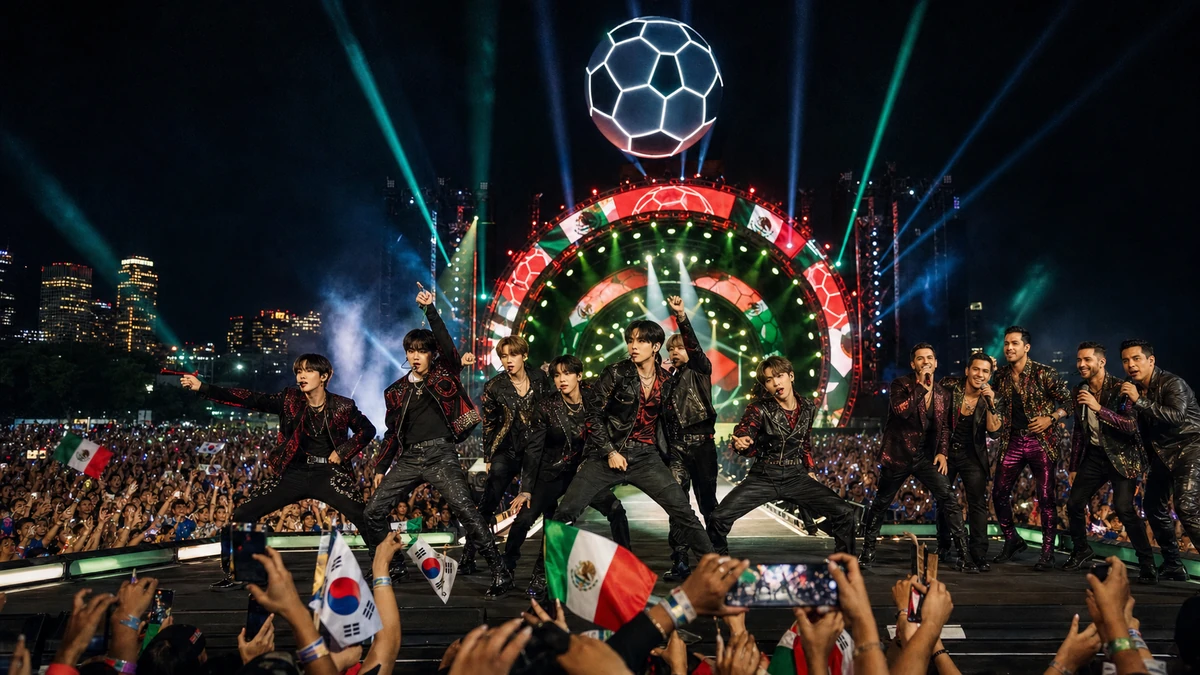
A World Cup party becomes a cross-cultural stage
Well before the first whistle of the 2026 FIFA World Cup, the tournament is already doing what global sporting events do best: pulling different cultures into the same orbit. In Mexico City last week, that meant a celebration built around soccer, local food, national pride and live music — and, notably, a major spot for K-pop.
At the festival known as CAMPO MARTE 26, held June 15 local time to mark the upcoming 2026 World Cup in North America, Korean boy group ENHYPEN and Latin pop act Santos Bravos took the stage for a roughly two-hour performance, according to information released by Hybe, ENHYPEN’s agency, and reported by South Korea’s Yonhap News Agency. The event was not a stand-alone pop concert attached to a sports brand. It was designed as a broad public celebration, where soccer fandom blended with the sounds, tastes and symbols of Mexico.
That distinction matters. In the United States, sports fans are used to halftime shows, opening-day concerts and celebrity tie-ins that add entertainment value to a game-day experience. But what happened in Mexico City points to something slightly different: K-pop was not treated as a novelty act or a brief international garnish. It was folded into the identity of a World Cup-themed civic festival, alongside a Latin pop group and amid an atmosphere built around Mexican culture.
For American readers, it may help to think of the event less as a traditional concert and more as the kind of all-day, citywide celebration that can grow around the Super Bowl, the NCAA Final Four or a World Series parade route — only with the global symbolism of the World Cup, the world’s biggest sports event, and with a deliberately international musical lineup. In that context, ENHYPEN’s appearance says as much about where K-pop now sits in the world’s cultural hierarchy as it does about the group itself.
The 2026 World Cup, of course, will be jointly hosted by the United States, Mexico and Canada, giving North America a rare opportunity to present itself not just as a sporting region but as a shared cultural stage. Mexico City’s festival offered a preview of that idea. And in one of the clearest signs of how global pop culture is being rearranged, one of the loudest expressions of that preview came from a Korean idol group performing in Spanish-speaking Mexico at a soccer celebration with worldwide ambitions.
Why this performance matters for ENHYPEN
ENHYPEN performed 11 songs during the event, including “Knife,” “XO,” “Outside” and “Stealer,” according to the material released by Hybe. That kind of set list is worth noting because it suggests this was not simply a cameo appearance or a ceremonial song or two before the next act. Instead, the group delivered a substantial performance built to introduce a range of its music to a mixed audience.
That mixed audience is the key. At a solo arena show, the crowd has already bought in. Fans know the choreography cues, the fan chants, the visual lore and the emotional arc of the set. At a public festival tied to a larger event — especially one centered on soccer rather than pop music — an act has to do something else. It has to capture people who may have shown up for entirely different reasons: the food, the party, the World Cup atmosphere, the host city’s programming or another artist on the bill.
By performing 11 songs, ENHYPEN appears to have approached the event not as a box-checking stop on an overseas itinerary but as an opportunity to prove stage power in a less controlled environment. That is an important measure of success for any touring act, but particularly for K-pop groups, whose international growth has often been discussed in terms of fandom size, chart positions and social media visibility. Those metrics matter, but they do not fully capture whether a group can connect in a public setting where many in attendance may be encountering the act for the first time.
For years, K-pop’s global expansion was often framed in American media as a niche becoming mainstream, then as an online phenomenon turning into an arena business. What stories like this show is the next phase: K-pop not just selling tickets to its own fans, but becoming a programmable, dependable part of broader cultural events outside Korea. That is a different kind of integration. It means promoters and organizers increasingly see K-pop as something that can help define the atmosphere of a major public occasion.
It also matters that Hybe, one of South Korea’s biggest entertainment companies and best known internationally as the home of BTS, positioned ENHYPEN in that environment. In the business of pop, where visibility is strategic and every appearance sends a message, this performance signals confidence that the group can carry a large stage even when the event’s center of gravity is bigger than any single act.
Soccer, K-pop and the new global festival economy
The phrase “cultural festival” can sound vague in English, but in this case it points to something increasingly common around mega-events: the competition itself is only part of the attraction. Host cities and organizers now build ecosystems around sports, where music, food, tourism and civic branding all reinforce one another. CAMPO MARTE 26 appears to have followed that model by combining soccer support, Mexican culture, food and live performance in one place.
That setup creates a natural opening for artists who can speak to more than one audience at once. Santos Bravos brought Latin pop, a genre with deep regional resonance and broad accessibility. ENHYPEN brought K-pop, a distinctly Korean entertainment form that has become a global youth language in its own right. Putting them on the same lineup did not erase their differences. Instead, it highlighted the event’s international ambition: a World Cup celebration should feel like a meeting place.
For American audiences, this may sound familiar in one sense and new in another. U.S. sports culture has long embraced music as spectacle, from the Super Bowl halftime show to baseball’s walk-up songs to celebrity performances at all-star events. But the World Cup operates on a different scale of cultural symbolism. It tends to invite a more explicit conversation about national identity, diaspora communities and transnational fandom. A World Cup event in Mexico City featuring a Korean act and a Latin pop group is not simply entertainment programming. It reflects the reality that major cities now host audiences whose tastes are formed across languages, platforms and borders.
K-pop is especially suited to that environment. The genre is often misunderstood in the U.S. as a single sound, when in practice it is a production system and performance tradition that draws from hip-hop, R&B, EDM, pop-rock, fashion culture and highly disciplined choreography. The “idol” system in South Korea — a training-and-management model that develops performers in singing, dancing, stagecraft and media engagement — has produced acts that are often unusually prepared for high-pressure, visually demanding live events. That makes K-pop groups effective not just in concert halls but also in festivals where they have to win over a crowd quickly.
At the same time, soccer provides a setting that K-pop cannot create on its own. It offers communal emotion at mass scale. People may arrive wearing club or national colors, expecting celebration rather than close listening, and ready to react collectively. When a K-pop group steps into that setting, the encounter becomes bigger than fandom. It becomes a test of whether the music can join a public mood that already exists. By all accounts from the festival, ENHYPEN was not isolated from that mood; it became part of it.
The power of a few words in Spanish
One of the most telling moments from the event did not involve choreography or production values. During the show, ENHYPEN members addressed the audience in Spanish, saying that seeing the crowd’s reaction made them feel happiness and joy as well, and that it made the day especially meaningful.
That may sound simple, even routine. Pop stars thank audiences in local languages all the time. But in a multinational setting like this one, the gesture carries extra weight. Language is one of the quickest ways to signal whether a performer sees a crowd as passive consumers or as collaborators in the moment. By speaking directly in Spanish, ENHYPEN acknowledged not just that they were performing in Mexico City, but that the emotional exchange in the room depended on meeting the audience where it lived.
For readers less familiar with K-pop, this kind of audience engagement is central to how many Korean idol groups build loyalty abroad. Fans are not simply buyers of albums or streams. They are participants in a highly interactive culture of support that includes chants, coordinated responses, social media organization and a sense of shared authorship in an act’s rise. When artists mirror that energy back — especially in the local language — they reinforce the idea that the performance is something made together.
In Latin America, where pop audiences are often known for their volume, emotional intensity and visible passion, such exchanges can have outsized impact. A crowd that feels recognized will often give more back. And in the context of a festival where many attendees may not have come specifically for ENHYPEN, speaking Spanish likely helped shorten the distance between artist and public almost immediately.
There is also a broader point here about what globalization in entertainment really looks like. It is not only about exporting songs from one market to another. It is about learning how to enter another culture respectfully and energetically without losing your own identity. ENHYPEN did not need to stop being a Korean group in order to connect with a Mexican crowd. The point was the opposite: a Korean act could arrive as itself, then build rapport through language, performance and presence. That is the kind of soft cultural fluency that increasingly defines success in international pop.
What this says about K-pop’s place in Latin America
K-pop’s popularity in Latin America is no longer a surprise, but stories like this help explain why the connection has remained durable. For more than a decade, countries across the region have produced intensely committed K-pop fan communities, often driven by digital platforms, dance cover culture and strong local networks of young fans who organize events, celebrate birthdays for idols and turn online enthusiasm into real-world turnout.
What has changed is the scale and legitimacy of that enthusiasm. A generation ago, Korean pop in Latin America might have been treated by outsiders as an internet subculture. Today, it is increasingly visible in mainstream programming, corporate partnerships and city-scale events. The fact that a World Cup-themed festival in Mexico City featured ENHYPEN alongside a Latin pop act reflects that shift. Organizers were not betting on obscurity. They were betting on a proven audience and on the broader appeal of an international lineup.
According to Hybe, large crowds gathered around the Music Pavilion before the performance began, suggesting substantial anticipation for both acts. Precise attendance figures were not disclosed, but the detail still matters. It indicates that interest in the performers translated into physical presence at the venue, not just online attention. In entertainment economics, that distinction is crucial. Real-world turnout is what convinces promoters, brands and event organizers that a genre belongs in premium slots.
Latin America has in some ways become an especially important proving ground for global pop acts because audiences there are often willing to embrace music across language barriers if the emotional and performance connection feels strong. American readers can think of the way Spanish-language music has increasingly crossed over in the United States not because every listener understands every lyric, but because sound, persona and atmosphere create their own access points. K-pop often works similarly. Even when listeners do not speak Korean, they connect to rhythm, storytelling, visuals and the intensity of live performance.
That helps explain why a group like ENHYPEN can make sense at a Mexican World Cup festival. The appearance is not random. It sits at the intersection of several established realities: K-pop’s international touring power, Latin America’s appetite for transnational pop, and the World Cup’s function as a giant amplifier for culture as much as sport.
Beyond charts and comebacks
Entertainment coverage often narrows K-pop stories to familiar benchmarks: album sales, Billboard rankings, streaming milestones, awards, viral clips and comeback schedules. Those numbers are easy to compare and easy to package. But they can miss what makes a story like this meaningful.
ENHYPEN’s Mexico City performance was not primarily about a new record or a chart campaign. It was about placement — where K-pop now appears, what kinds of public events it can anchor, and how it interacts with audiences who are not limited to a single fandom identity. A person at CAMPO MARTE 26 might have come as a soccer supporter, a local resident, a fan of Santos Bravos, a curious tourist, a food lover or a K-pop devotee. The significance of the event is that those categories were allowed to overlap.
That overlap is one of the clearest cultural signatures of the current moment. Young audiences around the world rarely sort themselves into neat entertainment boxes. They can follow the Champions League, reggaeton, anime, K-dramas, Marvel movies and Premier League transfer rumors all in the same week. Festivals tied to mega-events increasingly reflect that reality. The old programming logic — one audience, one genre, one lane — is giving way to something more blended and more global.
In that environment, K-pop’s advantage is not only that it has passionate fans. It is that it has become legible to a broad international audience as premium pop spectacle. People may not know every member’s name or every deep-cut track, but they understand that a K-pop performance promises precision, energy and a high level of visual commitment. That recognition opens doors beyond the traditional music industry pipeline.
It also changes how success should be measured. If K-pop groups are now appearing at festivals connected to the World Cup, then the question is no longer just whether they can sell tickets to their own concerts. It is whether they can help shape the atmosphere of global public life. In Mexico City, ENHYPEN appears to have done exactly that — not by replacing local culture, but by entering a celebration already rich with it and adding another layer.
A preview of the World Cup’s wider cultural map
There is a temptation to view every pre-World Cup event as mere promotional machinery, a warm-up before the real action begins. But culturally, these moments can be revealing. They show what host cities want the tournament to mean and what kinds of audiences the event is trying to gather. If CAMPO MARTE 26 is any indication, the 2026 World Cup will not simply be a series of soccer matches spread across North America. It will be a contest surrounded by music, food, local identity and a highly globalized idea of entertainment.
That matters especially for the United States, where soccer has long occupied a complicated position — massively popular at the youth and immigrant-community levels, growing in mainstream visibility, but still chasing the total cultural saturation of the NFL, NBA or college football. The 2026 tournament offers an opportunity for North American cities to present soccer not as a niche interest but as a cultural meeting ground. Mexico, with its deep soccer tradition, is already showing how that can look.
In that sense, ENHYPEN’s appearance at a Mexico City World Cup festival is a small story that points to a larger one. It suggests that the soundtrack of global sports is changing. It is no longer enough to think in terms of domestic stars entertaining domestic crowds. The audience for events like the World Cup is multilingual, mobile and digitally connected, and the programming around those events increasingly reflects that reality.
For ENHYPEN, the performance offered a chance to demonstrate live range in front of an audience broader than its core fan base. For Santos Bravos, it reinforced the centrality of Latin pop in a major regional celebration. For organizers, it showcased the value of genre crossover at a public festival. And for anyone watching the cultural buildup to 2026, it provided a vivid snapshot of what this World Cup may come to represent: not just competition among nations, but a shared festival space where Korean pop, Latin music, Mexican identity and the global language of soccer all make sense together.
No additional appearances or future plans tied to this event were disclosed in the release cited by Yonhap. But even on its own terms, the Mexico City performance stands as a telling moment. A K-pop group did not just visit Latin America; it became part of a civic celebration linked to the biggest event in world sports. In an era when culture crosses borders faster than ever, that may be the most important headline of all.
Comments
Post a Comment