Budweiser’s Daytime EDM Party in Seoul Signals a Bigger Shift: South Korea’s Nonalcoholic Beer Market Is Growing Up
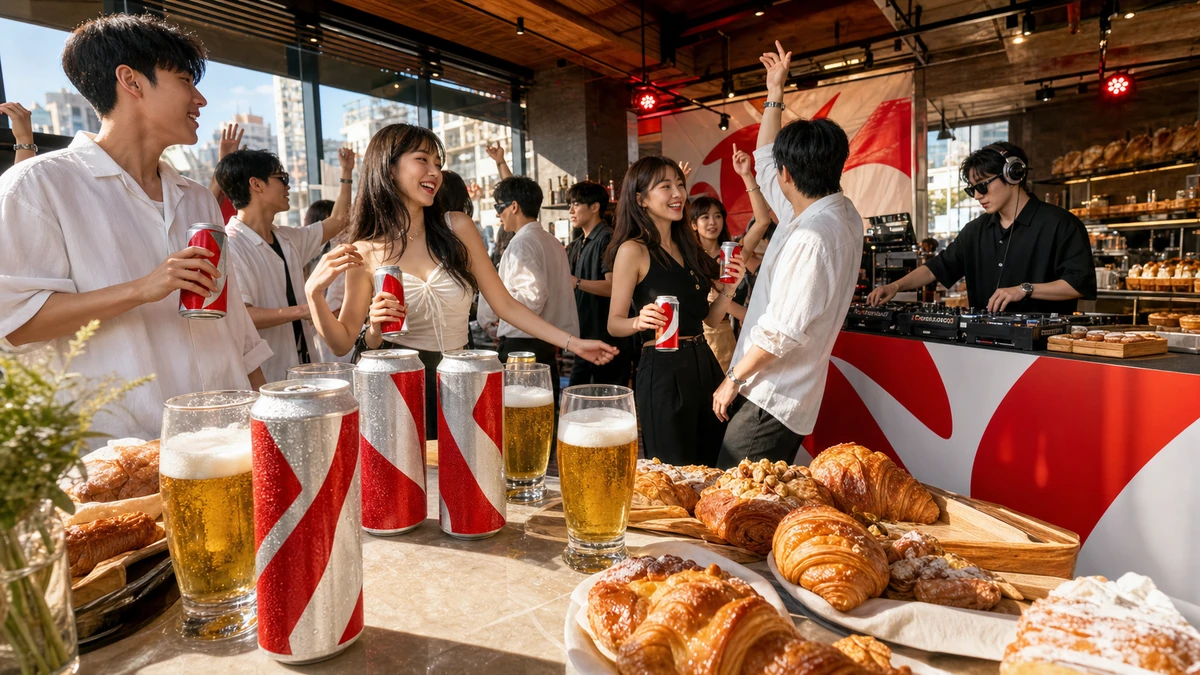
A beer party at 10 a.m.? In Seoul, that is increasingly the point
In a country where beer marketing has long been tied to late-night dinners, after-work drinks and neon-lit bar districts, one of the most striking recent brand events in South Korea started at 10 in the morning.
Budweiser held what it called an “Early Bird” electronic dance music party on July 19 at Tartine, a bakery cafe in Seoul’s Itaewon neighborhood, according to Yonhap News Agency. The event ran until 3 p.m. and centered on nonalcoholic and low-alcohol drinks, a decision that says as much about changing lifestyles as it does about beverage trends.
For an American audience, the easiest comparison might be this: imagine a major beer brand hosting a DJ-driven brunch activation not in a sports bar or music club, but in a high-end bakery cafe in a trendy urban district, then using the event to position alcohol-free beer not as a compromise, but as part of a modern social routine. That, in effect, is what happened in Seoul.
The move reflects a broader shift underway in South Korea’s beverage industry. Major companies are no longer treating nonalcoholic or near-beer products as niche options for designated drivers or people abstaining for health reasons. Instead, they are building a category with its own marketing language, packaging, flavors, sales channels and cultural identity.
That matters because South Korea has one of Asia’s most dynamic consumer markets, especially among younger adults who often shape regional trends in food, fashion, beauty and entertainment. When a global brand like Budweiser reimagines where and when people are expected to drink beer-adjacent products in Seoul, it is not just staging a promotional event. It is testing a new model for social consumption.
Why Itaewon and why daytime matter
To understand why this event drew attention, it helps to understand the symbolism of the setting. Itaewon, in Seoul’s Yongsan district, is one of the city’s most internationally recognized nightlife and cultural hubs. Americans who have spent time in South Korea, especially military families connected to the nearby U.S. base or travelers familiar with Seoul’s club scene, will likely know Itaewon as a place associated with bars, restaurants, global cuisine and after-dark energy.
That is exactly why holding a beer-branded EDM event in a bakery cafe during the day stands out. It flips the standard script. Rather than inviting people into a bar after sunset, Budweiser brought them into a cafe in the morning. Rather than emphasizing intoxication or late-night release, it tied the brand to coffee-hours socializing, music, atmosphere and low-stakes daytime leisure.
In practical terms, this is a way of telling consumers that nonalcoholic and low-alcohol beverages belong to a different kind of occasion. They are not simply substitutes for regular beer. They can be their own choice, in their own setting, at their own hour.
That distinction is especially important in South Korea, where social drinking has historically played a significant role in workplace culture and group bonding. Company dinners and rounds of drinks have long been part of the country’s social fabric, even as younger Koreans have shown signs of pushing back against older expectations around heavy drinking. Over the past decade, that generational change has become increasingly visible: more interest in wellness, more individualized consumption habits, more premium cafe culture and more emphasis on curated experiences over sheer volume.
So the image of people gathering in Itaewon for daytime electronic music and alcohol-free beverages lands as a cultural message. It suggests that brands are trying to meet younger consumers where they already are: in lifestyle-oriented spaces, mixing social energy with personal control.
The rise of the “2030 consumer” in Korea
The Korean article refers to the target audience as “2030 consumers,” a common shorthand in South Korea that means people in their 20s and 30s. For American readers, the phrase can sound like a demographic projection, but in Korea it is a standard marketing label for young adults who are seen as highly influential in setting consumption trends.
This group matters because it has helped redefine what aspirational spending looks like in modern South Korea. Younger consumers often place a premium on aesthetics, shareable experiences, limited-edition products, neighborhood identity and mood. A cafe is not just a cafe; it is a setting. A beverage is not just a drink; it is part of a scene. Music, packaging, table presentation and location all matter.
That is one reason the Budweiser event is more significant than it might first appear. The company was not simply offering a product sample. It was constructing a moment designed to feel aligned with the daily rhythms and visual culture of a younger urban audience. The beverage became part of an experience that could be posted, remembered and repeated.
This is a familiar playbook in other consumer categories. Beauty brands host pop-ups. Fashion labels stage immersive installations. Coffee companies build identity through interiors and playlists as much as through beans. What is changing in Korea is that beer companies, especially in the nonalcoholic space, are adopting those same tactics more aggressively.
That reflects a broader evolution in how alcohol-adjacent products are sold globally. In the United States, consumers have seen sober-curious trends push nonalcoholic cocktails onto restaurant menus, alcohol-free spirits into specialty stores and zero-proof options into everything from wellness retreats to music festivals. South Korea appears to be developing its own version of that shift, shaped by local habits and local spaces.
From substitute to standalone category
One of the clearest takeaways from the South Korean market is that nonalcoholic beer is no longer being framed only as a backup option. It is increasingly marketed as a standalone product category with its own points of differentiation.
That distinction shows up in several ways. Companies are rolling out new products, refreshing packaging and expanding bottled formats for restaurants and other food-service channels. The message is subtle but important: this is not just a shelf filler for people who cannot or do not want to drink alcohol. It is a product worth competing over.
Consider the relaunch of Cass Lemon Squeeze Zero, a nonalcoholic beer product that has been updated and reintroduced as demand expands. Cass is one of South Korea’s best-known beer brands, the kind of mainstream name that carries immediate recognition. By using an established brand and tailoring it with a clear flavor profile and zero-alcohol positioning, the company is not merely creating a beer alternative. It is carving out a distinct consumer identity within an existing brand universe.
The same logic applies to packaging decisions. In many markets, cans are associated with convenience, portability and mass retail, while bottles can signal a more deliberate on-premise experience, such as dining out or socializing in a venue. In South Korea, the expansion of bottled nonalcoholic products into restaurants and cafes suggests companies want these drinks to appear not tucked away in a health aisle, but on tables, next to food, in full public view.
That is a meaningful shift in status. When a product is ordered in a restaurant and set on a table in a bottle, it is participating in the ritual of social consumption. It stops being something chosen privately and starts becoming part of a shared dining culture.
The Korean reporting also underscores that competition is becoming more nuanced. Once the market moves beyond the simple question of whether a drink contains alcohol, companies have to compete on flavor, format, branding, setting and emotional appeal. Lemon flavor becomes a selling point. A bottle becomes a branding surface. A music event becomes a distribution strategy by other means.
In short, the market is maturing.
Fast sales give the category momentum, but not certainty
Another datapoint from the Korean industry helps explain why brands are moving quickly. HiteJinro, one of South Korea’s largest beverage companies, launched bottled Terra Zero, a nonalcoholic beer, in late June. According to the report, the company sold through its initial production run of 900,000 bottles in just 10 days.
That is a notable number in any market, and especially so in one where nonalcoholic beer has often been viewed as secondary to traditional beer and soju, the clear distilled spirit that remains deeply embedded in Korean dining and nightlife. A rapid sellout does not prove long-term market transformation on its own, but it does suggest a level of immediate consumer interest that competitors cannot easily dismiss.
For American readers, it is worth treating that figure the way one might view a buzzy launch in the U.S. beverage space: it signals momentum, but not yet permanence. Early sales can be driven by novelty, distribution push, curiosity or promotional timing. The more important question is what happens after the first wave. Do consumers buy again? Do restaurants continue to stock the product? Does the category become routine, rather than trendy?
Those questions are especially relevant in South Korea, where consumer markets can move quickly and branding cycles can be intense. Products can enjoy explosive attention at launch, particularly if they tap into a broader lifestyle narrative. The challenge for companies is turning interest into habit.
Still, strong early sales matter because they influence corporate behavior. When one major company posts a visible success, rivals respond. That can mean more product launches, bigger marketing budgets, broader restaurant placement and more experimentation in how the drinks are presented. In other words, even if one sellout does not guarantee long-term demand, it can accelerate the competitive race that helps build the market in the first place.
The restaurant and cafe channel could be the real battleground
One of the most consequential developments in the Korean story is not flashy at all: the expansion of bottled nonalcoholic and low-alcohol beverages through food-service channels.
That means more products are being sold not just in convenience stores or supermarkets, but in places where people gather to eat, meet, work and socialize. In South Korea, those settings matter enormously. Dining out is central to urban life, and cafe culture is particularly strong in Seoul, where independent cafes and branded chains alike play an outsized role in social life.
For a non-Korean reader, it may help to think of Seoul’s cafes as occupying some of the social ground that bars, coffee shops, study spaces and casual meeting spots might collectively hold in an American city. They are often highly designed, trend-aware and central to how younger adults spend time.
If nonalcoholic beer can secure a foothold there, the category gains something more powerful than one-off sales: normalcy. A menu placement can do what advertising often cannot. It can make a choice feel routine, acceptable and even stylish.
That is also why the Budweiser event and the rise of bottled restaurant formats fit together as part of the same strategy. One expands the imagination of where these drinks belong. The other makes that new behavior easier to repeat in everyday life.
There is a practical business case, too. Food-service placement lets brands reach consumers in moments when they are already making real-time purchasing decisions, often in groups. A bottle on a menu or table can prompt conversation, lower the perceived barrier to trying the product and reinforce visibility in a way retail shelves cannot always match.
For brands, the question becomes not only what to sell, but where and in what form. A daytime cafe event in Itaewon says one thing. A bottle available during lunch or at a group dinner says another. Together, they build a narrative of flexibility: this is something you can choose anytime, not just when everyone else is drinking alcohol.
What this says about changing drinking culture in South Korea
It would be too simplistic to say South Korea is becoming a nonalcoholic society. Traditional drinking culture remains powerful, and alcohol still plays a major role in socializing, dining and entertainment. But it is increasingly clear that the old assumptions no longer go unchallenged.
Younger Koreans have helped drive changes in work culture, dating norms, home life and wellness habits. That has included more openness to solo dining, lower tolerance for rigid workplace hierarchies and greater emphasis on mental and physical health. In that environment, nonalcoholic and low-alcohol beverages fit into a larger social story. They offer participation without all the trade-offs. They allow someone to join the occasion without fully opting into intoxication.
What is especially notable in the latest round of Korean marketing is that the brands are not leaning too heavily on restraint or self-denial. They are not framing these drinks primarily as what consumers give up. Instead, they are emphasizing what consumers gain: daytime flexibility, taste, stylish settings, music, flavor and social belonging.
That is a smart repositioning. In the United States, some of the most successful alcohol-free brands have moved away from a moralizing tone and toward one centered on choice, balance and identity. South Korean companies appear to be following a similar path, though with local twists shaped by Seoul’s cafe culture, nightlife geography and youth-driven trend cycles.
The result is a more culturally confident category. A nonalcoholic beer is no longer presented only as what you drink when you cannot have the real thing. It is increasingly marketed as the right thing for a particular moment.
That may be the most important development of all.
A signal worth watching beyond Seoul
For now, the clearest evidence points to a fast-moving competition among major beverage brands in South Korea. Budweiser is experimenting with experience-based marketing in unconventional spaces. Cass is refreshing its zero-alcohol offering with flavor-led branding. HiteJinro is posting strong early sales with bottled Terra Zero. Restaurants and cafes are becoming more important distribution points. And younger consumers are being courted not just through product claims, but through scenes and settings.
Whether that turns into durable market change remains to be seen. Initial buzz can fade. Consumer curiosity can cool. A successful event can generate headlines without fundamentally altering behavior. Companies still have to prove they can turn attention into repeat business.
But even at this stage, the direction of travel is hard to miss. South Korea’s beverage makers are not waiting for demand to define itself. They are actively building the rituals, spaces and cultural cues that could make nonalcoholic drinks a more permanent part of urban life.
For American readers watching the Korean Wave, or Hallyu, this is also a reminder that South Korea exports more than entertainment and beauty trends. It often serves as a high-speed laboratory for consumer culture, where brands test how taste, identity and social behavior interact. What happens in Seoul’s cafes and nightlife districts can offer an early look at broader shifts in how younger adults want to gather, spend and self-present.
A daytime EDM party in a bakery cafe may sound like a novelty. In South Korea’s evolving drinks market, it looks more like a strategy.
And if the industry is right, it may also be the beginning of a new social script — one in which beer branding no longer depends on late nights, loud bars or drinking to excess, but instead on something more adaptable, and perhaps more modern: being present for the scene without having to drink the old way.
Comments
Post a Comment