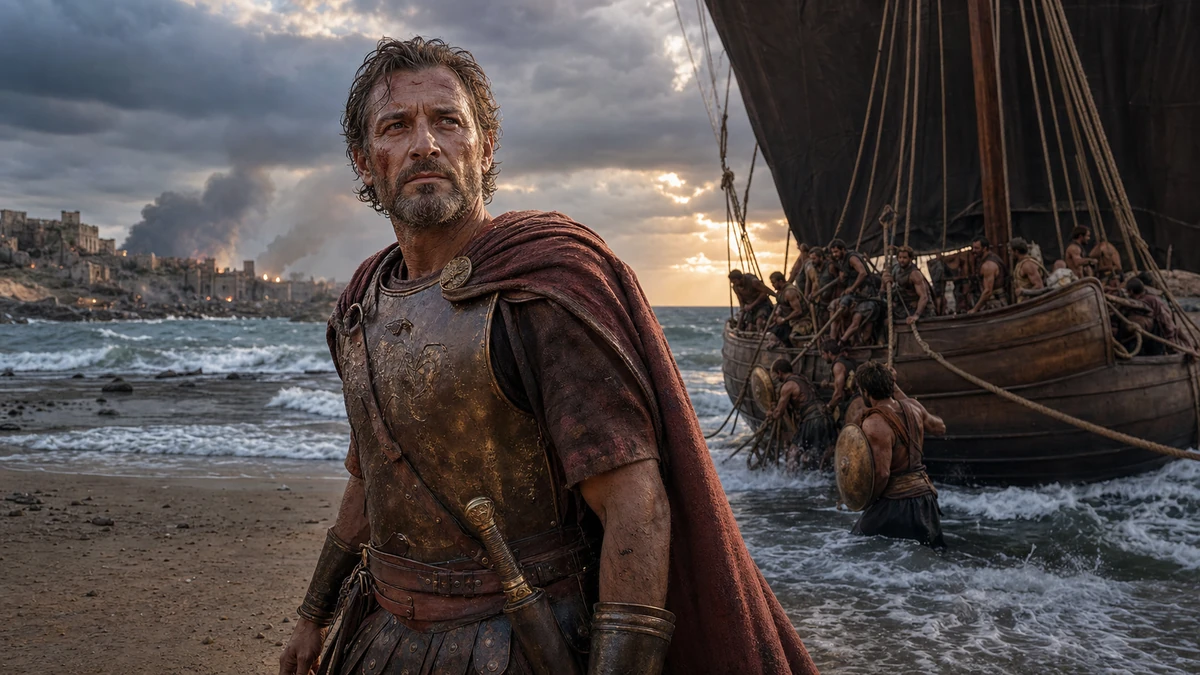
A Greek classic returns to the multiplex
Christopher Nolan has built one of the few directing careers in Hollywood where even an early casting announcement can feel like a major entertainment event. So news that Matt Damon will play Odysseus in Nolan’s new film, “The Odyssey,” is more than a routine bit of movie-business reporting. It immediately frames the project as one of the most closely watched literary adaptations now in development: a filmmaker associated with spectacle, scale and intellectual ambition taking on one of the foundational adventure stories in Western literature.
The source material is Homer’s “Odyssey,” the epic poem believed to have been composed around the eighth century B.C. For many Americans, that title may ring a bell from high school English or mythology units, even if the details have grown fuzzy over time. The broad outline is simple and enduring. After the Trojan War, the Greek hero Odysseus tries to make his way home to Ithaca, the island kingdom where he rules. What should be a victory lap becomes a punishing, yearslong struggle against storms, monsters, temptation, divine interference and his own limits.
That premise alone helps explain why the story has lasted for roughly 3,000 years. “The Odyssey” is not just about war, conquest or ancient gods. At its core, it is about trying to get home after history has already declared you a hero. In modern American terms, it is less the story of winning the championship than of what happens after the confetti falls, when the cameras leave and the hard part — finding your way back to ordinary life — begins.
That emotional architecture may be especially suited to Nolan, whose films often place characters inside overwhelming systems of time, memory, duty and survival. In “Inception,” he turned a heist movie into a meditation on guilt and reality. In “Interstellar,” he transformed space travel into a deeply personal story about separation, sacrifice and the ache of return. With “The Odyssey,” he appears to be moving from science fiction and time-bending thrillers to something older and more elemental: a sea voyage, a battered king and a home that remains painfully out of reach.
For American audiences, the film’s appeal is likely to come from exactly that blend of familiarity and reinvention. The title is ancient, the plot archetypal, but the promise is unmistakably contemporary. This is not a museum piece. It is a major studio-era filmmaker taking one of civilization’s oldest stories and asking what it can feel like on a modern giant screen.
Why Odysseus still matters
If the “Iliad,” Homer’s other great epic, is fundamentally about war, glory and rage, the “Odyssey” begins where those grand public themes leave off. The fighting at Troy is over. The famous Trojan Horse strategy — the deceptive military plan that leads to Greek victory — has already secured Odysseus a place in legend. But triumph does not bring peace. Instead, it sends him into another ordeal, one that is in many ways lonelier, stranger and more intimate than the war itself.
That distinction matters. One of the most interesting things about the “Odyssey” is that its tension does not come from whether the hero can win a battle. He already did that. The suspense comes from whether victory in war means anything if a person cannot reclaim his life. Ithaca, his homeland, is not just a destination on a map. It represents order, identity, family and the possibility of belonging again after years defined by conflict.
That is a deeply legible idea for an American audience, even outside a classical-literature context. For generations, U.S. storytelling has returned to versions of the same question: What happens when the soldier comes home? You can see it in everything from post-World War II dramas to Vietnam-era films to contemporary stories about veterans navigating civilian life. The “Odyssey” is not a modern trauma narrative in the language we use today, but it shares a similar recognition that surviving war is not the same as returning from it.
The Korean summary of the film’s premise highlights the paradox at the center of the story: the hero who leads the strategy that ends the war cannot remain in the celebration of victory. He must go back out onto the sea. That paradox is one reason the story feels so durable. It understands that accomplishment does not cancel vulnerability. Being brilliant in one arena does not make a person invincible in the next. Odysseus may be a king and tactician, but the ocean does not care. Fate does not care. The trip home can be more punishing than the campaign that made him famous.
And that is where the story becomes universal. You do not have to know much about ancient Greece to understand longing for home, exhaustion after a prolonged ordeal, or the stubborn instinct to keep moving toward people and places that define who you are. Strip away the helmets and mythology, and “The Odyssey” is about endurance — about continuing after the obvious climax has already passed.
Matt Damon and the two faces of heroism
Casting Matt Damon as Odysseus makes intuitive sense on several levels. Damon has spent much of his career playing men who project capability without losing recognizably human vulnerability. He can be cerebral, as in “Good Will Hunting”; physically credible, as in the “Bourne” films; and quietly weary, as in “The Martian” or “Oppenheimer.” That range matters for a character like Odysseus, who cannot simply be a marble-statue warrior. He has to work as both mythic figure and tired man.
The Korean account emphasizes the “two faces” of the character. On one hand, Odysseus is the proven war hero, the ruler, the strategist whose intelligence helps win Troy. On the other, he is a traveler at the mercy of forces he cannot command. He is powerful, but he is also delayed, tested, isolated and repeatedly thrown off course. That combination is the role’s real challenge. If a performance leans too far toward invulnerable grandeur, the journey loses emotional traction. If it leans too far toward ordinary suffering, the mythic stakes may shrink.
Damon, now in a stage of his career where authority comes naturally onscreen, may be well positioned to bridge those halves. American viewers know him as a star who can carry large-scale filmmaking without overwhelming it with showiness. He tends to anchor spectacle rather than compete with it. In a Nolan film, that could be especially valuable. Nolan’s movies are often remembered for their architecture — the concepts, the mechanics, the visual construction — but they work best when an actor gives the audience a steady emotional line through all that machinery.
There is also something appealingly unglamorous about Damon in this context. Odysseus is famous for cleverness as much as brute force. He is not Achilles, the pure embodiment of martial dominance. He survives by adapting, persuading, enduring and calculating. Damon’s screen persona has often thrived in exactly that register: resourceful rather than ornamental, determined rather than mythically aloof.
For viewers in the United States, where heroic storytelling is often split between comic-book invincibility and gritty realism, Odysseus offers a third model. He is a hero not because every plan works, but because he keeps going when plans collapse. If Nolan and Damon capture that quality, “The Odyssey” could resonate well beyond audiences who already come in caring about Homer.
Nolan’s scale meets one of the oldest stories ever told
Nolan’s name now carries its own genre of expectation. Audiences do not simply ask what his next movie is about. They ask what kind of cinematic experience it will create: how it will sound, how big it will feel, whether it will demand the largest possible screen. That expectation has only intensified in recent years, especially after “Oppenheimer” turned a historical drama into a full-scale theatrical event.
“The Odyssey” gives him raw material that seems designed for his strengths. The story unfolds across war-scarred memory, open water, strange islands, divine obstacles and a homecoming charged with both hope and danger. It is a classic journey narrative, but it is also episodic in a way that can feel almost modern — a succession of crises, detours and escalating tests, each revealing something new about the traveler. For a director who likes pressure, momentum and immersive environments, the poem offers plenty to work with.
The Korean coverage points to the anticipated collision between Homer’s ancient world and the language of modern blockbuster filmmaking. That may be the movie’s central artistic question. How do you translate a text from nearly 30 centuries ago without reducing it to a classroom assignment or burying it beneath empty spectacle? In other words, how do you preserve the emotional clarity of a man trying to get home while still giving audiences the grandeur they expect from Nolan?
That balance is not easy. Hollywood has adapted ancient epics before, with mixed results. Some films lean on pageantry and muscular combat while flattening the psychology. Others chase prestige but lose urgency. Nolan’s opportunity is to treat the old story not as a relic, but as a living engine of suspense. The sea voyage is not merely a sequence of set pieces. It is the physical expression of a much larger truth: the closer Odysseus seems to get to home, the more fragile the idea of home can become.
It also helps that modern audiences have been primed for this kind of revival. In television and film, familiar mythology has become a recurring draw, whether through reboots, comic-book reinterpretations or franchise world-building that depends on viewers knowing at least part of the lore ahead of time. “The Odyssey” occupies a more prestigious lane than most of those properties, but the cultural habit is similar. People enjoy seeing how a known story will be staged, cast and emotionally reframed.
That helps explain why even a poster, teaser or brief clip from a Nolan project can generate so much discussion. Fans are not only asking what happens. They are asking how it will look and feel when this particular filmmaker gets hold of it. In that sense, anticipation becomes part of the entertainment. The buildup begins long before opening weekend.
The homecoming story that outlasts war
One of the most compelling aspects of the “Odyssey” is that its emotional center is not conquest but return. In American pop culture, the word “odyssey” has long since escaped the classroom and entered everyday language as shorthand for any long, difficult journey. People use it to describe everything from a cross-country move to a bureaucratic nightmare to an injury comeback season. That linguistic afterlife says something important: the story’s deepest image is not the battlefield, but the road — or, in this case, the sea — between where someone is and where he belongs.
In Homer’s version, the ocean is both pathway and barrier. It is the route home and the force that keeps home remote. That duality, highlighted in the Korean summary, is one reason the setting matters so much. The sea is not decorative. It embodies the movie’s central tension. Every wave promises progress and threatens reversal. Every mile traveled can be followed by a storm, a diversion or another test of patience.
For a filmmaker like Nolan, whose work often dramatizes humans confronting forces larger than themselves, the sea may be as important as any individual supporting character. It can carry hope and dread at the same time. It can make victory feel provisional. That is especially potent in a story where the destination is so clear. Odysseus is not searching for some abstract revelation. He wants to return to Ithaca. The clarity of the goal sharpens every setback.
There is another reason this aspect of the story may land with American viewers now. In a culture saturated with origin stories, sequels and endless escalation, there is something refreshingly direct about a narrative built around going back rather than going bigger. “The Odyssey” suggests that the hardest human achievement is not always discovery or domination. Sometimes it is restoration. Sometimes it is getting back to what was interrupted.
That theme can hold surprising emotional weight in a postwar context, but also in broader social terms. After years marked by global upheaval, dislocation and prolonged uncertainty, stories about rebuilding ordinary life have acquired a renewed resonance. An ancient king trying to reach his home island may sound far removed from contemporary experience, yet the emotional mechanics are instantly recognizable. People know what it is to feel delayed from their own lives.
Why Korean entertainment media is paying close attention
Although this is fundamentally a Hollywood story, it makes sense that Korean media outlets are covering it closely. South Korea has one of the world’s most engaged, globally literate entertainment audiences. Hollywood tentpoles, auteur-driven prestige cinema and international franchise developments are followed there with an intensity Americans might recognize from major fan communities around Marvel, “Star Wars” or prestige TV. In Korea, where moviegoing has long been a robust part of urban cultural life, a new Nolan film is not merely another foreign release. It is an event to track from casting to trailer to opening weekend.
There is also a useful cultural parallel in how anticipation works. In the same way K-pop fans study teaser images, concept shifts and short promotional clips for clues about an artist’s next era, film audiences increasingly dissect posters, casting notes and trailer frames for insight into a major director’s intentions. The genres differ, but the participatory culture is similar. Fans share theories, compare source material and build collective expectations before the finished work arrives.
That kind of pre-release engagement helps explain why a project like “The Odyssey” can generate global conversation well before audiences know much about the final film. The title is canonical. The director is high-profile. The lead actor is instantly recognizable. And the themes — war, survival, perseverance, homecoming — translate easily across borders.
For English-speaking readers less familiar with Korean media culture, it is worth noting that entertainment coverage in South Korea often treats major international film developments with the same seriousness and detail American outlets devote to domestic awards contenders or franchise launches. That is partly because Korean audiences are highly plugged into world cinema, and partly because global entertainment now circulates so quickly that “foreign” and “domestic” attention cycles increasingly overlap.
So when a Korean outlet highlights the appeal of Nolan’s scale, Homer’s world and Damon’s casting, it is not simply echoing Hollywood publicity. It is participating in a transnational conversation about what kinds of stories still feel big enough to command a theater and old enough to carry built-in meaning.
What to watch as the film takes shape
The most intriguing question surrounding “The Odyssey” may be whether Nolan emphasizes the story’s grandeur, its intimacy, or both at once. The obvious selling points are easy to identify: ancient warfare in the background, a perilous sea journey, the return of a king, and the chance to render one of literature’s best-known quests with state-of-the-art filmmaking. But the reason the material has endured is more human than monumental.
Odysseus is compelling because he is not a finished hero at the moment the war ends. His best-known achievement — the Trojan Horse plan — does not close his story. It opens the harsher, stranger part of it. He must continue not because glory demands it, but because home does. That distinction could give Nolan’s adaptation unusual emotional force if the film resists treating the journey as a mere obstacle course.
American audiences, especially those who know Nolan primarily through his puzzle-box narratives and immersive visual style, may find themselves drawn to a different kind of challenge here. The “Odyssey” is not obscure material. Its outline is public knowledge. The suspense will come less from surprise than from execution: the rhythm of the voyage, the accumulation of peril, the sense of time lost, and the emotional credibility of a man who has already given a decade to war only to face another long trial before he can sit in his own home again.
That is the promise embedded in this project. It takes a story nearly everyone has heard of and asks whether it can feel urgent again — not as a dutiful adaptation, but as a living piece of popular cinema. If Nolan succeeds, “The Odyssey” could remind audiences why old epics became classics in the first place. Not because they are ancient, but because they understand things modern people still struggle to articulate: that victory can be incomplete, that returning can be harder than conquering, and that the most universal journey is often the one back to where we began.
For now, the casting of Damon as Odysseus offers the clearest early clue about the film’s direction. It suggests a hero who is strategic without being remote, weathered without being diminished, and recognizable enough to ground a story that otherwise belongs to myth. In Hollywood terms, that is a strong start. In literary terms, it means one of the oldest surviving protagonists in Western storytelling is preparing for another trip across the sea — this time to the modern multiplex.
Comments
Post a Comment