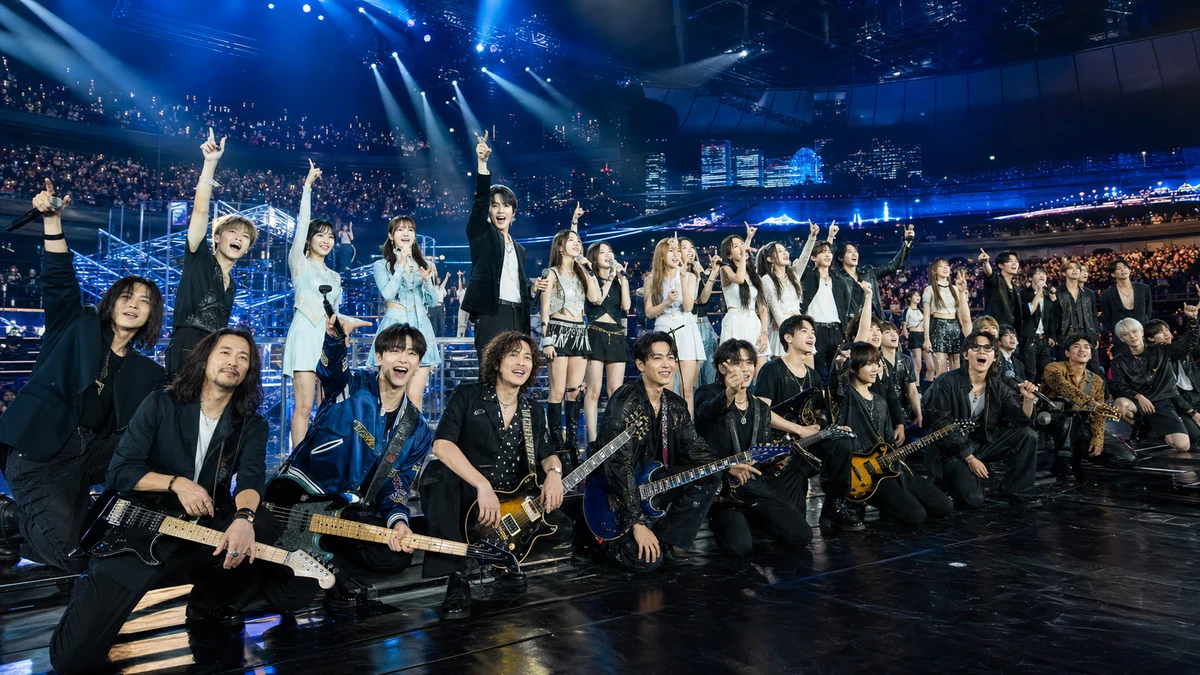
A Korean entertainment tradition heads back to Japan
FNC Entertainment, one of South Korea’s long-running music agencies, is bringing back its annual-style “family concert” in Japan this December, underscoring a business model that may be less familiar to many Americans than a standard arena tour but has become a durable part of the Korean pop culture ecosystem.
The company said it will hold “2026 FNC Kingdom: The Floating Bazar” on Dec. 12 and 13 at Pia Arena MM in Yokohama, according to South Korea’s Yonhap News Agency and the company’s own announcement. The event will gather a broad mix of artists under the FNC roster, including veteran bands FTISLAND and CNBLUE, actor Jung Hae-in, rock band N.Flying, boy groups SF9, P1Harmony and Ampers&One, as well as Hi-Fi Un!corn and rookie band AxMxP.
For American readers, the quickest comparison might be a label-wide festival crossed with a fan convention and a holiday-season revue. Imagine if a U.S. entertainment company brought together its charting acts, emerging artists and one of its TV stars for two nights under a single brand, with audiences coming not just for one headliner but for the identity of the company itself. That is part of what makes a Korean “family concert” distinct. It is not simply a compilation show. It is a statement about the agency, its artist pipeline and the relationships among fan communities that follow those acts.
That concept matters in South Korea, where entertainment agencies play a far more visible role in shaping performers’ careers than many U.S. labels do. K-pop companies are often deeply involved in artist training, branding, overseas expansion, merchandising and fan events. A concert like FNC Kingdom becomes more than a live music booking. It functions as a living showcase of the company’s past, present and future.
This year’s subtitle, “The Floating Bazar,” suggests an event built around variety and movement: different generations of performers, different performance styles and a marketplace-like sense of discovery. The company has not yet detailed stage order, collaborations or the exact role actor Jung Hae-in will play, but the lineup alone signals a broad tent. That is especially notable because FNC is not only an idol company. It has long been associated with live bands, actors and hybrid acts that sit at the intersection of pop polish and instrumental performance.
In a K-pop era often dominated by massive global tours from single superstar acts, FNC Kingdom offers a different proposition: not one name on the marquee, but an ecosystem.
What “FNC Kingdom” means in the Korean entertainment business
FNC Kingdom first launched in 2013, making this year’s edition the 11th under the brand. That longevity is a major part of the story. In the music business, especially in pop, one-off joint concerts are common enough. What is harder to sustain is a recurring live brand that remains recognizable even as the roster evolves, groups debut, military service affects schedules and entertainment trends shift.
That endurance tells us two things. First, FNC has managed to keep enough artist depth on its roster to justify a multi-act event year after year. Second, fans have continued to respond to the package itself, not only to any single performer. In industry terms, that is valuable. A lasting concert franchise gives an agency another way to introduce younger acts, reinforce loyalty across fandoms and expand the life cycle of artists who may be at different commercial peaks.
For readers less steeped in Korean pop culture, the word “family” in “family concert” does not mean relatives performing together. It refers to artists under the same company umbrella — labelmates presented as members of a shared creative household. Korean agencies have long used this framing to create a sense of connection among stars who may have very different careers. That can mean veteran acts and rookies appearing in the same program, or singers sharing billing with actors and TV personalities represented by the same management company.
It is a concept that reflects both commerce and culture. On the business side, it encourages fan overlap. A concertgoer may buy a ticket for CNBLUE and leave having discovered P1Harmony or Hi-Fi Un!corn. On the cultural side, it reinforces a familiar K-pop narrative: that a company is not just a distributor of music, but a curator of talent and a kind of creative home.
FNC Kingdom has also stood out because it has historically leaned into live-band credibility. FNC Entertainment helped build its identity through bands at a time when global audiences often equated Korean pop solely with synchronized dance groups. That has given the brand a somewhat different texture from many idol-focused showcases. Even when boy groups are part of the lineup, the company’s band tradition remains central to how it markets itself.
The 11th edition, then, is not simply another concert date. It is a reminder of how Korean entertainment companies create long-term brands that exist alongside individual artists. In an American context, where labels and management firms are often invisible to casual fans, that is a meaningful difference.
Why Japan remains a crucial stop for Korean pop acts
The choice of Yokohama is no accident. Japan has long been one of the most important overseas markets for Korean popular music, and for companies like FNC, it is a logical place to stage a multi-act event with built-in demand. Even as K-pop has expanded dramatically in the United States, Europe and Latin America, Japan remains a pillar of the business because of its size, proximity to South Korea, mature concert infrastructure and deep fan culture.
In practical terms, a two-night run in Yokohama gives FNC a way to concentrate attention in a market where several of its acts already have established followings. Pia Arena MM, located in the greater Tokyo metro area, is positioned in a region that is easy for domestic Japanese fans and international visitors to access. That makes it a natural venue for an event designed not just as a concert, but as a gathering point for multiple fandoms.
For Americans who know K-pop mainly through sold-out stadium dates in Los Angeles or Newark, Japan’s role can be easy to underestimate. But long before K-pop became a mainstream phrase in the United States, Korean artists were recording Japanese releases, touring Japanese arenas and building dedicated local fan bases there. Japan has often been the first and most stable overseas growth market for Korean agencies. It is also one where fan loyalty can support repeat events and premium live experiences over many years.
That matters for a brand like FNC Kingdom. A recurring family concert works best where there is enough local familiarity with several acts at once. Japan offers that. Fans may come for the legacy of FTISLAND or CNBLUE, for the rising international profile of P1Harmony, or because they know actor Jung Hae-in from Korean dramas that have traveled across Asia and beyond through streaming platforms. The event’s value lies in that overlap.
There is also a symbolic dimension. Holding the show in Japan reinforces the idea that FNC Kingdom is not merely a domestic Korean event exported abroad, but a cross-border franchise in its own right. The company is presenting the concert not as a side trip for one artist, but as a branded international meeting place for its roster and its regional fan base.
At a time when global touring economics are increasingly complicated, a concentrated two-day event in a proven market can also be efficient. Rather than sending multiple artists out on separate overseas runs, a company can create a destination event that delivers scale, visibility and cross-promotion all at once.
A lineup built on generations, genres and strategic crossovers
The most interesting thing about this year’s lineup is how clearly it maps FNC’s internal history. FTISLAND and CNBLUE represent the company’s veteran backbone, acts that helped define its reputation for band-driven performance and emotional rock-pop songwriting. For many longtime followers of Korean music, those names are not just nostalgic touchstones; they are foundational artists in the Korean wave’s second-generation expansion across Asia.
Then there is N.Flying, a band that carries the label’s live-performance identity into a younger era, alongside Hi-Fi Un!corn and rookie band AxMxP, which represent newer chapters in that lineage. Their inclusion suggests that FNC wants audiences to see continuity rather than fragmentation — an ongoing band tradition passed from senior artists to junior ones.
That through line is significant because K-pop is often discussed internationally as though it were synonymous with idol dance groups. FNC’s lineup pushes back on that simplified picture. Here, the concert’s “band axis,” to borrow the logic of the Korean coverage, is not a side note. It is one of the defining features of the show.
The group side of the bill broadens the appeal. SF9 brings a polished idol-group presence with years of experience and a fan base that extends across Asia and beyond. P1Harmony, meanwhile, has built notable momentum among younger global fans, including in North America, where the group has been one of the more visible FNC acts in recent years. Ampers&One adds another layer, representing newer-generation activity and the company’s effort to keep its boy-group lineup fresh.
When these acts share one program, the effect is not just variety for variety’s sake. It creates a carefully paced event. Bands can deliver the emotional lift and instrumental energy of live rock-pop arrangements; idol groups can change the tempo with tightly choreographed stages, fandom chants and visual spectacle. In a two-day setting, that contrast becomes part of the appeal.
From a business standpoint, it also works as a discovery engine. Fans who buy a ticket for one act may end up paying attention to another simply because of proximity and atmosphere. In the streaming era, where algorithms drive discovery online, family concerts recreate a more old-fashioned version of cross-exposure in person. You show up for your favorite artist and leave with a new playlist.
That may be especially useful for newer names like AxMxP. Rookie acts often face the challenge of standing out in an overcrowded market. A family concert gives them something few debut-era performers can easily secure on their own: a large room, a built-in audience and the implicit endorsement of sharing a stage brand with established seniors.
Why actor Jung Hae-in’s inclusion stands out
Among the announced names, the one likely to raise the most eyebrows for casual international readers is Jung Hae-in. He is best known not as a recording artist, but as a popular South Korean actor whose credits include romance dramas and character-driven series that have found audiences through the global spread of Korean television.
His presence in a concert led mainly by musicians is not random. It reflects another hallmark of the Korean entertainment system: the agency as a multi-sector talent house. Companies like FNC do not always separate music and screen talent as cleanly as U.S. audiences might expect. Under one corporate roof, an actor and a band can be part of the same branding ecosystem.
That does not necessarily mean Jung will suddenly be performing as a pop singer. The company has not said what form his appearance will take, and it would be premature to speculate about whether that means a talk segment, special stage, hosting role or some other kind of fan-facing participation. But his inclusion itself broadens the emotional and demographic range of the event.
For some fans, especially those drawn to Korean dramas as much as K-pop, Jung’s appearance could make FNC Kingdom feel less like a standard concert and more like a Korean entertainment festival. That hybrid identity is useful in an era when the “Korean wave,” or hallyu, extends far beyond music. Dramas, films, variety shows, fashion and celebrity culture all feed one another. A fan who first knows Jung from a streaming series may be nudged deeper into the music side of FNC’s universe, just as a band fan may become more aware of the company’s acting talent.
In American terms, it is a little like a studio-backed event that includes both recording artists and an actor from one of the studio’s breakout series, leveraging the fact that audiences increasingly follow entertainment brands across formats. The difference is that in South Korea, this kind of crossover has been normalized far more systematically through agency culture.
Jung’s participation also helps underline the concert’s subtitle. A “bazar,” or bazaar-like concept, implies an assemblage of attractions rather than a single-lane experience. The message is that fans are coming to wander through a world of talent, not just to watch a sequential string of songs.
The enduring appeal of the family concert model
Family concerts occupy a peculiar but important lane in K-pop. They are not as easy to market to the general public as a blockbuster single-artist world tour, and they do not always generate the same international headlines as the biggest chart-dominating groups. Yet they remain one of the clearest windows into how Korean entertainment companies think.
At their best, family concerts do three things at once. They reward existing fans with more content, more variety and the thrill of seeing labelmates share a banner. They support newer acts by placing them in front of established audiences. And they reinforce the company’s own identity as a producer of culture, not merely a background business partner.
That last point is essential. In the United States, most casual listeners know the artist far better than the label. Outside of a few iconic imprints, labels usually do not inspire the kind of emotional attachment that K-pop agencies often do. But in South Korea, fans may track trainee debuts, label history, inter-artist friendships and agency aesthetics with remarkable attention. A family concert taps into all of that.
There is also a practical audience benefit. In a time when live entertainment costs can be steep, the chance to see multiple artists with one ticket is its own selling point. Korean coverage of the event highlights this dynamic: fans may arrive for one favorite act and end up discovering another. That kind of exposure is difficult to replicate through isolated solo concerts.
FNC Kingdom’s continued existence after more than a decade suggests that the formula still works, especially when the roster is broad enough to sustain contrast across generations and genres. It also suggests that there is still a market for company-centered live experiences even as streaming and social media have made fandom more fragmented and individualized.
The unknowns, for now, are the details that often make these events memorable: surprise collaborations, shared stages, theme-driven production and the emotional chemistry of artists acknowledging one another’s careers in front of fans. Those elements have not yet been announced. But even without them, the basic frame is clear. FNC is offering not just a concert, but a narrative of itself.
What this says about the current Korean wave
Seen more broadly, FNC Kingdom arrives at a moment when the Korean wave is both global and increasingly specialized. K-pop has never been bigger internationally, but the ecosystem beneath the biggest headlines is also becoming more complex. Not every event is designed to conquer the Billboard charts or dominate Coachella discourse. Some are about maintaining durable regional ties, building fan pathways between artists and strengthening brand loyalty in markets that have supported Korean entertainment for years.
That is why a two-day family concert in Yokohama matters. It reflects a mature phase of hallyu, one in which Korean entertainment companies are no longer simply exporting one breakout act at a time. They are managing portfolios, cultivating multi-artist event brands and weaving together music, acting and fandom into a single live product.
For English-speaking readers, especially those coming to this story without deep background in Korean culture, the key takeaway is that this is not just another overseas stop on a tour calendar. It is a showcase of how a Korean company organizes talent, builds continuity and courts audiences across borders. The 11th edition of FNC Kingdom is a reminder that the infrastructure of the Korean wave is not only about viral songs and star power. It is also about systems — agencies, traditions, recurring events and carefully maintained fan relationships.
There is something almost old-school about that in the best sense. In an entertainment economy shaped by constant churn, FNC is returning to a branded event it first launched in 2013 and using it to connect senior bands, younger groups, a rookie act and a television star before a Japanese audience that understands the format. That is not flashy reinvention. It is strategic continuity.
The title “The Floating Bazar” may sound whimsical, but the idea behind it is straightforward: gather a range of talent in one place, invite fans to browse the company’s world and let discovery do the rest. If K-pop’s global expansion has often been compared to a cultural wave, this event shows the importance of the docks and harbors too — the recurring spaces where that wave keeps landing, year after year.
With FTISLAND and CNBLUE anchoring the bill, younger groups and bands extending the roster’s reach, and Jung Hae-in bringing drama-star appeal into the mix, FNC Kingdom looks poised to function as both celebration and strategy. For FNC Entertainment, that may be the point. For fans, it is a chance to see how a Korean entertainment company tells its own story live.
Comments
Post a Comment