In a Rural South Korean County, Digital Health Care for Seniors Focuses on Daily Habits, Not Just Data
A small county tries a big idea
In the United States, remote health care for older adults often brings to mind telehealth video calls, smartwatch heart alerts or apps that ping patients to refill prescriptions. In a rural county in South Korea, local officials are testing a version of that idea that is both high-tech and strikingly simple: Use wearable devices and connected health monitors not only to collect numbers, but to help older residents stick to the ordinary routines that often matter most.
Health officials in Hoengseong County, a mountainous agricultural area in Gangwon Province, say 330 residents are taking part this year in an elderly health management program that uses artificial intelligence and internet-connected devices to support people 65 and older. According to county officials, that total includes 126 newly enrolled participants and returning users who rejoined the service.
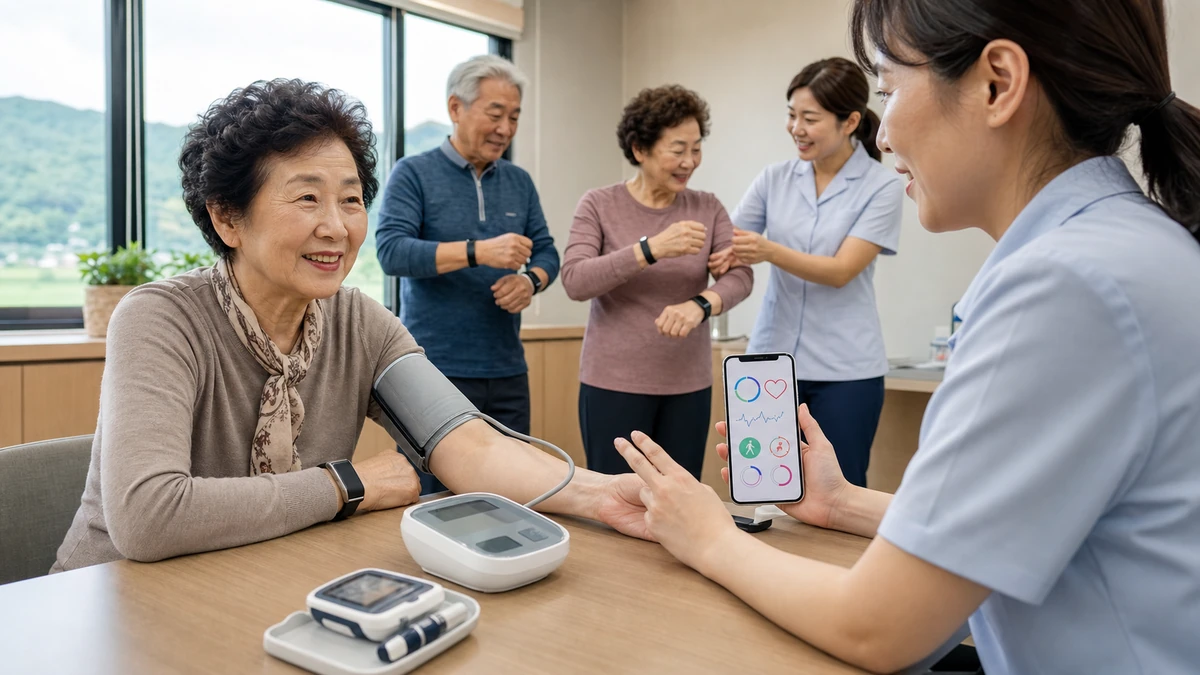
The program provides seniors with devices such as smart bands, blood pressure monitors and blood glucose meters. Those tools feed data into a mobile application called Today Health, allowing participants and local public health workers to track information remotely. But the most notable part of the program is not the gadgetry itself. It is the way local health officials have structured the service around repeated daily behaviors: taking medicine on time, walking, leaving the house, checking blood pressure or blood sugar regularly, and eating three meals a day.
That may sound modest compared with the promises often attached to AI in health care. Yet it reflects a practical reality in aging societies on both sides of the Pacific. For many older adults, especially those managing chronic conditions, better health does not hinge on one dramatic intervention. It depends on whether they can sustain small, consistent actions day after day.
In that sense, Hoengseong’s effort offers a revealing snapshot of how South Korea is trying to adapt technology for a rapidly aging population. Rather than treating health monitoring as a one-time check or a stream of disconnected numbers, the county is trying to turn those readings into a record of everyday life — and then use that record to support healthier routines.
What the program actually does
South Korea’s public health system includes local health centers, known as public health offices, that play a larger community role than many Americans may expect. In smaller cities and rural counties, these offices often function as a front line for preventive care, wellness education and chronic disease management. Hoengseong County’s health office is using that infrastructure to run what is essentially a hybrid of self-tracking, public health outreach and regular coaching.
Residents 65 and older who join the program receive digital devices tailored to their needs, including a smart band to track movement and, when appropriate, blood pressure and blood sugar monitors. The information is linked to the Today Health app, creating one place where readings and activity records can be reviewed. The service is non-face-to-face, meaning it is designed to work remotely rather than requiring frequent in-person visits.
Still, this is not a fully automated system. County health professionals review participants’ health information once a week and provide counseling based on what they see. That detail matters. One common weakness in digital health programs is that devices are distributed, apps are installed and then users are largely left on their own. Hoengseong’s model attempts to close that gap by pairing self-monitoring with regular human follow-up.
Officials say the service has drawn strong satisfaction from participants, though the summary released publicly did not include a formal satisfaction rate or survey data. What is clear is the scale of participation in a county-level program: 330 users, including both first-time and returning enrollees. In a rural community, that suggests not just one-time curiosity but a degree of continuity.
The structure also highlights a broader public health philosophy. The county is not simply telling every older resident to hit the same step count or log the same number of readings. Instead, it sets individualized health tasks based on each person’s situation. One participant may need to focus on medication adherence and blood sugar checks. Another may need more emphasis on walking, getting outside daily and maintaining regular meals. The technology is standardized; the routine is personalized.
From measuring health to practicing it
The most interesting shift in Hoengseong’s program is conceptual. Many digital health systems begin and end with measurement. They count steps, log glucose readings, graph blood pressure and generate alerts. Those functions can be useful, but they can also create the illusion that monitoring is the same thing as improving health.
Hoengseong’s program appears to start from a different premise: that numbers matter most when they reinforce action. County officials have emphasized that the service is designed less around isolated readings and more around whether participants are carrying out repeated daily behaviors. In other words, the centerpiece is not the blood pressure cuff. It is whether the person remembered to take medication, got up and moved, went outdoors, ate regular meals and checked their condition as part of a routine.
That distinction may seem subtle, but it is important for older adults, many of whom live with chronic illnesses that require long-term habit management rather than short bursts of treatment. A blood sugar reading, by itself, tells only part of the story. Did the person eat breakfast? Did they skip lunch? Were they sedentary all day? Did they take the medication they were prescribed? Those surrounding behaviors often shape the meaning of the number.
For American readers, there is a familiar parallel here. Doctors in the United States have spent years urging patients with diabetes, hypertension and heart disease to focus on adherence: take the pills, keep moving, eat regularly, check your readings and stay connected to a clinician. The challenge has never been understanding the advice. It has been building systems that make it easier to follow consistently, especially for older adults who may live alone, have transportation limitations or struggle with digital tools.
Hoengseong’s approach suggests that local public health officials are trying to build exactly that kind of system. The devices are not the destination. They are reminders, prompts and recording tools that support an everyday rhythm. The app gathers the information in one place, but the larger goal is behavioral continuity.
This helps explain why the county separates “walking every day” from “going out every day” as distinct tasks. On paper, those might sound redundant. In practice, they capture different dimensions of healthy living. Walking measures movement. Going out measures social and environmental engagement — whether a person is leaving the isolation of home, maintaining a daily routine and staying connected to the world beyond their front door.
Why getting out the door matters
That emphasis on daily outings may be especially meaningful in a country like South Korea, where the population is aging quickly and where social isolation among older adults has become a growing concern. In rural areas, as in many parts of the United States, older residents can face barriers ranging from limited transportation to shrinking family networks as younger generations move to larger cities for work.
Public health experts have long argued that healthy aging is about more than medical treatment. It also depends on maintaining physical mobility, social contact and structure in daily life. Hoengseong’s program seems to reflect that broader understanding. By making “go outside every day” a formal task, it treats leaving the house as a meaningful marker of well-being, not just an incidental detail.
Americans saw a version of this lesson during the coronavirus pandemic, when seniors were often cut off from routine activities, exercise and face-to-face contact. Families, health systems and community groups learned how quickly health can decline when days lose their structure. Appetite drops, walking decreases, medications are missed and small issues become bigger ones. Hoengseong’s program appears designed, in part, to guard against that kind of drift.
The smart band plays a role here, but only as part of a wider picture. It can help document activity and movement, yet the county’s own framing suggests that the goal is not simply to generate a larger step total. It is to sustain habits that keep older adults engaged in daily life.
That is also why meals are included alongside blood pressure and blood sugar monitoring. In the U.S., remote monitoring programs often focus heavily on biometric data, partly because those numbers are easy to transmit and track. Hoengseong’s model ties those readings to whether a person is also eating regularly. For seniors, especially those managing diabetes or frailty, regular meals are not a lifestyle luxury; they are a basic part of staying stable.
The result is a service that treats health as a sequence of connected actions rather than separate checkboxes. Take medication. Walk. Go outside. Eat. Measure. Review. Repeat. That logic may be unglamorous, but it is often what preventive care looks like in real life.
Aging, technology and South Korea’s public health challenge
South Korea is one of the fastest-aging countries in the world, a demographic reality that is reshaping everything from pensions to housing to medical care. Rural communities feel that pressure especially acutely. Younger residents often leave for Seoul and other major cities, while older adults remain in smaller towns and farming regions. That can leave local governments searching for cost-effective ways to support people with chronic conditions without requiring constant in-person visits.
This is the backdrop for programs like the one in Hoengseong. The phrase “AI and IoT” can sound futuristic, but the policy problem it addresses is immediate and familiar: how to help an older population manage chronic disease in a way that is sustainable for both individuals and public institutions.
South Korea is well positioned to experiment with digital solutions. It has high smartphone penetration, strong broadband infrastructure and a government that has often been willing to integrate technology into public services. At the same time, older adults are not always natural adopters of new devices, and digital literacy gaps remain real. That makes program design crucial. A successful service cannot simply assume that handing out devices will produce healthier behavior.
Hoengseong’s weekly review system appears to recognize that. By having trained staff check participants’ information and provide counseling, the county is effectively building a bridge between self-management and institutional support. Participants are expected to play an active role in tracking their own health, but they are not expected to navigate everything alone.
That balance may be one reason returning participants remain in the program. Re-enrollment can indicate that residents found the service useful enough to continue, though the publicly available summary does not offer detailed outcomes such as changes in blood pressure, blood sugar levels or long-term adherence rates. In other words, the program’s design is clear, but its measurable clinical impact has not yet been fully documented in the information released so far.
That limitation is worth keeping in mind. It would be premature to claim that the model definitively lowers hypertension rates or prevents diabetes complications based on enrollment figures alone. What the county can show is operational continuity: people are signing up, using the devices, receiving counseling and participating in a structured effort to maintain healthy habits.
Lessons Americans may recognize
For U.S. readers, there is something strikingly familiar in this Korean local-government project. American health care systems have spent years trying to solve a version of the same problem, especially through Medicare Advantage plans, remote patient monitoring services and community-based aging programs. The tools differ, reimbursement systems differ and the politics of health care certainly differ. But the core challenge is shared: how do you help older adults stay healthy between doctor visits?
In the United States, remote monitoring is often framed as a way to reduce hospitalizations and cut costs. Those are likely concerns in South Korea as well, even if local officials speak more in terms of health promotion and wellness support. But the Hoengseong case underscores another point that American systems sometimes learn the hard way: behavior change usually needs both convenience and accountability.
A smartwatch can remind a person to move. A connected blood pressure cuff can transmit a reading. An app can display a trend line. None of that guarantees a person will take a morning walk, eat lunch, refill a prescription or keep using the tool after the novelty wears off. What may help is a structure in which someone knows their pattern will be reviewed and that support is available if they fall behind.
That is where the weekly counseling component stands out. It suggests that even in a digital program, human contact remains central. The county is not replacing care workers with machines. It is using machines to make care workers’ time more targeted and continuous.
There is also an important cultural point for non-Korean readers. In South Korea, local public institutions often take a hands-on role in community wellness, especially for seniors. A county health office distributing devices and tracking lifestyle tasks may feel unusually direct to Americans used to a more fragmented system of hospitals, insurers, primary care practices and senior centers. But in the Korean context, this kind of structured local-government involvement fits within a broader public health tradition.
That said, the underlying logic is universal. Older adults do better when support is regular, practical and woven into everyday life. The technology may be Korean. The lesson is not.
The promise and the unanswered questions
Programs like Hoengseong’s are easy to celebrate, and there is good reason to see them as promising. They are relatively low-cost compared with intensive medical interventions. They can reach people in rural settings. They encourage self-management without abandoning participants to self-management. And they align with what clinicians have long known: the hardest part of chronic disease care is often not diagnosis, but consistency.
Still, there are fair questions that remain unanswered. How easy is the app for older adults to use? How much training do participants receive? How many continue active use over time, rather than merely remaining enrolled? Do the weekly reviews change behavior in a durable way? And, most importantly, do the routines translate into measurable improvements in blood pressure control, glucose management, mobility or quality of life?
The public summary does not provide those details. It does not include formal satisfaction percentages, outcome benchmarks or clinical results tied to specific tasks like walking or going out daily. That means the program should be understood, at least for now, as an example of operational design rather than definitive proof of medical effectiveness.
Even so, design matters. In health care, many well-intentioned digital projects fail because they overestimate the value of devices and underestimate the difficulty of sustained use. Hoengseong’s model appears to move in the opposite direction. It treats technology as useful, but secondary. The primary goal is to make healthy behavior more repeatable.
That may be the most important insight in this story. In an era when AI is often marketed as a transformational force, one rural county in South Korea is using it in a far less dramatic, and perhaps more realistic, way: to support medication schedules, meals, walks, outings and routine measurements. Not to revolutionize aging, but to make ordinary days go a little better.
If that sounds almost old-fashioned, it may be because the best public health ideas often are. They do not start with a miracle. They start with a question: What helps people keep doing the basics? Hoengseong County’s answer is that even in a digital age, the path to better health may still run through habits, follow-through and a weekly check-in from someone paying attention.
Comments
Post a Comment