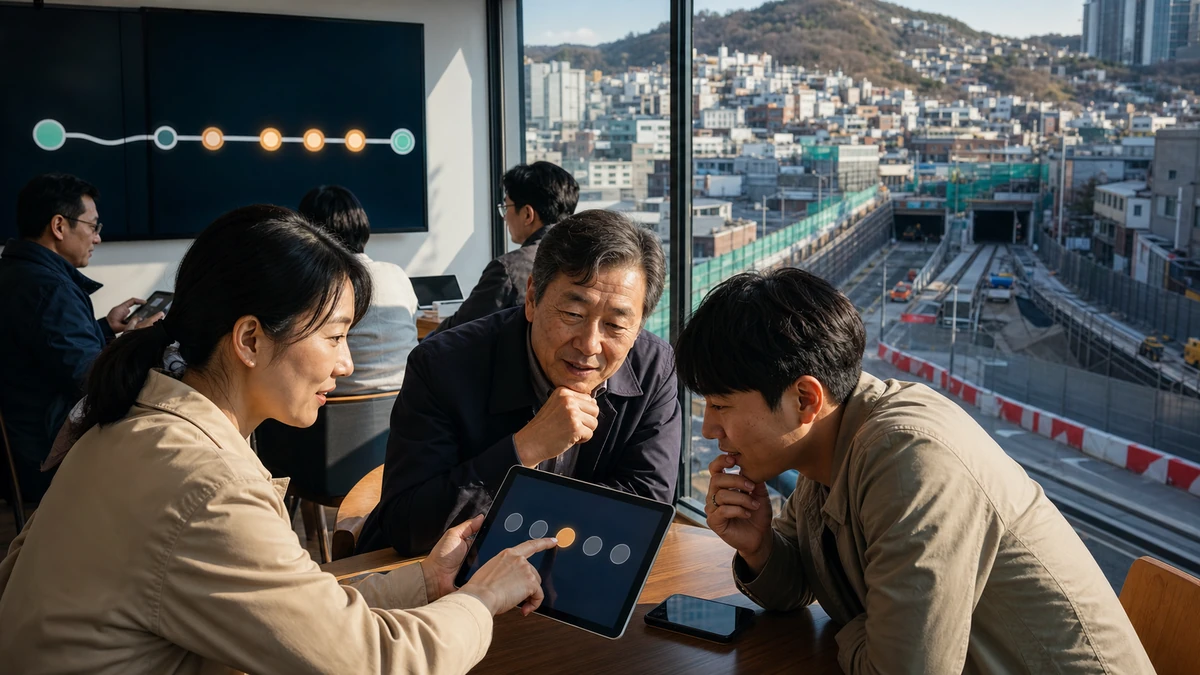
Why a station name matters
In most big cities, the naming of a transit stop can seem like a bureaucratic footnote — the kind of detail commuters only notice once it appears on a map, an announcement or a smartphone app. But in Seoul, one of the world’s most densely connected and transit-dependent capitals, the question of what to call a new station can carry unusual weight. It can shape how a neighborhood is recognized, how residents describe where they live, and how outsiders come to understand an unfamiliar part of the city.
That is why a new public survey in Seoul’s Seongbuk district is more than a housekeeping exercise. District officials said they began polling residents Tuesday on preferred names for four newly planned stations on the Dongbuk Line, a light urban rail route scheduled to open in 2027. The survey runs through Aug. 5 on the district’s website and applies only to the four brand-new stops in Seongbuk that do not already connect with existing subway stations.
At first glance, it may look like a simple vote over what should appear on a signboard. In reality, it offers a window into how urban identity is made in South Korea: not just through steel, concrete and engineering, but through language. A station name in Seoul is repeated endlessly — in directions, on route maps, in taxi rides, in first dates, in job interviews, in real estate listings and in everyday conversations about where to meet. Once fixed, it often becomes shorthand for a whole pocket of the city.
For English-speaking readers more familiar with arguments over whether a stadium, airport terminal or subway stop in New York, Los Angeles or Washington should carry a local landmark’s name, a historical figure’s name or a more geographic label, the Seongbuk process may feel recognizable. What is distinct in Seoul is how deeply the subway system functions as civic infrastructure in daily life. The station name is not merely wayfinding. It becomes part of the social vocabulary of the neighborhood.
That helps explain why local officials are asking residents first, then sending the result through a more formal review process. It reflects a two-step approach that combines public preference with administrative screening — an effort to balance local familiarity, historical relevance, clarity for riders and consistency across the city’s larger transit system.
The Dongbuk Line and the four unnamed stops
The Dongbuk Line is one of Seoul’s upcoming urban rail projects, intended to improve east-northeast transit connections and knit together areas not as directly served by the capital’s existing subway network. In Seongbuk district, the line is set to include six stations in total. But two of those stations will connect to existing subway stops: one planned transfer station tied to Korea University Station, known locally as Goryeodae Station, and another linked to Mia Sageori Station, a major intersection and current subway stop.
Because those two transfer points already have established names, they are excluded from the current survey. The district is instead asking residents to weigh in on the names of the four other newly created stations, identified for now only by construction-stage numbers: 105, 106, 108 and 109.
That numerical labeling is typical during planning and construction. Engineers, contractors and administrators often rely on station numbers before final names are chosen. But a numbered stop is an internal reference. It is the language of a project, not the language of a city. The move from “Station 105” to a name residents will actually use marks the moment when infrastructure begins to enter public life.
That shift is important in a place like Seoul, where the transit map is not just a transportation guide but a mental map of the metropolis itself. Neighborhood identities are often tied to stations, and in many cases younger residents or recent arrivals may know an area’s subway name more readily than its older administrative boundaries. A station name can elevate one landmark over another, signal which local institution carries the greatest symbolic weight, or preserve a traditional place name that might otherwise fade.
Seongbuk, in northern Seoul, is an especially interesting setting for that conversation. The district mixes established residential neighborhoods with major academic institutions, older hillside communities and areas that have changed over decades of rapid urban development. It is also a part of the city where local identity is often highly granular. Residents may feel attached not just to a district name, but to a smaller neighborhood, school area, market zone or historic designation. Choosing a station name, then, is not only about convenience. It can also be about which local story gets institutional recognition.
How the public input process works
The online survey now underway is not the first time residents have been asked for ideas. According to district officials, Seongbuk previously conducted a first round of public input from June 10 through July 10 through neighborhood community service centers. In South Korea, those local offices often serve as a frontline administrative touchpoint, handling everything from residency documents to community notices. They are familiar civic spaces, roughly comparable to local municipal service centers where residents can interact with government close to home.
That first round appears to have functioned as a broad collection phase. Residents submitted station name suggestions tied to their understanding of the area. The district then narrowed the list, selecting names that received strong support or were proposed above a certain threshold. The current online poll is therefore not an open-ended naming free-for-all. It is more like a second-stage preference check, designed to measure public backing for a smaller pool of candidate names that already emerged from neighborhood input.
Officials have not publicly released the specific candidate names or the percentage of suggestions each received in the earlier round, at least based on the information made available so far. That means outside observers cannot yet evaluate whether certain kinds of names are leading — for example, names based on geography, nearby schools, major roads, cultural sites or long-standing local place names.
Still, the process itself says a great deal. Rather than allowing a single memorable suggestion to dominate, Seongbuk’s method appears designed to identify names with some degree of shared recognition. That matters because a transit name has to work over time and for large numbers of people, including first-time visitors, elderly riders, schoolchildren and people who may not know the area well. A successful station name typically needs to be legible, distinctive and durable.
The district has also effectively split participation across two channels: in-person or community-based input through neighborhood offices first, then wider digital participation through the district website. In a country as digitally connected as South Korea, online public surveys are common, but the earlier neighborhood collection phase suggests an attempt to avoid making digital participation the only route into the process. In practice, that can widen representation by reaching residents who are more engaged through local offices than through municipal websites.
More than branding: The politics of naming public space
Americans are familiar with naming controversies in public life, whether they involve school buildings, sports venues, roads, military bases or transit stops. Those disputes can touch on history, prestige, memory and power. The same is true in Seoul, even when the process appears mild and procedural.
A station name is a public label endorsed by the state and repeated thousands of times a day. It can boost the visibility of a university, a market, a historical site or a residential area. It can strengthen property identity. It can also influence what people imagine when they hear a neighborhood mentioned. In some cases, station names become so dominant that they effectively overwrite older local references.
That is why the Seongbuk survey, despite its narrow scope, reflects a larger question: Who gets to name the city? In this case, the answer is not simply residents, and not simply officials. It is both, sequentially. Public preference comes first, but it does not automatically become policy.
After the survey closes, Seongbuk plans to review the results through its place name committee before submitting a formal naming proposal to the Seoul city government. That extra step may seem technocratic, but it serves a purpose. The committee can examine whether a proposed name creates confusion with existing stations, duplicates another local label, lacks geographic clarity or raises other administrative concerns. In other words, popularity is important, but so is public usability.
This layered approach is common in South Korean local governance, where resident consultation often exists alongside committee review and city-level approval. It reflects a broader administrative culture that values public participation, but generally within structured institutional channels rather than direct, final-decision plebiscites. For American readers, it may feel somewhat like a city transportation authority seeking community input at public hearings and through comment forms, then letting a board or commission make the official call.
In the Korean context, the naming issue also connects to something more intimate: the language of everyday orientation. Seoul residents often organize movement through station names with remarkable precision. To say where one lives, works or plans to meet someone, the nearest subway stop can matter almost as much as the neighborhood name itself. A new station, once named, enters that system immediately. It becomes part of the city’s grammar.
What this says about civic culture in Seoul
International coverage of South Korea often centers on K-pop, Korean film, semiconductor exports, North Korea or high-stakes national politics. Those are important stories, but they can obscure the texture of ordinary civic life. The Seongbuk station survey is a reminder that one of Asia’s most globally visible countries is also shaped by highly local, practical decisions about how people inhabit urban space.
There is something quietly revealing about the fact that residents are being asked to help choose names before the line opens in 2027. It suggests that preparing a transit route is not only about tracks, timetables and financing. It is also about social readiness. Before a station can function as part of daily life, people need a name they can remember, say out loud and recognize as belonging to their community.
That is especially meaningful in Seoul, where urban redevelopment has often moved quickly and where neighborhoods can experience dramatic physical change within a generation. Naming can serve as a stabilizing act. It can preserve a familiar local term even as new construction changes the landscape. Or it can signal a shift, elevating a newer institutional identity over an older one.
For Seongbuk residents, the current poll may feel like one of the few directly accessible ways to participate in a major infrastructure project. Most people do not weigh in on tunnel boring methods, signal systems or construction contracts. But almost anyone can offer an opinion about what a place should be called. That makes naming one of the most democratic points of contact between ordinary residents and long-term urban planning.
Even the mechanics of the process are revealing. The first round through neighborhood offices acknowledged local, face-to-face civic networks. The second round online reflects South Korea’s comfort with digital public administration. Together, they show a hybrid participation model: analog enough to be rooted in neighborhood life, digital enough to fit a hyperconnected city.
None of this should be romanticized as pure grassroots rule. The district committee and Seoul city government still retain a gatekeeping role. But the process does indicate that local authorities see value in grounding official place names in lived community usage rather than imposing them entirely from above.
Why overseas readers should pay attention
For readers outside South Korea, this may seem like an oddly granular local matter. But it offers a useful lens on how global cities construct identity. Much attention is paid to spectacular urban projects — gleaming skyscrapers, waterfront redevelopments, giant cultural venues. Less attention goes to the naming practices that help residents make those places meaningful. Yet names are often what turn infrastructure into memory.
Think about how Americans talk about neighborhoods through transit shorthand: taking the Red Line, meeting in SoHo, getting off at Dupont Circle, living near Wrigleyville, heading to Flushing. Those names do more than direct movement. They signal class, history, ethnicity, aspiration and belonging. Seoul’s station names operate similarly, though within its own cultural and linguistic context.
That is one reason this survey is a revealing urban story rather than a minor administrative note. It shows how a city as large and fast-moving as Seoul still leaves room, however limited, for residents to influence the words that define public space. It also underscores that names are never purely neutral. They organize memory. They distribute visibility. They can favor one landmark, institution or local narrative over another.
The outcome of the Seongbuk survey remains unknown. The district has made clear that no final station names have been decided. Whatever preferences emerge by Aug. 5 will move into committee review, and only after that will a formal proposal be submitted to Seoul. The story, for now, is not that four stations have been named. It is that the naming process itself is underway — and that residents are being asked to participate before those names are locked into maps, train announcements and daily speech.
That process may not make international headlines the way a blockbuster K-drama or a new BTS project would. But it captures another side of modern Korean life: a deeply urban society where public systems are woven into routine, and where even something as mundane as a station sign can become a site of community negotiation.
By 2027, when the Dongbuk Line is expected to open, riders will likely speak those station names without a second thought. Visitors will use them to navigate. Businesses may adopt them in advertisements. Friends will text them as meeting points. Real estate listings will invoke them to sell convenience. And in that sense, the names chosen through today’s survey and tomorrow’s administrative review will outlast the poll itself. They will become part of how Seoul describes itself.
That is the larger meaning behind Seongbuk’s quiet vote. A city is not only built. It is named, repeated and remembered. In Seoul, four future subway stops are now at the beginning of that journey.
Comments
Post a Comment