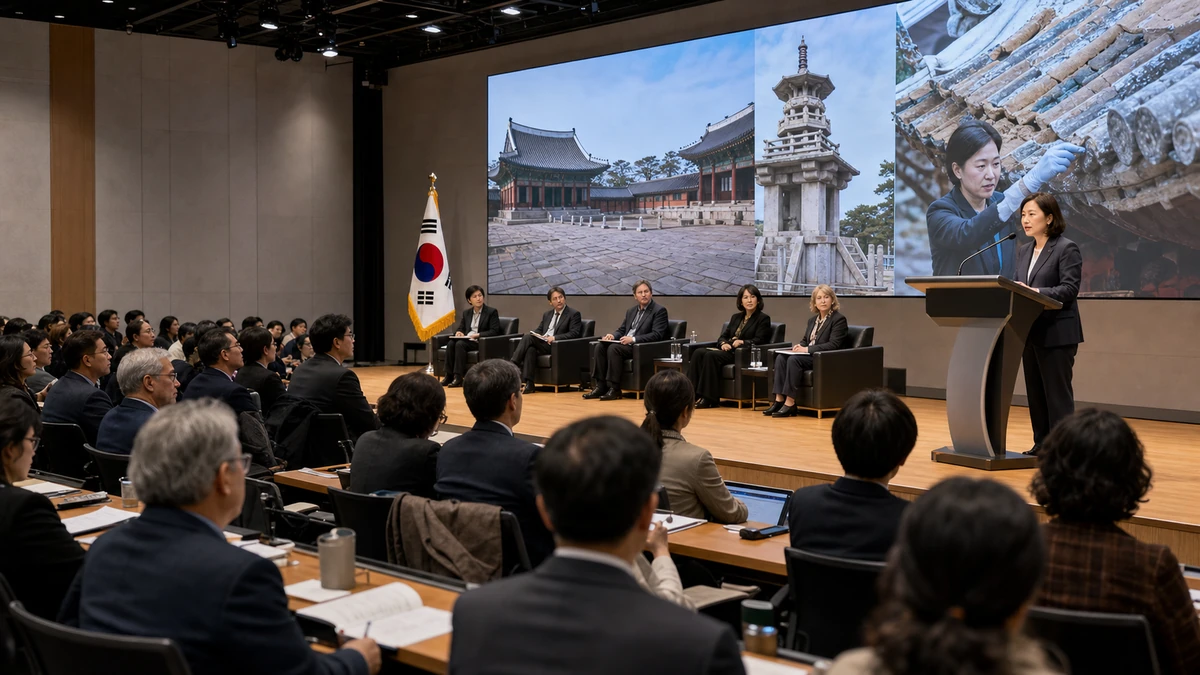
Why a conference about interpretation matters
SEOUL — When most people think about UNESCO World Heritage, they think about famous places: the Pyramids of Giza, the Grand Canyon, the Acropolis, maybe the Statue of Liberty. The conversation usually begins with preservation — how to protect a historic site from war, climate change, over-tourism or neglect. But in Seoul this week, South Korea put the spotlight on a different question: Once a place is protected, who gets to explain what it means?
That was the focus of the 10th International Conference on World Heritage Interpretation, held at Konkuk University in Seoul and co-hosted by South Korea’s Foreign Ministry and the International Council on Monuments and Sites’ International Scientific Committee on Interpretation and Presentation, known as ICOMOS-ICIP. According to the South Korean government, the gathering brought together more than 100 experts and officials, including ICOMOS President Teresa Patricio, to discuss what organizers described as the challenges and future of heritage interpretation and the possibility of revising international norms.
That may sound abstract, even academic. But the issue is deeply political, increasingly global and surprisingly familiar to American audiences. In the United States, fierce debates over monuments, museums, slavery, Indigenous history and the Civil War have all revolved around a similar question: It is not enough to preserve a site or an artifact. The more difficult task is deciding how to tell its story, whose perspective counts and what version of the past gets presented as universal truth.
South Korea is now trying to elevate that same debate onto the international stage. Rather than treating cultural heritage as a static collection of old buildings, the country is presenting heritage interpretation — the language, framing and values used to explain the past — as a major agenda item in what Seoul calls public cultural diplomacy. In other words, this is not just about archaeology or tourism brochures. It is about how a nation communicates meaning to the world.
For American readers less familiar with the institutional language of the UNESCO world, “interpretation” here does not mean translation from one language into another. It refers to the process of explaining why a heritage site matters, what historical experiences it represents and how people from different countries and cultural backgrounds can understand its significance. A temple, palace, fortress or memorial is not only a physical object. It is also a story, and stories are rarely neutral.
That is what makes this Seoul meeting noteworthy. At a moment when South Korea is already enjoying extraordinary global cultural influence through K-pop, film, television and cuisine, it is also trying to shape another, quieter conversation: how the international community talks about history itself.
South Korea’s long game in cultural diplomacy
The conference did not appear out of nowhere. South Korea has hosted this international meeting 10 times since 2016, according to the Foreign Ministry, suggesting a sustained effort rather than a one-off cultural event. That continuity matters. In global governance, influence is often built less through dramatic announcements than through the patient work of convening experts, framing agendas and creating institutions where future rules are debated.
For years, South Korea’s cultural rise abroad has largely been understood through the lens of the Korean Wave, or “Hallyu,” the term used to describe the global popularity of Korean pop culture. Americans know the phenomenon through acts like BTS and Blackpink, films like “Parasite,” Netflix hits such as “Squid Game,” and the spread of Korean beauty products and Korean food. But there is another layer to Seoul’s cultural strategy, one that gets far less attention. The government has increasingly treated culture not only as entertainment or branding, but also as diplomacy — a way of building relationships, shaping narratives and enhancing international standing.
That helps explain why South Korea’s Foreign Ministry, not just a culture agency or university department, is so deeply involved in a conference on heritage interpretation. The official who opened the event, Oh Jin-hee, heads the ministry’s bureau for public and cultural diplomacy. Her remarks, as summarized by the government, emphasized the importance of interpretation in understanding what UNESCO calls a site’s “outstanding universal value,” a key term in the World Heritage system. The phrase refers to the exceptional importance that makes a site significant not merely to one nation, but to humanity as a whole.
Yet the very idea of “universal value” can be complicated. What seems obvious or inspiring to one country may look incomplete, selective or even exclusionary to another. A heritage site can embody national pride, colonial trauma, religious devotion, imperial power, technological achievement or unresolved grievance, sometimes all at once. Interpreting that complexity for an international audience requires more than a plaque on a wall.
That is where South Korea sees an opening. By hosting repeated conferences on this topic, it is positioning itself as a country that does not simply maintain its own heritage, but also helps guide the global discussion on how heritage should be explained. The distinction is important. Many countries possess significant heritage sites. Fewer are able to turn that into leadership in rule-making, norm-setting and international dialogue.
In practical terms, hosting the conference also helps South Korea build networks among diplomats, scholars, preservation specialists and UNESCO-related institutions. Those networks can matter later when debates arise over nominations, management disputes, language in official documents or broader reforms to the international heritage system. In that sense, Seoul’s role is less about dictating answers than about creating the space in which answers take shape.
The fight over who tells history
The heart of the conference theme was not preservation technology or site management, but interpretation itself. Organizers framed the meeting around “Challenges and Future of Heritage Interpretation: Toward Revising International Norms,” signaling that the conversation is moving beyond best practices and into the realm of standards and principles.
That shift reflects a broader reality: cultural heritage is no longer seen as just a technical matter for conservators and curators. It is intertwined with identity, memory and power. Across the world, museums and historic sites are under pressure to widen the lens, include marginalized voices and acknowledge painful histories that older official narratives often downplayed or ignored.
Americans have watched this unfold at home. Debates over Confederate memorials, the 1619 Project, Native American repatriation, Japanese American incarceration sites and the representation of slavery at plantation museums all show how interpretation can be as contentious as preservation. A building can remain standing while its meaning changes dramatically depending on who is doing the explaining. A battlefield can be framed as a story of military valor, a tragedy of national division, a defense of white supremacy or all three in uneasy coexistence.
South Korea’s emphasis on “inclusive interpretation” places it squarely within that global conversation. The materials released around the conference did not spell out a detailed policy blueprint, and no specific amendments to international rules were publicly announced. But the concept of inclusivity suggests a move away from single-authority narratives toward approaches that take multiple perspectives seriously.
That matters in the heritage world because many sites carry layered or contested meanings. A royal palace might be a masterpiece of architecture, but also a symbol of class hierarchy. A colonial-era building might be beautiful in form yet bound up with exploitation. A sacred landscape may attract tourists while remaining spiritually significant to local communities. Inclusive interpretation asks whether official storytelling can make room for such tensions instead of smoothing them over.
There is also a diplomatic dimension. UNESCO heritage sites are, by definition, presented to an international audience. Visitors, scholars and officials bring different historical experiences with them. What reads as patriotic commemoration in one country may strike outsiders as selective or nationalistic. Inclusive interpretation, at least in theory, creates a shared language for discussing the past without requiring total agreement about it.
That is easier said than done. Around the world, governments often prefer coherent stories that project legitimacy and pride. Heritage can be a source of tourism revenue, soft power and domestic political symbolism. Opening interpretation to a wider range of voices may produce richer history, but it can also generate discomfort. That is one reason the Seoul conference matters: it acknowledges that the challenge is not simply how to conserve a site, but how to manage disagreement over meaning.
A network of institutions behind the effort
The structure of the event says as much as its theme. It was co-hosted by South Korea’s Foreign Ministry and ICOMOS-ICIP, with the Korean National Commission for UNESCO and the Korean committee of ICOMOS listed among the organizers, and with support from the World Heritage Interpretation and Presentation Centre and Konkuk University’s World Heritage Studies Research Institute.
To outsiders, that alphabet soup may seem impenetrable. But it reveals an important point: heritage interpretation sits at the intersection of diplomacy, academic research, international bureaucracy and on-the-ground practice. No single ministry or professional field can handle it alone.
ICOMOS, for example, is one of the world’s best-known advisory bodies in cultural heritage. It plays a major role in evaluating sites and shaping global standards. UNESCO, meanwhile, provides the institutional framework through the World Heritage Convention, the 1972 treaty that underpins the global heritage system. National governments bring political authority and diplomatic reach. Universities and research institutes supply scholarship and analysis. Specialized centers such as the World Heritage Interpretation and Presentation Centre help connect those discussions to training, implementation and professional exchange.
In the American context, readers might think of the way the National Park Service, the Smithsonian, state historical commissions, university historians and international bodies each bring different expertise to the interpretation of significant places. None of them can simply declare the final meaning of a site without reference to the others. The same is increasingly true in global heritage governance.
The attendance of ICOMOS President Teresa Patricio underscored that the Seoul meeting was not merely a domestic conference with an international label. It was part of a larger expert network in which South Korea is seeking a sustained, visible role. And that role appears to be expanding just as the country takes on another prominent responsibility in the UNESCO system.
From Seoul to Busan, a bigger diplomatic stage
The timing of the conference is particularly significant because it comes just before South Korea chairs the 48th session of the World Heritage Committee in Busan, the major port city on the country’s southeastern coast. The committee is one of the most visible organs in the UNESCO heritage system, overseeing inscriptions, monitoring and broader policy discussions tied to the World Heritage Convention.
For South Korea, the sequence of events — experts meeting in Seoul, followed by committee diplomacy in Busan — creates a powerful message. The country is not only hosting international conversations; it is helping set their tone. The Foreign Ministry has said South Korea will continue working for the development of the World Heritage Convention system, including through an inclusive approach to heritage interpretation.
There are limits to what can be concluded from that. The publicly available summary of the conference did not identify specific proposals that will be taken up by the committee, nor did it suggest that any immediate formal decision is guaranteed. International norm-making is usually incremental, especially in bodies where many states, institutions and professional traditions must be accommodated.
Still, diplomacy often works through signaling. By elevating interpretation in advance of the Busan meeting, South Korea appears to be making clear that it views heritage storytelling as a serious policy issue, not an afterthought. That framing may influence how delegates, experts and partner institutions approach upcoming discussions even if no headline-grabbing resolution emerges right away.
Busan itself is an apt setting for such a moment. Long known as one of South Korea’s most important ports, the city symbolizes the country’s international connectedness. During the Korean War, it also served as a crucial refuge and logistical hub. Today, it is often marketed abroad through film, trade and tourism. Hosting a major UNESCO-related meeting there reinforces the image of South Korea as both a cultural power and a diplomatic crossroads.
In Washington policy circles, this kind of agenda-setting is increasingly recognized as part of middle-power diplomacy. Countries that may not dominate military or economic systems in the way superpowers do can still shape global norms through expertise, convening power and coalition-building. South Korea has done that in technology, development and democracy promotion. It is now trying to do something similar in cultural heritage.
What “inclusive interpretation” could mean
The phrase “inclusive interpretation” can sound appealing while remaining frustratingly vague. Organizers did not release, at least in the summary available, a detailed definition or operational standard. But the concept points toward several practical questions that are now central in the heritage field.
Who is represented in the official story told about a site? Are local communities involved in shaping how visitors understand it? Do historical explanations acknowledge conflict, displacement or social inequality when those issues are part of the record? Is interpretation accessible to international audiences without flattening local nuance? Can multiple viewpoints be presented without collapsing into relativism or political paralysis?
Those are not easy questions, and different countries answer them differently. In South Korea’s case, the turn toward inclusivity may reflect a recognition that heritage exists in a global conversation shaped by colonial legacies, transnational tourism and competing memories across East Asia and beyond. The Korean Peninsula’s own history — marked by monarchy, colonization, war, division and rapid modernization — offers many examples of places whose meanings cannot be captured by a single narrative.
For American readers, a useful comparison might be the evolving interpretation of sites connected to Indigenous peoples. For decades, many U.S. historic sites were explained largely through settler, military or architectural frameworks. In recent years, there has been increasing pressure to include Native voices, treaty histories and the lived consequences of dispossession. That shift has not solved every problem, but it has changed expectations about what responsible interpretation looks like. Something similar is happening internationally, though across a much wider range of political systems and historical experiences.
Inclusive interpretation also has a communication challenge. Heritage experts often use technical or bureaucratic language, while the general public responds to stories, symbols and emotion. If the field becomes too jargon-heavy, it risks losing the audiences it claims to serve. South Korea’s emphasis on public cultural diplomacy suggests an awareness that interpretation must work not only in expert meetings, but also in the broader public sphere where nations are understood and judged.
That may be one reason the issue has taken on greater significance in a country so attuned to image and narrative. South Korea knows from the success of the Korean Wave that stories can travel. It is now applying that insight to a different domain: not pop songs or streaming dramas, but the communication of historical meaning across cultures.
What South Korea’s push says about its global ambitions
The Seoul conference does not by itself rewrite international rules, and there is no evidence yet of a formal breakthrough on heritage norms. But it does reveal something important about South Korea’s evolving place in the world.
For much of the postwar era, the country’s international image was tied to security threats from North Korea, export-led economic growth and, later, democratic consolidation. Over the past two decades, it added cultural prestige through entertainment and consumer trends. Now, it is increasingly presenting itself as a country capable of helping manage the frameworks through which the world understands culture, memory and value.
That is a subtler kind of influence than topping music charts or hosting a mega-event. It involves institution-building, agenda-setting and repeated participation in the less glamorous machinery of international cooperation. But those activities can have lasting impact. Standards developed in expert forums often shape future policy, training and public expectations long after the conference banners come down.
The deeper challenge for South Korea, as for any country seeking leadership in this area, will be whether it can translate broad principles into concrete practice. It is one thing to champion inclusivity and dialogue in conference settings. It is another to embed those ideals in the actual governance of heritage sites, the wording of international guidance and the messy politics of memory.
Even so, the fact that Seoul is investing diplomatic energy in this conversation is telling. It suggests a view of heritage not as decorative nationalism or tourist branding, but as an arena where international trust, legitimacy and cultural understanding are negotiated. In an era when history is repeatedly weaponized in politics at home and abroad, that may be one of the most consequential forms of cultural diplomacy available.
At minimum, the conference sends a message that the future of heritage will not be decided only by engineers, curators or preservationists, important as their work remains. It will also be shaped by diplomats, communities, scholars and publics arguing over how the past should be explained. South Korea wants to be at the center of that argument.
And for a country whose global influence has often rested on the power of storytelling, that ambition makes a great deal of sense.
Comments
Post a Comment