K-Beauty’s Next American Test Is in Los Angeles, as Olive Young Bets Shoppers Want More Than a Viral Product
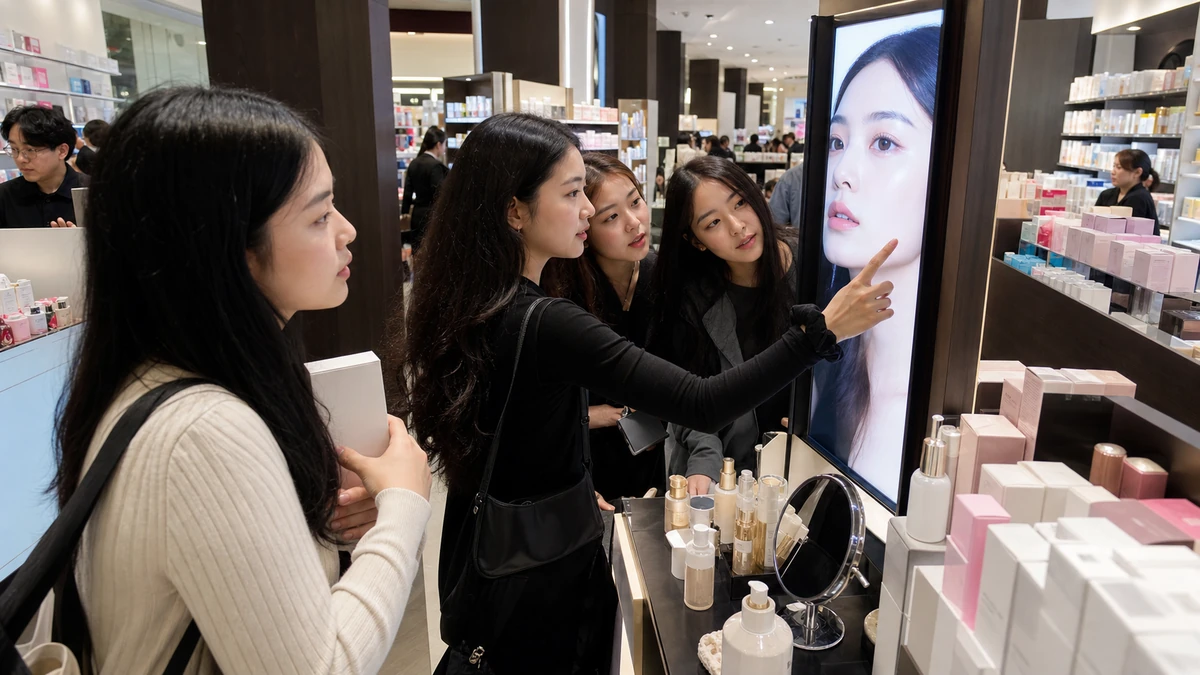
A Korean beauty giant brings its store model to California
For years, American shoppers discovered K-beauty the way they discover so many modern obsessions: through screens. A snail mucin serum goes viral on TikTok. A sunscreen from Seoul earns rave reviews on Reddit. A sheet mask pops up in an Amazon recommendation after someone searches for “glass skin,” the term often used to describe the clear, smooth, dewy complexion associated with Korean skin care trends. Now one of South Korea’s best-known beauty retailers is betting that online curiosity in the United States is ready to become something more physical, and more lasting.
Olive Young, the dominant beauty chain in South Korea, has opened its second Los Angeles-area store just two weeks after launching its first California location, according to South Korean broadcaster MBC. The expansion is small in raw numbers, but the symbolism is large. In South Korea, Olive Young occupies a cultural position Americans might recognize from a blend of Sephora, Ulta Beauty and a highly curated drugstore, with an added emphasis on rapid trend turnover and discovery of smaller brands. Its shelves often function as a real-time scorecard of what younger consumers in Korea are trying, posting about and repurchasing.
The company’s California push suggests that K-beauty has entered a new phase in the United States. This is no longer only a story about imported products finding niche online audiences. It is increasingly about Korean companies exporting a retail experience: the idea that beauty shopping should be hands-on, highly personalized and organized around routines rather than single hero products. In that sense, Olive Young is not just opening stores. It is testing whether an American audience is ready to shop beauty the Korean way.
The early signals appear encouraging. At the opening of Olive Young’s first California store, MBC reported, the line of customers stretched around the shopping complex for roughly 400 meters, or about a quarter of a mile. For a beauty retail opening, that is an attention-grabbing scene in any market. It also reflects how K-beauty interest in the United States has evolved. The appetite is no longer limited to search traffic, influencer reviews and late-night impulse buys. Shoppers want to touch products, compare textures, swatch colors and ask questions in person.
That matters because beauty, perhaps more than most consumer categories, is hard to fully understand online. A cleanser may look elegant in a video, but a customer still wants to know if it leaves the skin tight. A cushion foundation may trend on social media, but the buyer wants to see the finish under real light. A toner may promise hydration, but consumers want help figuring out whether it belongs before or after a serum, or whether it fits with sensitive or acne-prone skin. Olive Young’s model is built around answering those questions on the sales floor.
Why Olive Young matters in Korea and why that matters in America
To understand why this expansion is getting attention, it helps to understand Olive Young’s place in South Korea. The company is far more than a chain selling cosmetics. It is one of the country’s most influential beauty gatekeepers, a retailer that can help elevate small domestic brands from relative obscurity into national prominence. Young Korean shoppers often browse Olive Young for the same reason many Americans walk into Sephora without a fixed shopping list: to see what is new, what is popular and what other people are talking about.
But Olive Young’s influence also stems from the structure of the Korean beauty market itself. South Korea has one of the world’s most competitive cosmetics industries, with a dense ecosystem of conglomerates, independent labels, dermatology-inspired lines and trend-driven startups. Product cycles move quickly. Packaging matters. Ingredient storytelling matters. So does the ability to tailor a product to a specific concern, whether that is barrier repair, redness, uneven tone or oil control. In that environment, retailers are not just middlemen. They are editors, curators and translators.
That curatorial role is especially relevant for American consumers, many of whom are now aware of K-beauty but may not know how to navigate it. U.S. shoppers often encounter Korean products piecemeal: a cleansing balm here, an essence there, a pimple patch in the checkout line. What they may be missing is the larger logic behind Korean beauty routines, which tend to emphasize layering lighter products, prevention rather than correction, and maintaining the skin barrier as much as treating visible problems. A store model that explains both the products and the sequence of use can make the category feel far less intimidating.
According to MBC, Olive Young’s U.S. stores carry more than 400 brands and roughly 5,000 products, with more than 80 percent of them coming from Korean brands. That scale matters. In American retail, K-beauty has often been represented by a limited handful of brands or a narrow selection of bestseller items. A broader assortment allows for something closer to what Korean consumers actually experience at home: comparison, experimentation and the possibility of building a routine tailored to individual skin needs instead of buying a single trendy product in isolation.
There is also an important business angle here. Korean beauty’s international reputation has often been described in terms of innovation, packaging and affordability. But one of its real advantages has been speed. Smaller independent brands can react quickly to ingredients, social trends and emerging consumer anxieties. A retailer like Olive Young can turn that dynamism into a coherent shopping environment. For American consumers, that means seeing not just the final product, but the pace and variety of a beauty culture that has been unusually good at responding to changing tastes.
From Amazon success to in-store experience
Online platforms were the first major bridge between K-beauty and many American shoppers, and they remain essential. MBC noted that independent Korean brands such as APR and Goodai Global expanded their U.S. reach largely through Amazon and other digital channels. APR has drawn attention for beauty devices, while Goodai Global has raised its profile in North America through Beauty of Joseon, a brand whose name references Korea’s Joseon Dynasty and whose marketing taps into a blend of heritage imagery and contemporary skin care language.
That online pathway helped Korean brands do something difficult and valuable: reach U.S. consumers without first needing massive American brick-and-mortar footprints. In many ways, K-beauty was built for the social media era. It photographs well. It produces highly shareable before-and-after claims. It lends itself to routines, rankings and shelf tours. Independent brands, in particular, have often been nimble enough to tell clear stories around ingredients such as centella asiatica, rice extract or fermented formulas while targeting shoppers who were already educating themselves through beauty content online.
But online success comes with limits. Digital marketplaces are crowded, and visibility can be expensive. Brands often need to keep spending on advertising just to remain prominent in search results. Consumers, meanwhile, can struggle to sort genuine quality from algorithmic hype. In beauty, where counterfeit products and misleading claims are longstanding concerns across global e-commerce, trust is part of the product. Physical retail offers a different kind of credibility. A store lets customers test colors, smell cleansers, compare textures and ask staff how products fit into a routine.
That is the gap Olive Young appears eager to fill. Rather than simply stocking internet-famous items, the retailer is emphasizing consultation and personalized recommendations. MBC reported that the company’s strategy includes checking a customer’s current skin condition and suggesting products accordingly. That is notable because it mirrors a broader Korean retail approach to skin care: the goal is not merely to sell a bottle or jar, but to help customers understand how multiple products work together over time.
For American consumers, this could be one of the most meaningful imports from Korean beauty culture. In the United States, beauty shopping is often organized around categories like anti-aging, acne treatment or makeup coverage. Korean beauty tends to package skin care more as a routine and a texture experience. The emphasis can be on layering toners, essences, ampoules and creams in an order that supports hydration and barrier health, while adjusting for season, skin sensitivity and climate. In other words, a Korean beauty store does not simply ask, “What product do you want?” It often asks, “What is your skin dealing with right now, and how should your routine respond?”
The rise of “experience retail” in K-beauty
The timing of Olive Young’s California expansion also fits a broader trend in American shopping. Even as e-commerce dominates many categories, consumers continue to show up for stores that offer something harder to replicate on a screen: expertise, novelty, community or sensory experience. In food, that has helped specialty grocers thrive. In books, independent stores have survived by leaning into events and curation. In beauty, stores remain powerful because texture, color and finish are difficult to digitize convincingly.
That helps explain why a quarter-mile line at a store opening matters. It is not just a measure of fandom. It is evidence that K-beauty’s appeal is shifting from passive awareness to active participation. American customers are no longer only asking, “What are Korean consumers using?” They are asking, “How do I use this, and what else goes with it?” That is a subtle but important evolution. It suggests the market is maturing from impulse-driven product discovery to a more durable kind of category engagement.
There is also a cultural layer. For many U.S. consumers, K-beauty sits within a larger Korean Wave, or Hallyu, the broad global spread of South Korean popular culture through music, television, film, fashion and food. Fans who first came to Korea through K-pop or Korean dramas often develop curiosity about beauty and skin care next. What a store like Olive Young offers is a physical point of entry into that world. Just as Korean grocery chains introduced American shoppers to ramyeon, kimchi and ready-made banchan, Korean beauty stores can introduce them to a vocabulary and routine that once felt distant or specialized.
Some of those concepts need translation for an American audience. “Glass skin,” for example, is less about looking shiny than about skin appearing smooth, intensely hydrated and even-toned. “Tone-up” products are not necessarily self-tanners but often creams or sunscreens that brighten the look of skin. “Ampoules” are concentrated treatment products, closer in concept to potent serums. A store environment can demystify that language quickly. It can also prevent one of the most common mistakes American beginners make with K-beauty: overbuying a routine because a trend made it look universal, even though Korean skin care culture tends to be far more adaptive and individualized than the stereotype of a rigid 10-step regimen suggests.
For brands, the payoff is significant. A shared retail platform lowers barriers for smaller companies that might otherwise struggle to build local distribution and marketing systems from scratch in the United States. Instead of opening a standalone flagship or competing endlessly in paid search, they can appear next to other Korean brands in a retail environment where the customer has already shown interest in the category. That clustering effect can help the entire ecosystem, especially in a market as geographically and demographically complex as the United States.
Europe is becoming the next big proving ground
While California is drawing headlines, the broader story is that K-beauty’s international ambitions now extend well beyond North America and China. MBC reported that the category’s expansion stage is broadening into Europe, where major retailers have begun responding to rising demand. In Britain, department store chain John Lewis started selling Korean cosmetics in April after seeing increased search activity for Korean beauty products on its online platform over the prior year. Brands including Beauty of Joseon, Medicube and Anua have joined its assortment.
That development is significant for a few reasons. First, department stores do not move quickly or casually, especially in beauty, where shelf space is valuable and brand reputations matter. A retailer like John Lewis taking K-beauty seriously suggests the category is no longer viewed as a niche internet fascination or a specialist import for devoted enthusiasts. Instead, it is becoming part of the mainstream product mix considered relevant for general beauty shoppers.
Second, Europe has long been considered a beauty stronghold, home to powerful French, British and Italian traditions in cosmetics, fragrance and skin care. Gaining traction there is different from building buzz on American social media. It requires staying power, retail relationships and the ability to compete not only on novelty, but on formulation, price, design and performance. For Korean brands, that is both a challenge and an opportunity. If they can establish themselves in major European channels, they move closer to being understood not as a trend, but as a permanent beauty category.
MBC said South Korea’s cosmetics exports to 58 European countries reached 2.3113 trillion won, nearly doubling over two years. The exact exchange-rate equivalent fluctuates, but the direction is unmistakable: the market is widening. Importantly, this is not being driven by one single breakout item or one country alone. The growth suggests a broader appetite across multiple European markets, which is often a healthier sign for a category’s long-term stability.
That widening footprint could also reinforce growth in the United States. Global beauty trends are increasingly interconnected. A product that does well in London can gain credibility in Los Angeles. A retailer expansion in California can help validate a brand for buyers in Paris or Berlin. And once distribution improves across multiple regions, brands can scale more efficiently, lowering some of the operational burdens that come with international growth. In practical terms, that means an American shopper may soon find that the Korean product she once hunted down online is available not only at a specialty K-beauty shop, but at multiple mainstream outlets that now consider the category essential.
What American shoppers are really buying
At first glance, it may seem as if American consumers are simply buying cleansers, moisturizers and lip tints from another country. But the real export here is more layered. What shoppers are increasingly buying into is a system: a way of evaluating skin, selecting products and building routines. That system places unusual emphasis on prevention, consistency and fit. It rewards consumers for noticing how their skin changes with weather, hormones, sleep, travel and age. And it encourages them to think less in terms of miracle products and more in terms of combinations.
That helps explain why in-store consultation is so central to Olive Young’s approach. A recommendation based on current skin condition acknowledges that beauty is situational. Someone with dry, irritated skin after a long flight to Los Angeles may not need the same routine she needed during a humid summer in Houston. Someone with oily skin may still need hydration, just in lighter textures. Korean beauty has been especially effective at translating those distinctions into product categories and retail language. For American audiences, that can feel both sophisticated and approachable, especially when compared with more intimidating luxury counters or more clinical treatment-driven skin care messaging.
It also means K-beauty’s future in the United States is unlikely to depend on one superstar serum or one fleeting TikTok trend. The stronger play is category depth. If shoppers walk into a store for one viral sunscreen and leave understanding double cleansing, toner layering and barrier repair, the retailer has done more than close a sale. It has expanded the customer’s relationship to the category. That kind of education can create repeat business in a way that trend-chasing alone rarely does.
For Olive Young, the next test is scale. MBC reported that the company plans to expand to five U.S. stores by the first half of next year. That is still a modest footprint in a country as large as the United States, and success in Southern California does not automatically translate to every market. Los Angeles is one of America’s most diverse, trend-sensitive and Asian American-influenced cities. It is uniquely fertile ground for K-beauty. But if the concept works there, it could provide a blueprint for expansion into other metropolitan areas where beauty consumers are already highly engaged and open to discovery.
The bigger takeaway is that K-beauty is no longer just exporting products. It is exporting a retail format and a consumer mindset. That may sound abstract, but the implications are concrete. More physical stores mean more chances for smaller Korean brands to be found. More curation means less friction for new customers. More mainstream retail adoption in Europe and North America means the category becomes harder to dismiss as a fad.
For American shoppers, the result could be a beauty market that looks noticeably different in a few years: more Korean brands on shelves, more emphasis on routines and skin condition, and more expectation that products should be tested, compared and personalized before purchase. For Korean companies, the opportunity is just as large, but so is the challenge. Viral demand can open the door. Building trust in-store is what keeps it open.
That is what makes Olive Young’s Los Angeles expansion worth watching. In a crowded global beauty market, the company is making a straightforward but ambitious wager: that U.S. consumers are ready for K-beauty not only as a product category, but as an experience. If the lines outside its first California stores are any indication, that bet is landing at the right moment.
Comments
Post a Comment