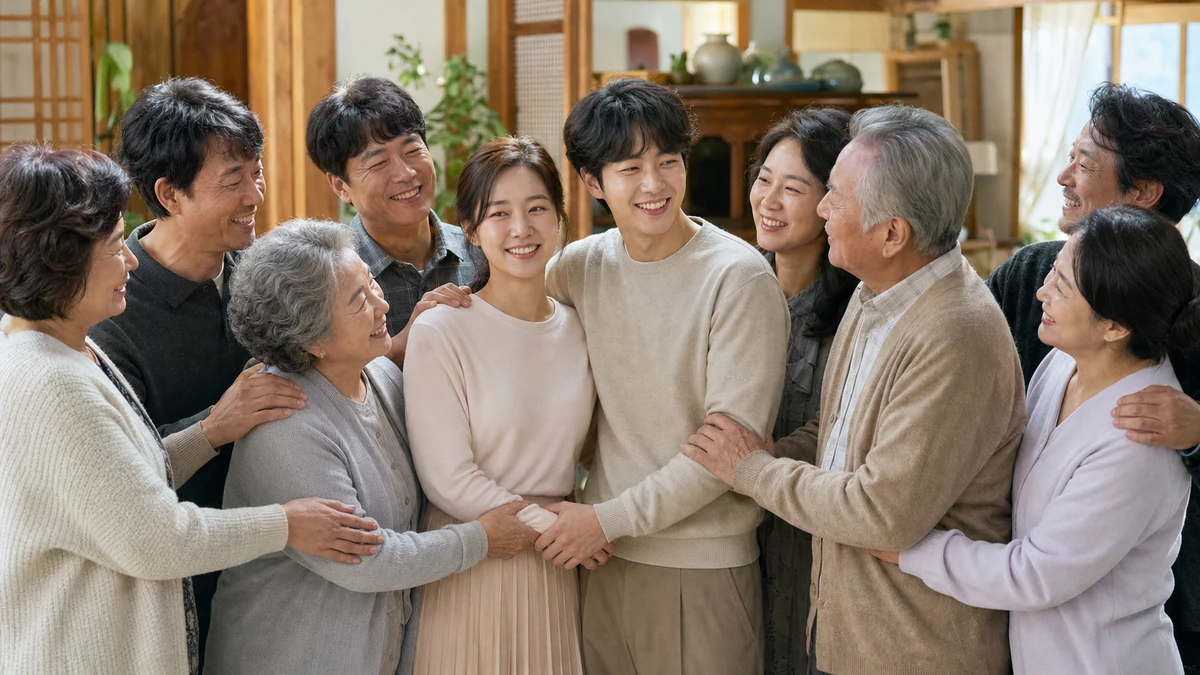
A steady finish for a distinctly Korean TV tradition
A popular South Korean weekend drama wrapped up its 50-episode run with a solid ratings finish, underscoring the staying power of a television format that may feel unusual to many American viewers but remains a durable part of Korean broadcast culture. KBS 2TV’s “Love, We Prescribe It,” starring Jin Se-yeon and Park Ki-woong, ended Sunday with a nationwide audience rating of 15.3%, according to Nielsen Korea, closing out a six-month run that began in January.
In the United States, a drama posting numbers like that on a traditional broadcast network would almost certainly be treated as a major success, especially in an era defined by streaming fragmentation and shrinking live audiences. In South Korea, the picture is a little more nuanced, but the result still signals a healthy performance, particularly for a long-running family series airing on weekends. The show’s peak rating was 15.9% in Episode 44, and the fact that the finale finished only slightly below that mark suggests viewers stayed invested through the end.
That matters because Korean television is often discussed internationally through the lens of glossy global hits on Netflix and other platforms: fast-paced thrillers, romantic dramas with 16 episodes, or prestige genre series designed to travel. But that version of Korean TV, while real, is only part of the story. Weekend family dramas on major Korean broadcasters such as KBS, MBC and SBS occupy a different lane. They are longer, broader and often more intergenerational, designed as appointment viewing for households rather than binge-watchers.
“Love, We Prescribe It” appears to have delivered exactly what that audience expects: emotional release, family conflict, reconciliation and a closing note of reassurance. Its final episode centered on the end of a 30-year feud between two families, the Gongs and the Yangs, and chose healing over revenge. For American viewers more familiar with courtroom showdowns, antiheroes or finales built around a shocking twist, that choice may seem old-fashioned. In the Korean family-drama tradition, it is often the point.
The finale did not simply tie up a romance. It resolved grievances spanning decades, restored a family elder to health and framed love less as a private feeling than as a force capable of repairing a damaged family network. That approach helps explain why the series held its audience. It was not asking only whether the lead couple would wind up together. It was asking whether an entire fractured social world could be made whole again.
What the finale was really about
According to Korean media reports, the final episode depicted the Gongs and the Yangs finally ending the bitter conflict that had linked them for three decades. The show’s concluding movement focused on these once-hostile families becoming, in effect, one family. That may sound simple on paper, but it reflects a larger storytelling logic common in Korean weekend dramas: the idea that personal happiness cannot be fully separated from family stability.
That is one of the biggest cultural distinctions American readers may need explained. In many U.S. dramas, conflict is often resolved through individual choice. A character leaves town, cuts off a toxic relative, wins a legal battle or claims independence. Korean family dramas are often more interested in whether relationships can be repaired without completely severing the social ties that bind generations together. The emotional endpoint is not always liberation. Sometimes it is reintegration.
That appears to be exactly how “Love, We Prescribe It” framed its ending. Rather than having one side defeat the other, the show chose mutual recognition, shared hardship and a redefinition of family itself. Korean coverage emphasized that the drama did not reduce reconciliation to a single sentimental scene. Instead, it presented unity as something earned through crisis and sacrifice.
For audiences in South Korea, that kind of payoff lands in a society where family obligation still carries powerful cultural weight, even amid rapid modernization, low birthrates, changing gender roles and growing generational divides. Korean dramas often serve as a kind of emotional negotiating ground for those tensions. They dramatize the strain of inheritance, duty, pride and resentment, then imagine a path back toward coexistence.
To American viewers, the idea of two families being described as the “Gong family” and the “Yang family” may also need context. In Korean, it is common to refer to families by their surnames, especially in more formal or multigenerational storytelling. That naming convention does more than identify characters. It emphasizes lineage, hierarchy and the sense that a person belongs not only to themselves but to an extended familial structure.
So when a Korean outlet says the Gongs and the Yangs ended a 30-year “ill-fated relationship” or feud, the emotional meaning is broader than two people reconciling. It suggests the repair of a broken relationship between entire family lines, with all the history, pride and social memory that implies. That is the scale on which this finale operated.
Why a medical crisis became the emotional center
The decisive emotional catalyst in the finale was not the young couple’s romance but the health crisis of Yang Seon-chul, an elder in the Yang family played by veteran actor Joo Jin-mo. After collapsing with acute leukemia, the character underwent successful surgery, and his recovery became the event that finally pulled both families into common cause.
Here again, the series leaned into a familiar Korean drama device with a specifically family-centered twist. Medical emergencies in television are universal, of course. American soap operas, prime-time dramas and even sitcoms have long used illness as a way to force confrontation or reconciliation. But in Korean family dramas, an elder’s illness often carries a larger symbolic function. It is not just a plot obstacle; it tests whether the younger generation and estranged relatives can still uphold the moral obligations of family.
What seems especially important in this ending is that the show did not stop at the successful operation. Korean reports highlighted Yang’s return to his hanuiwon, or traditional Korean medicine clinic. That detail may be unfamiliar to non-Korean audiences. A hanuiwon is a clinic practicing hanbang, often translated as traditional Korean medicine, which can include herbal treatments, acupuncture and other longstanding therapeutic approaches. In Korean dramas, such spaces are often more than workplaces. They represent continuity, identity and social rootedness.
By sending Yang back to his clinic after surgery, the series appears to have staged recovery not merely as survival but as restoration of everyday life. In American TV terms, it is the difference between a patient leaving the intensive care unit and actually returning to the family business, the neighborhood and the rhythms that define who he is. The symbolism is clear: healing is complete only when life resumes.
The show’s title, “Love, We Prescribe It,” also comes into sharper focus through that lens. The “prescription” in the finale was not simply a doctor’s order or a romantic metaphor. It became a broader argument that what needed treatment was not one person but a wounded family system. Physical healing and relational healing were made to mirror each other.
That kind of thematic symmetry is a hallmark of long-form melodrama. The best examples make plot mechanics serve emotional meaning. Here, the elder’s medical recovery seems to have stood in for the possible recovery of the family itself. If the patriarchal figure could survive a near-fatal crisis and return to his place, then perhaps the family network that had been destabilized for decades could also be restored.
The romance mattered, but it was never the whole story
That is not to say the central couple did not matter. They did, and in ways likely familiar to K-drama fans worldwide. Park Ki-woong’s Yang Hyun-bin and Jin Se-yeon’s Gong Joo-a were presented in the final episode as a happily married pair enjoying newlywed life, a satisfying resolution for viewers who had followed their relationship through the shadow of their families’ long conflict.
But one notable feature of the ending, based on the Korean summary, is that it refused to isolate their romance from the broader family narrative. Their happiness was shown alongside the peace and fulfillment found by relatives on both sides. In other words, the marriage was not the finish line by itself. It was evidence that a new family structure had actually taken hold.
That differs in meaningful ways from how romance is often handled in American television. In many U.S. series, especially those built around a central couple, the question is whether the two leads will choose each other despite outside pressure. Once they do, the narrative job is largely done. In Korean family dramas, the union often has to be socially absorbed. It is not enough for love to exist. It has to survive family, be recognized by family and, ideally, transform family.
The pairing of Park and Jin also carried extra resonance for longtime Korean drama fans because the actors had previously appeared together in “Bridal Mask,” a well-known 2012 period action drama. Their reunion after 14 years gave existing viewers a layer of nostalgia, something akin to seeing two actors from a beloved earlier network drama reunite in a completely different role years later. For audiences who remembered them from that earlier project, “Love, We Prescribe It” offered both familiarity and a chance to see how their on-screen chemistry had matured.
That sort of casting memory matters in South Korea, where television actors often build long relationships with viewers across multiple generations of dramas. It contributes to the sense that family serials are not just stories but communal media events, with stars, veteran performers and longtime viewers all participating in a shared cultural rhythm.
And yet the show’s apparent restraint in the finale is telling. It did not turn the newlywed couple into a self-contained fairy-tale ending. Instead, their marriage was folded back into the larger question the series had been asking all along: not merely how two people fall in love, but how love can alter inherited resentment.
The veteran cast helped carry the weight of 50 episodes
One reason that kind of storytelling can work over 50 episodes is the presence of a deep supporting ensemble. Korean reports credited not only the lead couple but also a roster of veteran and midcareer actors, including Yoo Ho-jeong, Kim Seung-su, Kim Hyung-mook, So Yi-hyun, Kim Chang-wan, Kim Mi-sook and Joo Jin-mo, with providing the emotional backbone of the series.
For American audiences used to prestige television built around a handful of leads, it can be easy to underestimate how crucial this is. A long Korean family drama does not survive on romantic chemistry alone. It needs parents, in-laws, elders and siblings who feel like they have full emotional lives of their own. The form depends on viewers caring not just about who marries whom but about dinner-table tensions, old resentments, parental regrets and the slow shifts that happen when relatives are forced to coexist.
That is where veteran actors often become indispensable. They lend credibility to backstory. They make decades of grievance feel lived-in rather than invented for plot convenience. And when a finale asks audiences to believe that a family truly has changed, those performances supply the emotional evidence.
This matters especially in a drama anchored by a 30-year feud. Such a premise can easily become repetitive or exaggerated if the actors do not communicate the passage of time in their gestures, hesitations and layered reactions. A character’s pause before forgiving someone, or a parent’s inability to say what they mean directly, can carry years of buried history in a Korean melodrama. Seasoned performers know how to make those moments land.
Korean television has long relied on that multigenerational ensemble model, and it remains one of the genre’s strengths. While international fans often discover Korean entertainment through young stars and romance-driven plots, domestic viewers have historically rewarded dramas that give equal weight to older characters. In that sense, “Love, We Prescribe It” appears to have succeeded by staying true to the form rather than trying to imitate the flashier aesthetics of globally marketed streaming content.
The return of Yoo Ho-jeong to television after an extended break also added another layer of interest for domestic viewers. Casting choices like that can generate anticipation that has less to do with fandom in the online, stan-culture sense and more to do with trust. Viewers see familiar actors and expect a certain level of emotional competence, especially in a weekend slot associated with accessible, family-oriented storytelling.
What the ratings say, and what they do not
The raw ratings tell an encouraging but incomplete story. “Love, We Prescribe It” reached a series high of 15.9% with Episode 44 and closed at 15.3% in its finale, according to Nielsen Korea. That narrow gap is meaningful. It suggests the audience did not abandon the show as it moved toward resolution and that viewers remained interested in how the central questions would be answered: Would the two families reconcile? Would Yang Seon-chul survive surgery? What kind of future awaited the younger couple?
In a fragmented media environment, retaining audience attention over 50 episodes is an achievement in itself. American readers might compare it to a long-running broadcast family drama maintaining stable week-to-week viewership deep into its season, even as so much entertainment consumption has become on-demand and individualized.
But ratings alone cannot explain why the ending appears to have resonated. The more important point may be what kind of conclusion those numbers were attached to. This was not a finale built around spectacle, scandal or abrupt reversal. It was built around reassurance. Korean coverage described the ending as warm, stable and emotionally coherent with the show’s larger message.
That consistency matters. Long-form dramas risk frustrating viewers if they spend months building conflict only to resolve it through a last-minute twist or a hastily redeemed villain. By contrast, “Love, We Prescribe It” appears to have followed through on its central metaphor: that love’s true power lies not in defeating an enemy but in mending relationships damaged by time, pride and pain.
There is also a broader lesson here for those trying to understand Korean popular culture beyond its export hits. The Korean Wave, or Hallyu, is often discussed in America through its most visible global successes: K-pop stadium tours, Oscar-winning films and viral streaming dramas. But domestically successful Korean television often reflects something quieter and more rooted: a continuing appetite for stories about family endurance, generational conflict and emotional repair.
That may be part of why these dramas continue to matter. They offer a counterpoint to both the hyper-competitive realities of modern South Korean life and the relentless churn of global streaming culture. They slow things down. They ask viewers to stay with a family’s problems for months, not hours. And when they end well, the reward is less adrenaline than relief.
Why this kind of ending travels beyond Korea
For international audiences, especially those newer to Korean dramas, “Love, We Prescribe It” offers a reminder that not every K-drama is built for cliffhangers, murder boards or internet discourse about plot twists. Some are built around something more traditional and, in many ways, more universal: the wish that damaged families can still find their way back to one another.
That does not mean the show is culturally interchangeable with an American family saga. Its emotional grammar is distinctly Korean, from its emphasis on elders and surnames to its use of a traditional medicine clinic as a symbol of continuity and care. But the underlying appeal is easy to recognize. Across cultures, viewers understand stories in which a health crisis forces people to confront their grudges, where a marriage means more than romance, and where the real victory is not beating someone else but learning to live together again.
At a time when television around the world often prizes disruption, irony and darkness, there is something noteworthy about a drama that commits to warmth without embarrassment. The final emotion of “Love, We Prescribe It,” judging by Korean accounts, was not triumph so much as exhale: the sense that after years of hurt, the people at the center of the story had finally chosen one another.
That kind of ending may not dominate headlines in the United States the way a buzzy dystopian thriller or a celebrity scandal does. But it helps explain why Korean television remains so rich and varied beyond the titles that break out internationally. There is a whole ecosystem of storytelling in South Korea that still values patience, ensemble acting and emotional closure.
And in that ecosystem, a 15.3% finale for a 50-episode weekend family drama is more than just a number. It is evidence that audiences still show up for stories that take family seriously, that believe healing can be dramatic and that understand love not simply as romance but as a form of care sturdy enough to hold together what conflict has tried to tear apart.
For a series called “Love, We Prescribe It,” that may be the most fitting diagnosis of all.
Comments
Post a Comment