A Korean tech giant takes its message overseas
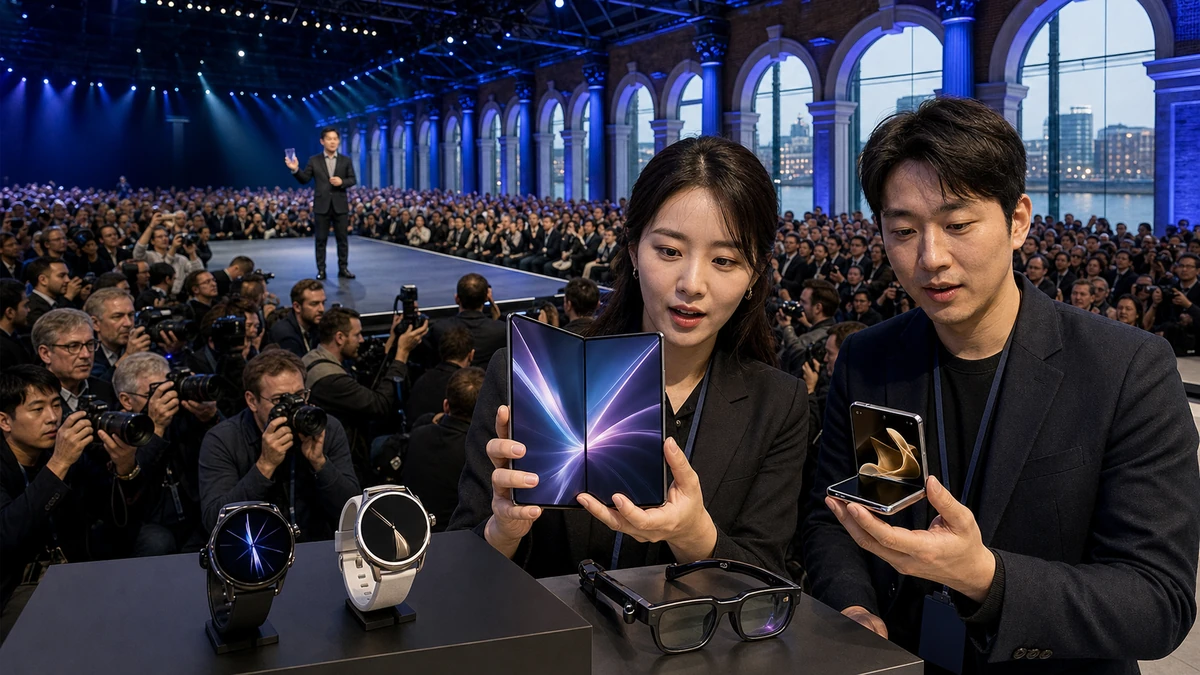
Samsung Electronics chose London, not Seoul, to unveil its latest wave of devices: the Galaxy Z Fold8, Galaxy Z Fold8 Ultra and Galaxy Z Flip8, alongside new watches and a pair of smart glasses it called Intelligent Eyewear. On paper, that sounds like a standard product launch. In practice, the event was something larger — a carefully staged demonstration of how a South Korean company now sells not just gadgets, but a vision of how people might move through daily life with artificial intelligence woven across screens, rooms and wearable devices.
According to the Korean news agency Yonhap, about 1,200 journalists and influencers from around the world gathered at Old Billingsgate, a London events venue, to watch the presentation. Long lines formed outside well before the show began. When Samsung executive TM Roh took the stage, the crowd reportedly responded with cheers. New products drew applause and audible excitement, the kind of reaction that tech companies hope will ripple outward through social media clips, first-impression videos and breaking-news stories in dozens of languages.
For American readers, the scene may sound familiar. Think of the line outside an Apple keynote, the attention surrounding a major CES reveal in Las Vegas, or the way a blockbuster studio premieres a tentpole film to a room packed with critics, creators and influencers whose reactions can shape the narrative within minutes. That is the territory Samsung is operating in. The company was not merely introducing new hardware. It was turning a tech announcement into a global media event, one with the feel of a cultural happening as much as a business presentation.
That matters because South Korea’s global influence is often discussed through K-pop, Korean dramas and film. But the Korean Wave — often referred to by the Korean term “Hallyu” — has never been limited to entertainment. It also includes beauty, fashion, food and consumer technology. Samsung’s London launch was a reminder that Korean innovation, like Korean pop culture, now travels internationally with confidence, polish and a growing expectation of worldwide attention.
From a U.S. perspective, Samsung’s move also reflects a changed consumer landscape. Americans are used to Silicon Valley firms trying to define the future of personal technology. Increasingly, however, that future is also being shaped by companies from East Asia, where hardware ecosystems, display technology and mobile design have become intensely competitive. Samsung is one of the clearest examples. With this launch, it was signaling that the next contest in consumer tech may not be about a single hero device at all, but about who can make a whole network of devices feel like one seamless experience.
The real headline was not just the phones
The flashiest names at the event were the foldables. Samsung introduced three models in that category: the Galaxy Z Fold8, the Galaxy Z Fold8 Ultra and the Galaxy Z Flip8. Foldables occupy a distinctive niche in the smartphone market. Unlike standard slab-style phones, they open and close, changing both the size of the screen and the way users interact with it. In the United States, foldables remain more of a premium curiosity than a mainstream purchase for most consumers, but Samsung has spent years betting that they represent a serious direction for mobile computing rather than a gimmick.
Still, the London event suggested that Samsung does not want the story to stop at flexible screens. Also introduced were the Galaxy Watch Ultra2 and Galaxy Watch9, as well as the company’s smart glasses. Taken together, the lineup sent a clear message: Samsung is trying to present not one product category, but a broader computing environment built around the Galaxy brand.
That strategy is important because hardware launches no longer live or die on raw specifications alone. Bigger screens, thinner hinges, brighter panels and faster chips still matter, but those features are increasingly difficult to use as the sole basis for standing out in a crowded premium market. Instead, tech companies want consumers to buy into an ecosystem — a word now used so often that it can sound vague, but in this case it has a specific meaning.
When Samsung talks about a “Galaxy ecosystem,” it is describing a system in which multiple devices — phones, watches, televisions and wearables — are linked through shared software, data and AI features. In everyday terms, it means the technology is supposed to follow the user, not stay trapped inside one screen. A request started on a phone might continue on a watch. Information surfaced on a watch might appear on a TV. A smart glasses interface might eventually add another layer, putting notifications or AI assistance closer to a person’s line of sight.
That framing helps explain why Samsung revealed so many products on the same stage. The point was not only to showcase each device. It was to argue that each device makes more sense when seen as part of a connected experience. For consumers used to comparisons like iPhone versus Galaxy, or Apple Watch versus Galaxy Watch, Samsung appears to be pushing toward a different pitch: choose the network, not just the gadget.
Why London, and why this audience?
There is symbolic power in a South Korean company unveiling its latest mobile strategy in one of Europe’s major capitals before a crowd of 1,200 global media figures. Samsung could have chosen its home turf in Seoul, where it would have drawn patriotic enthusiasm and a strong domestic press corps. By choosing London, it emphasized something else: this was a message aimed first at the world.
Old Billingsgate, the venue for the launch, sits in a city long associated with finance, media and international business. For a company like Samsung, which operates across continents and depends on both local distribution and global brand prestige, London offers a neutral but high-status stage. It is far enough from Silicon Valley to signal independence from the American tech script, but central enough to attract journalists, creators and analysts from Europe, the Middle East, Asia and North America.
The composition of the audience is just as telling as the location. Yonhap’s account notes that journalists and influencers gathered together in the same room. That combination reflects the new media reality of consumer technology. A traditional reporter may file a story explaining corporate strategy, market implications and product positioning. An influencer may post an unboxing reel, a quick hands-on video or a reaction clip reaching millions within hours. Both help shape public perception, and companies now court both with equal intensity.
In that sense, product launches have become interpretation contests. The company presents the official message, but then hundreds of attendees immediately translate it for their own audiences. A British reviewer might focus on design. An American business reporter might emphasize competition with Apple. A Korean commentator may see it as a moment of national industrial pride. A lifestyle creator might frame it as a fashion-forward accessory story. Samsung’s job is to make sure all of those different reactions still orbit the same central idea. In London, that idea was connection — between devices, between settings and, above all, between AI tools and everyday habits.
For American readers, there is another layer worth noting. Korean companies increasingly understand that international launches are not just about selling abroad; they are about setting the agenda abroad. In entertainment, Korean acts learned long ago that global visibility can amplify domestic prestige and vice versa. Tech companies now operate in a similar feedback loop. A product celebrated in London, dissected in New York and clipped across TikTok or YouTube does not simply gain overseas attention. It returns to South Korea with enhanced legitimacy as a world-class brand narrative.
Samsung’s bigger bet: AI as a continuous experience
The phrase Samsung emphasized onstage, according to the Korean summary, was the “Galaxy ecosystem.” More specifically, the company described an AI experience that “smoothly extends” from the phone to the wrist and then to the living room television. That wording matters. It suggests Samsung wants to shift the AI conversation away from isolated features and toward continuity.
Over the past two years, AI in consumer tech has often been marketed through lists of functions: summarize this message, edit that photo, translate this call, rewrite this email, generate this image. Those capabilities can be impressive, but they also risk feeling fragmented. Many users quickly discover that the problem is not whether a device can perform a clever trick. The problem is whether the technology fits naturally into real life without making people think too hard about which device, which app or which interface they are supposed to use.
Samsung’s pitch appears designed to answer that frustration. Rather than treating AI as a collection of one-off tools, the company is presenting it as a layer that travels with the user. In theory, that means the technology should feel less like opening a special feature and more like moving through a familiar environment where assistance is always available in the right form factor. On a phone, that may mean the main screen in the hand. On a watch, it may mean glanceable information and health or communication prompts. On a television, it may mean a larger shared display in a family or social setting. On smart glasses, it may eventually mean a more ambient and immediate interface.
There is a reason companies across the industry are chasing this idea. The smartphone market, especially at the high end, is mature. Consumers keep devices longer. Breakthrough hardware alone no longer guarantees excitement. AI offers a new selling point, but only if companies can convince people it delivers meaningful convenience rather than buzzwords. By describing AI as something that moves fluidly across settings — from pocket to wrist to living room — Samsung is effectively arguing that the future value of technology lies in reducing friction between moments, not simply adding more capabilities to each device.
For Americans, this may sound comparable to the way Apple has long marketed continuity across the iPhone, Apple Watch, Mac and Apple TV. The difference is that Samsung is using foldables and emerging wearables to suggest a somewhat broader range of physical experiences. A folding phone changes the shape of the screen itself. A watch keeps the interface on the body. Smart glasses, if they gain traction, would place information at the edge of human vision. The shared AI layer is what is meant to make these very different devices feel like pieces of one coherent system rather than disconnected experiments.
That said, the Korean report does not provide detailed specifications, pricing or release schedules, and those omissions matter. A sweeping ecosystem vision is easy to present on stage; it is much harder to deliver consistently in the hands of consumers. The test will not be whether the phrase “Galaxy ecosystem” sounded compelling in a keynote. It will be whether users find that device-to-device transitions actually feel smooth, useful and reliable in daily life.
What foldables mean in the American market
Samsung has spent years trying to turn foldable phones from futuristic curiosities into a durable premium category. The Fold line typically targets power users who want a tablet-like display that can still fit in a pocket, while the Flip line leans more compact and lifestyle-oriented, often appealing to buyers drawn to portability, design and nostalgia for the old flip-phone form. The introduction of a Galaxy Z Fold8 Ultra suggests Samsung is continuing to segment the foldable market, offering not just one foldable experience but multiple tiers within it.
That could be significant in the United States, where foldables have generated buzz but remain far from the default choice for smartphone buyers. Many Americans are intrigued by the concept yet still worry about price, durability, repair costs and whether the form factor truly changes how they use their phones. Samsung’s answer has been persistence: release new versions, refine the design, improve the hinge, strengthen the case for multitasking and make the category look less experimental with each cycle.
By pairing foldables with watches and smart glasses at the London event, Samsung may also be trying to reposition foldables within a bigger technological story. Instead of asking consumers to see the foldable alone as the future, the company is placing it at the center of a broader personal-computing system. In that framework, the foldable becomes less of a novelty and more of a command center — a larger mobile screen that anchors everything else around it.
This is where cultural context matters. South Korea has long been one of the world’s most wired societies, with high smartphone penetration, fast networks and a consumer base comfortable with early adoption. Companies like Samsung often develop and refine products in an environment where digital habits are deeply integrated into daily routines. When those products are introduced to American audiences, they encounter a different mix of expectations: a larger, more fragmented market, stronger carrier influence, different price sensitivities and a consumer culture that often balances enthusiasm for innovation with skepticism about whether new form factors are worth the cost.
Samsung knows that gap exists, which is one reason its international presentations matter. The company is not just showing a device; it is teaching audiences how to imagine using it. That is especially true of foldables, whose value proposition is not always immediately obvious if a customer has spent more than a decade with the same basic smartphone shape. Launch events help build the cultural script around the device: this is for multitasking, this is for entertainment, this is for creators, this is for fashion-conscious buyers, this is for AI-powered convenience. The more coherent that script becomes, the better Samsung’s chances of moving foldables from niche aspiration to more mainstream adoption.
From K-pop soft power to Korean tech influence
It is tempting for American coverage of South Korea to separate entertainment from industry: BTS and Blackpink in one category, semiconductors and smartphones in another. In reality, they often reinforce each other. South Korea’s modern global identity has been shaped by both cultural and technological exports, and each has helped create the conditions for the other to travel more easily.
The Korean Wave offers a useful reference point here. In American discourse, “K-wave” or “Korean Wave” often refers to the worldwide popularity of Korean music, television, film and food. But the broader concept is about the circulation of Korean brands, aesthetics and ideas across borders. Samsung benefits from that environment even when it is not directly tied to entertainment. A younger global audience already primed to see South Korea as trendsetting, design-forward and culturally influential may be more open to viewing a Korean tech launch as an event worth paying attention to.
At the same time, Samsung’s scale gives South Korea a different kind of global visibility — one rooted in industrial power. If K-pop demonstrated that Korean entertainment could shape global taste, Samsung and other major Korean firms demonstrated that Korean companies could compete at the highest level in hardware, displays, batteries and advanced manufacturing. The London event brought those two dimensions together in subtle ways. Its atmosphere — the crowd, the anticipation, the cheering, the influencers documenting everything in real time — resembled the emotional energy often associated with pop-cultural events. But the object of attention was a suite of connected devices and an AI strategy.
That blend is increasingly characteristic of the 21st-century global economy. Technology is no longer sold purely as engineering; it is sold as identity, lifestyle and narrative. South Korea has become adept at exporting all three. A Samsung launch, then, is not just a business story. It is also part of a broader story about how Korean institutions — from media companies to electronics giants — have learned to capture international attention in an era when attention itself is a strategic asset.
For U.S. audiences, this is a useful reminder that America’s closest Asian reference points should not stop at China and Japan. South Korea has become a major player not only in security and geopolitics, but in the consumer imagination. What happens at a Samsung stage in London can influence how Americans think about phones, AI and premium electronics just as surely as a hit Korean drama can influence what they watch next on Netflix.
The unanswered questions after the applause
For all the excitement in the room, launch-day enthusiasm does not guarantee long-term success. Applause, lines outside the venue and social-media buzz are indicators of attention, not proof of adoption. Samsung’s task now is to convert a strong narrative into a compelling real-world experience, and that is where the harder questions begin.
How well do these devices actually work together in practice? Does the AI layer genuinely reduce friction, or does it mostly repackage features consumers already find elsewhere? Are the foldables durable enough and affordable enough to expand beyond a devoted premium audience? Will smart glasses become a meaningful consumer product or remain an intriguing side project in a category that has repeatedly struggled to reach the mainstream?
Those questions matter because the promise Samsung is making is ambitious. It is not simply claiming that it has a better phone. It is claiming that it can organize everyday digital life across multiple devices in a way that feels smooth and natural. That is a much bigger promise, and consumers are often quick to notice when seamless demos become messy realities.
Yet the London event also showed why Samsung remains one of the few companies capable of making that promise credibly. It has breadth: phones, watches, TVs, chips, displays and now wearable experiments that extend beyond the wrist. It has global distribution. It has brand recognition that reaches far beyond Korea. And it has years of experience trying to push hardware categories, especially foldables, before the rest of the market fully catches up.
What happened in London, then, was more than another product cycle checkpoint. It was a snapshot of where the global tech industry is heading: away from single-device stories and toward systems; away from raw hardware bragging and toward AI-assisted continuity; away from launches aimed at one national market and toward spectacles designed to resonate instantly around the world.
Samsung used a London stage to tell that story, but the subtext was unmistakably Korean. A company that rose from South Korea’s industrial ascent is now trying to define how global consumers imagine the next phase of personal technology. Whether the Galaxy Z Fold8, Z Fold8 Ultra, Z Flip8, new watches and Intelligent Eyewear ultimately deliver on that vision remains to be seen. But for one afternoon in London, Samsung made clear that it intends to compete not just on devices, but on the very idea of what a connected digital life should feel like.
Comments
Post a Comment