SM Entertainment turns fandom into a 10K: Incheon event shows how K-pop is moving beyond the concert stage
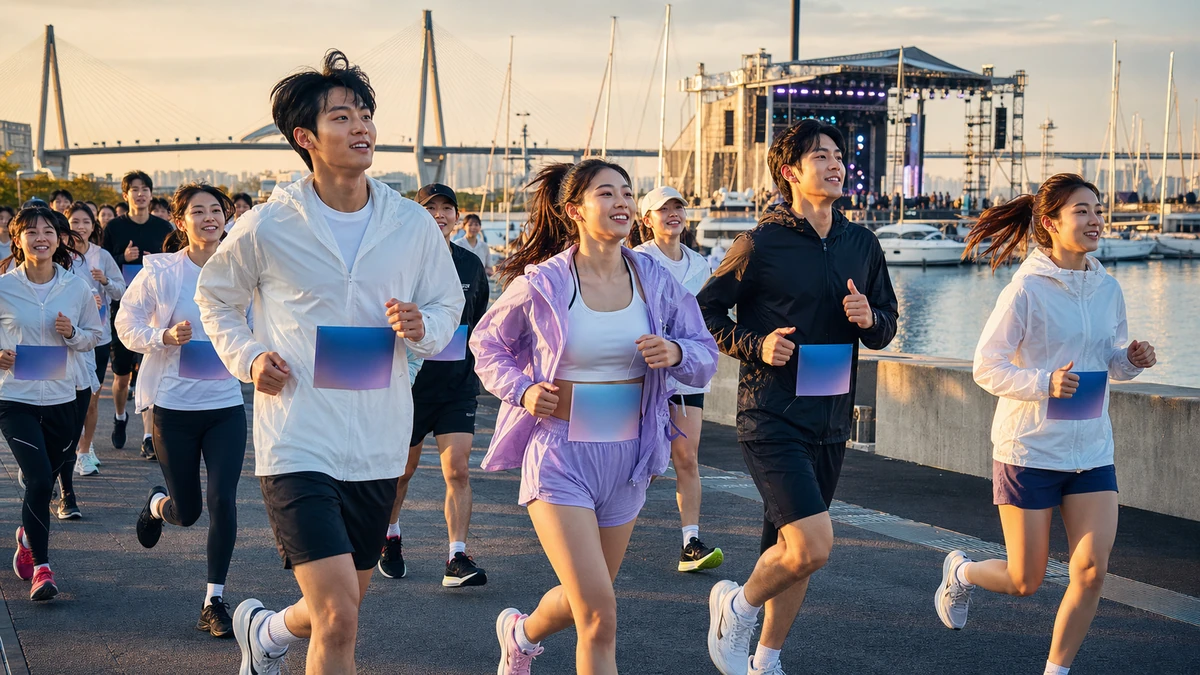
K-pop fandom heads to the starting line
For years, the basic rhythm of K-pop fandom has been easy to recognize, even for Americans who do not follow the genre closely: fans stream songs, trade photo cards, organize online campaigns, line up for merchandise and, when they can, pack arenas to watch impeccably choreographed live shows. What usually defines that relationship is a clear division of roles. Artists perform. Fans watch, cheer, sing along and document the experience for social media.
SM Entertainment, one of the most influential companies in South Korean pop music, is now testing what happens when that script changes. The company said it will hold a 10-kilometer running festival called “SMTOWN RUN CLUB 26” on Oct. 3 at Wangsan Marina in Incheon, west of Seoul. According to details released by the company and reported by South Korea’s Yonhap News Agency, the event will bring SM artists and fans together not just in front of a stage, but on the same race course. After the run, participants will stay for live performances by SM singers.
That may sound like a novelty — part road race, part concert, part fan event — but it also points to something bigger happening inside the K-pop business. For an industry that has long excelled at turning music into an all-encompassing lifestyle brand, the next frontier may be shared physical experience. In other words, the fan is no longer only a consumer of content. The fan becomes part of the event itself.
For American readers, one useful comparison might be the way music festivals, charity runs and creator-led fan conventions have increasingly blurred into one another. Imagine if a major pop label staged a 10K with its artists in the morning and then turned the finish line into a live showcase in the afternoon. It would feel unusual in the United States, but not entirely out of step with a broader entertainment economy that rewards community, wellness branding and social-media-friendly participation. In South Korea’s K-pop scene, where fan culture is already highly organized and deeply communal, the idea may be even more potent.
The event’s premise is straightforward. Participants will start at Wangsan Marina, run past Wangsan Bridge and return to the marina along a 10-kilometer route. The finish line is not the end of the day. It leads directly into a music performance featuring SM artists. That sequencing matters. The run is not a warm-up act before the “real” attraction begins. By placing the race first and the concert afterward, SM is making the run itself the centerpiece of the festival.
Why this is more than a quirky promotional event
SM describes the gathering as its first offline running festival where artists and fans run together. In a business built on closeness but also carefully managed distance, that distinction is significant. K-pop agencies have become experts at building intimacy at scale — through live streams, fan-sign events, behind-the-scenes content and tightly coordinated fan communities. But most of those interactions still happen within a controlled performance framework. Even when artists seem accessible, they are usually accessible as stars.
A road race changes the symbolism. A 10K is not casual. It asks for preparation, stamina and a willingness to share effort in public. On a concert floor, the relationship between artist and fan is still shaped by lighting, costumes, ticket tiers and stage design. On a running course, at least in theory, everyone faces the same distance, the same route and the same finish line. The appeal is not that celebrity status disappears. It does not. The appeal is that the event creates a temporary sense of common activity rather than one-way spectatorship.
That helps explain why the festival stands out even in a crowded K-pop market where agencies constantly search for new ways to deepen loyalty. Fans have grown used to comeback showcases, pop-up stores, online memberships and global livestream events. What “SMTOWN RUN CLUB 26” suggests is a shift from asking, “What did the fan watch?” to “What did the fan do together with the artist?” In experiential marketing terms, that is a meaningful change. In cultural terms, it hints at a more participatory idea of fandom — one that is active, embodied and measurable.
There is also a practical reason the concept resonates now. Running has become a visible lifestyle trend across much of the world, including South Korea. In many cities, run clubs have become part fitness routine, part social network and part personal branding exercise. The modern run club is not just about athletic performance; it is about belonging. Photos from group runs, race medals and matching gear all translate easily into the image-driven ecosystems where K-pop already thrives. By attaching its “SMTOWN” brand to a run club format, SM is tapping into a broader global language of wellness and community.
That does not mean the company is abandoning the core mechanics of idol culture. Quite the opposite. It is expanding them. The finish-line concert ensures that the music remains central. The running festival becomes a new delivery system for the familiar emotional payoff of seeing artists perform live. The body is engaged first; the fandom feeling follows and, ideally for the organizer, intensifies.
From a London moment to an official festival
The roots of the event go back to a moment that was never originally presented as a formal festival. According to the Korean report, the idea grew out of what fans called “SM London Run,” a scene from July of last year in which SHINee member Minho ran through London with fellow SM artists who were there for an SMTOWN concert. That image — artists from the same label, across generations, running together in a major world city — drew attention among fans and became a talking point beyond the performance itself.
Minho is an especially fitting figure for that origin story. Even casual K-pop followers in South Korea know him as an idol closely associated with athleticism, competitiveness and variety-show stamina. His public persona has long included a reputation for being intensely energetic and physically driven, qualities that make a running-themed event feel less random than it otherwise might. But the key point here is not just Minho as an individual celebrity. It is that the London run involved a cross-section of SM artists, reinforcing the sense that this was an “SM family” moment rather than a one-off gimmick built around a single star.
That distinction matters because “SMTOWN” is itself a powerful brand concept. Much like a major American entertainment conglomerate bringing multiple acts under one umbrella event, SMTOWN represents more than any one group. It evokes a shared label identity spanning different generations of artists, from veteran acts to newer names. Using that collective brand for a running festival signals that SM is not simply selling a concert ticket or a fan meeting. It is selling membership in a larger cultural community.
In London, the run was symbolic — artists on tour creating a memorable offstage moment. In Incheon, that symbolism is being turned into a structured public event where fans can participate directly. That is often how modern fandom economies evolve. A spontaneous or semi-spontaneous moment catches attention online, fans attach meaning to it, and a company then builds a formal experience around the emotional energy that moment created. What begins as a viral image becomes a commercial and communal platform.
For American audiences, it may help to think of the progression the way sports leagues or entertainment brands sometimes turn a behind-the-scenes tradition into a fan-facing event. Something that once belonged to insiders becomes part of the official calendar. The shift is not accidental. It reflects a recognition that fans increasingly want access not only to polished final products, but to the rituals, habits and lifestyle aesthetics that surround celebrities. Running, in this case, becomes one of those rituals.
Why the Incheon setting matters
The venue is also part of the story. Wangsan Marina sits in Incheon, the port city that serves as a global gateway to South Korea and is best known internationally for Incheon International Airport. For many visitors, Incheon is the first place they encounter the country. Holding the event there gives it a subtly outward-facing quality. Even when the immediate audience is domestic or regionally based, the location carries the feel of a destination event tied to Korea’s international image.
The course itself is designed with simplicity and cohesion in mind. Runners start at the marina, pass Wangsan Bridge and return to the same point. That start-and-finish structure matters because it keeps the entire day centered in a single shared space. In a typical concert, fans’ experiences can differ sharply depending on seat location, ticket access or proximity to the stage. In a road race, the hierarchy is not erased, but the logic changes. The common denominator is completion of the course. Everyone begins at the same line and aims for the same finish.
That physical setup reinforces the event’s message. The run is not happening somewhere offsite before fans are bused to a separate concert hall. The race and the performance are linked through place as well as schedule. The marina becomes the anchor for the whole experience: anticipation at the start, exertion on the course, satisfaction at the finish, then celebration through music. From an event-design perspective, it is a neat narrative arc.
There is also a symbolic appeal to a marina setting. Waterfront venues often carry a sense of openness and spectacle, and they photograph well — an increasingly important consideration in any event aimed at digitally active fan communities. K-pop agencies understand that fans do not just attend events; they document them, remix them and redistribute them. A scenic course and a shared finish area can help turn the day into a stream of user-generated content that extends the event’s reach far beyond those physically present.
What has not been confirmed, at least based on the information released so far, is which specific artists will perform after the race, how many participants will be allowed or what the detailed logistics will look like. That uncertainty is important to note. In K-pop coverage, speculation can quickly harden into rumor, especially when fan anticipation is high. For now, the clearest confirmed facts are the date, the location, the 10-kilometer format and the promise of post-race stages by SM singers.
A changing definition of what a fan does
One of the most revealing aspects of this event is what it says about the evolution of fan labor and fan identity. In K-pop, fans already do a great deal of organized work: they coordinate streaming drives, translate content, fund birthday ads, support chart campaigns and manage community projects with a level of discipline that would be familiar to political organizers or sports booster clubs. “SMTOWN RUN CLUB 26” adds a more literal physical dimension to that culture of participation.
That matters because fandom in South Korea is often described from the outside as emotional or digital, but it is also highly material and embodied. Fans travel, queue, collect, decorate, chant and synchronize. The running festival extends that pattern. It asks participants not just to show up and feel something, but to move through space together. It creates a day structured around exertion, endurance and shared accomplishment, not simply admiration.
There is a delicate balance here. Entertainment companies must be careful whenever they frame fan relationships in especially intimate terms. The healthiest version of this event is not one that pretends artists and fans are personal friends in some exaggerated or unrealistic way. It is one that offers a concrete, bounded form of togetherness: we are all here, on this day, doing this course, then enjoying this music. That is a more grounded form of connection than the vague promise of constant closeness that often drives parasocial culture.
Seen that way, the event’s strongest idea may be its clarity. Fans run 10 kilometers. They finish. Then they watch a performance. The structure avoids some of the ambiguity that can surround fan marketing language. Instead of selling a feeling alone, it sells an itinerary. Instead of telling fans they are “part of the journey” in an abstract sense, it gives them a literal journey to complete.
American entertainment companies have flirted with similar forms of immersion, from branded wellness retreats to fan cruises to influencer fitness events. But K-pop has a particular advantage in this area: the fan base is already accustomed to collective identity and organized participation. In that context, a run club is not a radical departure so much as a natural extension. It turns a fan community into a temporary athletic community while keeping the music at the center.
The business logic behind the finish line
From a business perspective, the event fits neatly into the larger evolution of the K-pop industry. Agencies are no longer just record companies in the traditional sense. They are intellectual property managers, event organizers, merchandise sellers, digital-platform operators and lifestyle brand architects. Every successful K-pop company is, in effect, trying to answer the same question: how many parts of a fan’s day, and how many forms of a fan’s identity, can the brand meaningfully occupy?
A running festival is a clever answer to that question. It reaches beyond listening habits into wellness culture. It opens opportunities for branded apparel, event partnerships and social-media storytelling. It gives artists another way to express personality beyond music releases and variety-show appearances. And it can appeal to fans who increasingly value experiences that feel active rather than passive.
The name itself — “RUN CLUB” — is also telling. A run club sounds social, recurring and community-oriented. It does not carry the purely competitive feel of a race series. Even if the event is built around a 10K course, the branding suggests inclusion and belonging more than speed. That aligns well with the Korean report’s emphasis on the shared, community-like image created by artists and fans participating together.
There is another layer here as well: the use of the “SMTOWN” umbrella rather than the name of any one group. That choice spreads the event’s appeal across multiple fandoms and generations of artists, and it reduces dependence on one headliner. It also allows the company to present the festival as an extension of the label’s collective identity rather than a niche side project. In the long run, that may be the more valuable play. Individual stars rise and fall, but a successful umbrella brand can create continuity across decades.
Whether this becomes a recurring model will depend on execution. Fans may embrace the novelty, or they may treat it as a one-time experiment. Much will hinge on which artists participate, how accessible registration is and whether the event feels meaningful rather than merely promotional. But even before those details are known, the concept itself says something useful about where K-pop is headed. The genre’s global expansion has never been only about exporting songs. It has been about exporting systems of participation.
What American audiences should watch next
For readers in the United States, the most interesting part of this story may not be the race itself, but what it reveals about the maturity of K-pop as a cultural industry. When a music company can credibly turn a backstage running moment into a public 10K-and-concert festival, it suggests a level of brand power that extends far beyond album sales. It means the company believes fans will show up not only for songs, but for a curated lifestyle experience attached to the songs.
That is a familiar pattern in American pop culture, where stars increasingly sell makeup, tequila, sportswear, books and wellness regimens alongside their primary work. What makes the K-pop version distinct is the collective structure. Rather than one celebrity building a personal lifestyle empire, a company like SM can mobilize an entire roster under a shared banner and fold fans into the ecosystem through ritualized participation. That is less like a single artist’s brand extension and more like an entertainment universe building new modes of entry.
The event also arrives at a time when K-pop companies are under pressure to keep fan engagement fresh without relying entirely on the old formulas of album versions, fan calls and stadium shows. The global fan base is larger and more diverse than it was a decade ago. Sustaining enthusiasm requires new formats. Some will be digital. Others, like this one, will lean into physical co-presence and the appeal of doing something memorable in the real world.
There are still open questions. Will the artists actually run alongside fans in a substantial way, or will their participation be more symbolic? How large will the event be? Will this format remain limited to South Korea, or could it travel internationally in some form? And if it succeeds, will rival agencies try something similar? Those are the kinds of questions worth watching because they point beyond one day in Incheon to a broader transformation in fan culture.
For now, what has been confirmed is enough to make the event notable. On Oct. 3, at Wangsan Marina in Incheon, SM plans to stage a 10-kilometer festival in which artists and fans share the same course before gathering for live music. In practical terms, it is a hybrid event: road race, fan gathering and concert. In symbolic terms, it is a sign that K-pop’s most important stage may no longer be only the one with lights and speakers. It may also be the route that leads to it.
Comments
Post a Comment