South Korea Tests AI ‘Guide Dog’ Robots in a Subway System, Aiming to Expand Mobility for Blind Riders
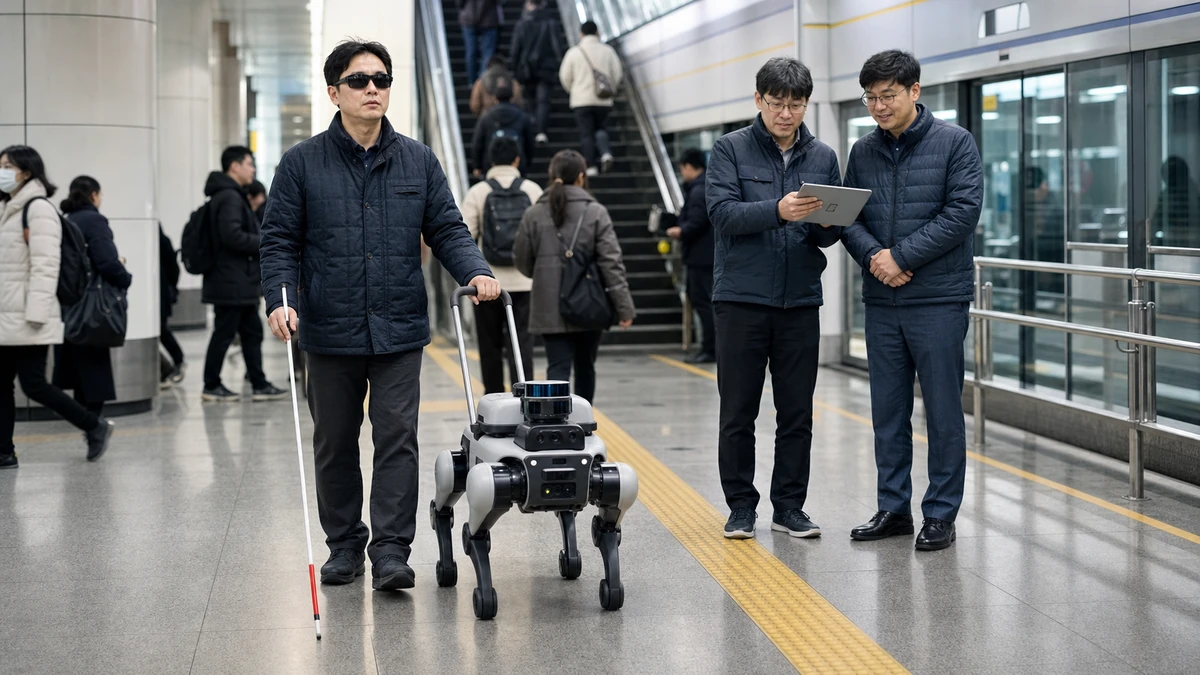
A subway station becomes a real-world lab
In South Korea, where futuristic transit technology often arrives in everyday life faster than it does in the United States, a new experiment is bringing artificial intelligence out of the lab and into one of the most ordinary — and challenging — public spaces: the subway station.
Officials in the central city of Daejeon said they will begin testing an AI-powered wayfinding robot designed to assist blind and visually impaired passengers inside two urban rail stations, Noeun Station and World Cup Stadium Station. The project is being carried out by the Daejeon Transportation Corp. in partnership with the Electronics and Telecommunications Research Institute, or ETRI, one of South Korea’s best-known government-backed technology research organizations.
The demonstration, scheduled for July 16, 2026, is not simply a robotics showcase. Researchers plan to evaluate whether the machine can perform in the messy, complicated environment of an actual working station, where passengers move through entrances, ticket gates, concourses, platforms and the critical boarding area between platform and train. That distinction matters. Plenty of robots can navigate a controlled hallway. Far fewer can handle the layered choreography of a public transit hub in real time.
For American readers, it may help to think of the challenge less as building a talking GPS device and more as creating a robotic mobility companion that can move with a rider through something as complex as a Washington Metro transfer station, a New York City subway platform or a busy BART concourse. In all of those places, spatial awareness is only part of the task. Timing, safety, crowd flow and constant environmental change matter just as much.
That is what makes the Daejeon test notable. South Korea’s subway stations are not being treated here as passive backdrops for a gadget demo. They are being used as living test beds for accessibility technology — spaces where the success of AI is measured not by novelty, but by whether it can help a person get from a street entrance to a train door safely and reliably.
What ‘guide dog’ means in this project
The Korean name for the research effort includes the phrase “guide dog,” but that can be misleading if read literally. The project does not involve replacing service animals with robot animals, nor does it refer to an actual dog-like machine. In this case, “Guide Dog” is the name of a research initiative focused on AI-based walking robots and the movement intelligence needed to accompany a blind or visually impaired user to a destination.
That nuance is important, especially for audiences outside Korea who may picture a mechanical Labrador trotting through a station. The idea is closer to a robotic guide system that physically accompanies a person and helps navigate a route. The emphasis is on assistance, not symbolism.
Researchers and transit officials have also been careful to frame the technology as a supplement to existing mobility support, not a replacement for guide dogs or human help. In South Korea, as in many countries, the number of people with visual impairments far exceeds the number of working guide dogs available. The gap has prompted growing interest in what technology can realistically do to expand options.
That mirrors a broader international conversation. In the United States, blind and low-vision riders often rely on a mix of tools: white canes, guide dogs, station staff, smartphone accessibility apps, tactile paving and audio announcements. None is a perfect solution in every setting. Service animals remain invaluable, but they are expensive to train and available only to a relatively small number of users. Human staff can help, but staffing levels vary and assistance may not always be immediate. Smartphone navigation works well outdoors in many cases, yet indoor navigation in large transit systems remains a stubborn problem.
The South Korean experiment sits squarely in that gap. The question is not whether a robot is more emotionally resonant or socially meaningful than a guide dog. It is whether an AI mobility device can add one more practical layer of support in places where independent travel is often difficult.
Why subway stations are such a hard test
A train station may sound like an obvious place to test navigation technology, but in practice it is one of the hardest indoor environments to master. A rider entering from street level must first identify the correct entrance, move through a gate line, orient within a concourse, find an elevator or escalator if needed, locate the right platform, position safely for boarding and then manage the gap and door alignment when the train arrives. Each step depends on the one before it.
That is precisely why Daejeon’s test has drawn attention. According to the project outline, researchers are not limiting the robot to a simple predetermined route. They want to see whether it can carry out a continuous, connected journey across several station zones used by real passengers. In other words, the goal is not merely to prove the robot can move. It is to prove it can guide.
The two stations selected for the demonstration will serve as data-rich experimental sites. Spatial information from inside the stations will be collected, and a test bed will be built to support the trials. That spatial data is foundational. For any navigation robot, especially in a crowded indoor setting where GPS is often unreliable or unusable, understanding precisely where it is and how the environment is structured is essential.
American transit systems have spent years grappling with similar questions. Agencies from Boston to Los Angeles have introduced tactile strips, improved signage, mobile apps and digital accessibility tools, but end-to-end indoor navigation for visually impaired passengers remains incomplete. The basic problem is that stations are dynamic environments. Escalators go out of service. Construction reroutes foot traffic. Temporary barriers appear. People cluster unpredictably near gates and stairs. Audio cues are inconsistent. A route that is technically correct may still be hard to use in practice.
That is why the Daejeon test’s focus on “real environment” verification matters more than the hardware alone. It suggests a shift from what engineers think should work to what transit riders actually experience.
The three capabilities researchers will be watching
Officials have highlighted three core areas the robot must prove in the field: walking performance, localization and route finding. Those terms may sound technical, but together they describe the fundamental building blocks of useful mobility assistance.
Walking performance is the most basic. The robot must be able to move stably and safely while accompanying a person through the station. That means more than rolling in a straight line. It must handle changing surfaces, turns, narrow passageways and the stop-and-go rhythm of public foot traffic. If a device cannot move smoothly beside a user through a station entrance, around other passengers and toward a platform, the rest of the system becomes irrelevant.
Localization refers to the robot’s ability to understand where it is inside the station at any given moment. For a human rider, spatial orientation might come from signs, memory, platform sounds or tactile cues. For a robot, it depends on sensors, mapped station information and software capable of matching live observations to a known environment. Without accurate localization, the robot cannot know whether it is at the gate line, near the stairs, approaching the platform edge or heading in the wrong direction.
Route finding is the third pillar. Once the robot knows where it is, it must determine how to get the user to a destination in the correct order: entrance to gate, gate to concourse, concourse to platform, and platform to boarding area. The challenge is not only selecting a path but managing a sequence of connected decisions in an environment where safety is paramount.
These capabilities are interdependent. Poor localization undermines route planning. Weak walking performance makes a correct route unusable. Strong movement without contextual awareness can create risk. The Daejeon demonstration is essentially a test of whether these separate functions can operate as one coherent service rather than as isolated technical achievements.
That distinction is likely to be familiar to Americans who have watched AI products excel in demos and then struggle in public settings. The real hurdle for emerging AI systems is often not a single feature but the integration of many features under unpredictable conditions. In that sense, the subway project is less about a flashy robot and more about systems engineering in the service of accessibility.
Why Daejeon matters in South Korea’s tech landscape
Daejeon is sometimes described as one of South Korea’s leading research centers, a city associated with science institutes, universities and government-backed innovation. For readers in the United States, it occupies a role somewhat comparable — though not identical — to a research-oriented regional hub where public infrastructure and state-supported R&D can intersect more directly than they often do in sprawling American systems.
ETRI, the research institute partnering on the project, is a major name in Korean information and communications technology. Its involvement gives the effort institutional weight. The Daejeon Transportation Corp., meanwhile, is not developing the robot itself. Its role is to support field testing by providing access to stations, spatial information and an operational environment. That division of labor is revealing. It reflects a model in which a public transit operator and a research institution collaborate to move a technology from prototype logic to practical use.
South Korea has built a reputation for rapidly integrating digital tools into daily life, from mobile payments and delivery platforms to smart city experiments and high-speed communications infrastructure. Yet accessibility technology often receives less international attention than consumer-facing innovation. This project stands out because it places disabled riders, rather than convenience for the average commuter, at the center of the technological question.
It also reflects a subtle but important shift in how transit innovation is defined. Much public discussion around rail technology focuses on speed, efficiency, ridership or automation of train operations. This demonstration asks a different question: not how fast people can move through a city, but how equitably they can access the system in the first place.
That may resonate well beyond Korea. In the United States, debates over transit modernization often revolve around infrastructure funding, delayed repairs, signal upgrades and service frequency. Accessibility is legally required under the Americans with Disabilities Act, but in practice it is still uneven, especially in older systems where elevators fail, platform access is limited or wayfinding remains confusing. A project like Daejeon’s suggests another layer of possibility: intelligent mobility support embedded within the rider experience itself.
Accessibility, not just efficiency
The most significant idea behind the Daejeon trial may be philosophical rather than technical. It treats accessibility as a central measure of transit quality. That sounds obvious, but public transit agencies around the world have not always designed systems around the lived experience of disabled riders. Too often, accessibility is addressed as a matter of compliance, retrofit or special accommodation rather than as a core part of everyday mobility.
By contrast, the AI guide robot project starts from the journey of a visually impaired rider. Can that rider move from station entrance to train boarding with confidence? Can a machine provide support not only by giving information, but by accompanying the person through physical space? That notion of accompaniment is especially important.
In many current navigation tools, assistance is informational. A phone app may announce direction changes. A station sign may indicate a platform. A map may display a route. But those tools still require the user to translate information into movement in a complex environment. A robotic guide attempts something different: it turns wayfinding into a shared physical process.
For Americans, a useful comparison might be the difference between being handed written directions in a busy airport and having someone walk you all the way to your gate. Both are forms of help, but they impose very different demands on the traveler.
That does not mean the technology is close to widespread deployment. The Korean announcement makes clear that this is a field demonstration, not a commercial launch. No public timeline has been given for full service introduction, operational rollout or broad station deployment. That caution matters. Tech reporting often blurs the line between prototype, pilot and product, creating unrealistic expectations.
In this case, the distinction is essential. A field test is where developers discover what breaks, what confuses users, what environmental variables were underestimated and what safety issues require redesign. Success in a demonstration may open the door to future service. It does not guarantee one.
What comes next — and what the rest of the world may learn
The next chapter in Daejeon will be written not in press releases but in performance data. Can the robot maintain stable movement through connected station spaces? Can it accurately recognize its position indoors? Can it select and execute a useful path all the way to the boarding zone? And just as importantly, how does the experience feel from the user’s perspective?
Those user-centered questions are likely to determine whether the technology evolves into a meaningful mobility tool or remains an interesting engineering experiment. A navigation system for blind riders cannot be judged only by precision metrics. Trust, predictability, comfort and ease of use matter too. A robot that is technically impressive but awkward or stressful to travel with may not become practical at scale.
There are also broader social questions ahead. If systems like this mature, how will transit agencies integrate them? Will they be available on request, station by station? Will public systems bear the cost, or will access depend on institutional partnerships and pilot grants? How will agencies handle maintenance, training, software updates and liability in crowded public spaces? Those are not side issues. They are often the difference between a promising demo and a durable public service.
Still, the Daejeon trial deserves attention because it captures something larger about the current phase of AI. Around the world, the conversation has often been dominated by chatbots, image generators and office productivity tools. This South Korean project points to another future — one in which AI is judged by whether it can help people move through the world more safely, independently and with greater dignity.
That is a far more grounded standard than hype usually allows. A subway station is not a speculative metaverse or a concept video. It is a place where people are rushed, distracted, tired and dependent on public systems that either work for them or do not. If an AI-guided walking robot can prove itself there, it may offer lessons well beyond Daejeon.
For now, what South Korea has announced is not the arrival of robot guides in every station. It is something more modest, and perhaps more meaningful: a serious attempt to test whether AI can support blind riders in one of the most demanding everyday environments modern cities create. If it works, even imperfectly, it could help reframe how transit agencies in Korea, the United States and elsewhere think about the future of accessibility.
And if it does not work, that too would be valuable. Field testing in real stations is supposed to expose limitations before technology is presented as a solution. Either outcome would offer a clearer picture of what AI can actually do for disabled riders, beyond the promises that so often accompany emerging tech.
In a moment when AI is frequently discussed in abstract terms, Daejeon’s subway experiment brings the conversation down to platform level. The measure of innovation here is not spectacle. It is whether a person who cannot rely on sight can enter a station, navigate its many thresholds and board a train with greater independence than before. That is a standard any city should understand.
Comments
Post a Comment