South Korean Education Officials Bring Six Universities Under One Roof in Jeonbuk, Offering Families a Rare One-Stop Admissions Guide
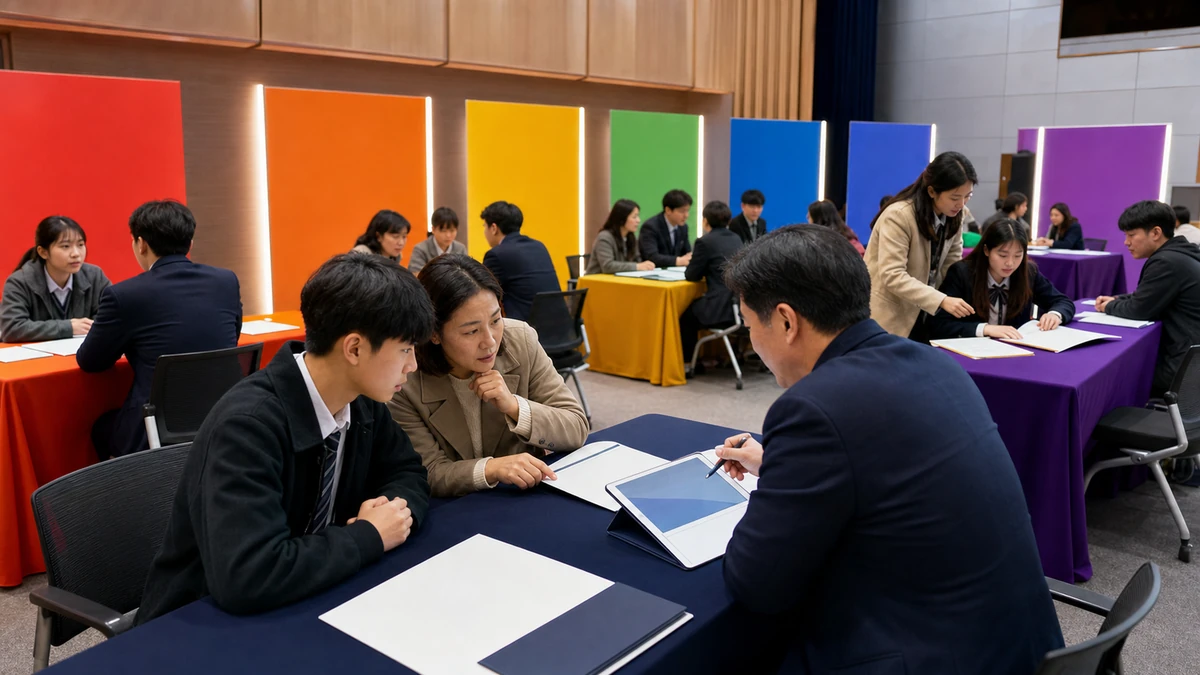
A regional college fair with a distinctly Korean purpose
In the United States, families preparing for college often think in terms of campus tours, school counselors, college fairs in convention centers and a long cycle of SAT prep, essays and financial aid forms. In South Korea, the process can look very different: more centralized, more test-driven and often more tightly connected to local education offices. That context helps explain why education authorities in Jeonbuk, a province in the country’s southwest, are drawing attention with a new admissions event that will gather six local universities in one place for students, parents and teachers.
The Jeonbuk State Office of Education said it will host an admissions briefing on July 25 for students preparing for the 2027 academic year, along with their families and school staff. According to the office, the event is designed not simply as a promotional showcase for colleges, but as a practical information hub where attendees can compare admissions tracks across multiple institutions and sit down for one-on-one consultations with admissions officers.
The participating schools are Jeonbuk National University, Kunsan National University, Wonkwang University, Jeonju University, Jeonju National University of Education and Woosuk University. For American readers, the lineup is roughly comparable to a state or regional education agency inviting a mix of public flagships, teaching-focused institutions and private universities to explain their admissions criteria side by side, all in a government-run venue rather than on a single campus.
That arrangement matters in South Korea, where access to accurate admissions information can shape not only where students apply, but how they organize their final years of high school. Korean college admissions can involve a combination of test scores, school records, interviews and school-specific application tracks. The details vary by institution and by major. In that environment, students often need far more than a glossy brochure or a general presentation. They need help understanding which path best fits their grades, interests and long-term goals.
What Jeonbuk officials are offering, then, is less a traditional college fair than a coordinated public service. The event reflects a broader role Korean education offices often play: not just overseeing schools, but serving as a bridge between families, teachers and the higher education system. By placing six universities in a single room and inviting admissions staff to speak directly with attendees, officials appear to be trying to lower the informational barriers that can make the admissions process feel opaque, especially outside the Seoul metropolitan area.
Why this matters in South Korea’s high-pressure admissions culture
To understand why a regional admissions session would merit notice, it helps to understand the weight college admissions carries in South Korea. The country’s education culture is famously competitive, and university entry remains one of the defining milestones of adolescence. The best-known symbol of that pressure is the annual College Scholastic Ability Test, or CSAT, known in Korean as the suneung, a single exam so consequential that flights are sometimes rescheduled to reduce noise near testing sites.
But South Korea’s admissions system is not just about one big exam. Universities operate multiple admissions tracks, and students may be evaluated through combinations of academic transcripts, standardized testing, essays, recommendations, extracurricular records and interviews. The Korean term jeonhyeong, often translated as “admissions track” or “selection process,” refers to these different pathways. For families unfamiliar with the system, or even for those who have been following it closely, comparing those pathways across several universities can be confusing.
That confusion is not limited to students. Parents are deeply involved in educational planning in South Korea, often to a degree that would feel intense even by American suburban standards. Teachers, too, play a significant role in counseling students about college choices, application timing and realistic admissions options. In many schools, a homeroom teacher or college-guidance teacher is expected to help students navigate a complex and evolving process. When an event includes all three groups — students, parents and teachers — it signals that college planning is being treated as a shared undertaking rather than an individual one.
Jeonbuk’s event also fits into a longstanding concern in South Korea over educational imbalance between the capital region and the rest of the country. Seoul and its surrounding areas dominate the national conversation on college prestige, private tutoring and academic opportunity. Regional governments and local universities have spent years trying to persuade students that they do not need to leave home to build a strong future. A well-organized, public-facing admissions event can serve both practical and symbolic purposes: It helps students make informed decisions while also highlighting local institutions as serious options, not fallback choices.
For American readers, the closest comparison may be the way some U.S. states try to steer students toward in-state public colleges by emphasizing affordability, local industry connections and scholarship opportunities. The difference is that in South Korea, the informational ecosystem is often more centralized and the social stakes attached to university decisions can feel sharper. An event like this is therefore not just informational housekeeping. It is an intervention in one of the most stressful parts of family life.
Six universities, one room and a chance to compare options directly
The clearest feature of the July 25 event is its format: six universities from the Jeonbuk region participating at the same venue, under the auspices of the provincial education office. That means students do not have to chase down separate information sessions, sort through scattered websites or rely solely on secondhand advice from private tutoring academies, known in Korea as hagwons. Instead, they can hear directly from each institution and compare what they learn in real time.
That side-by-side structure may sound routine to Americans used to college fairs, but in this context it offers something more targeted. Each university is expected to explain its admissions guidelines and core application strategies — not just who can apply, but how applicants should interpret the requirements. In practice, that can mean clarifying whether grades carry more weight than test scores in a certain track, what academic record is most competitive, or how students should think about aligning their interests with a program’s expectations.
For undecided students, the format creates a low-friction way to explore options. A teenager who has not settled on a school can sample multiple approaches without the pressure of committing to a single campus narrative. For students who already have a target in mind, the value may be more diagnostic: They can test whether their assumptions hold up when they hear a school’s criteria explained in detail, and they can use competing presentations as a benchmark.
The participating institutions bring a range of academic identities. Jeonbuk National University is one of the best-known public institutions in the province and often serves as a major local destination for students seeking a comprehensive university. Kunsan National University offers another national university option in the region. Wonkwang University and Jeonju University are private institutions with established reputations, while Jeonju National University of Education has a more specialized role in training future elementary school teachers. Woosuk University adds another private-university perspective to the mix. Together, the group gives students access to a spectrum of missions and admissions profiles rather than a single model of higher education.
There is also a subtle but important policy message embedded in the venue itself. Because the event is being held at the Jeonbuk State Office of Education rather than at one of the universities, the state is effectively positioning itself as a neutral convener. Instead of a school marketing to prospective applicants on its own turf, multiple schools are being presented in a common civic space. That arrangement suggests an effort to make admissions information feel more public, comparable and less filtered through institutional branding alone.
Beyond brochures: Why one-on-one counseling could be the most valuable part
Large presentations are useful for explaining the basics, but they rarely answer the question every family is really asking: What does this mean for us? Jeonbuk officials say attendees at the July 25 session will also be able to consult individually with admissions officers, a feature that may prove more important than the general talks themselves.
In college admissions, specificity is everything. A student may understand a university’s stated requirements and still have no idea how competitive a particular major is, whether a certain academic record fits a given admissions track, or what supporting materials deserve the most attention. A parent may want to know how realistic an option really is before investing time, money and emotional energy. A teacher may need clearer guidance to advise not just one student, but an entire class with varying goals. Those are not questions that can always be answered from a slide deck.
One-on-one counseling changes the value of the event because it turns information into application. It allows students to move from passive listening to active comparison. Instead of hearing that a university has several pathways for admission, they can ask which of those pathways best fits their own profile. Instead of wondering whether they should focus more on grades, subject preparation or extracurricular evidence, they can raise that question directly with someone inside the admissions process.
That is especially important in South Korea, where admissions language can sound technical and where small differences between institutions can have outsized consequences. A track that looks accessible on paper may favor a different student profile than families assume. A school’s public explanation may become much clearer when students are able to ask follow-up questions tied to their own circumstances. In that sense, the counseling component does more than reduce anxiety. It can improve the quality of decision-making.
Still, it is worth noting what such counseling cannot do. Admissions officers can explain policies, preferences and procedures, but they cannot make decisions for students. Nor can a single consultation erase the larger uncertainties of the admissions race. The Jeonbuk education office appears careful on that point, framing the event as a way to help students build a strategy that suits them, not as a shortcut to acceptance. That distinction matters in a culture where educational advice can sometimes be treated like a competitive asset to be acquired at all costs.
Parents and teachers are not bystanders in the Korean system
One of the more revealing details of the Jeonbuk announcement is who the event is for: not only students, but also parents and teachers. To American audiences, that might sound like a standard outreach line. In South Korea, it is a recognition of how college planning actually works.
Parents in Korea are often closely involved in education from early childhood through high school graduation, sometimes coordinating after-school tutoring, academic planning and test preparation with remarkable intensity. Conversations about major choice, commuting, dorm life, financial considerations and long-term job prospects are usually family conversations, not private decisions made by a teenager alone. By inviting parents into the same room as students and admissions officers, the education office is acknowledging that many of the most practical admissions decisions are made collectively.
Teachers occupy an equally significant role. Because Korean high schools often provide structured guidance on academic records and college placement, teachers are expected to keep up with changing admissions rules and help students interpret them. That is not easy when a single teacher may be advising students pursuing very different kinds of institutions and majors. Bringing several universities together can therefore help teachers update their knowledge efficiently and then carry that information back into classrooms and counseling offices.
There is another benefit to that shared model: It reduces the risk that students, parents and teachers are working from different versions of the truth. In any admissions system, misunderstandings can multiply when information is relayed secondhand. A student hears one thing, a parent reads another online, a teacher recalls an older guideline, and confusion sets in. When all three groups attend the same briefing and have access to the same admissions personnel, the likelihood of mixed signals goes down.
That shared-information approach also reflects a broader philosophy of public education support. Rather than leaving families to navigate the admissions maze entirely on their own — or pushing them toward private counseling if they can afford it — the Jeonbuk office is trying to provide a common baseline of access. For rural and regional families especially, that can matter. Travel time, uneven access to elite private advising and differences in school resources can all shape who gets the best information first. A centralized event cannot eliminate those inequalities, but it can narrow them.
What this says about regional universities and local opportunity
There is a bigger story here than one day’s schedule. The Jeonbuk event points to a question that has become increasingly urgent in South Korea: how to sustain regional universities and convince young people that opportunity does not exist only in Seoul.
Like many countries with strong capital-city concentration, South Korea has struggled with the pull of the metropolitan center. Students often associate the Seoul area with prestige, jobs, networking and social mobility. That perception has contributed to a long-running drain of young talent from provincial regions. Local universities, in turn, have had to work harder to recruit students and demonstrate their relevance in a highly competitive market.
An admissions session that highlights six Jeonbuk universities is not, by itself, a solution to demographic or economic centralization. But it is part of the infrastructure of regional retention. It helps students understand what is available close to home, from teacher training to comprehensive public education to private-university pathways. It invites families to think concretely about fit, not just brand recognition. And it allows universities to present themselves in relation to one another, rather than as isolated institutions competing for attention in a fragmented information environment.
That matters because regional choice is often misunderstood. Choosing a local university is not necessarily a sign of lower ambition. For some students, it can mean lower living costs, family support, stronger ties to a local profession or a clearer path into a regional labor market. For others, a specialized school may align better with career goals than a more famous but less focused institution in a larger city. The more clearly students can compare these trade-offs, the more likely they are to make decisions grounded in evidence rather than status anxiety.
The education office’s emphasis on helping students understand local universities is telling. The operative word is not merely “apply,” but “understand.” In an admissions culture often dominated by ranking talk and social prestige, understanding implies a more deliberate process: knowing how a school evaluates candidates, what kinds of students thrive there and how one’s own preparation lines up with available pathways. That is the kind of information students need whether they ultimately stay in Jeonbuk or look elsewhere.
A practical model for making admissions information more public
It is easy to overlook events like this because they do not announce a major policy overhaul or a dramatic shift in admissions rules. But practical systems often matter most to families. What Jeonbuk is offering on July 25 is, at its core, an information service — one that tries to make a complicated process more navigable by organizing it around comparison, direct access and shared understanding.
The model has a few obvious strengths. It saves time by bringing multiple institutions to one site. It improves clarity by letting attendees compare admissions tracks in the same setting. It adds depth by including one-on-one consultations rather than relying solely on stage presentations. And it broadens the audience in a way that reflects how real educational decisions are made, with students, parents and teachers working from the same factual base.
For American readers, the lesson may be familiar even if the setting is not. College admissions systems are often criticized for being bewildering, unequal and heavily dependent on who has access to the best guidance. South Korea has its own version of that problem, shaped by its own academic culture and institutional structures. Jeonbuk’s event does not erase competition, and it does not simplify every variable students must weigh. But it does show one concrete way local governments can improve transparency without waiting for a national overhaul.
Officials in Jeonbuk have indicated they plan to continue offering admissions briefings in the future, suggesting the July 25 session is part of a broader effort to keep college information flowing to students rather than a one-off publicity event. The details of future programs have not been announced, but the direction is clear: more active involvement by the education office in connecting students with higher education options.
In a moment when many families in South Korea are trying to balance aspiration, cost, geography and uncertainty, that may be the most important takeaway. Sometimes the most meaningful educational reform is not a sweeping law or a new exam. Sometimes it is making sure students can walk into one room, ask good questions and leave with a clearer sense of where they stand.
Comments
Post a Comment