South Korea’s Soccer Leaders Face a Public Reckoning as Lawmakers Probe World Cup Failure and Federation Governance
A National Obsession Meets a National Inquiry
In South Korea, soccer is not just another sport on the weekend calendar. It is one of the country’s most visible sources of national pride, a rare institution that can unite generations, regions and political camps in a country often divided by fierce competition in nearly every other sphere. So when the men’s national team stumbled out of the group stage of the 2026 FIFA World Cup in North America, the fallout did not end with angry call-in shows, disappointed fans and a round of sports-page soul-searching. It reached the National Assembly.
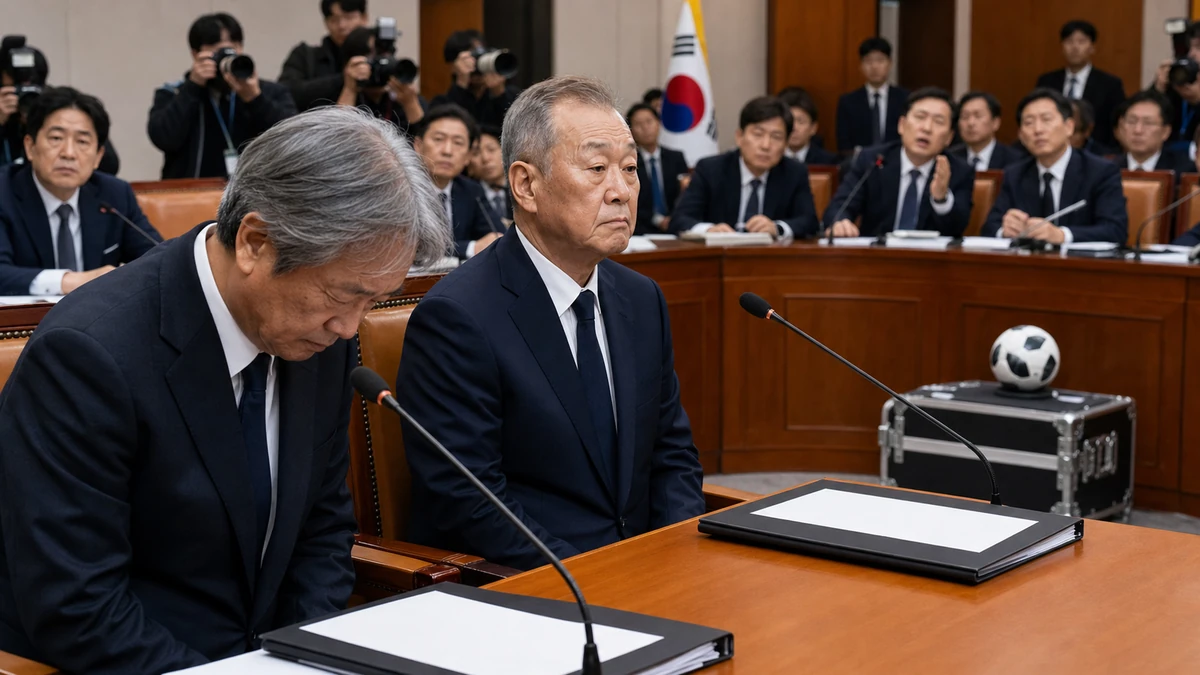
On Monday, South Korean lawmakers hauled senior figures from the Korea Football Association, or KFA, into a lengthy parliamentary hearing to answer questions about how the national team was run, how its coach was chosen and whether the organization at the center of one of the country’s most beloved sports has been operating with the kind of transparency the public now expects. Among those appearing as witnesses were Hong Myung-bo, the former national team coach and one of the most recognizable names in Korean soccer history, and Chung Mong-gyu, the former head of the KFA.
The hearing, held by the National Assembly’s Culture, Sports and Tourism Committee, lasted roughly 12 hours and turned into something broader than a postmortem on a bad tournament. Lawmakers focused on fairness in the process of appointing the national team’s manager, the internal administration of the KFA and what critics say is a culture of defensiveness inside Korean sports governance. Hong and Chung apologized for the World Cup disappointment, according to South Korean media reports, but largely denied the suspicions and allegations raised by lawmakers.
For American readers, the closest comparison may be a congressional hearing into U.S. Soccer after a catastrophic World Cup run, mixed with the kind of public anger that would follow a major NCAA governance scandal. But even that may not fully capture the emotional weight of the issue in South Korea, where the national team has long carried meaning far beyond the field. The result is that this week’s hearing was not just about tactics, substitutions or one failed tournament. It was about trust — in leadership, in procedure and in whether a sports organization can still claim to represent the public when the public believes it has stopped listening.
That distinction matters because, in modern sports, performance and governance are increasingly inseparable. Fans may first notice the score line. But they quickly begin asking who made the decisions, how those decisions were made and whether the people in charge are accountable when things go wrong. That is the question now hanging over South Korean soccer.
Why This Matters So Much in South Korea
To understand why a soccer hearing became a national political event, it helps to understand the place the sport occupies in South Korean life. Baseball is also popular, and esports commands huge attention among younger audiences, but soccer has a special role as a symbol of the country abroad. Generations of South Koreans still remember the electric run to the semifinals of the 2002 World Cup, when the country co-hosted the tournament with Japan and the national team’s success became a defining cultural moment. Streets filled with fans in red shirts, the so-called “Red Devils” supporters became an iconic image, and the team offered a newly confident South Korea a chance to see itself as a serious player on the global stage.
That legacy has endured. National team matches are not viewed simply as entertainment; they are often wrapped up in broader ideas of discipline, merit, national prestige and international respect. In a country where exams, jobs and public institutions are often judged by exacting standards, sports organizations are also under pressure to show professionalism and fairness. When those standards appear not to be met, criticism can quickly become moral as well as managerial.
The hearing also reflects a familiar feature of South Korean public life: institutions are expected to answer directly, and often publicly, when trust breaks down. In the United States, sports controversies might play out through league investigations, independent reviews or media exposés. In South Korea, it is not unusual for lawmakers to step in when a matter touches a major public interest, especially one tied to national identity. That does not mean every hearing produces sweeping reform, but it does show that sports administration is not viewed as a private matter.
Lawmakers underscored that point by framing soccer as a “national sport,” a term that in the Korean context carries emotional and civic weight. The idea is not merely that many people like the sport. It is that the sport belongs, in a sense, to the public. The KFA therefore is being judged not only as an athletic organization but as a steward of something culturally shared.
That is why the hearing’s central concern extended beyond whether the team lost. Even the best-run federation can fail at a World Cup. What lawmakers appeared to be asking was something more fundamental: Did the KFA act fairly? Were decisions made transparently? Were the right people consulted? And when criticism mounted, did officials respond with accountability or with denial?
The Coach Appointment Controversy at the Center
Much of the questioning focused on the process used to appoint the national team coach, an issue that has become a lightning rod for broader frustrations about Korean soccer’s decision-making culture. In elite sports, head coach appointments are never just technical choices. They reflect a federation’s priorities, its appetite for reform, its willingness to consult outside voices and its confidence in its own internal process. In South Korea, where personal networks and organizational hierarchy can be especially influential, questions about a coaching appointment can quickly become questions about favoritism and closed-door governance.
Hong Myung-bo is not a marginal figure in this debate. He is one of the most famous players in South Korean soccer history, remembered internationally for his role in the 2002 World Cup era and domestically as a highly visible football figure whose name carries enormous symbolic weight. That prominence cuts both ways. Supporters may see experience and prestige; critics may see a system that recycles familiar faces rather than building an open, modern selection process.
At the hearing, lawmakers pressed witnesses on whether the coach appointment was handled fairly and whether the federation’s internal processes were credible. According to reports, Hong and Chung rejected many of the suspicions surrounding the appointment and the broader management of the team. But even where allegations are denied, the political damage can already be done if the public concludes that the process was opaque or insulated from meaningful scrutiny.
That dynamic will sound familiar to American readers who have watched controversies unfold around coaching searches at powerhouse college programs or executive hires in major sports leagues. Often, the argument is not strictly about whether the eventual choice was qualified. It is about whether the process was transparent enough to command confidence. In sports, as in politics or business, legitimacy increasingly depends not only on outcomes but on visible fairness.
The World Cup disappointment sharpened those concerns. A poor tournament run tends to expose every unresolved tension that existed before the opening match: player selection disputes, tactical disagreements, factional politics and administrative mistrust. What might have remained an insider complaint in a successful year can become a national grievance after a humiliating exit. The KFA is now dealing with exactly that phenomenon. Its critics are not simply litigating one decision. They are asking whether the system itself needs to change.
More Than the Scoreboard: Governance Under Scrutiny
One of the clearest themes to emerge from the hearing was that South Korea’s soccer crisis is being framed less as a sporting slump than as a governance problem. That distinction is important. Teams lose for many reasons — injuries, tactics, form, luck. Governance failures, by contrast, suggest something more structural and more durable. They imply that the people running the institution may be undermining the conditions required for long-term success.
Lawmakers questioned not only the national team’s management but also the federation’s broader administrative practices, including internal operations and even officiating-related issues. Some of the controversy centered on how association officials answered questions and whether their demeanor reflected a willingness to engage sincerely with criticism. In a political environment where public apologies are common but often judged by their perceived sincerity, tone matters almost as much as substance.
That may be especially true in South Korea, where trust in institutions can be fragile and where the public often responds strongly to signs that elites are closing ranks. A hearing that produces apologies but also repeated denials can leave two competing impressions at once: acknowledgment that the result was unacceptable, and refusal to accept responsibility for the decisions that may have contributed to it. That combination rarely satisfies angry fans.
The broader issue is whether the KFA has kept pace with global expectations for sports governance. Around the world, football associations are increasingly judged not only by results but by how professionally they are run. Questions of independent oversight, conflict management, transparency in hiring and communication with supporters are no longer side issues. They are part of competitive strength. A federation that cannot earn trust internally may struggle to build a stable, high-performing environment for players and coaches.
American readers have seen variations of this in Olympic federations, college athletics and even professional leagues. Governance scandals can erode morale, sour sponsor relations and alienate the public long before they are fully resolved. They also have a way of narrowing the pipeline of talented people willing to serve inside the institution. If coaches, former players and administrators conclude that reform is impossible from within, the organization can become more insular over time — exactly the opposite of what a modern federation needs.
That helps explain why the hearing’s significance extends beyond a single cycle or a single chairman. It is part of a larger debate over whether South Korean soccer will be run as a modern, accountable public-facing institution or as a legacy organization protected by prestige, hierarchy and habit.
Hong Myung-bo’s Complicated Role in the Debate
Hong’s testimony drew particular attention because he occupies a rare place in Korean public life: part sporting hero, part establishment figure and part lightning rod for frustration. He reportedly argued during the hearing that the football community should not dismiss critical voices from soccer commentators and media personalities. At the same time, he suggested that those demanding change should also consider participating directly in the association and helping reform it from the inside.
That argument touches on a real dilemma in sports institutions everywhere. Outsiders often see problems clearly but lack access to the levers of change; insiders have access but may be constrained by organizational loyalty or inertia. Hong’s comments appear to acknowledge that criticism has legitimacy while also defending the idea that lasting reform requires engagement, not just denunciation.
Still, that stance can be read in sharply different ways depending on the audience. Supporters may view it as a practical call for collective responsibility. Critics may hear it as an attempt to deflect outside scrutiny by telling skeptics to stop complaining unless they are willing to join the machine themselves. In a moment of distrust, even constructive appeals can sound defensive.
Hong’s own stature makes the issue more sensitive. National sports icons often carry immense symbolic capital, especially in countries where landmark international achievements become part of national memory. But fame and legacy do not insulate a figure from demands for procedural accountability. If anything, they can increase expectations. When a revered former player becomes associated with an unpopular system, the backlash can be especially intense because it feels, to disappointed fans, like a betrayal of the values that made him admired in the first place.
That tension is visible in South Korea now. Hong is respected for what he gave the national team as a player and public figure. Yet his appearance at the hearing placed him in the uncomfortable position of representing not only a personal career but a governing culture under attack. Whether he emerges as part of the solution or part of the problem may depend less on his legacy than on whether the KFA demonstrates meaningful change in the months ahead.
What Korean Fans Want Now: Trust, Not Just Wins
For all the emotion surrounding the World Cup failure, this controversy is not simply about demanding better results next time. Fans want evidence that the federation understands why trust has frayed. In that sense, the hearing revealed something important about how sports audiences have changed. Today’s supporters are not satisfied with slogans about unity or vague promises to improve. They want a credible explanation of who made key decisions, what standards were applied and how accountability will work going forward.
That shift mirrors changes well beyond sports. South Korea is one of the world’s most digitally connected societies, and its public sphere is fast-moving, highly participatory and intensely skeptical. Fans do not wait for official press conferences to shape the narrative; they debate decisions in real time across YouTube, social media, online forums and sports talk programs. In that environment, institutions that respond slowly or defensively can look out of touch almost overnight.
The hearing also highlighted a deeper expectation that sports bodies must communicate with the public, not merely govern athletes and competitions. In effect, supporters are saying that a national team federation owes explanations to the nation. That is especially true when public funding, commercial sponsorship and national symbolism all converge in one place.
If there is a path forward for the KFA, it likely begins with accepting that administrative credibility is part of performance. The federation may need clearer hiring procedures, stronger governance standards, more open communication and a willingness to involve a broader range of expertise. None of that guarantees tournament success. But without those changes, every future setback risks reigniting the same suspicion: that the problem is not one coach or one campaign, but a system that has not earned the benefit of the doubt.
For South Korea, which has spent decades building itself into a global cultural and economic power, that is no small issue. The country’s rise has been fueled in part by institutions learning to meet world-class standards, whether in technology, manufacturing, entertainment or education. Soccer fans are now asking why the same standards should not apply to the sport that has so often carried the country’s name onto the world stage.
The Bigger Stakes for Korean Soccer’s Future
The immediate political theater of a 12-hour hearing will fade. What lasts will be whether the Korea Football Association changes in response. If it does not, this week’s testimony may be remembered as a missed opportunity — one more moment when public anger was absorbed but not answered. If it does, the hearing could mark a turning point in how South Korean soccer understands leadership, transparency and public trust.
The stakes are larger than one federation. Global sports today are fiercely competitive not just on the field but in administration, scouting, player development and brand management. Countries that want sustained success need institutions that are agile, credible and professionally managed. South Korea has the fan base, talent pool and football culture to remain a significant force in Asia and beyond. But that potential can be limited if governance becomes a recurring vulnerability.
There is also an international dimension. The 2026 World Cup, hosted by the United States, Canada and Mexico, was expected to showcase the ambitions of many Asian national programs on a larger-than-ever stage. For South Korea, an early exit did not just disappoint domestic supporters; it raised questions abroad about whether one of Asia’s most established football nations is evolving as quickly as the modern game demands. The aftermath now suggests that the answer may depend as much on boardrooms and committee rooms as on training grounds.
In the United States, sports fans are used to the idea that winning cures almost everything. In South Korea, winning matters deeply too. But this episode shows that something else is at work: a conviction that public institutions, including sports bodies, must be worthy of the loyalty they receive. That is why a bad World Cup did not stay a sports story. It became a governance story, then a political story and finally a cultural one.
South Korean soccer’s challenge now is not only to rebuild a team capable of competing at the highest level. It is to rebuild belief in the people and processes behind that team. Until that happens, every future coach appointment, roster controversy and tournament setback is likely to be viewed through the same skeptical lens. The question facing the KFA is simple, even if the answer is difficult: Can it become the kind of transparent, accountable institution that modern fans expect?
After this week’s hearing, that may be the most important match Korean soccer has left to play.
Comments
Post a Comment