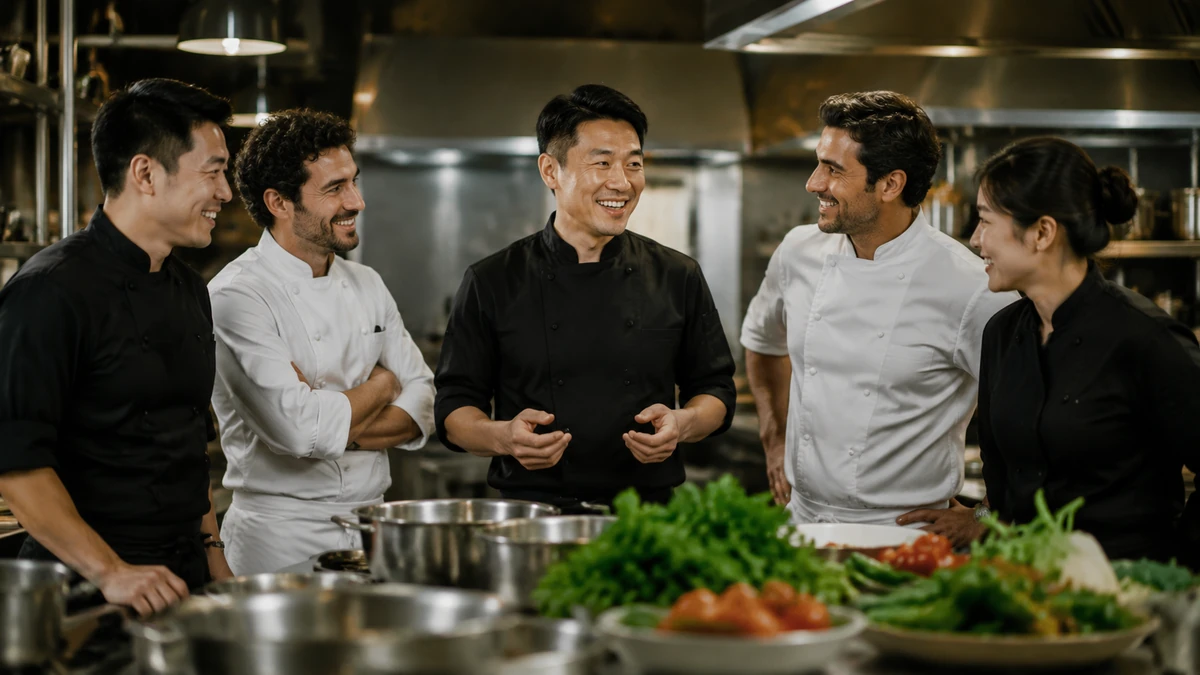
A Korean food reality hit is flipping its premise
South Korean cable network tvN says it plans to air a spinoff of its reality series “Undercover Chef” later this year, reversing the original show’s travel-and-labor formula in a way that could deepen the franchise’s appeal both at home and abroad. The network has not announced an official English title, a final Korean title or a specific premiere date. But it has revealed the central idea: cooks and senior kitchen staffers from restaurants in Parma and Naples, Italy, and Chengdu, China, will travel to South Korea, where the relationships formed in the first series will continue on new ground.
That premise may sound simple, but it marks a meaningful shift in how Korean reality TV — especially food-centered variety programming — is trying to tell stories. In the original “Undercover Chef,” prominent Korean chefs entered restaurants overseas in disguise, working at the bottom of the kitchen hierarchy as if they were junior employees. The tension came not just from whether they could complete missions, but from whether accomplished professionals could put aside their celebrity, adapt to a new workplace and earn trust in a foreign language. The spinoff turns that movement around. Instead of Koreans going abroad to prove themselves, the overseas kitchen veterans they once worked under will now come to Korea and experience the same dislocation, discovery and cultural negotiation.
For American audiences, the closest comparison might be a hybrid of “Parts Unknown,” “Top Chef” and workplace reality TV, but with far less emphasis on elimination and far more attention to how people learn to function together under pressure. If the original was about humility and adaptation, the new version appears poised to ask what happens when hospitality becomes reciprocal. The people who once set the rules will now be the visitors. The people who once struggled to keep up will, in some cases, become the hosts.
That reversal is one reason the project stands out in an entertainment landscape crowded with celebrity cooking competitions and fast-turnaround streaming food content. It is also part of a broader Korean television habit: taking a successful variety show concept and expanding it not only through new cast members or locations, but through emotional continuity. In this case, the continuity appears to come not from a format alone, but from human connections audiences already saw develop on screen.
Why the original resonated with Korean viewers
According to the network, the original “Undercover Chef” ended its run with a nationwide peak rating of 6.2%, based on Nielsen Korea data. In the United States, that number would need careful translation because the Korean TV market is smaller and operates differently, and because cable ratings often mean something different in Seoul than they do in Los Angeles or New York. Still, within the South Korean context, the performance was strong enough to signal that viewers had embraced the show’s tone and concept.
The appeal was not merely that recognizable chefs were thrown into unfamiliar kitchens. Korean viewers have seen plenty of celebrity-driven food programming over the past decade. Cooking shows are a durable part of the country’s entertainment economy, and chefs themselves have become public personalities, much the way celebrity restaurateurs and Food Network figures have in the United States. What distinguished “Undercover Chef” was the way it stripped status away. Well-known chefs such as Sam Kim, Jeong Ji-sun and Kwon Sung-jun entered foreign restaurants as the equivalent of kitchen rookies. In Korean workplace language, they essentially became the “maknae,” or the most junior person in the group — a role that carries not just less authority, but more errands, more scrutiny and more expectation to learn quickly without complaint.
That matters because hierarchy, mentorship and group dynamics are central to how many Koreans read workplace behavior, whether in offices, schools or restaurant kitchens. A cooking show in the United States might center individual flair, innovation or the bravado of a star chef. Korean audiences are often equally attuned to whether someone reads the room, respects seniority, handles discomfort gracefully and contributes to team harmony. “Undercover Chef” tapped into those expectations while setting them in an international context, where language barriers and different culinary traditions complicated every task.
As a result, the show worked on two levels at once. It satisfied viewers who enjoy watching skilled professionals pushed outside their comfort zones. But it also offered something gentler and arguably more lasting: a narrative about people from different countries learning how to cooperate through repetitive, unglamorous work. In restaurant kitchens, that means prep, cleaning, timing, communication and trust. Those scenes may not carry the flash of a televised cook-off, but they can reveal character in a way polished competition formats often do not.
The network’s decision to greenlight a spinoff suggests executives believe the emotional engine of the series was not suspense over who would win, but affection for the relationships that developed in those kitchens. That is a notable distinction. Spinoffs in reality TV often chase novelty. This one appears to be chasing continuity.
From Parma, Naples and Chengdu to South Korea
The places named for the spinoff are not random culinary backdrops. Parma and Naples are among Italy’s most recognizable food capitals, though in very different ways. Parma is associated with some of Italy’s most famous exports, including Parmigiano Reggiano and Prosciutto di Parma, and it evokes a tradition of regional precision and pride. Naples, of course, carries global weight as the birthplace of pizza and as a city with a famously vivid, often improvisational food culture. Chengdu, the capital of China’s Sichuan province, is known worldwide for flavors built around heat, fragrance and complexity, with dishes that have become familiar far beyond China, even if many American diners know only a simplified version of Sichuan cooking.
By bringing kitchen figures from those cities to Korea, the spinoff has the chance to do more than stage another travel show. It can explore how professionals rooted in iconic food traditions respond to Korea’s own deeply codified dining culture. South Korea’s culinary identity has become better known globally thanks to the spread of Korean barbecue, fried chicken, kimchi and streaming-era dramas that turn meals into visual events. But those entry points can flatten a cuisine that is also shaped by fermentation, seasonality, communal eating, etiquette and a distinctly Korean sense of balance between home-style comfort and restaurant specialization.
For viewers in the United States, imagine if seasoned pizza makers from Naples, a charcuterie expert from Emilia-Romagna and a veteran Sichuan line cook were suddenly dropped into a Korean culinary environment where the rules of service, the pace of prep, the language of deference and even the mechanics of sharing food at the table all require adjustment. The resulting friction would not necessarily be conflict in the dramatic reality-TV sense. More likely, it would come from small but revealing moments: who leads, who explains, who misunderstands, who adapts first and who becomes unexpectedly generous.
That may be exactly where the show sees its opportunity. In the original, Korean chefs had to interpret foreign kitchen cultures from the outside in. In the spinoff, the visitors will be reading Korea from their own perspectives. That opens room for a more two-way story about exchange — not simply Koreans admiring other food cultures, but outsiders encountering the norms, flavors and rhythms of Korean hospitality firsthand.
The power of relationships in Korean variety television
One of the more revealing details in tvN’s description is that the spinoff is built around people viewers already know from the first show. That is more important than it may appear. Korean variety TV often depends on chemistry, recurring dynamics and what fans sometimes describe as “narrative bonds” between cast members and guests. Audiences return not only for a concept, but to see how relationships evolve over time. In that sense, the new project sounds less like a reboot and more like a second chapter.
Producer Hong Jin-joo said the team hopes to deliver laughter and emotion again through what the network described as a “special bond” that crossed national borders. For U.S. viewers used to food TV that leans heavily on competition or prestige, that emphasis may be a little surprising. But in South Korea, it fits squarely within a powerful entertainment tradition: treating meals, travel and shared labor as vehicles for emotional storytelling. The joke, the setback, the awkward silence and the quietly supportive gesture can all matter as much as the dish itself.
This is part of why Korean unscripted television often travels well internationally, even when audiences do not catch every cultural nuance. Food and work are highly legible on screen. You do not need to speak fluent Korean, Italian or Mandarin to understand the meaning of a cook stepping in to help during a rush, a mentor correcting technique, or a once-intimidating colleague greeting an old teammate warmly in a new country. Those moments are visually and emotionally direct.
At the same time, the show’s use of the term “senior” kitchen staff — in Korean, the idea would typically map onto a sunbae-hoobae relationship, or senior-junior dynamic — carries a social dimension Americans may not immediately recognize. In South Korea, “senior” does not simply mean older or higher ranking. It also implies a relationship of guidance, responsibility, precedent and sometimes authority that extends beyond the immediate task. When Korean reports describe foreign kitchen “seniors” from the original series coming to Korea, the phrasing suggests those people were not just co-workers. They became figures of mentorship and reference within the story.
That makes the role reversal especially rich. If those senior figures arrive in Korea uncertain and disoriented, will the former juniors step up as cultural interpreters? Will the hierarchy soften? Will the emotional memory of their shared work abroad override the ordinary discomfort of being outsiders? Those questions are better television than a simple “Who cooked best?” challenge because they hinge on personality and reciprocity, not just technique.
Korean food TV is increasingly about exchange, not just export
The timing of the spinoff also says something about where Korean cultural exports are headed. Over the past decade, much of the global conversation around the Korean Wave — or hallyu, the term used to describe the international spread of Korean popular culture — has centered on music, dramas and, more recently, beauty products and fashion. Food has always been part of that story, but often as supporting texture. Kimchi appears in a drama. A celebrity eats ramyeon on camera. A travel show highlights a market stall. Increasingly, though, food programming is becoming a more intentional site of international storytelling.
“Undercover Chef” and its upcoming spinoff are notable because they do not treat foreign cultures as scenery. Nor do they present Korea simply as a destination to be admired. Instead, the format suggests a more reciprocal model: people from different culinary systems meeting each other through actual work. That is a subtle but important distinction. In some travel and food television, cultural difference becomes a spectacle. Here, based on the premise laid out so far, difference becomes a practical problem to solve together.
That approach may also help explain why these shows can connect with audiences beyond Korea, even when they are not made primarily for export. Americans have spent years watching food television become bigger, shinier and more competitive. There is room, of course, for high-stakes cooking contests and chef-driven documentaries. But there is also growing appetite for programs that treat food less as an arena of conquest and more as a language of everyday life. In that sense, the Korean format arrives at a moment when viewers may be especially open to stories about labor, belonging and cross-cultural curiosity.
The franchise also reflects a broader shift in Asian media representation. Rather than packaging “Asia” as a monolith for global consumption, the show is specific about regional differences: Parma is not Naples, and neither is Chengdu. Korea, likewise, is not just a generic East Asian setting. If the production follows through, the series could offer audiences a more textured understanding of how distinct food traditions interact without collapsing them into a single cosmopolitan blur.
What American audiences should watch for
Because tvN has not yet announced a title or broadcast date, any forecast about the spinoff remains provisional. But the concept alone offers several reasons to pay attention. First, there is the obvious entertainment value of reversal. Television loves fish-out-of-water scenarios because they create organic stakes. Viewers instinctively understand what it means to be competent in one setting and suddenly unsure in another. That narrative can be funny, tense and moving all at once.
Second, there is the question of how the series portrays Korea itself. When international guests arrive in a Korean reality program, the country can be framed in many ways: as modern and trendsetting, as traditionally rooted, as emotionally warm, as socially demanding or as all of those at once. The most compelling version of the show would resist tourism-poster simplifications and instead let the visitors encounter Korea through real routines — market trips, kitchen prep, staff meals, etiquette, time pressure and the texture of working life.
Third, the series could become a useful case study in how unscripted television builds soft power. Governments do not need to issue slogans when popular culture is already making everyday life legible and attractive. A cooking show that emphasizes teamwork across languages can do as much to shape perceptions of Korea as a glossy travel campaign. In the American context, where many viewers are familiar with K-pop or Netflix-era Korean dramas but less acquainted with Korean workplace culture or food service dynamics, that kind of programming can broaden the picture.
Finally, there is a quieter appeal that may prove most durable: watching people remember each other. In an era when many reality formats burn through cast members and concepts at high speed, there is something refreshing about a show that treats prior encounters as meaningful and worth revisiting. The central promise of this spinoff is not just novelty. It is reunion. The chefs and kitchen veterans are not strangers meeting for a one-off gimmick. They are colleagues of a sort, linked by a stressful, intimate environment that often builds bonds quickly.
If the original series asked whether accomplished Korean chefs could learn to be beginners again, the spinoff appears ready to ask a more generous question: what remains after the assignment ends? If trust was built in Italian and Chinese kitchens, can it survive translation into Korean space, Korean custom and Korean hospitality? That is not just a television hook. It is a recognizable human story, one that travels far beyond the specifics of any one cuisine.
A small announcement with bigger implications
On paper, tvN’s announcement was modest. No full title. No release date. No long cast list. Just a confirmation that a spinoff is in the works and that familiar overseas kitchen figures will come to Korea before the year is out. Yet even with those limited details, the project points to something larger in contemporary Korean entertainment: confidence in slow-burn storytelling, confidence in food as a serious cultural bridge and confidence that audiences care about what happens after the headline premise has been exhausted.
That may be the most promising sign of all. Too often, reality TV assumes viewers only want escalation — harder challenges, louder conflict, more dramatic twists. The “Undercover Chef” spinoff appears to be betting on a different instinct. It is betting that viewers want to see what happens when people who met through work carry that connection forward, across borders and into each other’s worlds.
In a media environment saturated with one-click global access yet still marked by misunderstanding across cultures, that is a bet worth watching. Whether the new series becomes a domestic ratings hit, an international streaming curiosity or both, its premise captures something timely: the idea that food television can do more than showcase taste. It can show how people negotiate difference without turning away from it. And in a franchise built on the humility of starting over in someone else’s kitchen, there may be no better next step than inviting those someone elses to return the visit.
Comments
Post a Comment