2PM’s full-group return in South Korea shows how a second-generation K-pop act still commands the stage
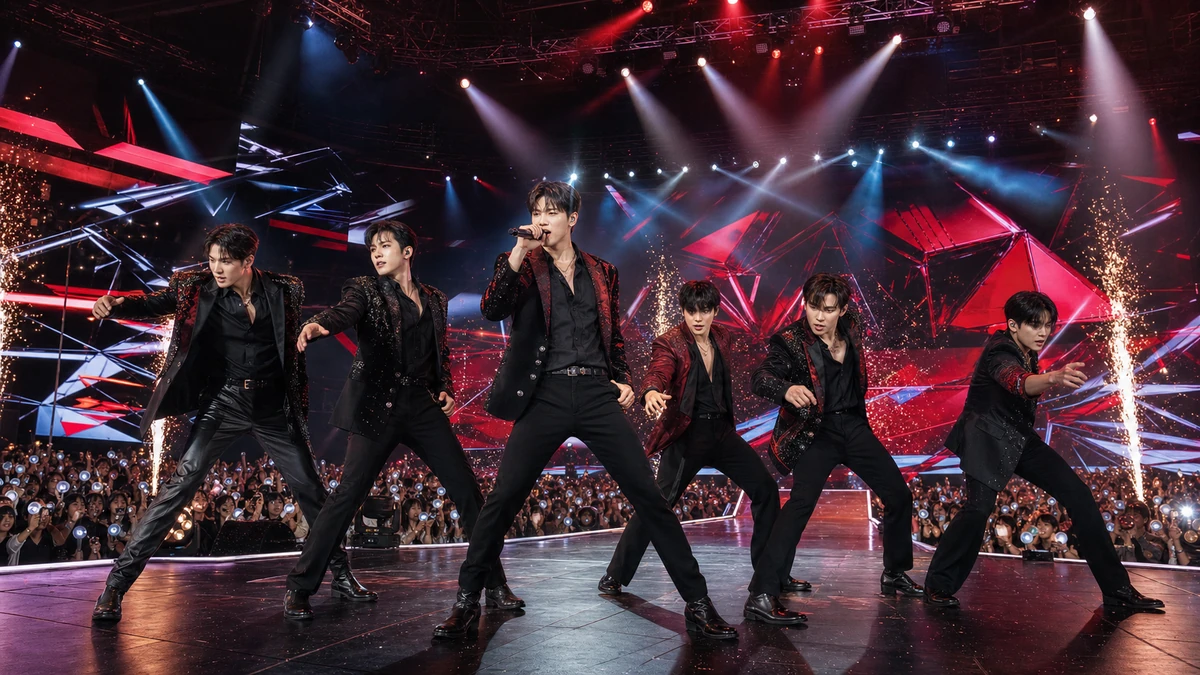
Image to help understand the article
A reunion concert that meant more than nostalgia
For many American music fans, reunion concerts usually come with a familiar script: a beloved legacy act returns, plays the hits, thanks the crowd and reminds everyone why those songs mattered in the first place. What happened this weekend in Incheon, South Korea, with the K-pop group 2PM looked similar on the surface. But in the context of Korean pop music, the group’s two-night concert, titled “The Return,” carried a more specific and revealing message. It was not simply a trip down memory lane. It was a public demonstration that one of K-pop’s defining second-generation boy bands still has real present-day pull.
2PM held the concert Saturday and Sunday at Inspire Arena in Incheon, marking the group’s first full-member concert in South Korea in three years, according to JYP Entertainment. For casual U.S. readers, that “full-member” distinction matters. In K-pop, fans often use the term to mean all members of a group are appearing together rather than promoting in partial units or as soloists. In an industry where military service, acting careers, solo music, hosting jobs and overseas schedules frequently pull members in different directions, getting all six members back on the same domestic stage is an event in itself.
The timing added another layer. This year marks 18 years since 2PM’s Korean debut, an unusually long run in an industry better known for rapid turnover, tightly packed comeback cycles and intense competition from younger acts. The group also noted that it is marking 15 years since its debut in Japan, underscoring a rare kind of longevity: not just survival at home, but endurance across two of Asia’s biggest music markets.
In that sense, “The Return” was less a declaration that 2PM was starting over than proof that the group never entirely left the conversation. The concert’s real significance was that it compressed nearly two decades of K-pop history into two nights and asked a direct question: Can a veteran idol group still feel current, not just cherished? By most available signs, 2PM answered yes.
Why 2PM still matters in K-pop history
To understand why this concert drew attention, it helps to place 2PM in the broader K-pop timeline. American audiences often first encounter K-pop through globally dominant names such as BTS, Blackpink or newer chart-facing acts that circulate widely on TikTok and YouTube. But those groups arrived in an international marketplace that had already been shaped by earlier generations of Korean artists who built the infrastructure, fandom habits and touring models that K-pop now relies on. 2PM belongs to that earlier wave.
Debuting under JYP Entertainment, one of South Korea’s major entertainment companies, 2PM became known in the late 2000s and early 2010s for a more overtly masculine, performance-heavy image than many of their peers. At a time when K-pop boy bands were often associated with polished prettiness or youthful romanticism, 2PM pushed a different brand: acrobatic choreography, sharply defined stage charisma and a “beast idol” image, a Korean industry phrase used at the time to describe male performers with muscular, high-intensity appeal. That branding may sound dated to some American readers, but it was important in helping 2PM stand out in a crowded field.
Their breakthrough songs became milestones of an era. “10 Out of 10,” their debut single, introduced the group with youthful swagger. “Heartbeat” helped cement their identity through striking, dramatic performance. “Only You” showcased a more emotional side, while “My House” would go on to enjoy renewed life years after its original release, helped by a younger generation of fans rediscovering the song online. Taken together, those tracks tell a story not just of chart success, but of adaptation. 2PM has never been reducible to one concept, one season of popularity or one fan age group.
That matters because longevity in K-pop can be deceptive. A group may have a famous name and a catalog full of recognizable songs, but that does not automatically mean it still functions as a living act. Some groups become brands attached mainly to memory. Others remain active in a more meaningful sense: fans still show up, the performances still hold together and the music still creates new entry points for younger listeners. The difference is subtle, but in pop culture terms it is the difference between a museum exhibit and an ongoing franchise. Think of how some classic American acts can still fill arenas because the songs have stayed embedded in several generations at once. 2PM is operating in that lane within K-pop.
A set list designed to connect generations of fans
One of the most telling aspects of the Incheon concerts was the set list itself. According to the Korean report, 2PM performed songs including “10 Out of 10,” “Heartbeat,” “Only You” and “My House,” effectively mapping the group’s history through its music. That may seem obvious for an anniversary-style concert. Yet the point was not simply to play the hits. It was to arrange songs from distinct chapters of the group’s career so that older and newer fans could experience the group’s evolution in a single shared space.
That is a powerful mechanism in pop fandom. A fan who discovered 2PM at debut can hear “10 Out of 10” and be pulled back to the late 2000s, when K-pop’s global reach was still emerging and social media had not yet flattened the distance between Seoul and the rest of the world. A fan who came in later through “My House,” which enjoyed a notable resurgence years after its release, can move backward through the catalog and understand why 2PM mattered long before that viral rediscovery. In one arena, across one weekend, those audiences overlap.
From an industry standpoint, that kind of catalog has real value. Entertainment companies often talk about intellectual property, and in practical terms that means more than streaming counts or licensing deals. For a long-running group, hit songs become a form of durable cultural capital. A new act has to persuade the public in real time, often with one title track at a time. A veteran act with a strong catalog can activate layers of memory. Each song carries not just melody and choreography, but the life period when fans first heard it, the performances they remember and the online communities they joined around it.
That gives legacy K-pop groups an advantage that differs from novelty-driven buzz. If a new release does not dominate the cycle, they can still build emotional momentum by staging continuity itself. In 2PM’s case, the three-year gap since the last full-group domestic concert made the return feel scarce in a way that heightened demand. Scarcity can cut both ways. If too much time passes, a fan connection can weaken. But if the artists return with the right material and the performance still delivers, the wait becomes part of the emotional payoff. The delay turns into narrative.
The concert title, “The Return,” fit that logic. It did not suggest a rookie-style reboot or a desperate attempt to reintroduce the group from scratch. Instead, it framed the moment as the reactivation of a story already in progress. In American terms, it felt less like a pilot episode and more like a prestige series coming back for a new season after a long hiatus, with enough trust in the audience that it did not need to explain why the characters mattered.
The meaning of a full-group concert in Korean pop culture
For readers less familiar with South Korea’s entertainment system, the importance of a “full-group” show may need some explanation. K-pop groups are rarely static. Even when the brand remains intact, the members often maintain parallel careers in acting, solo music, variety television, endorsements and international promotions. For male artists, South Korea’s mandatory military service can also interrupt group activities for years. That makes time itself one of the biggest obstacles to continuity.
When a group reaches its late teens in career years and still reunites with all members on a Korean stage, fans are not only celebrating the music. They are celebrating coordination, durability and commitment. The concert becomes evidence that the group still exists as a functioning unit rather than a nostalgic label. This is especially important in an industry where fans invest not just in songs but in the chemistry, shared history and public relationship among members.
That relationship is often discussed in Korea using the idea of “complete group” activity, a term that does not have a perfect equivalent in American pop. Plenty of Western groups break up, reunite, tour and then disperse again. K-pop’s version is more serialized and more structurally managed. Fans track whether a comeback includes all members, whether choreography is adjusted, whether the group identity is being maintained in official promotions and whether the company is treating the reunion as a real chapter or a ceremonial appearance. In that environment, the difference between a partial comeback and a full-group concert is meaningful.
That is why the 2PM concert resonates beyond its immediate ticket buyers. It speaks to a broader question about what K-pop maturity looks like. The genre is no longer young enough to treat every veteran act as a relic. A growing number of groups now have careers long enough to test whether K-pop can support the kind of multidecade artist relationships long familiar in American music. Can fans age with a group? Can a catalog deepen rather than expire? Can a band built in the idol system still retain authenticity after years of individual careers and industry change? Events like this one suggest the answer may be yes.
The members’ own comments reinforced that point. They thanked fans and said that with each concert and each moment they are reminded how precious their audience is, adding that performing on stage and seeing fans is itself a source of luck and happiness. In entertainment press releases, gratitude is common enough to risk sounding formulaic. But with an 18-year group, those words land differently. They imply that the concert is not merely another stop on a routine promotional calendar. It is a chance encounter made possible by years of mutual maintenance between artist and audience.
Two markets, one long career
Another important detail from the Korean report is 2PM’s dual anniversary: 18 years since debuting in South Korea and 15 years since debuting in Japan. That three-year gap tells a larger story about how K-pop expanded regionally before it became a truly mainstream topic in the United States. Long before K-pop became a regular feature on American award shows and festival lineups, Japan was a crucial overseas market for Korean acts, often serving as the most durable and lucrative expansion path outside South Korea.
For a group like 2PM, sustained Japanese activity is not just a side note. It is a marker of institutional staying power. Artists who last in Japan for more than a decade are not surviving on one hit or a brief export wave. They are building a second fan ecosystem with its own memories, routines and concert expectations. That matters because long-term success in K-pop increasingly depends on whether a group can maintain meaningful ties across borders, not just go viral abroad once.
American readers may compare that to artists who maintain parallel careers in the U.S. and Latin American markets, or legacy acts that remain especially strong in Europe even when domestic radio attention fades. The point is not simply geography. It is the creation of multiple homes for fandom. A group with a durable base in more than one country is harder to write off as finished, because its relevance does not hinge on one local trend cycle.
In 2PM’s case, the Korean and Japanese timelines also reveal something about the earlier architecture of globalization in K-pop. Today, international fandom can form almost instantly through streaming, subtitled content and algorithmic discovery. For second-generation groups, overseas growth was often slower and more sequential. It required localization, repeated touring, language adaptation and years of consistent promotion. That 15-year Japanese run stands as evidence that 2PM did not merely benefit from K-pop’s rise. The group helped build the template for what sustained overseas K-pop activity could look like.
No new overseas tour or future schedule was confirmed in the summary of the Incheon concerts. Still, the existing record is enough to matter. An act that has spent nearly two decades in Korea and a decade and a half in Japan is not relying on hype alone. It is drawing on accumulated trust. For industry watchers, that kind of trust may be more valuable than short-term virality. It suggests a group can reconvene and still draw energy from a fan base that sees itself not just as consumers of a product, but as keepers of a shared history.
What this says about K-pop’s future, not just its past
The easiest way to misread a concert like this would be to slot it into the category of nostalgia content and move on. There is certainly nostalgia in 2PM revisiting songs that helped define different phases of its career. But nostalgia alone does not explain why these performances matter now. The more revealing interpretation is that K-pop has matured to the point where veteran groups can serve as tests for the industry’s long-term sustainability.
For years, critics of the idol system have argued that K-pop is built for speed: fast debuts, fast comebacks, fast visual reinvention and, too often, fast burnout. That critique is not baseless. The system can be unforgiving, and many groups disappear well before reaching the kind of career longevity associated with classic acts in the United States. But 2PM’s concert suggests another possibility. Under the right conditions, a K-pop group can evolve from a cycle-based idol act into something closer to a long-running pop institution.
That evolution depends on more than fame. It requires a catalog that spans styles, members with individual identities strong enough to sustain off-cycle careers and a fan base willing to treat reunion not as an epilogue but as an active present-tense event. It also requires performance credibility. A veteran act cannot coast on branding forever. The songs still have to work onstage. The chemistry still has to feel real. The audience has to believe it is seeing a living group rather than a contractual obligation.
By the account provided in South Korean coverage, “The Return” succeeded precisely because it checked those boxes without overstating its ambition. This was not billed as a grand industry reset or attached to a splashy announcement of an all-new era. Its achievement was more disciplined: it showed that 2PM’s identity remains legible and emotionally potent in 2026, nearly two decades after debut. In an entertainment economy obsessed with what is next, that kind of continuity can be quietly radical.
It also points to where K-pop coverage in the English-speaking world may need to grow. Too often, international reporting treats the genre as a pipeline of novelty, centered on the newest chart anomaly or viral breakout. That misses a significant part of the story. K-pop is increasingly producing legacy acts, not just sensations. As those groups age, their concerts become case studies in how fandom matures, how cross-border music industries stabilize and how artists survive beyond the hyper-compressed lifecycle that once defined the genre.
For fans, the return was also about recognition
At the emotional core of the Incheon concerts was a simple exchange: the artists recognizing the fans, and the fans recognizing the artists not as memories, but as present companions in a long relationship. That may sound sentimental, but it is central to how K-pop operates. Fandom in Korea and across Asia has often been more participatory and ritualized than what many Americans associate with pop stardom. Concerts are not just places to hear songs live; they are sites where years of emotional investment become visible through fan chants, coordinated light sticks, inside references and shared chronology.
When 2PM thanked the audience and called the act of performing and meeting fans a form of luck and happiness, they were acknowledging that this relationship cannot be taken for granted after 18 years. A rookie group’s concert is usually framed as a step toward proving potential. A veteran group’s concert is something else: a test of whether the bond endured. Every familiar chorus becomes a measurement of continuity. Every cheer becomes evidence that the connection survived the gap.
That may be the clearest takeaway from “The Return.” The concert showed that 2PM’s value today is not only in what the group once represented, but in its ability to reactivate that meaning in the present. The songs are older. The members are older. The audience, in many cases, is older too. But if the music still works, the performance still lands and the reunion still feels earned, then age does not diminish a pop group’s relevance. It changes the terms of it.
For American readers trying to make sense of why a two-night concert in Incheon matters, that is the answer. 2PM is not just revisiting its history. It is demonstrating that K-pop’s past can remain commercially and culturally alive when artists and fans continue to meet each other halfway. In a genre often defined by constant acceleration, there is something striking about a group proving its power through endurance. “The Return” was not merely a comeback. It was a reminder that in pop music, staying together long enough to mean something across generations may be one of the hardest achievements of all.
Comments
Post a Comment