
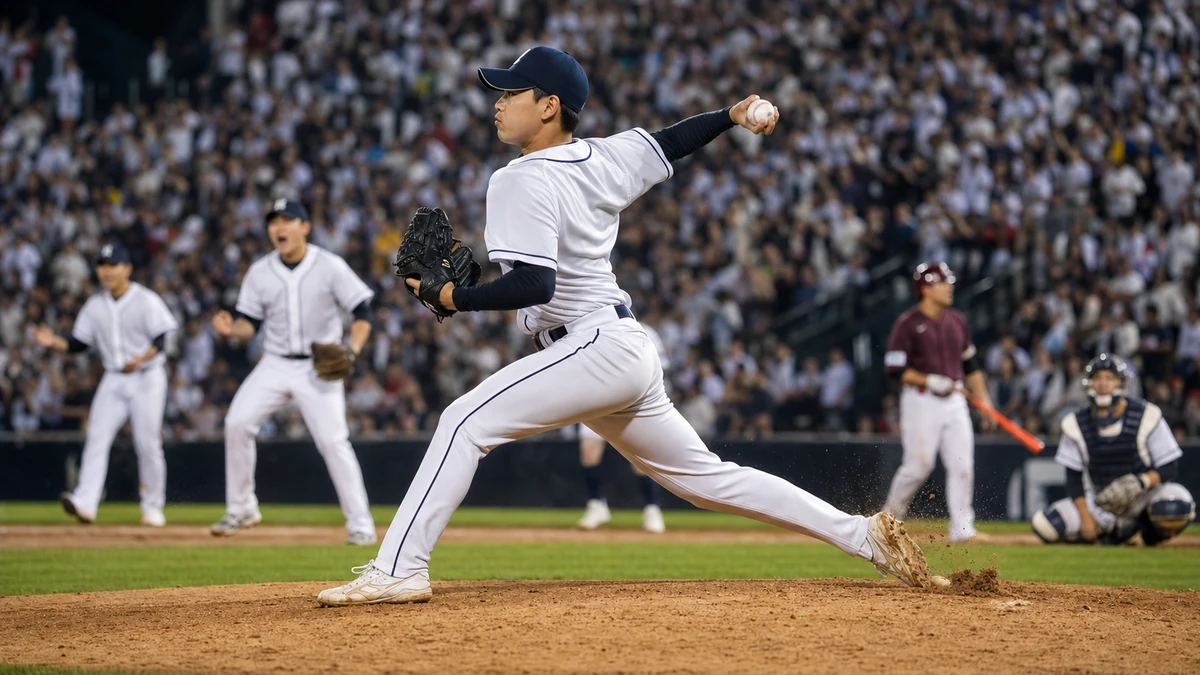
Image to help understand the article
A breakout night in Seoul was about more than one lopsided score
On paper, the result looked simple: the Doosan Bears beat the Kiwoom Heroes 15-1 on a late-season night at Jamsil Baseball Stadium in Seoul. But in the context of South Korean baseball, the game carried much more weight than a routine blowout. It showcased the rapid rise of 20-year-old starter Choi Min-seok, who held Kiwoom to one run over six innings and moved into sole possession of the Korea Baseball Organization, or KBO, lead in wins with 13. It also reinforced a formula that can decide playoff races in any country: reliable starting pitching, a lineup that strikes early, and enough depth to turn momentum into a rout.
For American readers, the easiest comparison is a young major league pitcher making the leap from prospect to pennant-race anchor almost overnight. Choi is still at an age when many pitchers in the United States would be in Class A, Double-A or perhaps making carefully managed innings-limited starts in Triple-A. Instead, he has become one of the central figures in a postseason push for one of Korea’s most tradition-rich clubs. The Bears, one of the KBO’s marquee franchises, are trying to hold onto fifth place, the final postseason spot, and every outing from Choi now carries implications not just for his own career but for the shape of the playoff field.
Doosan gave him support immediately. In the first inning alone, the Bears scored six runs, with Park Jun-soon opening the offense with a run-scoring double and veteran catcher Yang Eui-ji adding a two-run hit. Additional RBI knocks from Junior Severino, Cho Su-haeng and Jung Soo-bin turned what could have been a tense late-season game into a one-sided contest almost from the start. The Bears kept pouring it on with 16 hits and three home runs, including a two-run shot by Ahn Jae-seok, a towering two-run blast from Severino and a three-run homer by pinch-hitter Oh Myung-jin.
Still, the most important development was not simply that Doosan hit. It was that Choi used the kind of efficient, composed start that strong teams count on in September. He struck out five, allowed six hits and one walk, and gave up only a solo home run to Matt Davidson in the sixth inning before retiring the next three hitters. In a long season, that kind of outing does more than add another win to a pitcher’s record. It preserves the bullpen, settles the defense, and gives a team trying to survive the stretch run a sense that the game is under control.
That is what this night represented for Doosan: not a random offensive eruption, but a demonstration that the club may have found its most dependable path into October. And for the wider baseball audience, it was another sign that the KBO’s next generation is arriving in a way that deserves attention well beyond Korea.
Why Choi Min-seok’s rise matters in Korean baseball
South Korea’s baseball culture places enormous importance on the starting pitcher, perhaps even more visibly than modern Major League Baseball, where front offices often manage workloads aggressively and postseason games can turn into bullpen chess matches by the fifth inning. In the KBO, a young starter who can work deep into games and withstand pressure becomes a public figure quickly. Choi’s 13th win matters because it places him alone atop one of the league’s traditional benchmark categories, but the more revealing part of the story is how he got there.
According to postgame comments cited in Korean coverage, Choi said he has changed his approach as the season has unfolded. Earlier in the year, he tried to overpower hitters. More recently, he has focused on balance, command and throwing to spots without overexerting himself. That may sound like familiar pitcher-speak to American fans, but it is also one of the classic developmental shifts that separates throwers from pitchers. In other words, Choi is not just winning; he appears to be learning how to sustain winning.
That matters because his path to this point has not been perfectly smooth. After earning his ninth win on July 5 against Kiwoom, he did not immediately keep stacking victories. On July 24 against the Samsung Lions, he endured the roughest outing of his KBO career, allowing 10 runs in 2 2/3 innings, though only four were earned. Those kinds of starts can rattle a young pitcher. Instead, Choi responded by getting his 10th win on Aug. 13 against the Hanwha Eagles and then won his next two starts as well. He has now gone 4 for 4 in August appearances, turning a moment of vulnerability into a showcase of adjustment.
In the United States, a young pitcher’s maturation is often discussed through velocity readings, spin rates and biomechanics. Korean baseball certainly tracks those factors too, but there is still strong public emphasis on poise, rhythm and what Koreans often describe as game management. Choi’s outing against Kiwoom checked all of those boxes. He attacked the strike zone, worked ahead in counts and kept the game from getting complicated even after allowing a home run. For a 20-year-old on a playoff contender, that kind of calm can be as valuable as a radar-gun spike.
It also helps explain why his story is resonating. Korea has produced major league talent, from Chan Ho Park and Kim Byung-hyun to Hyun Jin Ryu, Kim Ha-seong and Lee Jung-hoo. Every time a young player begins dominating at home, there is immediate interest in what he might become and whether he could eventually be part of that broader lineage. It is too early to place Choi in that company, and nothing in this game alone proves he is future MLB material. But a 20-year-old leading the KBO in wins while refining his approach in real time is precisely the kind of profile that starts attracting attention from scouts, front offices and fans abroad.
What the Bears’ offensive explosion says about the playoff race
Doosan’s place in the standings gives this game an urgency that a casual reader might miss. The Bears are in fifth place, which in the KBO is especially significant because the league’s postseason structure rewards every rung on the ladder and makes simply getting in a major accomplishment. By beating Kiwoom and maintaining an eight-game cushion over the sixth-place NC Dinos, Doosan did more than notch a second straight victory. It protected the margin that could keep its season alive.
American readers can think of fifth place in the KBO as a hybrid of a wild-card berth and a play-in survival line. The exact path is different from MLB’s playoff bracket, but the principle is familiar: once you are fighting for the final seat at the table, every game becomes a referendum on your roster’s durability. For Doosan, the encouraging part of this win is that it did not depend on one star carrying the offense. The scoring came in waves and from multiple spots in the lineup.
That matters because offensive depth is often the hidden separator in late-season baseball. A club can survive a night when the middle of the order is quiet if the bottom third produces. It can survive an injury or slump if role players can generate extra-base hits. Against Kiwoom, Doosan got all of that. The first inning showed sequencing and pressure. The fifth inning brought Ahn Jae-seok’s two-run home run. Severino’s shot in the sixth answered Kiwoom’s lone run almost immediately, a classic momentum-stopper in any league. In the eighth, Oh Myung-jin came off the bench and added a three-run homer, the kind of contribution that reflects organizational depth more than simple hot hitting.
There was symbolism in Severino’s home run too. He is a replacement foreign hitter, a roster category that may require some explanation for American readers. KBO teams, like clubs in Japan’s NPB and many leagues around the world, rely on a limited number of foreign players to add impact, often in middle-of-the-order or front-line pitching roles. When those imports struggle, the scrutiny can be intense because roster flexibility is constrained and expectations are high. Severino had previously been sent down to the minors because of poor hitting, and this was his first KBO home run in 21 games since returning. In a league where import production is often treated as a referendum on front-office judgment, that swing carried outsized meaning.
The bigger takeaway is that Doosan looked like a team with a repeatable winning formula. Early run production. A starter who covers six innings. Limited bullpen strain. Home-run power layered on top of contact hitting. That is not just how a team wins 15-1. It is how a team positions itself to handle the grind of the final month. The Bears are not being presented here as a title favorite on the basis of one night. But this game offered a clear snapshot of why they remain dangerous and why Choi’s emergence could alter the postseason picture.
What this means in the United States
For American baseball audiences, the significance of a game like this extends beyond the box score in Seoul. The KBO no longer occupies a niche corner of the global baseball map. During the early months of the COVID-19 pandemic in 2020, when much of the American sports calendar shut down, KBO games aired in the United States and introduced a broader audience to Korea’s baseball culture: coordinated cheering sections, bat-flip flair, deep fan loyalty and a style of play that often blends contact hitting with sudden power. That exposure did not turn every KBO club into a household name in the United States, but it did accelerate curiosity among fans, media companies and MLB decision-makers.
Choi’s emergence fits into that longer trend. Whenever a young Korean player breaks out, American readers and front offices begin asking some version of the same questions: Is this a future international star? Could he eventually move to MLB? How does his development compare to top young pitchers in the United States? Those questions should be asked carefully. The posting system, service-time realities and player preference all shape whether Korean stars head to the major leagues. And not every KBO standout is destined for an MLB jump. But from an American perspective, Choi’s season is exactly the kind of development that deepens U.S. interest in Korean baseball as a talent ecosystem, not merely as a source of occasional exports.
There is also a broader business angle. MLB teams have steadily expanded their international scouting networks, and Korea remains one of the most strategically important baseball markets outside North America, Japan and parts of Latin America. A 20-year-old pitcher learning to win through command rather than raw force is the sort of player evaluators watch closely, even if no immediate move is on the horizon. U.S. teams increasingly value pitchers who can adapt, pitch efficiently and stay composed in meaningful games. Those qualities translate across leagues more readily than any one fastball reading.
American fans, too, have become more globally literate in the way they follow sports. Soccer supporters track academies in South America and Europe. Basketball fans monitor teenage prospects in France and Australia. Baseball, for all its history as an international game, is moving in that direction more visibly now. Korean stars such as Kim Ha-seong with the San Diego Padres and Lee Jung-hoo with the San Francisco Giants have helped build that bridge. Their success makes it easier for U.S. audiences to see KBO stories not as distant curiosities but as part of the same baseball conversation.
There is another layer for the United States: the relationship between American and Korean sports consumers. Korean pop culture has already transformed American entertainment habits through K-pop, Korean television dramas and film. Sports tend to follow more slowly, but they often benefit from the same familiarity once audiences feel comfortable with the broader culture. The more American viewers encounter Korean names, teams and leagues in entertainment and digital media, the easier it becomes for a KBO breakout season to register as meaningful. Choi’s rise will not lead cable newscasts in the United States, but in baseball circles, it is part of a larger pattern: Korea is not just exporting stars after they are finished products. It is producing story lines worth following in real time.
National team duty and the Korean view of responsibility
One of the most revealing details in this story is not statistical at all. Choi, despite leading the KBO in wins, said he is prioritizing September participation with South Korea’s baseball team for the 2026 Asian Games over his pursuit of a personal title. For American readers, that may sound unusual in a sports culture shaped heavily by franchise competition, individual awards and contract value. But in Korea, representing the national team carries enormous symbolic and emotional force, particularly in baseball, where international competition has long been a major stage for national pride.
The Asian Games are not the Olympics in terms of global profile, but in East Asia they matter. Baseball competitions involving South Korea, Japan and Taiwan are followed intensely, and roster selection can become a defining milestone in a player’s career. Choosing country over a statistical chase is therefore not a throwaway line. It reflects a hierarchy of values that many Korean fans would recognize and applaud.
There is an American parallel, though it is imperfect. Think of a young NBA star who treats Olympic duty as a career priority rather than a scheduling inconvenience, or a baseball player who openly values the World Baseball Classic as much as a personal milestone season. In recent years, U.S. fans have become more receptive to that kind of international framing because events like the WBC have proven capable of generating genuine drama and emotional buy-in. But in Korea, that sentiment has deeper roots in baseball. National team play is not a side plot. It is often central to how legacies are discussed.
That makes Choi’s comment notable because it suggests maturity beyond his age. He is not dismissing the achievement of leading the league in wins. Rather, he is signaling that career meaning can be measured in more than one way. For Korean fans, the image of a 20-year-old pitcher saying there will be time later to chase the wins crown, but that the national team matters more right now, reinforces his appeal. He looks not only like a rising star, but like a player who understands the weight of the uniform beyond his club.
For Doosan, of course, that creates a practical challenge. The team must manage its postseason push while one of its most important pitchers is also preparing for international duty. That tension between club needs and country needs is familiar across global sports. It is a reminder that Korean baseball does not operate in isolation from the national calendar. Choi’s story is therefore unfolding on three tracks at once: individual development, playoff consequence and international expectation.
A sign of where Korean baseball is headed
If there is a larger lesson in this game, it is that Korean baseball continues to evolve in ways that should interest audiences far beyond the peninsula. Choi’s outing against Kiwoom was not simply a highlight package of strikeouts and run support. It was evidence of a development pipeline producing younger impact players, of a major domestic league that still matters deeply in its own right, and of a baseball culture that blends team urgency with national ambition.
For years, American coverage of Asian baseball often followed a predictable script. A player dominated at home, then the story became whether he would come to MLB. That question still matters, but it is no longer enough. The KBO is increasingly worth covering as a competitive ecosystem with its own pressures, innovations and story lines. Doosan’s 15-1 win and Choi’s 13th victory do not need MLB validation to be compelling. They are compelling because they illuminate what late-season baseball looks like in one of the sport’s most passionate countries.
What should observers watch next? First, whether Choi’s command-focused approach continues to hold as opponents see him more often and the pressure grows. Young pitchers can dominate for a stretch, but sustaining that edge once scouting reports deepen is the real test. Second, whether Doosan can keep turning strong starts into efficient wins without overtaxing key arms. And third, how Choi handles the transition into national team duty, where expectations are often harsher and margins slimmer.
There is also a broader question for the United States and for global baseball: how much more interconnected will these baseball conversations become? MLB’s relationship with Korean talent is already established, but fan culture, media attention and digital distribution are making the ties more immediate. A generation ago, a six-inning, one-run start in Seoul might have stayed mostly local news. Today, it can become part of an international conversation about young pitching, playoff races and the next stage of Korea’s baseball influence.
That is what makes Choi’s night worth noticing. The raw details were impressive enough: six innings, one run, five strikeouts, 13th win, league lead. The surrounding story is richer. A 20-year-old is learning how to pitch, not just how to throw. A legacy franchise is strengthening its hold on a playoff berth. A national team call-up is reshaping priorities. And an American audience increasingly familiar with Korean culture has one more reason to pay attention to what happens at Jamsil Stadium. In a baseball world that is slowly becoming more connected, this was not just a big game in Korea. It was a glimpse of a trend that reaches well beyond it.


0 Comments