A Korean cancer center turns its 25th anniversary into a walk through art, offering a lesson in what healing spaces can mean
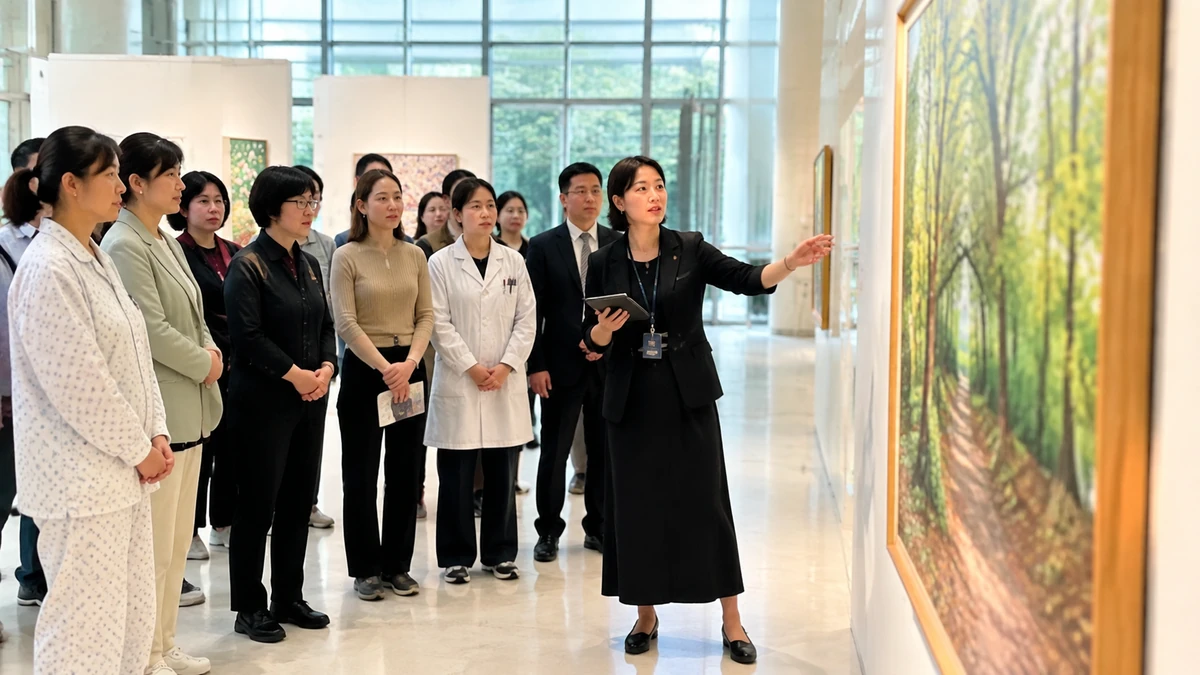
Image to help understand the article
A hospital anniversary, told not through applause but through a quiet walk
At a major national cancer hospital in South Korea, the 25th anniversary was not marked mainly by speeches, ribbon-cutting or a glossy summary of institutional achievements. Instead, visitors were invited to walk.
The National Cancer Center in Goyang, just northwest of Seoul in Gyeonggi Province, opened a special exhibition this week called “A Walk: The First Step of Healing With Art.” Staged across the first and second floors of the hospital’s main building, the exhibition was designed less like a formal ceremony and more like a 60-minute stroll through stories, artworks and conversation. According to the Korean summary of the event, the program included an introduction to the exhibition’s theme, talks with artists, a “donor wall story” segment highlighting the people who helped support the institution, and a docent-led explanation of key works.
That may sound modest, but the choice is revealing. For an American audience, it helps to think of the difference between a hospital gala and a museum visit — and then imagine those two experiences meeting in the hallway outside an oncology clinic. The point was not to turn medicine into performance, or to imply that paintings can do the work of chemotherapy, surgery or radiation. The center itself was careful not to make that claim. Instead, the exhibition offered something more grounded and, in some ways, more contemporary: an attempt to make a high-stress medical institution feel more human by creating space for reflection, memory and shared experience.
That distinction matters. In both the United States and South Korea, health information can travel quickly online, and language around “healing” can easily be stretched into misleading promises. The Korean organizers appear to have drawn a clear line. This was not presented as a clinically validated treatment program for cancer. It was framed as an artistic and communal experience inside a place where treatment already happens — a way to support patients, families, staff and the surrounding community without confusing culture with cure.
In that sense, the exhibition reflects a broader shift in how some public institutions want to be seen. Rather than treating a hospital as a purely functional site of diagnosis, paperwork, waiting and procedures, the event suggests another model: the hospital as a lived environment where emotion, memory and social ties also need room. That idea is hardly unique to Korea, but the National Cancer Center’s anniversary exhibition offers a vivid example of how it is being articulated there, through a distinctly public and collective frame.
Why this matters in Korea, where hospitals can feel both highly advanced and deeply impersonal
South Korea is widely recognized for its advanced medical system, dense urban hospital networks and highly organized specialty care. It is also a society where major institutions, especially national ones, carry symbolic weight beyond their immediate function. A national cancer center is not just another hospital. It represents public investment, state capacity and, for many families, a place bound up with some of the hardest moments of their lives.
That makes the anniversary format especially significant. In the United States, a hospital milestone might bring fundraising dinners, donor campaigns, commemorative reports or branding exercises aimed at alumni and local business leaders. Those things exist in Korea, too. But in this case, the center appears to have asked a different question: How do you mark 25 years in a way that involves the people who actually move through the building every day — patients in treatment, relatives in waiting areas, nurses crossing shifts, doctors carrying difficult news and neighbors who know the institution as part of their city?
The answer was “sanchaek,” or a walk. In Korean, the word often carries a softer and more intentional feeling than the English word “walk” sometimes does. It can imply a leisurely outing, a pause, a chance to take in one’s surroundings rather than rush through them. That nuance matters in a hospital context. The exhibition title placed emphasis on process over spectacle, on moving through space with attention rather than consuming a message quickly and moving on.
Just as important was the use of the hospital’s ordinary circulation spaces — the first and second floors of the main building — as the exhibition site. That decision lowered the barrier to entry. Visitors did not have to make a separate trip to a museum or cultural center. The art met them where they already were. In practical terms, that means a patient on the way to an appointment, a caregiver with an hour to spare, or a staff member between tasks might encounter the exhibition naturally, as part of the day’s emotional geography.
The Korean summary also emphasized the “donor wall story,” which placed donor narratives alongside artist talks and artwork interpretation. That is notable because it broadens the meaning of institutional history. Instead of telling the center’s first 25 years only through buildings, policies or administrative milestones, the exhibition highlighted the people who contributed to its life. That approach shifts the center of gravity from systems to relationships — not replacing the importance of medical infrastructure, but reminding visitors that institutions are built not only through budgets and architecture, but also through private acts of support, grief, gratitude and commitment.
What the exhibition says about a larger trend: the rise of the hospital as a cultural space
The most interesting aspect of the story may be that it is not really about one day’s event. It is about a trend. Around the world, health care institutions have been rethinking what a treatment environment should feel like and whom it should serve. Some of that conversation involves architecture, such as natural light, gardens and calmer interiors. Some involves patient-centered communication or trauma-informed care. And some of it involves the arts.
The National Cancer Center’s exhibition fits squarely into that broader movement, but with an important caution attached. The Korean report makes clear that the word “healing” should not be read as a substitute for medicine. That caution is not just legally sensible; it is intellectually serious. There is a growing tendency, in wellness culture especially, to blur emotional comfort, aesthetic pleasure and medical efficacy into one big promise. The stronger approach is the one this exhibition seems to have taken: acknowledging that art can shape atmosphere, empathy and experience without pretending it can eliminate disease.
In practice, that means focusing on what art can legitimately do in a hospital setting. It can interrupt the monotony and anxiety of waiting. It can offer patients and families a language for feelings that clinical terminology cannot capture. It can give staff members, who are often under enormous emotional pressure, a different way to encounter the institution where they work. It can make a public building feel less like an instrument and more like a place inhabited by people.
That idea becomes even more powerful when the audience is not limited to elite patrons or art-world insiders. The Korean center said it plans to continue with participatory exhibitions involving patients, families and staff, while also opening space to local artists. If that happens in a sustained way, the anniversary show will matter less as a one-off event and more as the first chapter in a continuing civic program. The institution would be moving from displaying art to building a structure in which multiple groups can contribute stories and meaning over time.
That is a subtle but important distinction. A rotating exhibition can beautify a hospital. A participatory cultural program can change how people relate to the hospital and to one another. It can also challenge the traditional hierarchy of who gets to speak inside a medical institution. Patients are often spoken about. Staff are often represented by titles and departments. Donors are often listed by name and amount. Community artists are frequently peripheral. A program like this suggests those groups can be co-present in a shared narrative rather than kept in separate lanes.
What this means for the United States
For American readers, the Korean exhibition lands in a familiar but increasingly urgent conversation: What should health care feel like in a society where medicine is highly sophisticated, emotionally exhausting and often alienating?
U.S. hospitals, cancer centers and children’s hospitals have long experimented with art collections, music programs, artist residencies, redesigned waiting rooms and other efforts to make clinical spaces less sterile and less psychologically punishing. The logic is easy to understand. Even when treatment is excellent, the experience of being inside a hospital can be frightening, tedious and isolating. Patients spend hours waiting. Family members often feel powerless. Clinicians and staff face burnout. Institutions have a strong incentive — humane, reputational and operational — to think about the environment they create.
What the Korean case adds is a public, civic frame. In the United States, these efforts are sometimes folded into philanthropy, branding or patient-experience strategy. They may be excellent programs, but they are often discussed in managerial language: outcomes, design principles, community engagement, donor visibility. The National Cancer Center story points to another vocabulary, one centered on shared stories and social empathy inside a public institution. That difference is worth noticing.
It also matters because the United States and South Korea are linked not only by security and trade ties, but increasingly by exchange in health care, design, entertainment and public culture. Americans tend to associate the Korean Wave, or Hallyu, with K-pop, television dramas, beauty products and food. But Korea’s growing international influence also includes how it packages public experiences and how it blends technology, design and emotional storytelling. Even a hospital exhibition can reflect that wider Korean talent for curation — for arranging movement, space and narrative in a way that feels intentional rather than accidental.
For American companies, especially those working in health care design, patient experience consulting, museum programming and philanthropic strategy, there is a practical lesson here. The most effective cultural interventions in medical settings may not be the most expensive or the most glamorous. They may be the ones that repurpose ordinary space, lower the threshold for participation and draw visible lines between institution, donor, staff member, patient and local community. In other words, what matters may be less the prestige of the artwork than the architecture of belonging around it.
For American audiences, there is another resonance. The U.S. has been wrestling for years with the emotional coldness many patients experience inside large systems, whether in hospitals, insurance networks or elder care settings. The Korean exhibition does not solve those structural problems. But it does model a simple proposition that feels increasingly relevant on both sides of the Pacific: care is not only the technical act of treatment. It is also the social environment in which treatment is received.
The line between comfort and cure must stay clear
If there is one point that deserves emphasis, especially for English-language readers used to a flood of wellness claims, it is this: the exhibition’s language of healing should not be misread as a medical promise.
The Korean summary is unusually clear on that point. The National Cancer Center did not present the event as a program with verified therapeutic effects on a specific disease. It did not claim that viewing art treats cancer. Instead, it framed the project as a way to add artistic experience to the routines of treatment, waiting and movement inside the hospital, while widening the circle of empathy to include families, medical workers and the broader community.
That may sound obvious, but it is a boundary worth defending. In the United States, the word “healing” can occupy a slippery space. It can describe recovery after surgery, emotional processing after trauma, spiritual consolation after loss or a lifestyle brand selling expensive products with little evidence behind them. In journalism, as in medicine, precision matters. Art can soothe, provoke, connect and dignify. It can help people feel seen. It can offer reprieve. Those are meaningful effects. They are not the same thing as clinical treatment.
Keeping that distinction clear actually strengthens the case for programs like this one. When institutions avoid overstating the power of art, they make room for a more honest argument: that human beings need more than procedures and efficiency, even in places built primarily to deliver procedures and efficiency. A hospital can be scientifically rigorous and emotionally attentive at the same time. In fact, many patients would say the two are not in conflict at all.
The Korean center’s approach also suggests a way to talk about “healing” that is relational rather than miraculous. Healing, in this narrower sense, refers not to the elimination of disease but to the creation of conditions in which people can face illness without being reduced entirely to it. That may include conversation, recognition, beauty, memory and a sense that one’s story remains legible inside a large institution.
What to watch next at Korea’s National Cancer Center
The long-term significance of the exhibition will depend on what happens after the anniversary banners come down. The center has said it plans to continue with exhibitions that allow participation from patients, families and employees, and to create exhibition opportunities for local artists as well. That future-facing commitment is the most important part of the story.
If the program continues, several questions will matter. First, who gets to participate, and how? Participatory art can be genuinely inclusive, or it can become a symbolic exercise involving only a narrow slice of the institution. Second, how will the hospital balance openness with privacy and emotional safety, especially in a cancer center where personal stories can be intensely vulnerable? Third, will the program remain integrated into everyday hospital life, or drift into a separate, decorative layer that staff and patients barely encounter?
There is also a question of durability. Anniversary events are often easier to fund and publicize than long-term cultural infrastructure. A one-day or one-season exhibition can generate goodwill. A sustained program requires staffing, institutional commitment and a clear understanding of purpose. If the National Cancer Center can maintain that effort without blurring the line between artistic support and medical treatment, it may offer a model that other institutions — in Korea, the United States and elsewhere — will watch closely.
That is especially true as hospitals everywhere search for ways to rebuild trust, reduce emotional strain and reconnect with the communities around them. Not every institution needs an art exhibition, and no exhibition can compensate for poor access, high costs or inadequate care. But the Korean example is a reminder that public institutions are always communicating values through space. A hallway can say, “Move along.” It can also say, “Pause here. Someone else has been through this, too.”
On its 25th anniversary, South Korea’s National Cancer Center appears to have chosen the second message. For patients and families living through cancer, that does not replace the need for excellent medicine. It simply recognizes an additional truth: that in the middle of treatment, people are still people, and institutions are at their best when they remember that.
Comments
Post a Comment