A Korean Diplomat From a Thousand Years Ago Still Offers a Lesson for America: How Seo Hui Turned a Military Crisis Into Strategic Gain
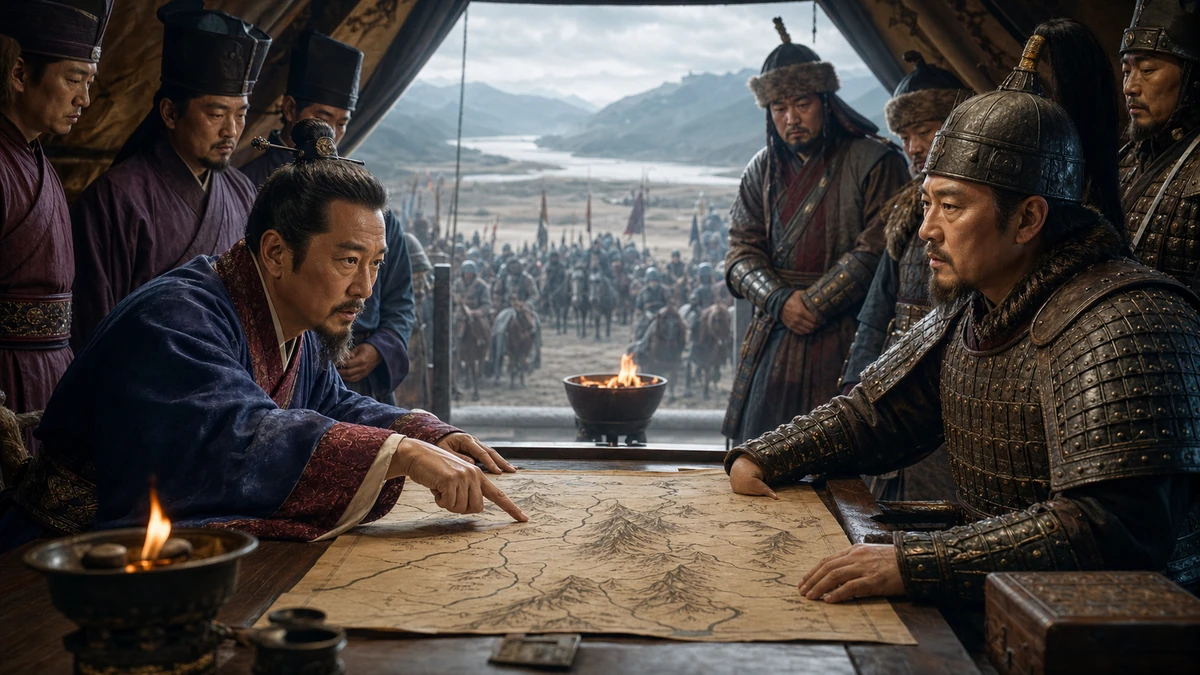
Image to help understand the article
A statesman, not a swordsman, became the hero of one of Korea’s defining border crises
In the American imagination, the decisive moments of history are often told through battlefield images: Washington crossing the Delaware, Lincoln at Antietam, Eisenhower planning D-Day. Korea has its own martial legends, but one of the most enduring stories from its medieval past turns on something quieter and, in modern terms, more familiar to Washington than to Hollywood: high-stakes negotiation.
The figure at the center of that story is Seo Hui, a senior official of the Goryeo dynasty, the Korean kingdom that ruled from 918 to 1392 and gave Korea its English name through an older transliteration. Born in 942 and dead by 998, Seo rose through the civil bureaucracy after passing the state examination system, the East Asian equivalent of a fiercely competitive merit test that functioned, in some ways, like a blend of elite university credentialing and federal service recruitment. He served in a series of important posts and became a core figure in the royal court.
What made him historically unforgettable, however, was not simply his rank. It was what happened in 993, when Goryeo faced a major invasion by the Khitan-led Liao dynasty, often referred to in Korean sources as the Georan. The crisis appeared, at least at first, to be headed toward humiliation or collapse. Enemy forces advanced. The Goryeo court was shaken. Some officials argued for surrender; others favored giving up territory to buy peace.
Seo Hui chose another path. Rather than treating war and diplomacy as separate arenas, he treated them as part of the same strategic contest. He read the invader’s motives, refused symbolic subordination, argued from history and geography, and opened the way for Goryeo not only to avoid capitulation but ultimately to secure control over territory later known as the Six Garrisons East of the River, or the Gangdong six prefectures.
For Koreans, this is not merely an old court anecdote. It is one of the classic examples of diplomacy used as statecraft under pressure: a smaller power facing a larger one, refusing panic, and using political logic to change the outcome. For American readers, the story lands at a moment when the language of deterrence, alliances, border security and great-power rivalry once again dominates international affairs. That makes Seo Hui feel less like a museum piece than a case study.
How the crisis unfolded: fear in the capital, pressure at the border
The immediate context was raw military danger. In 993, the Liao emperor sent the general Xiao Sunning against Goryeo. According to the Korean historical account summarized in the source material, the invading side boasted that an army of 800,000 had arrived and threatened total destruction if Goryeo did not submit. Whether that number reflected reality or deliberate exaggeration, the psychological effect was clear. This was coercion by scale, the medieval version of shock and awe messaging.
The invasion quickly destabilized the Goryeo court. After crossing the Amnok River, known in English as the Yalu, Khitan forces fought Goryeo troops in the area of Bongsan and gained an early advantage, including the capture of a forward commander. News of defeat, combined with enemy threats, created exactly the kind of atmosphere in which governments make bad decisions. Panic spread faster than strategy.
King Seongjong sent envoys to signal willingness for talks, but the Khitan side pushed beyond peace and demanded surrender. Inside the Goryeo government, that sharpened divisions. Some officials favored outright submission. Others supported what Korean sources describe as the policy of yielding land, essentially territorial concession as the price of avoiding further war. The king himself ordered grain in the northwestern city of Seogyeong, today associated with Pyongyang’s historical role, to be discarded rather than risk letting supplies fall into enemy hands.
Seo Hui objected. His reasoning was strikingly practical. A kingdom cannot defend its fortresses or sustain combat, he argued, if it destroys its own logistical base first. More important, he insisted that concessions would not end the problem. If Goryeo handed over land once, what would stop the invader from demanding more the next time? That line of thinking will sound familiar to any American reader who has followed debates over appeasement, deterrence or the credibility of red lines. Seo’s point was not that compromise is always impossible. It was that compromise detached from an accurate reading of the other side’s aims can become surrender by installment.
He also appears to have doubted the literal truth of the 800,000-troop claim, reading it as intimidation designed to break morale. That detail matters because it shows a sophisticated instinct: before reacting to the threat, assess whether the threat itself is part of the weapon. In modern geopolitical language, Seo was resisting information warfare as much as troop pressure.
The negotiation itself was about more than words; it was about status
Seo Hui then did what gave the episode its legendary stature: he went directly to negotiate with Xiao Sunning in the occupied frontier zone. The talks nearly broke down before substance even began, because protocol was itself a battlefield. The Khitan side demanded that Seo bow first to a representative of the “great state,” a ritual gesture that would have placed Goryeo in a subordinate position. To American readers, this might sound ceremonial or even trivial. In premodern East Asia, it was neither. Diplomatic etiquette signaled hierarchy, and hierarchy shaped what claims each side could make afterward.
Seo refused. He argued that while a subject bows to his ruler in court, there was no precedent requiring one minister of one state to bow unilaterally before a minister of another state. According to the source summary, he became angry, left the tent and returned to his lodging rather than accept the demand. That move was risky. He was in enemy space, negotiating under military duress. But he understood something essential: if he surrendered equality in ritual form, he would weaken Goryeo’s position in the substance of the talks.
Eventually, the Khitan commander relented, and the two men saluted each other in a reciprocal manner before sitting face to face. In effect, Seo won the first round without discussing territory at all. American diplomatic history offers its own parallels. Much of summitry, from Cold War state visits to modern standoffs over flag placement, seating arrangements and titles, can look petty from the outside. In fact, symbolic recognition often carries legal and political consequences. Seo grasped that with extraordinary clarity.
Once the conversation turned to claims, Xiao argued that Goryeo had arisen on former Silla territory and that the old lands of Goguryeo belonged instead to the Khitan side. Seo responded by asserting that Goryeo was the legitimate successor to Goguryeo, one of the ancient Korean kingdoms, and that even the state’s name reflected that inheritance. He cited Seogyeong’s importance as evidence of that continuity. Far from retreating into a defensive explanation, he countered with a rival historical map.
For non-Korean readers, this matters because territorial disputes in East Asia have long been argued not only through military occupation but through lineage, dynastic inheritance and historical legitimacy. Seo’s brilliance lay in using the language the other side respected. He did not say, in effect, “history is irrelevant.” He said, “if history is the standard, our case is stronger.”
Seo Hui’s real breakthrough came when he identified what the invader actually wanted
The turning point in the exchange came when the Khitan side asked a question that revealed more than it intended: if Goryeo bordered the Khitan realm, why was it maintaining relations across the sea with Song China rather than with Liao? In that moment, Seo appears to have recognized that the invasion was not simply punitive. It was strategic. The Liao court, engaged in broader rivalry with Song, wanted to prevent Goryeo from becoming a useful partner or rear-area problem for its southern rival.
That is the kind of insight that separates reactive diplomacy from strategic diplomacy. Seo recognized that the issue on the table was not merely today’s battlefield line but tomorrow’s regional alignment. If Liao were solely intent on destroying Goryeo, the question of diplomatic relations with Song would have been irrelevant. The fact that it surfaced meant there was room to bargain.
Seo’s answer was deft. According to the source summary, he said the lack of relations between Goryeo and Liao was not fundamentally a refusal by Goryeo but a matter of blocked routes, specifically because Jurchen groups stood in the way. Then he made the crucial move: if Goryeo could drive out those forces, recover former Goguryeo land, build forts and secure a transit route, why would it not establish relations with Liao?
In plain English, Seo took the invader’s demand for diplomatic recognition and turned it into an argument for Goryeo’s territorial expansion and frontier consolidation. He did not merely seek a ceasefire. He embedded within the diplomatic formula a rationale for Goryeo to occupy and fortify land to its northwestern frontier. That is why the episode later came to be remembered as opening the way to the Gangdong six prefectures. The outcome was not that Goryeo handed over northern territory and submitted. It was that the Khitan army withdrew, and Goryeo gained the opportunity to extend its position.
This is why Seo Hui remains such a compelling figure. He did not “win” by overpowering a stronger military in the conventional sense. He won by correctly diagnosing interests, distinguishing between threats and goals, and proposing an outcome the other side could accept without forcing his own state into disgrace. In modern policy circles, that would be called turning an adversary’s strategic concern into leverage.
Why this story still resonates in Korea: memory, identity and the politics of survival
Seo Hui’s fame in Korea rests partly on the result and partly on the style. Korean history, like that of many countries caught between larger powers, contains recurring memories of invasion, coercion and the need to maneuver among rival empires. That makes successful diplomacy especially potent in the national imagination. It is not merely about avoiding war. It is about proving that sovereignty can be defended through intelligence, discipline and moral steadiness, not only through force of arms.
The source summary also emphasizes Seo’s character outside the Khitan negotiations. He is described as a principled official willing to challenge his own king when he believed royal behavior violated propriety or sound judgment. He objected when the king sought private amusement in an improper way, and he drew lines even in matters involving royal authority and ceremonial conduct. This image is important. In Korean historical memory, Seo is not celebrated as a smooth opportunist or a flattering court insider. He is celebrated as a bureaucratic statesman whose credibility came from consistency.
That combination helps explain why his story survives. In the Korean tradition, the ideal civil official was not simply educated. He was supposed to be upright, historically literate and capable of remonstrance, meaning he would risk speaking uncomfortable truths to power. Seo fits that mold, but he also adds something more modern: strategic flexibility. He could be rigid on principle and highly adaptive in tactics.
There is another reason this episode endures. It dramatizes a familiar Korean theme: the importance of reading the intentions of stronger neighbors without succumbing either to fatalism or fantasy. Korea’s position between larger continental and maritime powers has shaped centuries of statecraft. A story in which a Korean envoy faces down a militarily superior commander and redirects the terms of engagement naturally became foundational. It tells Koreans that survival is not the same thing as passivity.
For a country whose modern history includes colonization, division, superpower rivalry and an unresolved Cold War on the peninsula, that older lesson still has emotional force. It speaks to diplomacy not as weakness, but as an expression of national confidence.
What this means for the United States: a lesson in alliance politics, leverage and reading the room
For American readers, the immediate temptation is to file Seo Hui’s story under “interesting ancient history.” That would be a mistake. The episode speaks directly to several debates that shape U.S.-Korea relations today, from how smaller allies navigate major-power competition to how Washington itself thinks about coercion, negotiations and the value of symbolic respect.
The United States and South Korea are bound by one of Washington’s most important alliances in Asia, backed by a mutual defense treaty, deep military coordination and extensive trade and cultural ties. Americans usually encounter South Korea through contemporary reference points: Samsung phones, Hyundai and Kia vehicles, Oscar-winning films like “Parasite,” Netflix hits such as “Squid Game,” or K-pop acts that fill stadiums from Los Angeles to New Jersey. But beneath that modern visibility sits a much older strategic culture shaped by geography, survival and diplomacy under pressure. Understanding figures like Seo Hui helps explain why South Korea today often combines hard security commitments with careful diplomatic messaging.
There is also a broader American lesson here. U.S. policy discourse often swings between two extremes: the belief that military power solves most problems, and the belief that talks are inherently a concession. Seo Hui’s example suggests something more sophisticated. Negotiation is not the opposite of deterrence. In the best cases, it is an instrument of deterrence, used to convert pressure into advantage when one side has accurately mapped the other’s priorities.
That insight matters in an era when Washington is managing simultaneous relationships with Beijing, Moscow, Seoul, Tokyo and Taipei while watching North Korea’s weapons programs and broader supply-chain vulnerabilities. American officials regularly talk about “strategic competition,” but competition is not only about aircraft carriers and export controls. It is also about who best understands the fears, dependencies and red lines of the other side.
There is a more commercial angle as well. American companies with deep exposure to South Korea, from automakers and chipmakers to entertainment firms and streaming platforms, operate in an environment where politics and history are never far from the market. The U.S.-Korea relationship is not simply a security alliance; it is a dense web of cultural and industrial interdependence. As the Korean Wave has grown, American audiences have become more interested in Korean stories, but often through the lens of pop culture alone. Historical episodes like Seo Hui’s show another side of Korea’s global appeal: not just exportable entertainment, but a political tradition rich with dramas of statecraft that resonate with current world affairs.
In that sense, the Seo Hui story also fits a broader trend in American media and publishing. U.S. audiences have shown sustained interest in historical narratives that illuminate present-day geopolitical anxieties, whether through Roman analogies, World War II revivals or Cold War retrospectives. Korea’s medieval past deserves a similar hearing. Its relevance is not exotic. It is analytical.
A thousand-year-old negotiation and a very modern trend: history as strategic analysis
If there is a reason this story feels newly timely, it is that much of the world has re-entered an age of contested borders, multipolar rivalry and weaponized interdependence. Governments are once again asking questions that would not have sounded foreign to Seo Hui: How do you avoid becoming a pawn between larger powers? When should you stand firm on status and symbols? When can an apparent crisis become an opening?
That is why this episode works best not as a one-day historical feature but as part of a larger trend. Across democracies, there is renewed public appetite for stories that explain how states navigate asymmetry. Ukraine’s diplomacy alongside battlefield resistance, Taiwan’s careful balancing of global relationships, and the strategic behavior of middle powers from Poland to South Korea all reflect the same core reality: countries do not need to be the biggest actor in the room to shape outcomes. They do need clarity about their interests and discipline about how they present them.
Seo Hui’s encounter with Xiao Sunning is, in that sense, an early classic of middle-power logic. He rejected panic. He rejected empty bravado. He refused humiliating ritual but did not confuse dignity with inflexibility. He listened closely enough to infer the real concern on the other side. Then he built a proposal that served Goryeo more than the initial balance of forces suggested was possible.
That does not make the story a tidy blueprint for every modern crisis. Historical analogies can mislead as easily as they instruct. Medieval East Asia was not the Indo-Pacific of today, and dynastic legitimacy is not the language of contemporary international law. But the fundamentals of statecraft do travel well across centuries. Status matters. Logistics matter. Geography matters. Reading motivations matters most of all.
For Americans, especially those newly curious about Korea through its music, film, television and technology, Seo Hui offers a useful corrective to the flattening effect of pop-cultural familiarity. South Korea is not only a cultural powerhouse and manufacturing hub. It is the inheritor of a long political tradition forged in hard strategic conditions. That tradition helps explain the confidence, caution and sophistication with which Seoul often approaches a turbulent neighborhood.
The enduring power of Seo Hui’s story lies in its reversal. A kingdom that seemed cornered found room to maneuver. A threatened frontier became the basis for expansion. A negotiation staged under pressure became, through intellect and nerve, an argument for equality. For a world once again defined by coercion, alliances and contested narratives, that is not merely ancient Korean history. It is a reminder that diplomacy, at its best, can do more than end a crisis. It can redefine the map of possibility.
Comments
Post a Comment