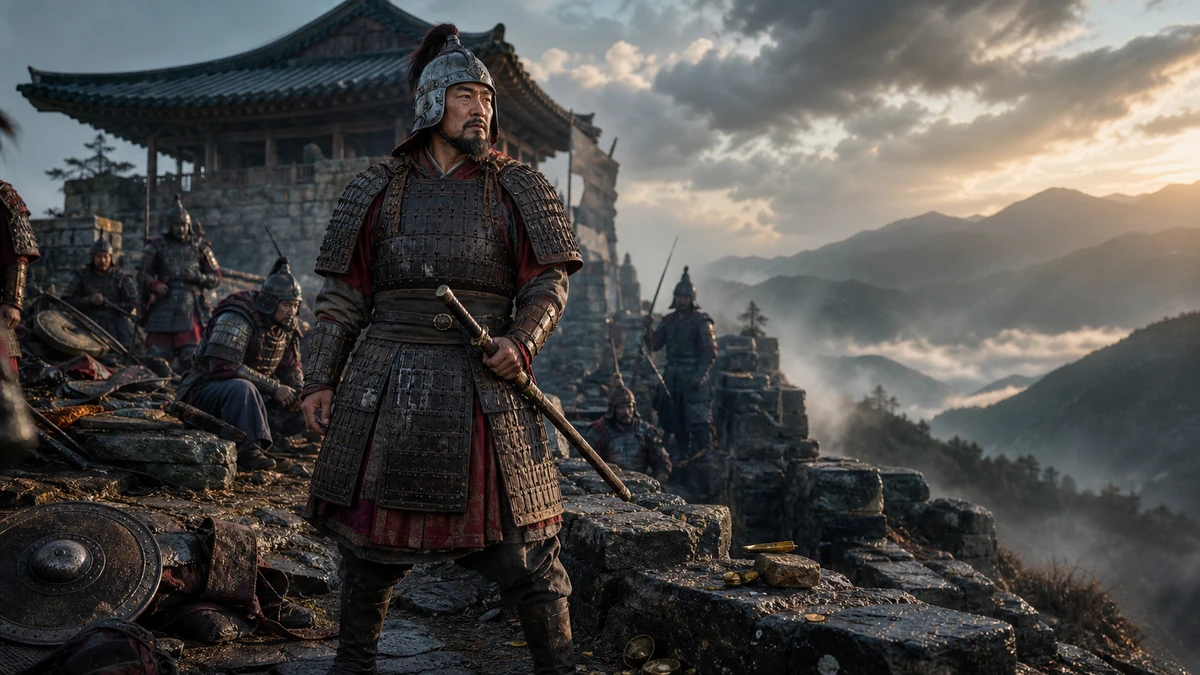
Image to help understand the article
A warrior’s life, and a moral code that outlived him
In Korean history, few military figures are remembered as vividly for personal austerity as for battlefield success. Choe Yeong, the 14th-century Goryeo general and statesman whose life stretched from 1316 to 1388, occupies that rare space. To many Koreans, he is not simply a soldier from a distant dynasty. He is a symbol of public virtue under pressure: a man praised for defending the state during years of invasion, political fracture and imperial interference, while also insisting that wealth should hold no power over a public servant.
That reputation rests in part on a phrase Koreans still recognize today. As a teenager, Choe was said to have received a final lesson from his father: “Regard gold as if it were stone.” The message was not merely about frugality. It was a warning against corruption, vanity and the seductions of office. In modern American terms, it reads like a frontier-era maxim crossed with a code of military honor: the idea that a leader who chases money cannot be trusted to protect the commonwealth.
Choe came from a family that could have steered him into civil office. His lineage included noted scholars and officials, and late Goryeo society still placed high value on classical learning and elite literary pedigree. But the historical record portrays him as physically imposing from a young age, drawn to military texts and martial training rather than to the career path expected of a son from a prominent bureaucratic family. That choice would place him at the center of one of the most volatile periods in Korean history, when Goryeo, the kingdom that ruled the Korean Peninsula from 918 to 1392, was struggling to survive between internal decay and external danger.
The contrast between Choe’s austere image and the culture around him is part of what makes his story enduring. The Korean chronicle tradition preserves anecdotes in which he mocked the appetite for luxury among the powerful. When officials admired a precious jewel left behind by another elite figure, Choe reportedly scolded them, suggesting that such objects only stained a great man’s legacy. In another story, he invited top officials to his home, kept them waiting until they were ravenous, and then served only humble millet rice and greens. When they praised the meal as the finest they had eaten, he answered that this, too, was a way of commanding men. The point was simple and unsparing: extravagance is often theater, and hunger strips status down to basics.
For American readers, the appeal of such stories may feel familiar. The United States also has a long habit of elevating military leaders who project simplicity, discipline and distance from luxury, whether in the mythology surrounding George Washington’s restraint, Ulysses S. Grant’s bluntness or Dwight Eisenhower’s image as a practical soldier-administrator. Choe belongs to a Korean version of that tradition. But his historical importance is not just moral. He emerged at a moment when the Korean state was under extraordinary stress, and his campaigns helped preserve its territorial core long enough for a new political order to emerge from its ruins.
Goryeo under pressure from empire, rebellion and raiders
To understand why Choe matters, it helps to understand the world he inherited. By the mid-14th century, Goryeo had spent roughly 80 years under the heavy influence of the Mongol-led Yuan dynasty. The relationship was not a simple military occupation in the modern sense, but it deeply constrained Korean sovereignty. Royal marriages, political interventions and territorial losses left Goryeo in a weakened and dependent position. At the same time, the Yuan dynasty itself was beginning to fracture across China, challenged by rebellions and succession disputes.
That imperial unraveling created both danger and opportunity for Korea. In the United States, the closest analogy might be a smaller ally or neighbor trying to reclaim room for independent action while a once-dominant superpower loses control. For Goryeo’s rulers, especially King Gongmin, this was the opening to push back against Yuan influence and recover lost authority. But such moments of transition are often the most dangerous. A fading empire can still strike back, and borderlands can become even more unstable as old structures weaken.
Choe’s military career unfolded inside that uncertainty. He first gained prominence fighting Japanese raiders, known in Korean sources as waegu, who attacked coastal areas and preyed on trade and settlements. These pirates were not simply a Korean problem. Maritime raiding in East Asia during this period reflected weak state control, fragmented coastal power and the profitable chaos of commerce and war. Later, Choe also confronted the Red Turbans, anti-Yuan rebel forces that surged across parts of China and spilled into Korea. In 1361, one such invasion captured Gaegyeong, the Goryeo capital. The king fled south, and the very survival of the state came into question.
These were not isolated security incidents. They were overlapping emergencies: northern incursions, southern coastal attacks, court intrigue and the looming question of who would dominate the region after the Yuan decline. A kingdom facing all of those at once needed commanders who could operate at scale and adapt quickly. Choe proved to be one of them. He built his reputation not as a court theorist of war but as a field leader repeatedly summoned to blunt immediate threats.
Recovering Ssangseong and reclaiming Korea’s room to breathe
Among the most significant episodes of Choe’s career was the campaign to recover Ssangseong, a former Goryeo territory that had fallen under Yuan control. In Korean historical memory, the retaking of Ssangseong is more than a border adjustment. It stands as a marker of Goryeo’s effort to reassert sovereignty after decades of subordination. The district, located in the northeastern part of the peninsula, had strategic and symbolic importance because it represented land taken away under imperial pressure.
Before that campaign, Choe had already expanded his military credentials. In 1354, when Yuan authorities requested Korean assistance against the Red Turbans in China’s Shandong region, Choe joined the expedition as a senior commander. According to the historical record, he not only led Goryeo troops but also took charge of a far larger body of Koreans already stationed under Yuan authority. The experience mattered. Commanding large numbers of men in a multinational, politically fraught war gave him the sort of operational background that later proved critical at home.
In 1355, after returning from that campaign, Choe was ordered by King Gongmin to move against the Yuan-held northeastern territory. The drive to recover Ssangseong aligned with a broader effort to restore lands Goryeo considered historically its own. Choe did not fight alone. Crucially, he was aided by Yi Ja-chun and Yi Ja-chun’s son, Yi Seong-gye. That name would later reshape Korean history. Yi Seong-gye would go on to found the Joseon dynasty in 1392, replacing Goryeo and ushering in a new political order that lasted more than five centuries.
This makes the Ssangseong campaign especially striking in hindsight. It brought together two men — Choe Yeong and Yi Seong-gye — who fought on the same side to reclaim territory from foreign control, only to become rivals decades later over how to respond to a new geopolitical crisis. That arc gives the story a dramatic quality familiar to Americans who study revolutionary or civil-war eras: yesterday’s allies become tomorrow’s adversaries once the common enemy fades and the question shifts from survival to the future shape of the state.
The recovery of Ssangseong also shows how Korean history in this period cannot be understood as passive reaction to larger powers. Goryeo was constrained, but it was not inert. Its leaders seized openings, rebuilt military capacity and made deliberate moves to recover autonomy. Choe’s career sits at the center of that process. He was one of the men who turned the weakening of imperial control into a concrete territorial and political gain.
Defending a battered kingdom from Red Turbans and Japanese raiders
If reclaiming territory helped define Choe’s strategic importance, defending the kingdom from repeated attack cemented his reputation. The 1361 Red Turban invasion was the most dramatic test. A force said to number more than 100,000 entered Goryeo and seized the capital, forcing King Gongmin to flee to what is now Andong. For any premodern state, the loss of the capital was a profound shock — not only a military defeat but a blow to legitimacy, administration and morale. Choe joined other commanders in the campaign to retake Gaegyeong the following year, helping restore the political center of the kingdom.
That alone would have secured his place in military history. But the threats kept coming. In 1364, forces backing a rival claimant connected to the Yuan court invaded again, seeking to unseat Gongmin. Choe helped repel them. In 1365 and after, Japanese raiders struck key islands and coastal areas, threatening trade routes, local populations and even royal imagery. At one point, after raiders stole a royal portrait, Choe was demoted, caught in the court politics that so often turned military setbacks into personal purges.
Yet his career did not end there. After the powerful monk-official Sin Don fell from power and was executed, Choe returned to prominence. In 1374, he helped suppress a major uprising on Jeju Island, deploying a multi-regional force across the sea in what amounted to a substantial amphibious operation for the time. Two years later, after Japanese raiders devastated areas of southern Korea and another commander suffered defeat, Choe again took the field. He won a major victory at Hongsan, and Korean accounts say the raiders came to fear the white-haired general, calling him “Baeksu Choe Manho,” a nickname suggesting dread of the aging commander.
In 1377 and 1378, he continued leading anti-piracy operations, including actions taken alongside Yi Seong-gye. And in 1380, when some officials proposed moving the capital because of the piracy threat, Choe opposed the idea, arguing that a kingdom could not abandon its seat of power simply because raiders had become dangerous. His resistance mattered. Strategic retreat can be prudent, but it can also become a public confession of weakness. Choe’s position suggested that repeated attacks should be met with stronger defense, not political surrender.
For modern readers, there is a lesson here about how states respond to chronic insecurity. The temptation to reorganize around fear — to relocate, retrench or overreact to repeated attacks — is not unique to medieval Korea. Choe’s answer was austere and hard-line: hold the center, restore confidence and deny the enemy a symbolic victory. That outlook helps explain why later generations remembered him as more than a tactician. He became a guardian figure, associated with steadiness when institutions were strained to the breaking point.
From battlefield hero to anti-corruption strongman
Choe’s rise was not limited to war. Late in life, he became central to a political reckoning inside Goryeo’s court. By the 1380s, the kingdom was not only fighting enemies at sea and on its borders; it was also rotting from within. Powerful aristocratic families and connected officials had accumulated land, private dependents and influence on a scale that damaged ordinary people and hollowed out the state. Korean historical writing often describes this class as entrenched and predatory, a late-dynasty elite more interested in protecting privilege than reforming a weakening realm.
The turning point came through a dispute involving land seizure and abuse of power. A figure named Jo Ban killed the servant of the influential official Yeom Heung-bang after accusing that network of confiscating land and exploiting the population. Rather than treat the matter as a sign of elite corruption, Yeom tried to transform it into a treason case. Under interrogation, Jo Ban argued that the true thieves were the grandees who had sent retainers everywhere to seize property and oppress the people. That line of attack resonated because it exposed a wider truth the court could no longer ignore.
King U ultimately turned to Choe Yeong and Yi Seong-gye to secure the palace and move against the entrenched elites. Yeom and other powerful figures were arrested. In the reshuffle that followed, Choe rose to the highest levels of government, becoming munhasijung, effectively the top state councilor. For a man known first as a general, it was the culmination of a long public career. It also fit the moral image attached to him: the commander who despised luxury was now positioned as the man to help purge corrupt aristocrats.
Americans will recognize the political pattern. Governments under external stress often discover that national defense and internal reform cannot be separated. A state weakened by corruption becomes less capable of fighting wars, collecting revenue or commanding trust. That does not mean every self-styled anti-corruption drive is sincere; history, in every country, is full of rulers who used reform rhetoric to consolidate power. But Choe’s personal reputation for plain living gave his ascent unusual credibility. He looked, in the historical record, like the rare strongman whose legitimacy came from saying no to private enrichment rather than mastering it.
Why Choe Yeong still matters in the United States
At first glance, a 14th-century Korean general may seem remote from contemporary American concerns. But Choe’s story lands at a moment when Korean history, Korean culture and Korea’s political identity matter more in the United States than ever before. Korean dramas, films, music and literature have created a broad American audience eager to understand not just modern Seoul but the deeper historical narratives that shape how South Korea sees itself. A figure like Choe helps explain one of those narratives: the belief that the Korean Peninsula has repeatedly had to defend autonomy against stronger outside powers while wrestling with its own elite failures at home.
That theme resonates in the U.S.-South Korea relationship, even if the circumstances are radically different. South Korea today is a treaty ally of the United States, one of America’s most important economic and security partners in Asia, and a cultural powerhouse with influence far beyond its size. Yet its political culture still carries long historical memories of invasion, domination and hard-won sovereignty. American observers often discuss the alliance in terms of North Korea, semiconductors, shipbuilding or China strategy. Those are essential topics. But Korean historical memory also matters, and stories like Choe’s help illuminate why questions of territory, national dignity and foreign pressure remain so emotionally charged.
There is also a striking trans-Pacific theme in the way Choe is remembered for integrity. In the United States, the public regularly swings between cynicism and yearning when it comes to political ethics. Scandals, influence peddling and elite insulation produce recurring demand for leaders who seem plainspoken, austere and personally incorruptible. Korea has its own version of that longing, visible across centuries. Choe’s father’s instruction to treat gold like stone survives because it speaks to a universal democratic anxiety: what happens when public office becomes a market good and patriotism becomes performance.
For American companies and audiences invested in Korean content, there is another reason this history matters. Historical figures like Choe offer part of the source material behind the values, conflicts and archetypes that reappear in Korean television and film — loyal generals, compromised courts, invasions from abroad, moral maxims about greed, and sudden reversals between comrades and rivals. Those themes are not just decorative. They are the narrative grammar of a culture that has exported its storytelling to the U.S. at scale. Better understanding the history enriches how American audiences interpret everything from prestige period dramas to contemporary political thrillers.
And there is a policy angle, too. As Washington and Seoul deepen cooperation on defense, technology and supply chains, American leaders and businesses are dealing with a partner whose national identity has been shaped by centuries of balancing larger powers while trying to preserve decision-making room. That does not make medieval history a direct guide to modern diplomacy. But it does make historical literacy useful. If Americans want to understand why sovereignty language carries weight in Seoul, why historical disputes can flare so intensely, or why public distrust of corrupt elites can quickly reshape politics, Choe’s era offers an instructive window.
The last campaign, and the hinge between two Korean dynasties
The final chapter of Choe’s life is also the one that marks a turning point in Korean history. In 1388, the newly established Ming dynasty in China asserted a claim over territory north of Cheollyeong, arguing that the area had once been administered through the Yuan-linked Ssangseong system and therefore should fall under Ming authority. To Choe, this was an intolerable challenge. He pushed for a military response, a campaign toward Liaodong that he saw as necessary to defend Goryeo’s standing and territorial rights.
Here the old alliance between Choe and Yi Seong-gye broke apart. Yi opposed the campaign and eventually turned back with his army at Wihwado, an act remembered in Korean history as the Wihwado Retreat. It was not a retreat in the sense of battlefield collapse; it was a political pivot, a military refusal that opened the way for regime change. Yi seized control, Choe was arrested, and the old general was executed. Within a few years, Goryeo was gone and Joseon had replaced it.
That ending complicates any easy heroic reading. Choe defended Goryeo repeatedly, helped cleanse the court of abusive elites and rose to supreme office — only to be destroyed by the very political-military realignment that produced the next Korean dynasty. In American historical terms, he resembles those formidable transitional figures who preserve an old order just long enough to reveal its limits. He was indispensable to Goryeo’s survival, yet he could not save Goryeo from transformation.
That is why his legacy has lasted. Choe Yeong is remembered not because he won every final argument, but because he embodied a civic ethic during an age when the state seemed perpetually at risk — from foreign control, invasion, piracy, elite corruption and factional struggle. The image that survives is of an old general who held the line, distrusted luxury and believed public duty was worth more than private gain. For a modern audience in the United States, where Korean culture is now mainstream but Korean history often remains unfamiliar, his life offers more than a distant biography. It offers a reminder that the moral stories nations tell about themselves — about service, corruption, resilience and sovereignty — often begin in moments when everything appears most fragile.
Comments
Post a Comment