Image to help understand the article
A comeback measured not in months, but in generations
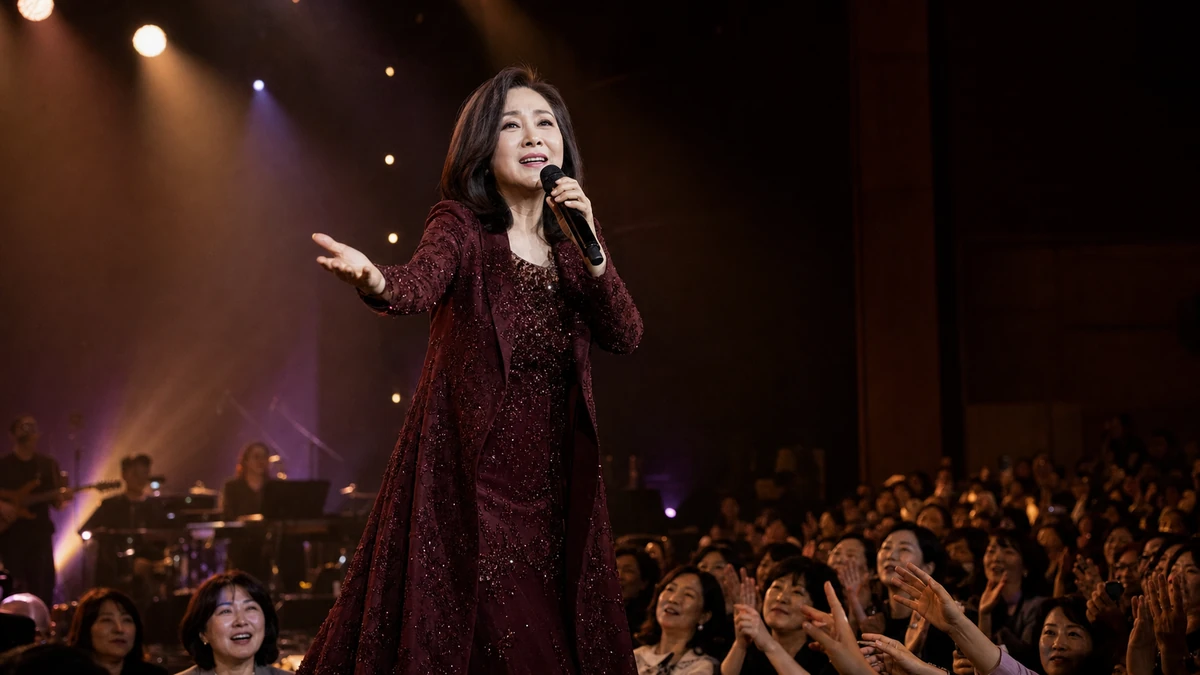
South Korean singer Yang Soo-kyung is set to open a new national tour in Seoul on Oct. 18, 2026, beginning a run called “Inyeon,” or “fateful connection,” that carries unusual weight in a music industry often defined by speed, youth and relentless reinvention. According to South Korean reports, it will be her first formal nationwide tour since 1992 and her first face-to-face concert performance for fans in roughly four years, following a 2022 year-end dinner show. Those facts alone would make the announcement notable. But what makes it meaningful is not simply that a familiar star is returning. It is that a singer who rose to fame in the late 1980s and early 1990s is stepping back into the demanding rhythm of live touring at 61, not as a one-night nostalgia attraction, but as an artist testing what her career means in the present tense.
For American readers, the easiest comparison may be to the way legacy acts in the United States continue to fill theaters and arenas long after their chart peaks, from adult contemporary singers to classic rock bands and veteran country stars. But Yang’s case lands somewhat differently because of where Korean pop culture is right now. Internationally, Korea’s music exports are frequently reduced to K-pop idol groups, viral choreography and global streaming numbers. That image is not false, but it is incomplete. Beneath the polished machinery of the idol system is a much broader music culture, one that includes singers whose careers were built in a pre-digital era, whose songs remain tied to family memory, television history and the emotional life of a generation now entering later middle age.
That is part of why this tour matters. A 34-year gap between nationwide tours is not just a scheduling detail. It is the kind of span that turns a performance into a cultural bridge. Some ticket buyers may remember Yang’s heyday firsthand. Others may know her through parents, older relatives or Korean television appearances. In that sense, the tour is not merely a return to the stage. It is a test of whether memory, identity and live performance can still create shared cultural space across decades.
The title “Inyeon” adds another layer. In Korean, the word refers to a bond, tie or destined connection, often used to describe human relationships shaped by time, chance and emotional continuity. It is a familiar concept in Korean storytelling, from family dramas to romance films, and it carries a warmth that does not map neatly onto a single English word. Used as a tour title, it suggests that Yang is not just revisiting old songs. She is inviting audiences to think about the relationship between singer and listener as something sustained over time, even after long silence. In an era when celebrity often feels disposable, that is a striking proposition.
Why the return of a veteran Korean singer matters now
Timing is everything in the concert business, and Yang’s return comes at a moment when live music audiences in South Korea, as in the United States, are proving there is still real demand for artists whose cultural value cannot be measured only by current chart performance. The post-pandemic concert economy has sharpened that reality. Fans across markets have shown a willingness to pay for experiences that feel emotionally grounded, not just technologically spectacular. In America, that has helped fuel the success of reunion tours, residency shows and retrospective performances built around catalog depth. In South Korea, where the public conversation around music can be dominated by younger acts, Yang’s announcement underscores a parallel truth: audiences also want continuity.
Her own explanation for the tour is revealing. At a press event in Seoul, South Korean reports said Yang described herself as happiest when she is “singer Yang Soo-kyung,” adding that a phrase she once found clichéd — that some performers are essentially “married to song” — has come to resonate more deeply with age. That may sound sentimental, but in industry terms it points to something practical. The persuasive case for a late-career return is not just that an artist was once famous. It is that the artist still has a compelling reason to stand before an audience now. Yang appears to be framing this tour not as a bid to relive former glory, but as a reassertion of professional identity.
That distinction matters. A dinner show, such as the one she last held in 2022, is a different proposition from a formal tour. Dinner shows, in Korea as in Las Vegas-style American entertainment culture, are often built around concentrated, event-based performance in a limited setting. A national tour demands stamina, repetition, travel discipline and the ability to sustain emotional precision across changing venues and audiences. It is closer to an endurance test than a commemorative appearance. By choosing that format, Yang is effectively putting her present-day artistic durability on display.
There is also a larger trend line here. As Korean popular music matures globally, its older stars are becoming newly legible as part of a broader historical canon rather than relics of a closed domestic past. That does not mean every veteran act will suddenly become an international draw. It does mean the Korean music conversation is widening. For years, much of the world has consumed Korean music through the lens of novelty: What is the next group, the next trend, the next export success? Yang’s tour points in another direction. It asks what happens when Korean music history itself becomes part of the attraction.
For the Korean industry, that could be significant. A healthy music ecosystem is not built solely on new releases and youth fandom. It also depends on catalog value, intergenerational loyalty and performers who can continue to generate meaning long after commercial peak years. In that sense, Yang’s comeback is not just about one singer’s schedule. It is about whether the market is ready to support a fuller version of Korean pop history in public.
The power of familiarity in an era of constant reinvention
One of the most telling details in the reporting around the tour is Yang’s stated musical direction: arrangements that stay as close as possible to the original songs. In a global concert business often obsessed with updating old material to make it feel contemporary, that choice may seem conservative. It is better understood as strategic.
In music rooted in memory, familiarity is not a weakness. It is the product. Audiences do not just remember a song’s lyrics. They remember an opening instrumental phrase, a shift in tempo, a vocal color, the emotional architecture of the track as they first encountered it. Those elements act almost like sensory triggers. In the American context, think of how audiences respond when a veteran artist performs a signature hit with the arrangement listeners grew up with rather than a heavily revised version. The crowd is not asking for innovation in the abstract. It is asking for recognition — for the song to unlock a part of personal history.
That appears to be what Yang is aiming for. By preserving the emotional texture of the originals, she is allowing the audience to reconnect not simply with her voice but with their own remembered lives. That can be especially potent for listeners who came of age in the 1980s and 1990s, when songs often traveled through terrestrial radio, television music programs, cassettes and household routines rather than algorithmic playlists. The performance becomes a communal act of remembrance, but not a static one. It connects who the audience was then to who it is now.
This helps explain why the long gap since her last formal national tour may work as an asset rather than a liability. In most pop narratives, a long absence is framed as decline or irrelevance. But memory-driven performance works differently. Time can deepen meaning. A song that once soundtracked young adulthood, first love, heartbreak or family life can return decades later with added emotional layers. The intervening years become part of the performance itself.
That is also where the title “Inyeon” becomes more than branding. If the tour succeeds, it will do so not because it recreates the past perfectly, but because it turns memory into a shared present-tense event. A fan who saw Yang in the early 1990s and a listener who discovered her later are not experiencing the same song in the same way. But they are entering the same emotional frame. In industry terms, that is one of the strongest possible propositions for a legacy tour: not just name recognition, but a durable relationship between repertoire and lived experience.
What this says about Korea beyond the idol economy
For outsiders, the dominant image of Korean popular music is still heavily shaped by the global rise of idol groups. There is a reason for that. K-pop has become one of South Korea’s most visible cultural exports, supported by sophisticated fan ecosystems, multinational branding and a highly online form of audience engagement that translates across borders. Yet that visibility can flatten the country’s music culture into a narrow stereotype. Yang’s return is a reminder that Korea’s entertainment industry contains older traditions of stardom, performance and audience loyalty that predate the current idol era.
In South Korea, singers from the 1980s and 1990s occupy a complicated place. They are not always centered in international coverage, but they often retain strong domestic recognition, especially among audiences that do not see themselves reflected in youth-oriented pop marketing. Their songs can function as social memory. They belong to a period of Korea’s development when the country was undergoing rapid economic and cultural change, and when television and radio still held tremendous power in shaping national taste. To revisit those songs is, for many listeners, to revisit a chapter of modern Korean life.
That is why Yang’s comeback can be read as part of a broader recalibration in Korean entertainment. The industry is beginning to show, more openly, that sustainability matters as much as novelty. A culture that exports the future also needs a way to honor its own past without embalming it. The challenge is not merely to celebrate veteran artists as symbols. It is to build workable platforms for them: tours, media appearances, catalog promotion and live settings that allow them to perform as active artists rather than ceremonial guests.
Yang’s comments about not wanting to avoid the challenge are especially important in that context. They suggest an artist who understands that longevity is not automatic. A singer in her 60s returning to a demanding tour schedule invites comparison not just with her younger self, but with changing audience expectations, changing vocal realities and the physical demands of repeated live performance. The more honest framing is not whether she can reproduce the past exactly. It is whether she can create a convincing artistic present. That is the standard many American legacy acts also face, and it is often the fairest one.
If the tour resonates, it may encourage Korean promoters and agencies to think more expansively about catalog-based live music. That does not mean replacing youth-driven pop, which remains a major commercial engine. It means recognizing that music industries become healthier when they make room for multiple life stages of artistry. In that sense, Yang’s comeback is less a detour from Korean pop’s global story than evidence that the story is getting richer.
What it means for the United States
For Americans, the immediate temptation may be to see Yang Soo-kyung’s tour as a domestically Korean event with limited relevance abroad. That would miss the larger point. As Korean culture has become more deeply embedded in American life — through music, film, television, beauty brands, food and streaming platforms — the United States is increasingly consuming not just the latest Korean trends but the wider cultural ecosystem behind them. A comeback like Yang’s matters because it broadens what American audiences and companies understand Korean music to be.
There are at least three ways this could matter in the U.S. market. First, it reinforces the idea that Korean music has a viable legacy lane, much like the American business built around catalog artists, anniversary tours and nostalgia-driven live events. U.S. promoters, Korean American cultural organizations and theaters in cities with significant Korean diaspora communities — Los Angeles, New York, New Jersey, Atlanta and parts of Texas, among others — have growing reasons to pay attention to veteran Korean acts, not only idol groups. The audience may be more niche, but it can also be older, more stable and less dependent on social media frenzy.
Second, it offers a more mature template for how Korean acts might expand in the United States outside the standard K-pop model. Not every Korean performer needs a Billboard Hot 100 strategy or arena-scale fandom to matter in America. Some may fit better in performing arts centers, casinos, festival circuits or heritage-focused events that resemble the way older Latin, country or adult contemporary artists maintain U.S. touring life. If Korean entertainment companies want deeper long-term roots in the American market, they will likely need that wider range of live formats.
Third, Yang’s return can sharpen how American fans and media talk about Korean culture itself. Too often, U.S. coverage treats Korean entertainment as if it began with the latest global breakout. But American understanding deepens when it includes historical continuity: the singers, dramas and cultural moods that shaped the generations before the current streaming era. That matters not just for criticism or fandom, but for business. Catalog discovery drives streaming; cross-generational storytelling drives documentaries; historical depth creates opportunities for licensing, archival programming and culturally informed marketing.
There is also a diplomatic and soft-power dimension, even if modest. U.S.-South Korea relations are often discussed through security alliances, semiconductors, trade or North Korea policy. But cultural familiarity increasingly helps define how the alliance is lived by ordinary people. Americans who engage Korean culture across generations, not just through trend cycles, are participating in a deeper kind of connection. In that sense, a veteran singer’s tour in Seoul can still tell us something about the texture of U.S.-Korea ties: they are becoming less episodic and more socially rooted.
None of that means Yang is suddenly poised to become a mainstream household name in America, and there is no need to exaggerate her likely reach. The more realistic conclusion is also more interesting. Her comeback shows how the Korean Wave, or Hallyu, is maturing. It no longer has to present only youth, speed and novelty to matter in the United States. It can also present memory, continuity and artistic longevity.
What to watch next in the Korean live music business
The most interesting question around “Inyeon” may not be opening night itself, but what comes after. In trend terms, Yang’s tour is a useful case study for several overlapping shifts in entertainment. One is demographic. South Korea, like the United States, is aging, and older audiences remain culturally active consumers with disposable income. Another is economic. As live performance becomes an increasingly important revenue source across the music industry, catalog artists may hold new value if they can mobilize emotionally committed audiences. A third is symbolic. Veteran performers can help an industry tell a fuller story about itself.
Whether Yang’s tour becomes a major template will depend on execution. Can the production balance intimacy with scale? Can close-to-original arrangements create emotional force without feeling museum-like? Can a 61-year-old singer returning after decades away from formal touring convert goodwill into momentum across multiple cities? Those are open questions, and they are precisely what make the project worth watching. A meaningful comeback is not guaranteed by affection alone. It must be earned in performance.
Still, even before the first show, the tour has already clarified something important. Korean popular music is not only a machine for producing the next sensation. It is also a long cultural timeline in which artists can leave, return and renegotiate their place. Yang’s insistence that she is happiest when she is a singer gives the story its emotional center, but the larger industry lesson may be structural: durability matters, and audiences still respond when artists treat their own histories as living material rather than static memorabilia.
For American observers, that should sound familiar. Some of the most enduring stories in U.S. music are not about constant reinvention by the young, but about reinvention through survival — artists who find new meaning in the songs that first made them known. Yang Soo-kyung’s comeback belongs to that tradition, even as it emerges from a distinctly Korean cultural setting. It is about labor, memory, identity and the stubborn power of live music to restore a bond thought to be dormant.
That is why this is more than a one-day entertainment item. It is a sign of where Korean culture may be headed next as it grows more confident abroad and more reflective at home. If the Korean Wave’s first global chapter was about arrival, its next chapter may be about depth: not just who is new, but who endures; not just what travels fastest, but what lasts. Yang’s tour, beginning with one Seoul stage and carrying the name of a bond that survives time, offers a small but telling glimpse of that future.
Comments
Post a Comment