
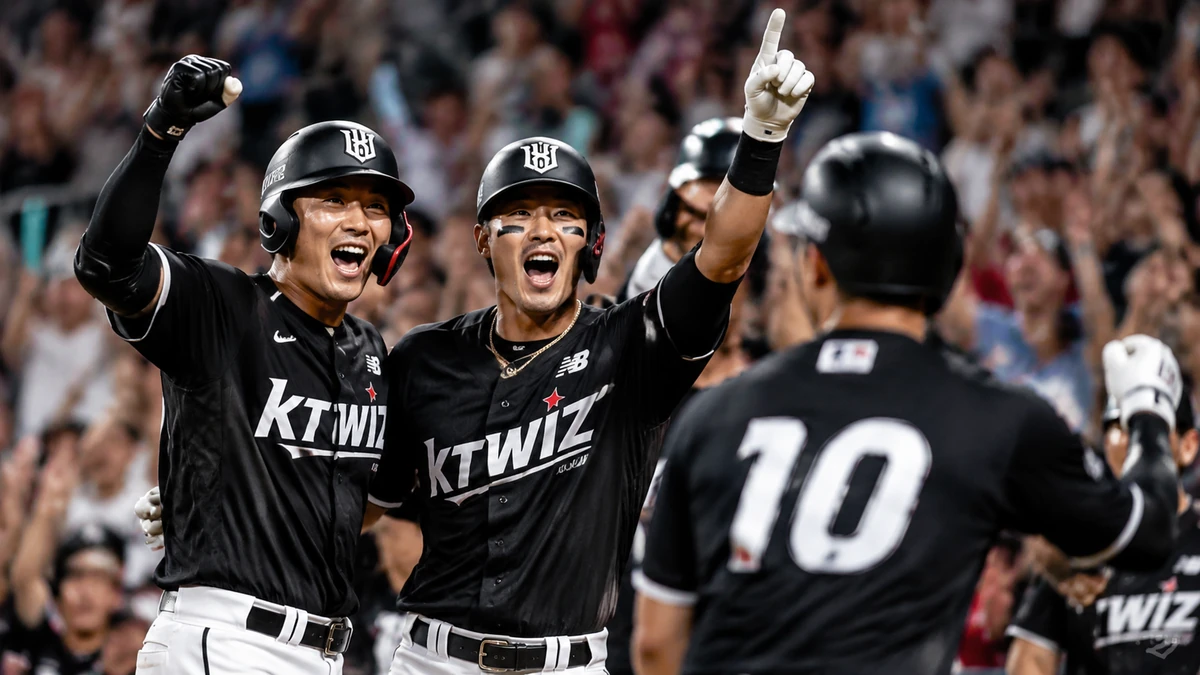
Image to help understand the article
KT Wiz’s comeback was about more than one win
The box score from Suwon looked straightforward enough: the KT Wiz beat the Kiwoom Heroes 6-2 after falling behind early, preserving first place in the Korea Baseball Organization standings. But the shape of the game — an early punch from the underdog, a calm comeback, a go-ahead hit in the middle innings and a late home run that put the result out of reach — helps explain why South Korean baseball has become easier for international audiences, including Americans, to follow and appreciate.
According to the Korean reports, KT entered the game clinging to a narrow lead atop the KBO table and left it still one game ahead of the Samsung Lions. That kind of margin would feel familiar to any U.S. baseball fan who has watched a pennant race tighten in August or September: every inning starts to carry a little more weight, every missed opportunity seems louder, and every comeback says something about how a club might hold up under pressure. KT improved to 62-39-2, while Samsung stayed close behind, turning what might otherwise have been a routine regular-season victory into a meaningful checkpoint in the race for the top spot.
The Korean account of the game emphasized two swings. Choi Won-jun delivered the go-ahead hit that flipped the game in KT’s favor, and Ahn Hyun-min added the insurance home run that effectively sealed it. In between was the larger story of the night: KT did not panic after giving up two runs in the top of the first inning, and it did not let the game get away while chasing from behind. The club instead did what good teams often do late in the season. It steadied itself, created traffic on the bases, tied the score and then converted a high-leverage moment into a lead.
For American readers who may not closely track the KBO, that composure is significant. Korea’s top professional baseball league, long respected in Asia, has in recent years become much more legible to foreign fans, especially after some U.S. viewers discovered it during the pandemic-shortened early months of the Major League Baseball season in 2020. Since then, the KBO has remained for many international fans a showcase for a style of baseball that can look at once familiar and distinct: disciplined situational hitting, strong game-to-game emotional swings, highly engaged crowds and a league table that often stays compressed enough to make late-summer games matter.
KT’s comeback win over Kiwoom fits that pattern neatly. It was not merely a highlight package of one clutch hit and one home run. It was a reminder that in Korean baseball, momentum can turn fast, and clubs that survive the pressure of a long season usually do so not by overpowering everyone every night, but by staying within a game until the one inning arrives that changes everything.
How the game unfolded, and why the turning points mattered
Kiwoom struck first, scoring twice in the opening inning with two outs. That detail matters because two-out production is often the difference between a promising inning and a painful one. The Heroes, a team sitting at the bottom of the standings according to the related Korean coverage, did exactly what struggling clubs need to do against a first-place opponent on the road: jump ahead quickly and force the favorite to play from behind. Early leads can matter even more in a pennant race, where the psychological pressure on the contender tends to rise with each quiet inning.
KT answered immediately. In the bottom of the first, the home side cut into the lead with extra-base hitting from Choi Won-jun and Ahn Hyun-min, reducing the deficit and resetting the emotional balance of the game. Even without every pitch-by-pitch detail, the broader picture is clear. KT did not allow Kiwoom’s fast start to define the night. That kind of response is often what separates a team that is simply talented from one that is mature enough to finish first.
The tie came in the sixth inning, when KT used a double by Huh Kyung-min and a pinch-hit single by Kim Min-hyuk to level the score at 2-2. For American readers, the use of a pinch hitter in that spot is another familiar baseball pressure point. Managers in close games, especially in leagues and moments that place a premium on execution, often turn to the bench to manufacture one inning. When it works, it becomes the hinge of the game. Korean coverage framed the sixth as exactly that kind of turning point — the moment the contest moved from an upset bid into a test of late-game concentration.
Then came the sequence that likely will endure in KT’s internal memory longer than the final margin suggests. Choi’s go-ahead hit gave the Wiz their first lead. Ahn’s home run later gave the crowd the release that often comes with a game that has felt tense longer than the scoreboard shows. From down 2-0 to ahead for good, KT did not need a wild offensive explosion. It needed timely contact and the confidence to wait for the opening.
That sequence is important because it reinforces the Korean description of KT not just as a team that happens to be first, but as one that plays like a leader. That phrase can sound vague in English sports writing, but the underlying idea is concrete. First-place teams are often judged by how they handle imperfect nights. Do they unravel after an early deficit? Do they strand runners and let frustration compound? Or do they keep the game within reach long enough for a single inning to swing it? On this night, KT offered the third answer.
Kiwoom, for its part, showed enough early offense to suggest that the gap between the top and bottom of the standings is not always reflected inning by inning. That, too, is one of the appeals of a long baseball season in any country. A last-place club can look dangerous for stretches. A first-place club can look vulnerable. The eventual winner is often the team better equipped to navigate the middle innings after the opening script has been torn up.
Why this result matters in the KBO race
Standings in mid-to-late season baseball can create their own kind of gravity. A one-game lead is not comfortable, but it is meaningful. It can shape bullpen choices, off-day moods and the tone around a club over the next week. In KT’s case, keeping the lead over Samsung matters not only because of the arithmetic, but because it preserves the sense that the Wiz remain in control of their own story at a time when the margin for error is shrinking.
The Korean reporting placed that race at the center of the game’s significance. KT held first place by one game over Samsung after both teams continued to pile up wins. For readers accustomed to Major League Baseball’s division races or wild-card chases, the dynamic is recognizable. The closer the top teams stay to one another, the less room there is for a bad series, let alone a slump. Every comeback win therefore carries extra value beyond the single entry in the standings. It prevents the kind of emotional spillover that can follow an avoidable loss.
This is one reason baseball people — in Korea, the United States or anywhere else — often say that not all wins feel the same. A blowout in May counts once. A comeback in a tight race late in the season also counts once, but it can stabilize a team in ways a routine victory does not. KT’s win over Kiwoom looks like that kind of stabilizer. The team absorbed an early setback, recovered in stages and maintained separation from its nearest challenger.
There is also a broader point about how pennant races are won. Fans often talk about star power or starting pitching depth, and those factors matter. But over a long season, contenders frequently distinguish themselves through repeatable habits: keeping innings alive, getting contributions from more than one part of the lineup, and staying emotionally even after early damage. The Korean summary highlighted KT’s concentration in decisive moments and its refusal to waste opportunities after tying the game. That is not a glamorous formula, but it is often the one that holds up.
As the regular season moves toward its final stretch, games like this one become a kind of stress test. If KT continues to convert close games, it strengthens the case that the club is built not just to reach the postseason but to enter it with momentum. If Samsung keeps pace, every such win becomes even more precious. And if lower-ranked clubs such as Kiwoom keep pushing favorites into uncomfortable innings, the race at the top will remain unstable enough to hold national attention in Korea.
What American audiences should understand about Korean baseball culture
To many U.S. readers, baseball in South Korea may still register as adjacent to Major League Baseball rather than central to the global game in its own right. That would miss something important. The KBO is not simply a developmental stop or a novelty for insomniac viewers; it is a mature, emotionally intense league with its own traditions, fan rituals and competitive identity.
Crowd culture is one of the biggest differences American audiences notice first. Korean baseball games are known for organized cheering sections, songs tied to individual players and a more coordinated style of support than many U.S. stadiums typically produce outside the postseason or college sports. A game in Suwon, where KT plays, is not just about the action between pitches. It is also about rhythm, performance and collective participation. That atmosphere can make a comeback feel even more dramatic, because the crowd is audibly involved in pushing the emotional arc forward.
There is also a stylistic distinction in how many Korean games are discussed and remembered. In American baseball culture, the language of analytics, pitch design and roster construction now shapes much of the conversation. Korea certainly has its own modern baseball analysis, but public storytelling around games often still gives more room to flow, momentum and what Korean sports coverage frequently describes as concentration in decisive moments. That does not mean the league is less sophisticated. It means baseball is narrated through a somewhat different balance of numbers, psychology and drama.
KT’s win illustrated those themes clearly. The reporting did not present the comeback simply as a statistical event. It described a first-place team showing poise, flipping the game’s rhythm and delivering at the decisive moment. American readers may recognize that as something closer to the way October baseball is written about in the United States — where every plate appearance becomes part tactics, part nerve and part theater.
Another important point for U.S. audiences is that South Korean baseball exists within a highly competitive domestic sports and entertainment environment. Baseball has to compete for attention with soccer, esports and a broader pop culture ecosystem in which stars from music, television and online platforms can dominate headlines. That reality can sharpen the storytelling around baseball teams, especially when a club is contending and a city is emotionally invested in a title race. KT preserving first place is not just sports page material in that environment; it becomes part of a larger national conversation about momentum, identity and regional pride.
That helps explain why a game against a last-place team can still feel urgent. In a compressed media landscape and a competitive standings race, every game can become a referendum on whether a contender looks sturdy enough for the stretch run. KT, at least for one night, answered yes.
What this means in the United States
For Americans, the significance of a game like this goes beyond curiosity about a foreign league. South Korean baseball has become part of a broader U.S.-Korea sports relationship that includes player movement, media rights, brand partnerships and fan communities that no longer see Asia and North America as separate baseball worlds. A late-season KBO thriller is still primarily a domestic Korean story, but it also feeds a growing international awareness of Korea as a serious baseball market with exportable talent, distinctive fan culture and commercial relevance.
That matters for U.S. audiences in several ways. First, American baseball fans increasingly consume the sport globally. They follow Japanese stars before they arrive in MLB, track international tournaments and watch clips from overseas leagues on social platforms. The KBO fits naturally into that ecosystem. Games like KT’s comeback against Kiwoom reinforce why: they provide the same ingredients U.S. fans recognize — a pennant race, a comeback, late heroics — while offering a slightly different cultural texture.
Second, U.S. companies and media platforms have practical reasons to care about the sustained visibility of Korean baseball. When a league develops an identifiable style and a committed global niche, it becomes easier to market streaming packages, social clips, sponsorships and tourism. Even without inventing new business deals beyond the source material, it is fair to say that compelling, competitive games help maintain the KBO’s profile abroad. The league’s international reputation depends not just on star exports but on the week-to-week quality and drama of its product. A first-place team rallying in front of a home crowd is exactly the kind of image that travels well.
Third, the story lands at a moment when U.S.-Korea ties are often discussed in terms of semiconductors, defense policy and pop culture. Sports receives less attention in those conversations, yet it is one of the most accessible ways ordinary Americans encounter modern South Korea. K-pop, Korean dramas and Korean food have already expanded Americans’ cultural reference points. Baseball adds another one, especially because it comes with a familiar grammar. A U.S. reader may not know every KBO club, but they understand what it means for a first-place team to erase an early deficit in a tight race. That familiarity can become a gateway to deeper interest in Korea beyond the field.
There is also an American comparison worth making carefully. In the U.S., sports media often turns late-season baseball into a character test: Which team is resilient? Which bullpen is cracking? Which clubhouse seems calm? Korean coverage of KT’s win used a similar frame, praising the team’s ability to stay composed and strike in the key moment. That overlap matters because it shows how easily KBO stories can be translated into terms American audiences already understand — not as exotic novelties, but as baseball stories with a different accent.
If there is a lesson for U.S. readers, it is this: Korea’s baseball league is not important only when a player leaves it for Major League Baseball or when an international tournament puts it in the spotlight. It is important because it has its own compelling internal races, its own loyal audience and its own ability to generate the kind of games that make baseball feel urgent. KT’s comeback is one small but vivid example.
What to watch next as the season tightens
The immediate question is whether KT can keep turning close games into wins as the pressure increases. The Korean summary suggested that this victory said something real about the club’s staying power: it did not just protect a place in the standings, it demonstrated an ability to reverse the flow of a game. If that becomes a pattern rather than a one-night description, KT’s path to finishing first grows more credible.
Just as important is the chase behind them. Samsung remaining within one game means KT gets little breathing room. In a race this narrow, scoreless stretches, bullpen management and bench contributions begin to matter more than season-long narratives about who looked strongest in June or July. The clubs at the top are now competing not only on talent but on steadiness. That is often where regular seasons are decided.
For Kiwoom, the loss still offered a measure of evidence that even lower-ranked teams can complicate the title picture. That is another reason the KBO stretch run can be compelling. A club far from first can still alter the race by stealing early leads, extending games and forcing contenders into high-stress innings. If Kiwoom can keep producing competitive starts against top teams, it may still shape the standings even without climbing them dramatically.
More broadly, this game underscores a trend that baseball fans in both Korea and the United States recognize well: late-season races are often defined less by dominance than by survival. Teams rarely look perfect in August. The best ones are those that absorb imperfect starts, take advantage of one or two openings and keep moving. KT did exactly that against Kiwoom.
For American readers, that makes the story easy to place. Think of it as the kind of late-summer game that tells you something about a contender’s emotional architecture. Down early. Calm in the middle. Better in the big moments. Still in first when the night ends. In a sport built on repetition, those are the small signs that can come to mean a lot.
And for followers of Korea’s place in the broader global sports landscape, the takeaway is equally clear. The KBO continues to produce meaningful, tightly contested baseball that speaks to local identity while remaining understandable to overseas audiences. KT Wiz’s 6-2 comeback over the Kiwoom Heroes may have unfolded in Suwon, but the themes — pressure, resilience, late power, a standings race tightening by the day — are universal. That is precisely why Korean baseball keeps earning a larger place in the international conversation.


0 Comments